

 README

README

Engram for Pi



Give every Pi session the same brain — local by default, cloud when you want it, and searchable across agents.
Pi is great at doing the work in front of it. The problem is everything around the work: what the agent learned yesterday, which architecture decision was accepted, why a bug was fixed a certain way, what the user prefers, and what should survive when the context window compacts.
Engram is persistent memory for AI coding agents. gentle-engram connects Pi to that memory so your agent can save the useful parts of a session and retrieve them later — without stuffing raw tool output back into the prompt.
Local bridge ownership protocol
Native Engram exposes a session-scoped responder on the local pi.events bus after
session_start. This is routing context, not authentication, and does not itself
suppress any Claude hooks. Consumers must route to the bus for the exact Pi runtime
session; ownership of a parent never establishes ownership of a nested session.
- Request channel:
engram:bridge:claim:v1 - Request fields:
{ runtimeSessionId: string, nonce: string, operation: "session-register" | "prompt-capture", promptDigest?: string } - Reply channel:
engram:bridge:decision:v1 - Reply fields: the exact three required request fields, the supplied
promptDigestwhen it is a string, andstatus: "owned" | "unknown".
Runtime IDs are opaque and compared without trimming. Nonces must be nonblank
strings of at most 256 JavaScript string units; consumers generate a fresh nonce
per query and correlate all three fields. Invalid requests and foreign IDs receive
no reply. Since emit does not await listeners, subscribe before emitting and use
a bounded consumer timeout (allow for the responder's 1000 ms decision budget).
No reply is not proof that native Engram is absent.
An eligible session-register claim can confirm registration using the existing
native registration path before the provider spawns, joining a pending registration.
Only its validated server acknowledgement permits owned; UI readiness never does.
A prompt-capture claim never registers or captures a prompt. It requires
promptDigest: exactly 64 lowercase hexadecimal characters encoding SHA-256 of
UTF-8 bytes of the original prompt after JavaScript .trim(). Only a matching
current native turn with a confirmed /prompts reply { id: <positive safe integer>, status: "saved" } permits owned. Missing, invalid, or mismatched digests return
unknown. The proof stores only the digest and routing identities, not plaintext,
private content, or durable metadata. Every before_agent_start clears prior proof
before initialization or early returns; lifecycle changes also invalidate it.
Short prompts (trimmed length <=10) retain the existing native skip policy and
therefore cannot establish prompt ownership. Failed or ambiguous delivery cannot
reuse a previous turn's proof, even for repeated identical prompts.
Digest matching identifies the original input, not full-fidelity storage:
native persistence still redacts private tags before truncating to 2000 JavaScript
string units plus an ellipsis when needed. Consumers must account for this policy
when deciding which capture is duplicate; ownership does not assert that private
or truncated content was stored. Failed, unresolved, stale, closing, or timed-out
claims cannot return owned. Timeout does not cancel an existing registration or
trigger a retry, and never emits a late positive decision. Unknown retains hooks.
Listeners and pending reply delivery are removed on shutdown and reload; reload still skips persistence shutdown. Each new native session must establish its own registration. Cross-runtime bridge routing and hook suppression are consumer responsibilities, not a process-global readiness signal.
Until a consumer of this protocol ships, the Claude Code plugin suppresses its own
hooks with the guard that pi-claude-bridge documents for Claude Code hooks: when
PI_CODING_AGENT is non-empty, every plugin hook script and engram hook claude-pre-tool-use
exit 0 with no output and no requests. Pi's native Engram owns the session and its
prompts, so the Claude child that the bridge starts records nothing. A Pi without
native Engram therefore gets no capture from those hooks either.
The guard reads an inherited environment variable, so it applies to every Claude Code
process that inherits it, not only to bridge children. For example, a tmux, zellij or IDE
server first started from Pi's shell passes PI_CODING_AGENT to every session it opens
later, and a claude started there records nothing in Engram, without any warning. Clear
it there (env -u PI_CODING_AGENT claude) when that session should use the plugin.
With the guard active, claude-pre-tool-use no longer binds a session id. This only matters
if the Claude child exposes Engram MCP tools, which the bridge's default strictMcpConfig
prevents. In that case the server resolves the write like any omitted-session write: the single
active runtime session for that project and directory, manual-save-<project> when there is
none, or a fail-closed error when several match. Use Pi's native mem_* tools instead.
Per-save prompt capture
Native mem_save honors capture_prompt (optional boolean, default true). It sends the available current turn's already-redacted, truncated prompt for the same session/project to Go core, which best-effort stores it using exact session/project/stored-content dedupe. Missing context or a capture failure does not fail the observation save. Prompt rows are independent; no observation-ID link is created.
capture_prompt=false skips only that save's capture attempt. It does not disable before_agent_start lifecycle capture or remove previously captured prompts. Synthetic/short turns, another runtime/project, and shutdown/reload cannot reuse the preceding turn's prompt. Enqueuing steer/follow-up input preserves the active run's capture. The initial user message_start after before_agent_start also preserves it; each subsequent user message_start marks consumption of queued input and clears both prompt context and ownership proof. Queued turns never inherit or capture prompt context, even when their text repeats the previous prompt. The next normal before_agent_start establishes its own context.
At a glance
| You want | Engram gives Pi |
|---|---|
| Fewer repeated explanations | Searchable memories from previous sessions |
| Lower context waste | Curated saves instead of raw tool-call dumps |
| Continuity after compaction | Required session summaries and recovery protocol |
| One memory across tools | Shared MCP-backed memory for Pi and other agents |
| Team/project memory | Optional Engram Cloud replication and dashboard |
The promise
Install it once. Keep coding. Pi remembers.
- One brain for many agents — Pi, Claude Code, OpenCode, Gemini CLI, Codex, VS Code/Copilot, Cursor, Windsurf, Antigravity, and any MCP-compatible agent can read/write the same Engram memory.
- Local-first memory — a single Go binary writes to SQLite + FTS5 on your machine. No Node service, Python stack, or hosted account required for the core path.
- Cloud when the team needs it — Engram Cloud adds opt-in, project-scoped replication, shared access, and a browser dashboard while keeping local SQLite authoritative.
- Token-efficient by design — Engram stores curated summaries, decisions, prompts, and session handoffs instead of a noisy firehose of raw tool calls. Agents search first, then fetch only the relevant memory.
- Compaction survival — before context resets, the Memory Protocol pushes summaries into Engram so the next session can recover what matters.
- Simple Pi setup — install the Pi package, retain the MCP adapter for other servers, run
pi-engram init, restart Pi. - Built by Gentleman Programming — Engram comes from the Gentleman Programming ecosystem: an open-source engineering community, YouTube channel, and hands-on agentic-coding workflow around real tools instead of toy demos.
- Real open-source project — Engram ships docs, releases, beta programs, contributor guidelines, issue templates, CI, and a growing contributor/community workflow around the main repository.
Built with the community
Engram is not an abandoned side script or a black-box SaaS. It is built in public by Gentleman Programming for developers who are already using coding agents seriously.
- YouTube channel: tutorials, demos, and product thinking around AI coding workflows — https://www.youtube.com/c/GentlemanProgramming
- Engram + Skills demo: https://www.youtube.com/watch?v=UoS_LP-PCG8
- Engram Cloud demo: https://www.youtube.com/watch?v=JPZkbGgJNUQ
- GitHub community: issues, discussions, beta feedback, contributors, and transparent roadmap work — https://github.com/Gentleman-Programming/engram
The goal is simple: make agentic development feel like a real engineering system — memory, specs, skills, cloud sync, review discipline, and community learning all connected.
Why this is different from “more context”
Context windows are temporary. Engram is memory.
| More context | Engram memory |
|---|---|
| Helps during the current run | Helps across sessions, agents, machines, and compactions |
| Often includes raw logs/tool output | Stores curated, searchable knowledge |
| Gets summarized away | Persists in SQLite + FTS5 |
| Usually tied to one agent | Works through MCP across agent clients |
Engram does not try to make the model read everything. It gives the model a disciplined memory protocol: save important knowledge, search before repeating work, and fetch full details only when needed.
See the memory
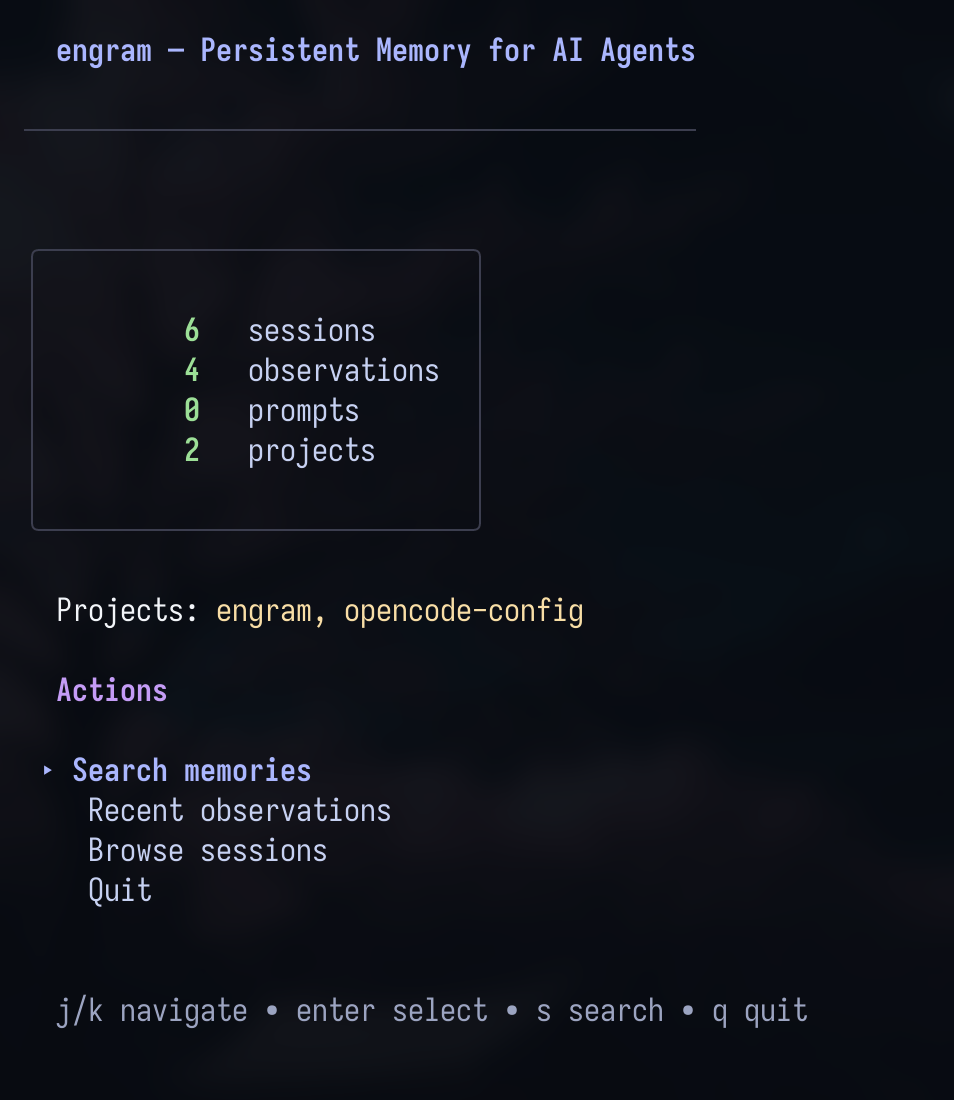
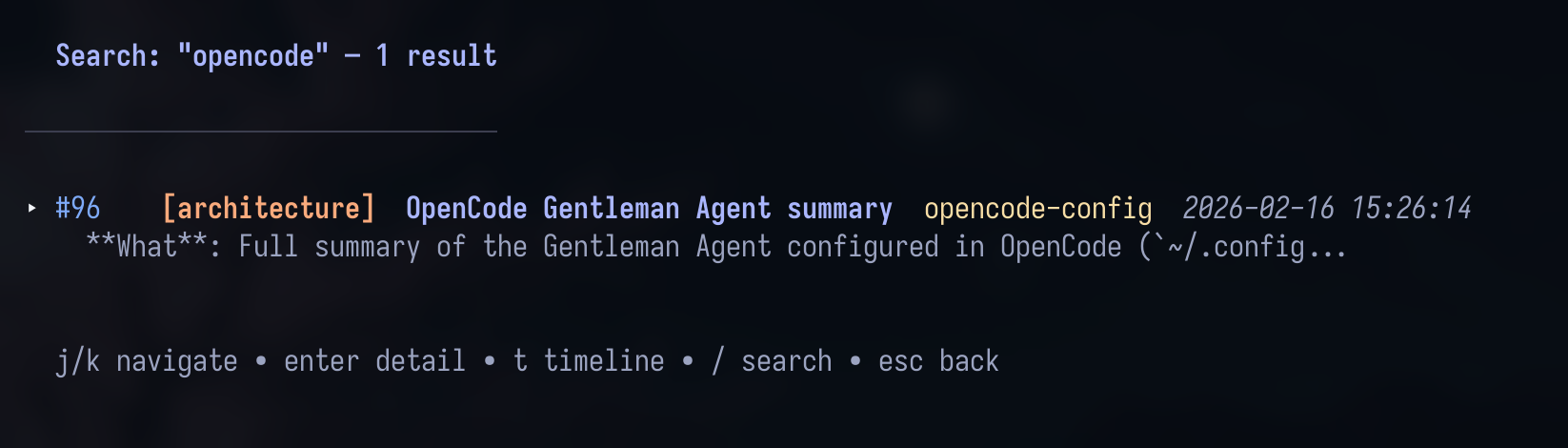
Engram includes a terminal UI for browsing sessions, observations, prompts, projects, timelines, and search results. Engram Cloud adds browser visibility for shared project memory.
Core resume compatibility
gentle-engram 0.4.0 negotiates root session resume through GET /health:
capabilities.root_session_resume: true enables it; explicit false or malformed
capability data disables it. When the capability is absent, a stable core version
of 3.0.0 or newer (optionally prefixed with v) is accepted. The tagged
v3.0.0 server implements core-selected continuation identities; earlier releases
are not inferred compatible. Unknown, malformed, and prerelease versions require
explicit support advertisement.
Each root registration flight retains its first resume-support decision and rechecks health before every dispatch. If support changes (including unreadable health after supported health), the retry stops before another POST. Retry once core health is stable: the earlier registration may have succeeded despite a lost acknowledgement, but no unacknowledged identity is adopted. Stable support permits an idempotent retry with the same resume flag.
Without resume support, fresh root sessions and still-active persisted mappings
can register normally without resume. If an ended identity needs continuation,
attributed writes stop with a diagnostic naming the plugin and core versions,
the support requirement, and upgrade guidance. Upgrade the Engram binary and
restart the running server, then retry; updating only the Pi package is not
sufficient. The plugin never invents a continuation ID or adopts a failed
registration. Read-only memory tools do not require resume support. Cross-project
satellite saves still require isolated_session_registration: true separately.
Read-only caller-binding diagnostic
Pi-native mem_doctor preserves the existing project/check request to GET /doctor
and adds a separate caller_binding assessment from POST /doctor/caller-binding.
Pi supplies observed runtime identity, a read-only effective mapping, and host API
availability; Go evaluates persisted session state. Model parameters cannot supply
these caller facts. A foreign project target does not inherit an unvalidated
mapping or create a satellite.
Project checks and caller binding are displayed separately. Healthy project checks
can coexist with a blocked or unknown caller. An ended root is not itself a blocker:
a live continuation may remain valid, or the normal registration path may support
safe resume. Missing or throwing host APIs provide missing evidence, not readiness.
An unsupported, failed, or malformed caller endpoint yields unknown with safe
support-verification guidance while retaining the project report.
Diagnosis never registers, renews leases, creates continuations, ends sessions,
appends mapping entries, or repairs bindings. Even ok does not guarantee a later
write. Only the six allowlisted fields in caller_binding are intended as shareable
evidence: no identities, projects, paths, raw responses, or errors are included.
The original project report is not asserted privacy-safe. CLI, HTTP project-only,
and MCP doctor behavior are unchanged. This diagnostic relates to #1622 and #1635;
it does not resolve either incident or weaken session guards.
Opt-in Pi session registration trace
For an affected quit/resume cycle, set ENGRAM_PI_SESSION_TRACE=1 before launching
Pi with gentle-engram 0.4.0 or a local source checkout. The older 0.2.0 package
does not include this instrumentation. When using a local extension, do not load
an installed npm copy at the same time.
If your Pi settings.json lists an installed npm:gentle-engram version under packages,
temporarily remove only that entry before launching the local extension, then
restore it after collecting the trace. Keep other packages enabled: -e adds
an extension; it does not replace the installed package.
From the repository root in a POSIX shell, set SESSION_ID to the ID
of the conversation you intend to resume, then run:
ENGRAM_PI_SESSION_TRACE=1 pi -e ./plugin/pi/index.ts --session "${SESSION_ID:?Set SESSION_ID to the conversation you intend to resume}"
Use the entrypoint that actually fails; the printed launcher hint is not known to reproduce every report. The flag is inherited by child processes. Loading or reloading this instrumented extension is required; setting it in an unrelated shell does not change a running Pi process.
Lifecycle and registration emit JSON lines prefixed with [engram:session-trace]
to stderr:
lifecycle:session_startorsession_shutdown; identity classified asfirst,same,different, ormissing, compared with the previous valid traced lifecycle identity in this extension instance. Shutdown reason is allowlisted asreload,other, ormissing, never the raw host string. Reload shutdown is observed before returning without persistence cleanup.context: availability ofappend_entryandget_branch, and whether the persisted mapping refers to the root or a continuation.dispatch: root/continuation request classification and the actualresumeboolean after capability negotiation, for each transport dispatch attempt.acknowledgement: root/continuation/invalid acknowledgement classification.adoption: the validated effective identity was adopted.rejection: HTTP status (or null) and the allowlisted reasonsession_already_endedorother; raw errors are never included.
Only these trace lines are intended for sharing. They contain no session IDs,
project names, paths, URLs, request bodies, memory content, or raw server errors.
Other stderr output may contain sensitive information; do not share the full log.
Concurrent registration traces may interleave and are not individually correlated.
Lifecycle comparisons reset on a new extension instance/process (including reload)
and after an event observed with tracing disabled. A missing identity does not
replace the last valid comparison identity. other does not identify the exact
shutdown reason or prove a picker switch; describe the entrypoint separately.
An absent trace does not prove no event/request occurred unless this extension and flag
were confirmed active; independent mem_session_start and satellite registrations
are outside this trace. Tracing does not change retry, adoption, or write rules.
Unset the flag (or set any value other than 1) for subsequent launches to disable
it. No trace file is created automatically.
Quick start
pi install npm:gentle-engram@0.4.1
pi-engram init
Engram core 3.3.1 and this source version of Go's engram setup pi pin 0.4.1. Older core 3.3.0 binaries pin 0.3.0; use the explicit install command above to select 0.4.1 with an older core. Earlier 0.1.16 still registers Engram MCP during pi-engram init, so do not use it for native-only setup.
Restart Pi after installation, then ask Pi what it remembers about the current project or call mem_context.
gentle-engram does not need an MCP extension. Pi 0.99.0 and later ship built-in MCP support that reads mcp.json in the Pi agent directory and is managed with /mcp or pi mcp add. An installed pi-mcp-adapter replaces that built-in support, so pi-engram init does not add it; an existing adapter entry in settings.json is left for you to keep or remove.
What gets installed
gentle-engram connects Pi to Engram through Pi-native tools. Direct MCP is separate and opt-in:
| Path | Purpose |
|---|---|
| Pi extension | Captures prompts/session events, injects the Memory Protocol, and exposes compact Pi-native mem_* tools over the Engram HTTP server. |
| Direct MCP (manual) | Standalone MCP clients may still run engram mcp; Pi setup does not register Engram MCP. Other MCP servers use Pi's built-in MCP (mcp.json). |
Pi-native mem_session_end accepts only the current Pi host session ID; a different, missing, or empty ID is refused before an end request. If a resumed conversation has a distinct persisted session ID, the matching host request ends that effective ID through the same coordination as session shutdown. A raw host-ID end requires locally confirmed registration; an uncertain registration cannot authorize it. A pending resumed ID whose end acknowledgement was lost can be reconciled without another end request only when Engram confirms that exact ID is already ended under the resolved local project. To end an independent/manual session, use a separate direct client rather than supplying its ID to the Pi-native tool.
Pi events/tools -> gentle-engram extension -> ENGRAM_URL / engram serve -> SQLite
Standalone MCP client -> engram mcp -> SQLite (deliberate, separate setup)
Pi-native compact tools use the same HTTP server path as event capture, including project detection, diagnostics, passive capture, lifecycle review, conflict-judgment tools such as mem_current_project, mem_doctor, mem_capture_passive, mem_review, mem_judge, and mem_compare, cross-project discovery through mem_list_projects, and local pin curation through mem_pin/mem_unpin. MCP tools remain a separate stdio path, so direct MCP usage still needs an Engram binary even when ENGRAM_URL points at a remote HTTP server. Engram MCP is not registered by Pi setup. An existing Pi MCP entry remains active until you manually remove it and restart/reload Pi; native-only agent writes are not guaranteed while it remains.
Compact memory tool rendering
mem_context accepts optional max_bytes and compact arguments and forwards supplied values to Engram's HTTP /context endpoint. Engram core owns the byte limit and context formatting; these options affect the context returned to the model, not Pi's separate compact/collapsed tool chrome. If either argument is omitted, Pi omits that query parameter and preserves the HTTP endpoint's existing behavior.
gentle-engram owns the Pi chrome for Engram memory tools by registering compact Pi-native mem_* tools in the companion package. When tools such as mem_search, mem_context, mem_save, mem_session_summary, mem_get_observation, mem_review, mem_judge, and mem_doctor run in Pi, the default collapsed view stays compact:
🧠 search “auth model” …
↳ ✓ 4 results
For lifecycle review, mem_review keeps the collapsed output explicit without exposing raw tool payloads:
🧠 review list “engram” limit 10 …
↳ ✓ 3 need review

🧠 review mark_reviewed #42 …
↳ ✓ reviewed #42
action=list shows memories whose local review_after timestamp is due. The optional project selector filters list and scopes mark_reviewed; omit it to list due memories across all projects. action=mark_reviewed asks Engram core to reset that observation's local review clock according to its memory type. That review reset atomically creates an observation sync mutation, preserving the same review date across git sync and enrolled cloud sync.
Normal memory activity also updates the status bar with short progress/result text such as 🧠 engram · search… and 🧠 engram · ✓ 4 results. The extension does not use notifications for normal memory operations.
Background capture failures use warning notifications in the owning Pi UI (interactive or RPC), rather than writing directly over the terminal editor. Print/JSON mode and calls without a UI context retain stderr diagnostics. If UI notification delivery fails, the diagnostic is safely discarded without falling back to terminal output or interrupting capture. Warnings are not injected into the model conversation; repeated session-project conflicts still warn only once per ownership conflict.
When a tool call fails because Engram cannot determine which project to use, the status bar shows an actionable label instead of the generic error:
| Status bar label | Meaning |
|---|---|
🧠 repos · ambiguous project |
Pi was started from a directory that contains multiple git repos. Run Pi from inside a single repo, or add .engram/config.json with project_name to the parent directory. |
🧠 repos · error |
A different tool or network error occurred. Expand the tool output in Pi for the full error message. |
Full tool details remain available by expanding the tool output in Pi. If gentle-engram or the Engram server is not installed/running, the compact tool reports an error instead of implying memory is available.
What Pi can remember
Pi sends eligible non-Engram tool results to Engram for passive scanning after redaction. Only structured learnings recognized by Engram's parser are persisted; raw or general tool output is not saved as an observation.
- Architecture decisions and tradeoffs
- Bug fixes, root causes, and gotchas
- User preferences and project conventions
- Session goals, next steps, and handoff summaries
- Prompt context tied to meaningful saved observations
- Cross-machine/team memory once a project is enrolled in Engram Cloud
Automatic user-prompt capture
Prompts with more than 10 trimmed characters are captured once at
before_agent_start, after Pi's input expansion. The extension uses the input
event's source to exclude extension-injected turns, including automatic subagent
wake notifications. Sessions marked with GENTLE_PI_AGENTS_CHILD also skip
automatic user-prompt capture; their memory tools and other lifecycle behavior
remain available.
Human-facing RPC prompts are still eligible: RPC alone does not identify a
subagent. When input provenance is unavailable, the existing capture policy is
preserved. Pending provenance is isolated by runtime session identity and cleared
on session start (including switching), shutdown, and reload. Queued steering and
follow-up inputs do not replace idle-input provenance: Pi delivers those through
its queues without a new before_agent_start capture.
This changes automatic capture only, not explicit mem_save_prompt calls, and
does not remove previously stored synthetic prompts.
Private blocks
gentle-engram redacts explicit private blocks before sending captured prompts, passive observations, or compaction summaries to Engram:
<private>
this should not be persisted verbatim
</private>
The persisted payload keeps the surrounding text but replaces the private block with [REDACTED]. Redaction is applied recursively to string values in outgoing JSON payloads and to query values in Engram HTTP requests.
This is a lightweight convenience convention, not a full secret-scanning system. Do not rely on it to detect credentials automatically.
Compaction recovery
When Pi emits a compaction lifecycle event, gentle-engram reads the current payload field compactionEntry.summary first, then falls back to supported legacy fields when that value is absent or blank. It uses the opaque Pi runtime session identity captured from a fresh lifecycle event; it never accepts a model-supplied session ID for compaction recovery.
Before archiving, the extension requires Engram to acknowledge registration for the effective session identity. Pi registers its runtime ID with resume: true; the Go core reuses a live continuation or creates the next <runtimeID>:resume:N identity when the root has ended. The extension validates and adopts the acknowledged ID rather than choosing a suffix; every ended row remains closed. Pi session entries retain the mapping for extension reloads, without appending duplicates on each renewal. If the host cannot append and read mapping entries, root registration does not request resume: an ended root is refused instead of creating an untrackable continuation. A valid existing continuation mapping can still be renewed without append support, but adopting any changed ID requires append support—even when fallback returns the runtime root. Root fallback supersedes the old mapping so writes and cleanup use the same identity. For read-only mappings, confirmed shutdown delivery is remembered in-process to avoid repeated /end; uncertain delivery remains retryable. Existing :resume:<uuid> mappings are registered as-is; when a mapped session has ended, Pi registers the runtime root with resume: true again. A fork uses its own runtime conversation ID and cannot inherit the parent's mapping. Unknown registration failures, invalid acknowledgements, and project ownership conflicts prevent attributed writes. An older server's 409 session_already_ended is reported with that specific cause, without client-side guessing. It checks runtime-identity ambiguity against Pi's host ID, saves a session_summary observation with topic key session/compaction-recovery under the acknowledged effective ID (including resumed continuations), then requests /context/compaction?session_id=... for recovery guidance scoped to that same effective session.
After a second distinct or blank/missing runtime identity, compaction recovery permanently fails closed until the plugin process restarts.
The next turn receives outcome-specific guidance:
- Confirmed archive: the summary is already saved; no manual
mem_session_summarycall is needed. - Definite archive failure: the manual
FIRST ACTION REQUIREDfallback remains available. - Timeout or unknown archive outcome: verify with
mem_searchormem_doctorbefore retrying so a possibly completed write is not duplicated. - Unavailable session, project, or registration: no attributed archive is attempted; verify the active Engram session and project before saving manually.
Unsupported event shapes fail gracefully and receive the same safe unavailable guidance rather than an attributed write.
Local, sync, or cloud
Engram can grow with your workflow:
| Mode | Use it when |
|---|---|
| Local SQLite | You want fast private memory on one machine. |
| Git sync | You want portable compressed memory chunks without a hosted service. |
| Engram Cloud | You want shared project memory, browser visibility, and replication across machines/agents. |
Cloud is opt-in and project-scoped. Local SQLite remains the source of truth; cloud replicates and makes memory visible when you explicitly enroll a project.
Importing Git-synced memories in Pi
Pi connects to Engram (starting a local server when needed) and detects the project without importing memories from a checkout's .engram/manifest.json. A manifest's presence does not establish that its chunks are new, valid, or appropriate for your local store. If you want to import Git-synced memories, run this command explicitly from the checkout:
engram sync --import
Run it again when new chunks are published and you want to import them. Opening Pi or restarting a session never imports new chunks automatically.
Requirements
- Pi coding agent with npm package support.
- Engram installed as
engramonPATH, orENGRAM_BINpointing at the binary. - For Pi-native
mem_list_projects, a running Engram core server v2.1.0 or later, which provides HTTPGET /projects. If/healthreturns 200 but this tool gets a 404, upgrade and restart the server; updatinggentle-engramalone does not add the route. - No MCP extension: Pi-native
mem_*tools come fromgentle-engram. Pi 0.99.0 and later provide built-in MCP for other servers.
If you only want HTTP session capture against an already running Engram server, set ENGRAM_URL and the extension will not auto-start a local engram serve process.
Background session registration reports exhausted timeout or unknown transport outcomes with safe-retry guidance, separately from invalid acknowledgement identities. Both failures block passive observations until registration is confirmed.
When ENGRAM_URL is unset, a confirmed local server that later refuses connections gets one bounded restart attempt per initialized runtime. Pi gives ordinary reads a bounded 10-second retry policy and mem_doctor a bounded 15-second retry policy. Session registration uses a separate bounded 5-second replay policy because Engram core implements that route as idempotent. Other writes are sent once with a short deadline: if their transport outcome is ambiguous, Pi reports it as unknown and tells you to verify before retrying rather than risking a duplicate mutation. Caller cancellation is propagated, not reported as a transport failure.
Native mem_save is the single exception. It creates one operation UUID and freezes the redacted request bytes and Engram destination before its first POST /observations. After an ambiguous acknowledgement it performs GET /observations/save-result?operation_id=.... Only the exact typed 404 body with code: "observation_save_result_not_found" and error: "no committed result found for operation_id" for a never-recorded operation permits one byte-identical replay after a cancellable 250ms backoff. A soft-deleted or tombstoned operation returns 410 and remains unknown without a replay or another lookup. An ambiguous initial POST outcome, including a malformed or invalid/non-positive successful receipt, proceeds to the result lookup; only its exact typed 404 may authorize one replay. A legacy 400, generic or malformed 404, lookup transport failure, or malformed or invalid/non-positive lookup receipt remains unknown without replay. An ambiguous replay—including 409 or 410—gets one final lookup and never another POST. The complete recovery is bounded; cancellation during any lookup, backoff, replay, or final lookup is propagated. The local operation ledger retains receipts indefinitely, so callers must not replace an uncertain operation ID automatically. Recovery telemetry remains deferred.
A local /health response without instance_id is treated as legacy only when it reports a recognized version older than 2.0.0-rc.11, the release that introduced instance identity. Current, unknown, absent, or malformed versions without identity fail closed with identity-verification guidance; Pi does not adopt, terminate, or replace that server automatically.
Local ownership mismatch
When the local health probe observes a different instance ID, Pi fails closed: it neither adopts the foreign server nor spawns or kills a server. The error includes the expected local ID, observed remote ID, and available CLI/server versions (unknown when unavailable). WSL2 shared-loopback can cause a server in another environment to answer the local port, but this is a possible cause, not a diagnosis.
mem_doctor returns a structured LOCAL error diagnostic with code ownership_mismatch and the retained evidence. It uses the initialization failure, without re-probing or sending /doctor, project, session, or memory requests to the foreign endpoint. Normal doctor calls still use the server and retain their project/session gates; other startup failures do not use this fallback. Startup retains its bounded retry cadence, so a later call can recheck after you fix the conflict.
Stop the foreign server from its owning environment, or choose a free local port and relaunch:
ENGRAM_PORT=17437 pi
This local-port remedy requires ENGRAM_URL to be unset. ENGRAM_PORT alone never overrides an explicit ENGRAM_URL; an explicit URL opts into an externally managed server and skips local ownership checks.
Configuration
Existing Engram server
Use an already running Engram HTTP server:
ENGRAM_URL=http://127.0.0.1:7437 pi
When ENGRAM_URL is set, the extension treats the server as externally managed and does not auto-start engram serve.
Custom Engram binary
Use a custom Engram binary for MCP tools and local auto-start:
ENGRAM_BIN=/path/to/engram pi
If the binary is missing, Pi keeps running and memory degrades instead of crashing with spawn engram ENOENT.
Environment variables
The Pi extension treats absent, empty, and whitespace-only ENGRAM_URL, ENGRAM_BIN, and ENGRAM_PORT values as unset. It detects blankness without trimming nonblank explicit values.
| Variable | Default | Effect |
|---|---|---|
ENGRAM_URL |
unset | Adopt an already running Engram HTTP server (for example http://127.0.0.1:7437). When set, the extension skips spawning engram serve and skips local instance-identity ownership checks; the server is treated as externally managed. |
ENGRAM_BIN |
engram |
Binary override. The named executable is resolved from PATH and used to auto-start the local server, resolve its instance identity (instance-id), and report its version (version). Binaries older than v2.0.0-rc.11 cannot resolve an identity and are reported with upgrade guidance. |
ENGRAM_PORT |
7437 |
Port of the local server the extension spawns and probes when ENGRAM_URL is unset. |
ENGRAM_DATA_DIR |
unset | Data directory inherited by the spawned engram serve process. When unset, the server stores memory in ~/.engram (%USERPROFILE%\.engram on Windows). |
Install command details
With this Pi package version, pi-engram init updates Pi-owned config in the Pi agent directory:
settings.json: ensuresnpm:gentle-engram@0.4.1is declared, replacing affectednpm:gentle-engram@0.1.8,npm:gentle-engram@0.1.11,npm:gentle-engram@0.1.12,npm:gentle-engram@0.1.14,npm:gentle-engram@0.1.15,npm:gentle-engram@0.1.16,npm:gentle-engram@0.2.0,npm:gentle-engram@0.3.0, andnpm:gentle-engram@0.4.0pins when present. It does not addnpm:pi-mcp-adapterand leaves an existing adapter entry untouched.mcp.json: never created or changed by init. ExistingmcpServers.engramtriggers a warning with its exact config path. Manually remove only that key and restart/reload Pi to guarantee native-only agent writes; preserve unrelated MCP servers.
engram setup pi also auto-pins npmCommand in Pi's settings.json when mise is detected in PATH. It sets npmCommand to ["mise", "exec", "node@<version>", "--", "npm"] so Pi always uses the mise-managed Node version. Existing npmCommand values are never overwritten; if mise is not found, this step is a no-op.
Existing mcpServers.engram entries are preserved even with --force; the flag does not bypass native-only safety guidance. The published mcp-template.json is a legacy Pi MCP configuration shape for explicit, optional Pi MCP clients; it is not a generic standalone MCP template and neither pi-engram init nor engram setup pi uses it.
The command respects PI_CODING_AGENT_DIR; otherwise it writes to ~/.pi/agent.
Project detection
The HTTP event-capture path mirrors Engram's normal project detection order as closely as a Pi adapter can:
- nearest
.engram/config.jsoninside the current git repo - git
originremote name - git root directory name
- single child git repo name
- current directory basename
MCP tool calls still use Engram core's canonical project resolver at call time. Pi-native tool calls ask the Engram HTTP server for /project/current; if that route is missing on an older running server, the adapter falls back to the nearest local .engram/config.json and returns a version-mismatch warning. For critical repos or monorepos, prefer an explicit .engram/config.json:
{
  "project_name": "my-project"
}
Cross-project saves
Each Pi runtime session is registered project_owned and keeps exactly one owning project: the project detected for Pi's working directory (or, when detection is unresolved, the first explicit project that registers it). Saving into another repository or worktree is explicit only:
mem_save,mem_save_prompt, andmem_session_summaryacceptproject: "name"orcwd: "/path/inside/other/repo".cwdis resolved through the same server detection as/project/current. An ambiguous or unresolvedcwdfails with the detection hint and available projects instead of guessing. When bothprojectandcwdare set they must agree (case-insensitive), otherwise the call fails before anything is written.- When the target differs from the runtime session's owning project, Pi registers a derived satellite session
<runtimeID>@<project>asproject_ownedunder the target project with no directory and writes with it.cwdonly resolves the target project; newly created satellites have an empty stored directory and are never implicit directory-matched runtime candidates for other MCP agents. The runtime session is never re-registered under the target, so nosession_project_conflictoccurs. The satellite renews its lease on every write, concurrent writes share one registration, and an ended satellite resumes through the normal<id>:resume:Ncontinuation. Pi ends its satellites when the runtime session quits; after an extension reload they stay unended and only their local lease lapses. - Before every satellite registration dispatch (including transport retries and the single bounded recovery replay), Pi requires
GET /healthto advertisecapabilities.isolated_session_registration: true(literal boolean). Missing, false, or malformed capabilities fail closed with upgrade guidance before any satellite POST; no version floor is guessed. Pi sendsisolated: true, which makes the server validate the root and selected continuation atomically before lease renewal or ownership repair. A previously persisted nonblank directory orsharedownership mode (including a blank-directorysharedrow) returns409 session_isolation_conflictwithout mutation; the row is never silently cleared or converted. Same-project runtime registration does not require this capability. - Same-project writes, and writes without an explicit target, keep using the runtime session exactly as before.
There is no automatic inference: editing files in another repository never changes where memories go. Prompt and passive capture always target the detected project.
Troubleshooting
| Symptom | Fix |
|---|---|
mem_* tools are missing |
Install/verify npm:gentle-engram@0.4.1, run pi-engram init, then restart Pi. Earlier 0.1.16 init still registers Engram MCP; do not use it for native-only setup. |
Pi cannot find engram |
Set ENGRAM_BIN=/absolute/path/to/engram. |
| Session capture should use another server | Set ENGRAM_URL=http://host:7437. |
Pi shows error MCP: 0/N servers but mem_* works |
That status covers Pi's MCP servers, not Engram's Pi-native HTTP tools. Check ~/.pi/agent/mcp.json for stale/unreachable servers such as remote OAuth services. |
Existing Pi mcpServers.engram entry |
Manually remove only that key from the warned mcp.json path and restart/reload Pi; setup never replaces user-owned MCP config. |
mem_current_project reports /project/current unsupported |
Restart or upgrade the running engram serve; check ENGRAM_URL/ENGRAM_BIN. If .engram/config.json exists, Pi uses it as a temporary fallback. |
mem_session_summary cannot detect a project |
Ask the user which project should receive the summary, then retry mem_session_summary with project: "name". |
| Pi warns that its runtime session belongs to another project | Pi registers runtime sessions as project_owned. If Engram already persists that session under another nonblank project, its structured 409 session_project_conflict response suppresses prompt and passive capture even after Pi restarts. Start a fresh Pi session in the current project. To save into another project from this session, pass project or cwd explicitly (see Cross-project saves). |
Status bar shows 🧠 repos · ambiguous project |
Pi was started from a parent directory that contains multiple git repos. Run Pi from inside a single repo, or add .engram/config.json with "project_name": "my-project" to the ambiguous directory. |
Next steps
- Run
engram tuito inspect stored memories. - Use
mem_current_projectto confirm project detection before writing memories. - Read the main Engram setup guide: https://github.com/Gentleman-Programming/engram/blob/main/docs/AGENT-SETUP.md
- Explore Engram Cloud: https://github.com/Gentleman-Programming/engram/blob/main/docs/engram-cloud/README.md
- Watch Gentleman Programming on YouTube: https://www.youtube.com/c/GentlemanProgramming
- Join the project through issues, discussions, and beta feedback: https://github.com/Gentleman-Programming/engram
 Directories

Directories

| Path | Synopsis |
|---|---|
|
test
|
|
|
support/real-server
command
Test-only HTTP bridge for the Pi native-tool persistence contract.
|
Test-only HTTP bridge for the Pi native-tool persistence contract. |