

 README

README

组件
Tracing
概览
- 基于 opentracing 语义
- 使用 protobuf 协议描述 trace 结构
- 参考 Kratos 代码改造,对比opentracing-go的实现更为轻量
结构定义
根据opentracing的语义:
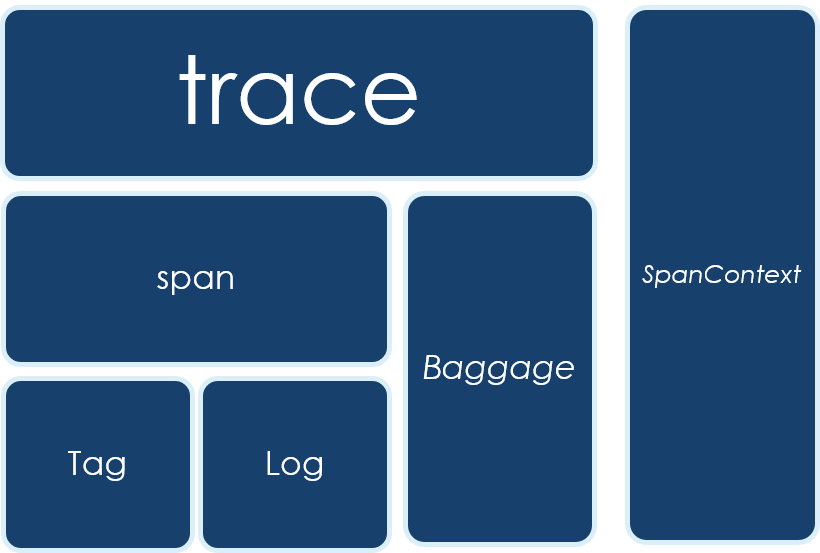
Tag
kv结构
Log
kv结构
封装
Inject:注入的过程就是把 context 的所有信息写入到一个叫 Carrier 的 map 中,然后把 map 中的所有 KV 对写入 HTTP Header 或者 grpc MetadataExtract:抽取过程是注入的逆过程,从 carrier,也就是 HTTP Headers(grpc Metadata),构建 SpanContext
整个过程类似客户端和服务器传递数据的序列化和反序列化的过程。这里的 Carrier (Map)支持 Key 为 string 类型,value 为 string 或者 Binary 格式(Bytes)
参考
 Documentation

Documentation

Index 
- Constants
- func NewContext(ctx context.Context, t SpanTrace) context.Context
- type BuiltinFormat
- type Carrier
- type HttpCarrier
- type LogField
- type SpanTrace
- type Tag
- func Bool(key string, val bool) Tag
- func Int(key string, val int) Tag
- func String(key string, val string) Tag
- func TagBool(key string, val bool) Tag
- func TagFloat32(key string, val float32) Tag
- func TagFloat64(key string, val float64) Tag
- func TagInt(key string, val int) Tag
- func TagInt64(key string, val int64) Tag
- func TagString(key string, val string) Tag
Constants 
View Source
const (
	// The type or "kind" of an error (only for event="error" logs). E.g., "Exception", "OSError"
	// type string
	LogErrorKind = "error.kind"

	// For languages that support such a thing (e.g., Java, Python),
	// the actual Throwable/Exception/Error object instance itself.
	// E.g., A java.lang.UnsupportedOperationException instance, a python exceptions.NameError instance
	// type string
	LogErrorObject = "error.object"

	// A stable identifier for some notable moment in the lifetime of a Span. For instance, a mutex lock acquisition or release or the sorts of lifetime events in a browser page load described in the Performance.timing specification. E.g., from Zipkin, "cs", "sr", "ss", or "cr". Or, more generally, "initialized" or "timed out". For errors, "error"
	// type string
	LogEvent = "event"

	// A concise, human-readable, one-line message explaining the event.
	// E.g., "Could not connect to backend", "Cache invalidation succeeded"
	// type string
	LogMessage = "message"

	// A stack trace in platform-conventional format; may or may not pertain to an error. E.g., "File \"example.py\", line 7, in \<module\>\ncaller()\nFile \"example.py\", line 5, in caller\ncallee()\nFile \"example.py\", line 2, in callee\nraise Exception(\"Yikes\")\n"
	// type string
	LogStack = "stack"
)
View Source
const (
	// The software package, framework, library, or module that generated the associated Span.
	// E.g., "grpc", "django", "JDBI".
	// type string
	TagComponent = "component"

	// Database instance name.
	// E.g., In java, if the jdbc.url="jdbc:mysql://127.0.0.1:3306/customers", the instance name is "customers".
	// type string
	TagDBInstance = "db.instance"

	// A database statement for the given database type.
	// E.g., for db.type="sql", "SELECT * FROM wuser_table"; for db.type="redis", "SET mykey 'WuValue'".
	TagDBStatement = "db.statement"

	// Database type. For any SQL database, "sql". For others, the lower-case database category,
	// e.g. "cassandra", "hbase", or "redis".
	// type string
	TagDBType = "db.type"

	// Username for accessing database. E.g., "readonly_user" or "reporting_user"
	// type string
	TagDBUser = "db.user"

	// true if and only if the application considers the operation represented by the Span to have failed
	// type bool
	TagError = "error"

	// HTTP method of the request for the associated Span. E.g., "GET", "POST"
	// type string
	TagHTTPMethod = "http.method"

	// HTTP response status code for the associated Span. E.g., 200, 503, 404
	// type integer
	TagHTTPStatusCode = "http.status_code"

	// URL of the request being handled in this segment of the trace, in standard URI format.
	// E.g., "https://domain.net/path/to?resource=here"
	// type string
	TagHTTPURL = "http.url"

	// An address at which messages can be exchanged.
	// E.g. A Kafka record has an associated "topic name" that can be extracted by the instrumented producer or consumer and stored using this tag.
	// type string
	TagMessageBusDestination = "message_bus.destination"

	// Remote "address", suitable for use in a networking client library.
	// This may be a "ip:port", a bare "hostname", a FQDN, or even a JDBC substring like "mysql://prod-db:3306"
	// type string
	TagPeerAddress = "peer.address"

	// 	Remote hostname. E.g., "opentracing.io", "internal.dns.name"
	// type string
	TagPeerHostname = "peer.hostname"

	// Remote IPv4 address as a .-separated tuple. E.g., "127.0.0.1"
	// type string
	TagPeerIPv4 = "peer.ipv4"

	// Remote IPv6 address as a string of colon-separated 4-char hex tuples.
	// E.g., "2001:0db8:85a3:0000:0000:8a2e:0370:7334"
	// type string
	TagPeerIPv6 = "peer.ipv6"

	// Remote port. E.g., 80
	// type integer
	TagPeerPort = "peer.port"

	// Remote service name (for some unspecified definition of "service").
	// E.g., "elasticsearch", "a_custom_microservice", "memcache"
	// type string
	TagPeerService = "peer.service"

	// If greater than 0, a hint to the Tracer to do its best to capture the trace.
	// If 0, a hint to the trace to not-capture the trace. If absent, the Tracer should use its default sampling mechanism.
	// type string
	TagSamplingPriority = "sampling.priority"

	// Either "client" or "server" for the appropriate roles in an RPC,
	// and "producer" or "consumer" for the appropriate roles in a messaging scenario.
	// type string
	TagSpanKind = "span.kind"

	// legacy tag
	TagAnnotation = "legacy.annotation"
	TagAddress    = "legacy.address"
	TagComment    = "legacy.comment"
)
Standard Span tags https://github.com/opentracing/specification/blob/master/semantic_conventions.md#span-tags-table
View Source
const (
	// trace 键
	GlobalTraceID = "atreus-trace-id"
)
Trace key
Variables 
This section is empty.
Functions 
Types 
type BuiltinFormat 
type BuiltinFormat byte
BuiltinFormat is used to demarcate the values within package `trace` that are intended for use with the Tracer.Inject() and Tracer.Extract() methods.
const (
	// HTTPFormat represents Trace as HTTP header string pairs.
	//
	// the HTTPFormat format requires that the keys and values
	// be valid as HTTP headers as-is (i.e., character casing may be unstable
	// and special characters are disallowed in keys, values should be
	// URL-escaped, etc).
	//
	// the carrier must be a `http.Header`.
	HTTPFormat BuiltinFormat = iota
	// GRPCFormat represents Trace as gRPC metadata.
	//
	// the carrier must be a `google.golang.org/grpc/metadata.MD`.
	GRPCFormat
)
support format list
type Carrier 
Carrier propagator must convert generic interface{} to something this implement Carrier interface, Trace can use Carrier to represents itself.
type HttpCarrier 
func (HttpCarrier) Get 
func (h HttpCarrier) Get(key string) string
func (HttpCarrier) Set 
func (h HttpCarrier) Set(key, val string)
type SpanTrace 
type SpanTrace interface {
	// traceid包含 traceid+spanid+parentid的组合
	TraceID() string

	// Fork fork a trace with client trace.
	Fork(serviceName, operationName string) SpanTrace

	// Follow
	Follow(serviceName, operationName string) SpanTrace

	// Finish when trace finish call it.
	Finish(err *error)

	// Adds a tag to the trace.
	//
	// If there is a pre-existing tag set for `key`, it is overwritten.
	//
	// Tag values can be numeric types, strings, or bools. The behavior of
	// other tag value types is undefined at the OpenTracing level. If a
	// tracing system does not know how to handle a particular value type, it
	// may ignore the tag, but shall not panic.
	// NOTE current only support legacy tag: TagAnnotation TagAddress TagComment
	// other will be ignore
	SetTag(tags ...Tag) SpanTrace

	// LogFields is an efficient and type-checked way to record key:value
	// NOTE current unsupport
	SetLog(logs ...LogField) SpanTrace

	// Visit visits the k-v pair in trace, calling fn for each.
	Visit(fn func(k, v string))

	// SetTitle reset trace title
	SetTitle(title string)
}
SpanTrace 为 Span 的公共接口
 Source Files
Click to show internal directories.
Click to hide internal directories.