

 README

README


 JobRunner
This is a fork of the bamzi/jobrunner package.
JobRunner is framework for performing work asynchronously, outside of the request flow. It comes with cron to schedule and queue job functions for processing at specified time.
It includes a live monitoring of current schedule and state of active jobs that can be outputed as JSON or Html template.
Install
go get github.com/Ctere1/jobrunner
Setup
package main

import "github.com/Ctere1/jobrunner"

func main() {
    jobrunner.Start() // optional: jobrunner.Start(pool int, concurrent int) (10, 1)
    jobrunner.Schedule("@every 5s", ReminderEmails{})
}

// Job Specific Functions
type ReminderEmails struct {
    // filtered
}

// ReminderEmails.Run() will get triggered automatically.
func (e ReminderEmails) Run() {
    // Queries the DB
    // Sends some email
    fmt.Printf("Every 5 sec send reminder emails \n")
}
Live Monitoring
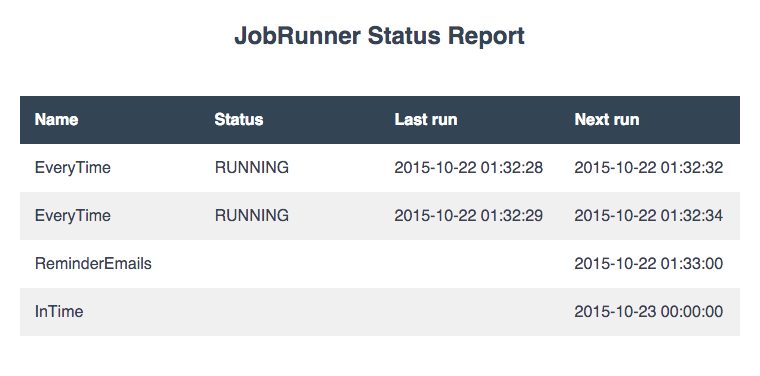
// Example of GIN micro framework
func main() {
    routes := gin.Default()

    // Resource to return the JSON data
    routes.GET("/jobrunner/json", JobJson)

    // Load template file location relative to the current working directory
    routes.LoadHTMLGlob("../github.com/Ctere1/jobrunner/views/Status.html")

    // Returns html page at given endpoint based on the loaded
    // template from above
    routes.GET("/jobrunner/html", JobHtml)

    routes.Run(":8080")
}

func JobJson(c *gin.Context) {
    // returns a map[string]interface{} that can be marshalled as JSON
    c.JSON(200, jobrunner.StatusJson())
}

func JobHtml(c *gin.Context) {
    // Returns the template data pre-parsed
    c.HTML(200, "", jobrunner.StatusPage())

}
WHY?
To reduce our http response latency by 200+%
JobRunner was created to help us process functions unrelated to response without any delays to the http response. GoRoutines would timeout because response has already been processed, closing the instance window all together.
Instead of creating a separate independent app, we wanted to save time and manageability of our current app by coupling-in the job processing. We did not want to have micro services. It's premature optimization.
If you have a web app or api service backend and want a job processing framework built into your app then JobRunner is for you. Once you hit mass growth and need to scale, you can simply decouple you JobRunners into a dedicated app.
Use cases
Here are some examples of what we use JobRunner for:
- Send emails to new users after signup
- Sending push notification or emails based on specifics
- ReMarketing Engine - send invites, reminder emails, etc ...
- Clean DB, data or AMZ S3
- Sending Server stats to monitoring apps
- Send data stats at daily or weekly intervals
Supported Featured
All jobs are processed outside of the request flow
- Now: process a job immediately
- In: processing a job one time, after a given time
- Every: process a recurring job after every given time gap
- Schedule: process a job (recurring or otherwise) at a given time
Compatibility
JobRunner is designed to be framework agnostic. So it will work with pure Go apps as well as any framework written in Go Language.
Verified Supported Frameworks
- Gin
- Echo
- Martini
- Beego
- Revel (JobRunner is modified version of revel's Jobs module)
- ...
Basics
    jobrunner.Schedule("* */5 * * * *", DoSomething{}) // every 5min do something
    jobrunner.Schedule("@every 1h30m10s", ReminderEmails{})
    jobrunner.Schedule("@midnight", DataStats{}) // every midnight do this..
    jobrunner.Every(16*time.Minute, CleanS3{}) // evey 16 min clean...
    jobrunner.In(10*time.Second, WelcomeEmail{}) // one time job. starts after 10sec
    jobrunner.Now(NowDo{}) // do the job as soon as it's triggered
 Documentation

Documentation

Index 
- Constants
- Variables
- func Entries() []cron.Entry
- func Every(duration time.Duration, job cron.Job)
- func In(duration time.Duration, job cron.Job)
- func Now(job cron.Job)
- func Remove(id cron.EntryID)
- func RemoveJobByName(jobName string) error
- func Schedule(spec string, job cron.Job) error
- func Start(options ...int)
- func StatusJson() map[string]interface{}
- func Stop()
- func UpdateJobIntervalByName(jobName string, newInterval time.Duration) error
- func UpdateJobScheduleByName(jobName, newSpec string) error
- type Func
- type Job
- type StatusData
Constants 
const (
	UNNAMED_JOB = "(unnamed)" // Default name for unnamed jobs

	JOB_RUNNING_STATUS = "RUNNING" // Job status constants
	JOB_IDLE_STATUS    = "IDLE"    // Job status constants
)
const DEFAULT_JOB_POOL_SIZE = 10 // Default number of concurrent jobs
Variables 
var (
	MainCron *cron.Cron // Job scheduler singleton instance

	HideBanner bool = false // Flag to control banner display
)
Functions 
func Now 
Now runs the given job once, immediately.
It pre-stamps lastRun synchronously before launching the goroutine so that any StatusPage call immediately after Now() returns sees the updated Prev — important for nudge-based WebSocket pushes. The goroutine's Run() will overwrite lastRun ~1ms later with the actual start time; both writes are atomic and the delta is negligible.
It reuses the registered *Job instance when possible so that Status and Latency updates during the run are visible in StatusPage.
func RemoveJobByName 
RemoveJobByName removes a scheduled job by its name.
func StatusJson 
func StatusJson() map[string]interface{}
StatusJson returns the job status as a JSON-serialisable map.
func UpdateJobIntervalByName 
UpdateJobIntervalByName updates an existing job's execution interval by its name.
func UpdateJobScheduleByName 
UpdateJobScheduleByName updates an existing job's schedule by its name.
Types 
type Job 
type Job struct {
	Name string `json:"name"`

	Status  string `json:"status"`
	Latency string `json:"latency"`
	// contains filtered or unexported fields
}
Job represents a scheduled task within the JobRunner system. It wraps an inner cron.Job and maintains execution metadata such as name, status, latency, last-run time, and total run count.
lastRun and runCount are placed first in the struct to guarantee 64-bit atomic alignment on 32-bit platforms (Go spec requirement).
func (*Job) LastRun ¶ added in v1.0.2
LastRun returns the time this job last began executing (scheduled or manual). Returns the zero time if the job has never run.
func (*Job) Run 
func (j *Job) Run()
Run executes the job and updates the job status, latency, last-run time, and run count.
func (*Job) RunCount ¶ added in v1.0.2
RunCount returns the total number of times this job has started executing.
func (*Job) StatusUpdate 
StatusUpdate updates the job status based on the atomic status flag
type StatusData 
type StatusData struct {
	Id        cron.EntryID `json:"id"`
	JobRunner *Job         `json:"jobRunner"`
	Next      time.Time    `json:"next"`
	Prev      time.Time    `json:"prev"`
	RunCount  int64        `json:"runCount"`
}
StatusData holds the observable state of a single scheduled job entry. Prev reflects the last execution start time across all execution paths (scheduled and manual), sourced from the Job's own atomic lastRun field.
func StatusPage 
func StatusPage() []StatusData
StatusPage returns the current state of all registered jobs. Prev is taken from the Job's own lastRun field — the single source of truth for execution time regardless of whether the run was scheduled or manual.
 Source Files