Documentation

Documentation

Overview 
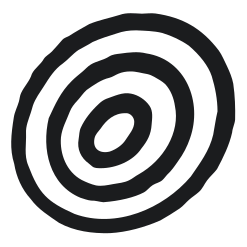
Package orbalogo carries the official Ordalie mark as pre-rendered art.
Source of truth: https://ordalie.com/brand/ORDALIE_LOGO_ICONO_NOIR_FULL.svg, whose six contours resolve under an even-odd fill to the three nested rings of the mark. The rings' own bounding box (224x220 inside the padded 247x247 viewBox) is what gets mapped, so the canvas carries the mark's proportions rather than the artboard's, rasterized offline onto one 24x11 monochrome Braille canvas per frame.
The canvas is wider than it is tall in cells to cancel the cell aspect: a Braille cell is 2 dots wide and 4 dots tall, so 24x11 renders the 224x220 mark at its true ratio when a terminal cell is about 1:2.14, which is where the common coding faces sit. Taller cells want a wider canvas and shorter cells a narrower one; only Width and the regeneration change.
The mark is legible in the first frame and grows six percent while its dots arrive. Only finished frames ship; Orb does no image work at runtime.
Index 
Constants 
const (
	// CompactWidth and CompactHeight are the update-screen canvas: the same
	// mark, about a third of the cells, so a one-shot CLI reveal does not fill
	// the terminal the way the empty-chat lockup does.
	CompactWidth  = 14
	CompactHeight = 6
)
const (
	// Width and Height are the fixed canvas every frame draws inside: rows are
	// at most Width columns wide and carry no trailing spaces, and every frame
	// has exactly Height rows so a redraw rewinds a constant number of lines.
	Width      = 24
	Height     = 11
	FrameCount = 48
)
Variables 
This section is empty.
Functions 
func CompactFrame ¶ added in v0.5.0
func CompactFrame(index int) [CompactHeight]string
CompactFrame is Frame scaled onto the update canvas. The unfold stages stay the same indices; only the cell grid changes. The empty-chat lockup keeps the full mark; only the update reveal calls this.
Types 
This section is empty.
 Source Files