

 README

README


plakar - Effortless backup & more



Deutsch | Español | français | 日本語 | 한국어 | Português | Русский | 中文
🔄 Latest Release
V1.0.5 - Minor Release: Refinements, Hooks, Build Improvements (October 15, 2025)
- Build & Packaging Improvements: Homebrew packaging fixed for macOS, added Windows builds, and multiple dependency updates for a more robust development environment.
- UI & Documentation Updates: New social links, updated documentation, synced Plakar UI to latest revision, improved asset serving, and enhanced manual pages.
- Pipeline & Concurrency Tuning: Adjusted backup pipeline concurrency for better stability and resource usage.
- Backup Hooks & Sync Enhancements: Added pre-hook, post-hook, and fail-hook support for backup commands, including Windows compatibility. Introduced passphrase_cmd for sync operations.
- Maintenance & Internal Refinements: Improved type safety, clearer messaging, better login clarifications, enhanced error handling, cache-mem-size parameter, and miscellaneous bug fixes.
- New Contributors: Welcome to @pata27 for their first contribution!
V1.0.4 - Major Release: Plugins, Windows, Packages, Performance (September 16, 2025)
- Pre-packaged binaries for easy installs:
.deb,.rpm,.apk, plus static tarballs.
Package repositories coming right after to install viaapt,yum, orapk. - Initial Windows support: Plakar now runs natively on Windows, including CLI and UI.
Current limitation: one concurrent operation per agent, as multi-agent support is coming next. - Integrations as plugins with
plakar pkg add <integration>
Example:plakar pkg add s3,plakar pkg add sftp,plakar pkg add gcp,imap,ftp, ... - Smarter agent: auto-spawn and auto-teardown after idle for frictionless concurrency.
- Cache improvements: fewer disk hits, lower footprint, better accuracy on very large corpora.
- Performance boosts across backup, check, restore: faster indexing, traversal, data access, and dedupe pipelines.
From x2 to x10 depending on workloads. - Policy-based lifecycle via
plakar prune
Examples:
plakar prune -days 2 -per-day 3 -weeks 4 -per-week 5 -months 3 -per-month 2
plakar prune -tags finance -per-day 5 - UI refinements: cleaner layouts, clearer hierarchy, better progress and error messages.
Try the demo: https://demo.plakar.io
🧭 Introduction
plakar provides an intuitive, powerful, and scalable backup solution.
Plakar goes beyond file-level backups. It captures application data with its full context.
Data and context are stored using Kloset, an open-source, immutable data store that enables the implementation of advanced data protection scenarios.
Plakar's main strengths:
- Effortless: Easy to use, clean default. Check out our quick start guide.
- Secure: Provide audited end-to-end encryption for data and metadata. See our latest crypto audit report.
- Reliable: Backups are stored in Kloset, an open-source immutable data store. Learn more about Kloset.
- Vertically scalable: Backup and restore very large datasets with limited RAM usage.
- Horizontally scalable: Support high concurrency and multiple backups type in a single Kloset.
- Browsable: Browse, sort, search, and compare backups using the Plakar UI.
- Fast: backup, check, sync and restore are operations are optimized for large-scale data.
- Efficient: more restore points, less storage, thanks to Kloset's unmatched deduplication and compression.
- Open Source and actively maintained: open source forever and now maintained by Plakar Korp
Simplicity and efficiency are plakar's main priorities.
Our mission is to set a new standard for effortless secure data protection.
🖥️ Plakar UI
Plakar includes a built-in web-based user interface to monitor, browse, and restore your backups with ease.
🚀 Launch the UI
You can start the interface from any machine with access to your backups:
$ plakar ui
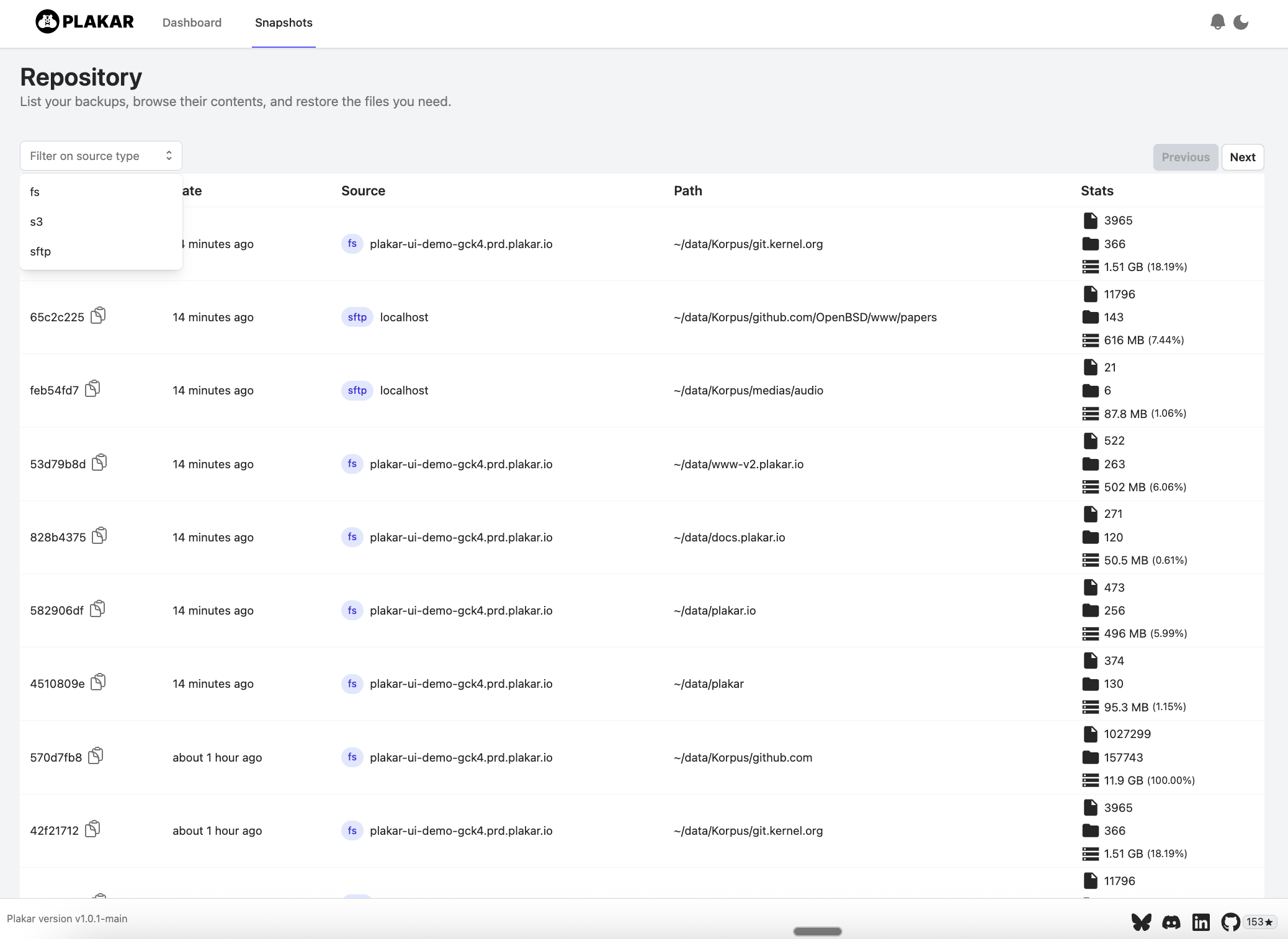
📂 Snapshot Overview
Quickly list all available snapshots and explore them:
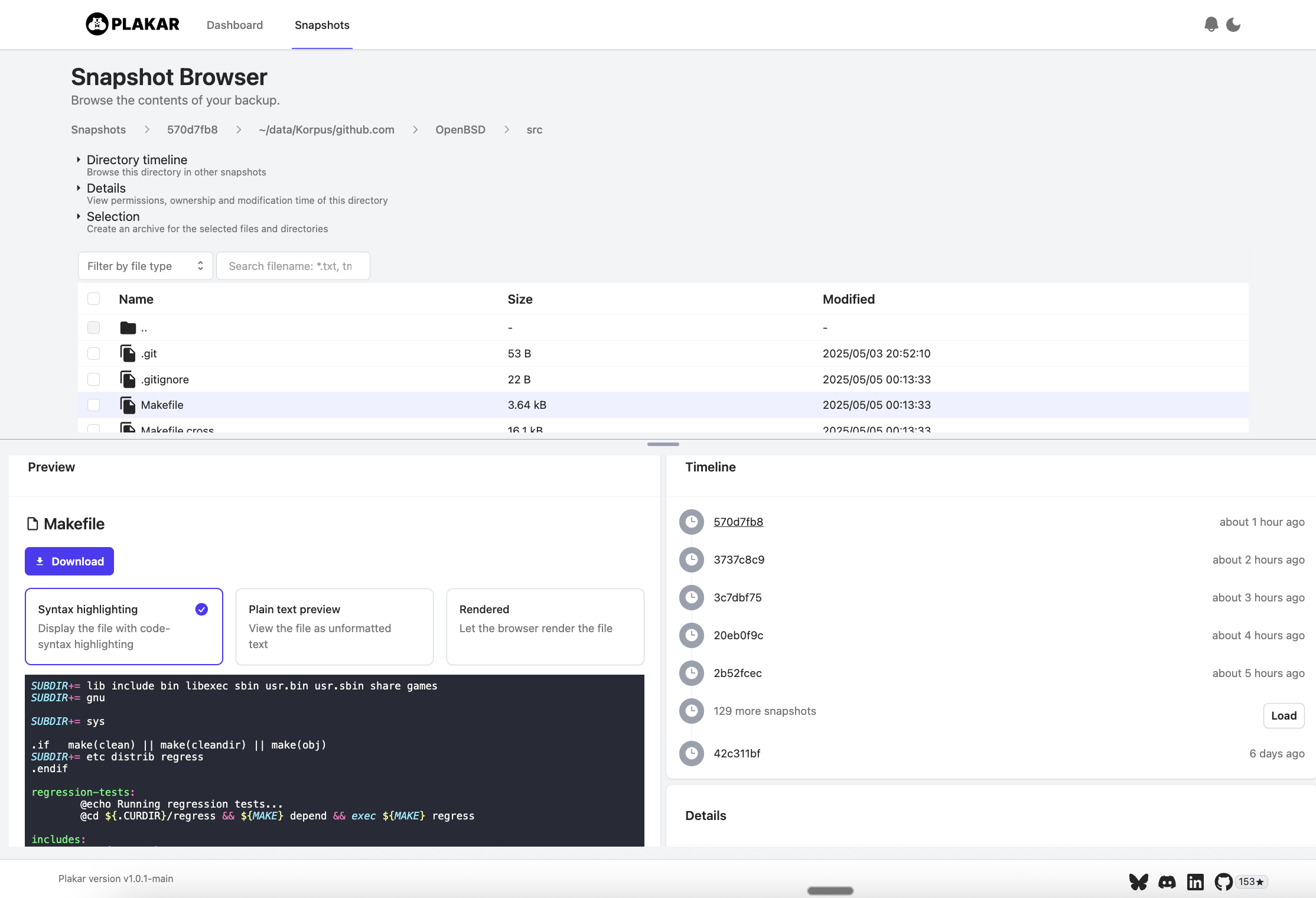
🔍 Granular Browsing
Navigate the contents of each snapshot to inspect, compare, or selectively restore files:
📦 Installing the CLI
From binaries
Visit https://www.plakar.io/download/
From source
plakar requires Go 1.23.3 or higher,
it may work on older versions but hasn't been tested.
go install github.com/PlakarKorp/plakar@latest
🚀 Quickstart
plakar quickstart: https://www.plakar.io/docs/v1.0.4/quickstart/
A taste of plakar (please follow the quickstart to begin):
$ plakar at /var/backups create                             # Create a repository
$ plakar at /var/backups backup /private/etc                # Backup /private/etc
$ plakar at /var/backups ls                                 # List all repository backup
$ plakar at /var/backups restore -to /tmp/restore 9abc3294  # Restore a backup to /tmp/restore
$ plakar at /var/backups ui                                 # Start the UI
$ plakar at /var/backups sync to @s3                        # Synchronise a backup repository to S3
🧠 Notable Capabilities
- Instant recovery: Instantly mount large backups on any devices without full restoration.
- Distributed backup: Kloset can be easily distributed to implement 3,2,1 rule or advanced strategies (push, pull, sync) across heterogeneous environments.
- Granular restore: Restore a complete snapshot or only a subset of your data.
- Cross-storage restore: Back up from one storage type (e.g., S3-compatible object store) and restore to another (e.g., file system)..
- Production safe-guarding: Automatically adjusts backup speed to avoid impacting production workloads.
- Lock-free maintenance: Perform garbage collection without interrupting backup or restore operations.
- Integrations: back up and restore from and to any source (file systems, object stores, SaaS applications...) with the right integration.
🗄️ Plakar archive format : ptar
ptar is Plakar’s lightweight, high-performance archive format for secure and efficient backup snapshots.
Kapsul is a companion tool that lets you run most plakar sub-commands directly on a .ptar archive without extracting it. It mounts the archive in memory as a read-only Plakar repository, enabling transparent and efficient inspection, restoration, and diffing of snapshots.
For installation, usage examples, and full documentation, see the Kapsul repository.
📚 Documentation
For the latest information, you can read the documentation available at https://www.plakar.io/docs/v1.0.4/
💬 Community
- 🗨️ Join our very active Discord
- 📣 Follow our subreddit r/plakar
- ▶️ Subscribe to our YouTube channel @PlakarKorp
 Documentation

Documentation


There is no documentation for this package.
 Source Files
 Directories