

 README

README

存储结构
qbase引用了cosmos-sdk的存储实现,在此对cosmos团队表示诚挚的感谢 此文档意在对cosmos-sdk存储模块进行分析,并说明qbase对其的修改,以供开发者参考
继承关系
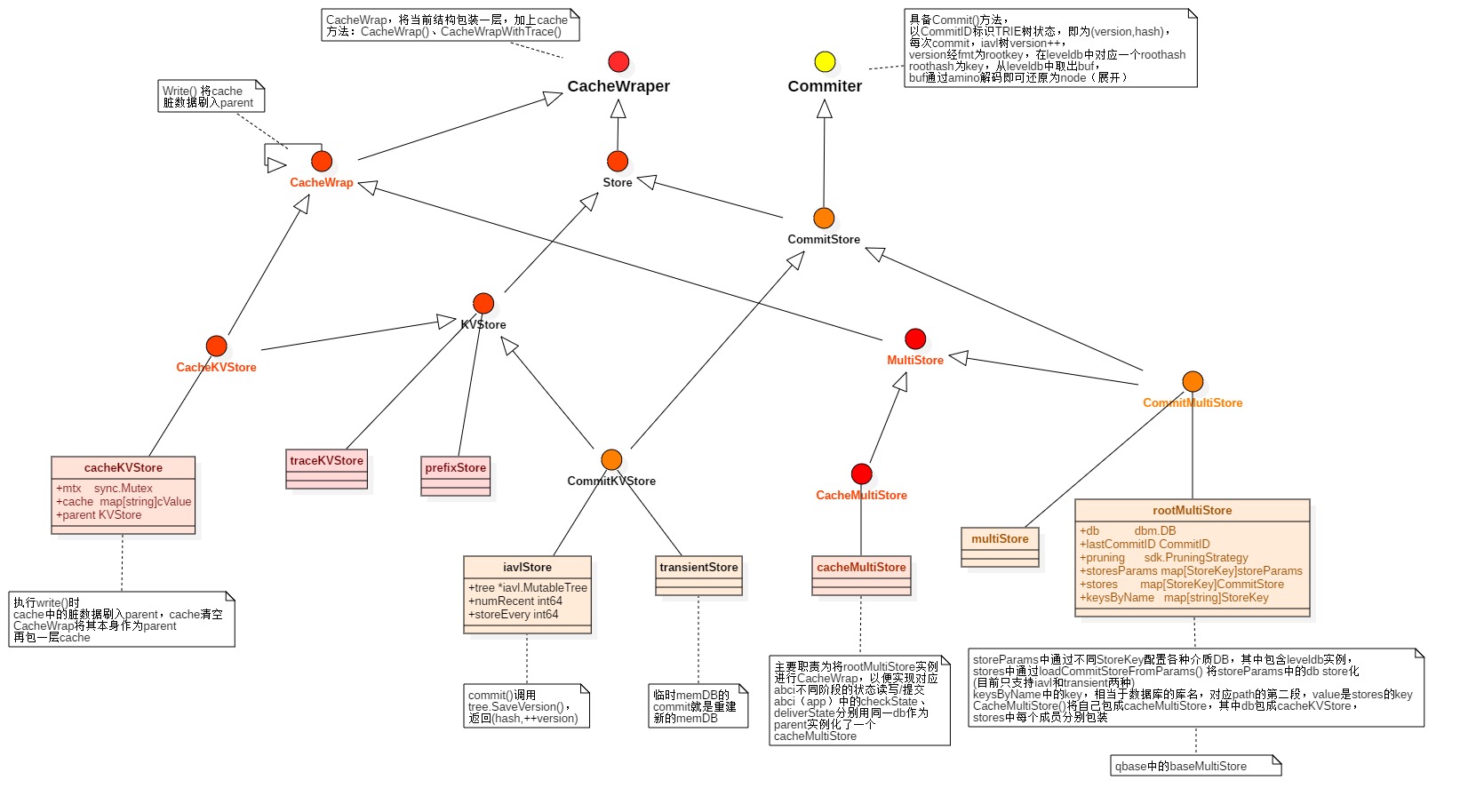 为了理解存储设计思路,突出两大类存储接口:
commiter
为配合abci接口调用的进程,实现对version的控制和提交到底层存储
cachewraper
为配合abci接口调用的数据生命周期,实现双层缓存/提交的控制逻辑
查询过程解释及接口定义
通过abci的Query(req RequestQuery)查询时:
- 为"store"/"key"时,表示当前查询目标为key为req.Data的value
- 为"subspace"时,比哦是当前查询目标为前缀为req.Data的子树(可展开) 需要注意存取的对象是否需要解码
存储过程解释及接口定义
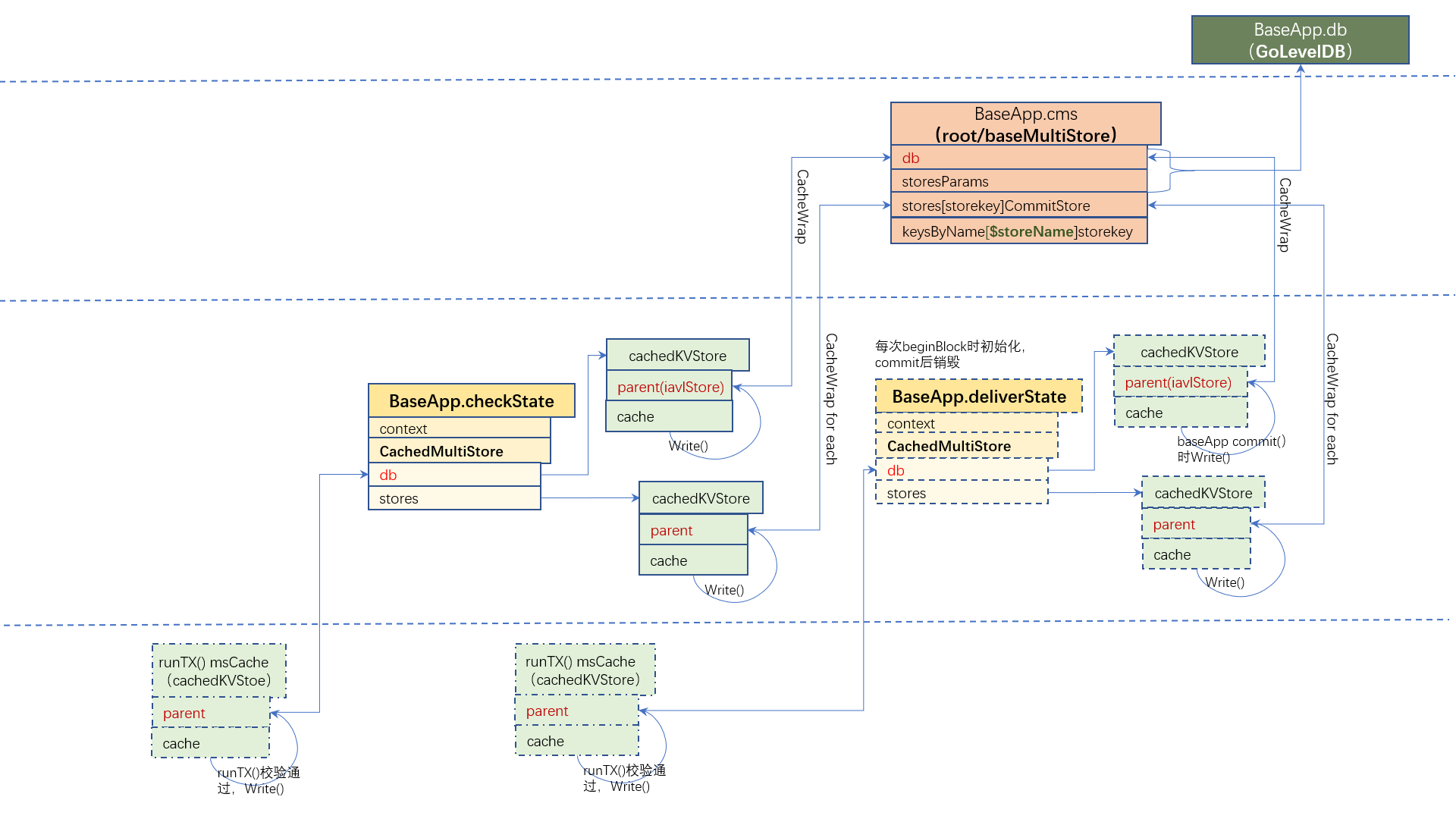
直接存储数值
调用可调用实例提供的mapper mapper直接访问BaseApp.cms实现存储
abci提交
两层缓存结构,在BaseApp.cms上,分别包装成两个缓存:checkState、deliverState
 Documentation

Documentation

Index 
- func NewCacheKVStore(parent KVStore) *cacheKVStore
- func NewCommitMultiStore(db dbm.DB) *baseMultiStore
- func PrefixEndBytes(prefix []byte) []byte
- func RequireProof(subpath string) bool
- func VerifyMultiStoreCommitInfo(storeName string, storeInfos []storeInfo, appHash []byte) ([]byte, error)
- func VerifyRangeProof(key, value []byte, substoreCommitHash []byte, rangeProof *iavl.RangeProof) error
- type CacheKVStore
- type CacheMultiStore
- type CacheWrap
- type CacheWrapper
- type CommitID
- type CommitKVStore
- type CommitMultiStore
- type CommitStore
- type Committer
- type Iterator
- type KVPair
- type KVStore
- type KVStoreKey
- type MultiStore
- type MultiStoreProof
- type PruningStrategy
- type Queryable
- type Store
- type StoreKey
- type StoreType
- type TraceContext
- type TraceKVStore
- func (tkv *TraceKVStore) CacheWrap() CacheWrap
- func (tkv *TraceKVStore) CacheWrapWithTrace(_ io.Writer, _ TraceContext) CacheWrap
- func (tkv *TraceKVStore) Delete(key []byte)
- func (tkv *TraceKVStore) Get(key []byte) []byte
- func (tkv *TraceKVStore) GetStoreType() StoreType
- func (tkv *TraceKVStore) Has(key []byte) bool
- func (tkv *TraceKVStore) Iterator(start, end []byte) dbm.Iterator
- func (tkv *TraceKVStore) Prefix(prefix []byte) KVStore
- func (tkv *TraceKVStore) ReverseIterator(start, end []byte) dbm.Iterator
- func (tkv *TraceKVStore) Set(key []byte, value []byte)
- type TransientStoreKey
Constants 
This section is empty.
Variables 
This section is empty.
Functions 
func PrefixEndBytes 
PrefixEndBytes returns the []byte that would end a range query for all []byte with a certain prefix Deals with last byte of prefix being FF without overflowing
func RequireProof 
RequireProof return whether proof is require for the subpath
func VerifyMultiStoreCommitInfo 
func VerifyMultiStoreCommitInfo(storeName string, storeInfos []storeInfo, appHash []byte) ([]byte, error)
VerifyMultiStoreCommitInfo verify multiStoreCommitInfo against appHash
func VerifyRangeProof 
func VerifyRangeProof(key, value []byte, substoreCommitHash []byte, rangeProof *iavl.RangeProof) error
VerifyRangeProof verify iavl RangeProof
Types 
type CacheKVStore 
type CacheKVStore interface {
	KVStore

	// Writes operations to underlying KVStore
	Write()
}
CacheKVStore cache-wraps a KVStore. After calling .Write() on the CacheKVStore, all previously created CacheKVStores on the object expire.
type CacheMultiStore 
type CacheMultiStore interface {
	MultiStore
	Write() // Writes operations to underlying KVStore
}
From MultiStore.CacheMultiStore()....
type CacheWrap 
type CacheWrap interface {
	// Write syncs with the underlying store.
	Write()

	// CacheWrap recursively wraps again.
	CacheWrap() CacheWrap

	// CacheWrapWithTrace recursively wraps again with tracing enabled.
	CacheWrapWithTrace(w io.Writer, tc TraceContext) CacheWrap
}
CacheWrap makes the most appropriate cache-wrap. For example, IAVLStore.CacheWrap() returns a CacheKVStore. CacheWrap should not return a Committer, since Commit cache-wraps make no sense. It can return KVStore, HeapStore, SpaceStore, etc.
type CacheWrapper 
type CacheWrapper interface {
	// CacheWrap cache wraps.
	CacheWrap() CacheWrap

	// CacheWrapWithTrace cache wraps with tracing enabled.
	CacheWrapWithTrace(w io.Writer, tc TraceContext) CacheWrap
}
type CommitKVStore 
Stores of MultiStore must implement CommitStore.
type CommitMultiStore 
type CommitMultiStore interface {
	Committer
	MultiStore

	// Mount a store of type using the given db.
	// If db == nil, the new store will use the CommitMultiStore db.
	MountStoreWithDB(key StoreKey, typ StoreType, db dbm.DB)

	// Panics on a nil key.
	GetCommitStore(key StoreKey) CommitStore

	// Panics on a nil key.
	GetCommitKVStore(key StoreKey) CommitKVStore

	// Load the latest persisted version.  Called once after all
	// calls to Mount*Store() are complete.
	LoadLatestVersion() error

	// Load a specific persisted version.  When you load an old
	// version, or when the last commit attempt didn't complete,
	// the next commit after loading must be idempotent (return the
	// same commit id).  Otherwise the behavior is undefined.
	LoadVersion(ver int64) error
}
A non-cache MultiStore.
type CommitStore 
Stores of MultiStore must implement CommitStore.
func LoadIAVLStore 
func LoadIAVLStore(db dbm.DB, id CommitID, pruning PruningStrategy) (CommitStore, error)
load the iavl store
type Committer 
type Committer interface {
	Commit() CommitID
	LastCommitID() CommitID
	SetPruning(PruningStrategy)
}
something that can persist to disk
type Iterator 
Alias iterator to db's Iterator for convenience.
func KVStorePrefixIterator 
Iterator over all the keys with a certain prefix in ascending order
func KVStoreReversePrefixIterator 
Iterator over all the keys with a certain prefix in descending order.
type KVStore 
type KVStore interface {
	Store

	// Get returns nil iff key doesn't exist. Panics on nil key.
	Get(key []byte) []byte

	// Has checks if a key exists. Panics on nil key.
	Has(key []byte) bool

	// Set sets the key. Panics on nil key.
	Set(key, value []byte)

	// Delete deletes the key. Panics on nil key.
	Delete(key []byte)

	// Iterator over a domain of keys in ascending order. End is exclusive.
	// Start must be less than end, or the Iterator is invalid.
	// Iterator must be closed by caller.
	// To iterate over entire domain, use store.Iterator(nil, nil)
	// CONTRACT: No writes may happen within a domain while an iterator exists over it.
	Iterator(start, end []byte) Iterator

	// Iterator over a domain of keys in descending order. End is exclusive.
	// Start must be greater than end, or the Iterator is invalid.
	// Iterator must be closed by caller.
	// CONTRACT: No writes may happen within a domain while an iterator exists over it.
	ReverseIterator(start, end []byte) Iterator

	// Prefix applied keys with the argument
	// CONTRACT: when Prefix is called on a KVStore more than once,
	// the concatanation of the prefixes is applied
	Prefix(prefix []byte) KVStore
}
KVStore is a simple interface to get/set data
type KVStoreKey 
type KVStoreKey struct {
	// contains filtered or unexported fields
}
KVStoreKey is used for accessing substores. Only the pointer value should ever be used - it functions as a capabilities key.
func NewKVStoreKey 
func NewKVStoreKey(name string) *KVStoreKey
NewKVStoreKey returns a new pointer to a KVStoreKey. Use a pointer so keys don't collide.
func (*KVStoreKey) Name 
func (key *KVStoreKey) Name() string
func (*KVStoreKey) String 
func (key *KVStoreKey) String() string
type MultiStore 
type MultiStore interface {
	Store

	// Cache wrap MultiStore.
	// NOTE: Caller should probably not call .Write() on each, but
	// call CacheMultiStore.Write().
	CacheMultiStore() CacheMultiStore

	// Convenience for fetching substores.
	GetStore(StoreKey) Store
	GetKVStore(StoreKey) KVStore

	// TracingEnabled returns if tracing is enabled for the MultiStore.
	TracingEnabled() bool

	// WithTracer sets the tracer for the MultiStore that the underlying
	// stores will utilize to trace operations. A MultiStore is returned.
	WithTracer(w io.Writer) MultiStore

	// WithTracingContext sets the tracing context for a MultiStore. It is
	// implied that the caller should update the context when necessary between
	// tracing operations. A MultiStore is returned.
	WithTracingContext(TraceContext) MultiStore

	// ResetTraceContext resets the current tracing context.
	ResetTraceContext() MultiStore
}
type MultiStoreProof 
type MultiStoreProof struct {
	StoreInfos []storeInfo
	StoreName  string
	RangeProof iavl.RangeProof
}
MultiStoreProof defines a collection of store proofs in a multi-store
type PruningStrategy 
type PruningStrategy uint8
PruningStrategy specfies how old states will be deleted over time
const (
	// PruneSyncable means only those states not needed for state syncing will be deleted (keeps last 100 + every 10000th)
	PruneSyncable PruningStrategy = iota

	// PruneEverything means all saved states will be deleted, storing only the current state
	PruneEverything PruningStrategy = iota

	// PruneNothing means all historic states will be saved, nothing will be deleted
	PruneNothing PruningStrategy = iota
)
type Queryable 
type Queryable interface {
	Query(abci.RequestQuery) abci.ResponseQuery
}
Queryable allows a Store to expose internal state to the abci.Query interface. Multistore can route requests to the proper Store.
This is an optional, but useful extension to any CommitStore
type Store 
type Store interface {
	GetStoreType() StoreType
	CacheWrapper
}
type TraceContext 
type TraceContext map[string]interface{}
TraceContext contains TraceKVStore context data. It will be written with every trace operation.
type TraceKVStore 
type TraceKVStore struct {
	// contains filtered or unexported fields
}
TraceKVStore implements the KVStore interface with tracing enabled. Operations are traced on each core KVStore call and written to the underlying io.writer.
TODO: Should we use a buffered writer and implement Commit on TraceKVStore?
func NewTraceKVStore 
func NewTraceKVStore(parent KVStore, writer io.Writer, tc TraceContext) *TraceKVStore
NewTraceKVStore returns a reference to a new traceKVStore given a parent KVStore implementation and a buffered writer.
func (*TraceKVStore) CacheWrap 
func (tkv *TraceKVStore) CacheWrap() CacheWrap
CacheWrap implements the KVStore interface. It panics as a TraceKVStore cannot be cache wrapped.
func (*TraceKVStore) CacheWrapWithTrace 
func (tkv *TraceKVStore) CacheWrapWithTrace(_ io.Writer, _ TraceContext) CacheWrap
CacheWrapWithTrace implements the KVStore interface. It panics as a TraceKVStore cannot be cache wrapped.
func (*TraceKVStore) Delete 
func (tkv *TraceKVStore) Delete(key []byte)
Delete implements the KVStore interface. It traces a write operation and delegates the Delete call to the parent KVStore.
func (*TraceKVStore) Get 
func (tkv *TraceKVStore) Get(key []byte) []byte
Get implements the KVStore interface. It traces a read operation and delegates a Get call to the parent KVStore.
func (*TraceKVStore) GetStoreType 
func (tkv *TraceKVStore) GetStoreType() StoreType
GetStoreType implements the KVStore interface. It returns the underlying KVStore type.
func (*TraceKVStore) Has 
func (tkv *TraceKVStore) Has(key []byte) bool
Has implements the KVStore interface. It delegates the Has call to the parent KVStore.
func (*TraceKVStore) Iterator 
func (tkv *TraceKVStore) Iterator(start, end []byte) dbm.Iterator
Iterator implements the KVStore interface. It delegates the Iterator call the to the parent KVStore.
func (*TraceKVStore) Prefix 
func (tkv *TraceKVStore) Prefix(prefix []byte) KVStore
Prefix implements the KVStore interface.
func (*TraceKVStore) ReverseIterator 
func (tkv *TraceKVStore) ReverseIterator(start, end []byte) dbm.Iterator
ReverseIterator implements the KVStore interface. It delegates the ReverseIterator call the to the parent KVStore.
func (*TraceKVStore) Set 
func (tkv *TraceKVStore) Set(key []byte, value []byte)
Set implements the KVStore interface. It traces a write operation and delegates the Set call to the parent KVStore.
type TransientStoreKey 
type TransientStoreKey struct {
	// contains filtered or unexported fields
}
TransientStoreKey is used for indexing transient stores in a MultiStore
func NewTransientStoreKey 
func NewTransientStoreKey(name string) *TransientStoreKey
Constructs new TransientStoreKey Must return a pointer according to the ocap principle
func (*TransientStoreKey) String 
func (key *TransientStoreKey) String() string
Implements StoreKey
 Source Files