


 README


Pogreb


Pogreb is an embedded key-value store for read-heavy workloads written in Go.
Key characteristics
- 100% Go.
- Optimized for fast random lookups and infrequent bulk inserts.
- Can store larger-than-memory data sets.
- Low memory usage.
- All DB methods are safe for concurrent use by multiple goroutines.
Installation
$ go get -u github.com/akrylysov/pogreb
Usage
Opening a database
To open or create a new database, use the pogreb.Open() function:
package main

import (
	"log"

	"github.com/akrylysov/pogreb"
)

func main() {
    db, err := pogreb.Open("pogreb.test", nil)
    if err != nil {
        log.Fatal(err)
        return
    }
    defer db.Close()
}
Writing to a database
Use the DB.Put() function to insert a new key-value pair:
err := db.Put([]byte("testKey"), []byte("testValue"))
if err != nil {
	log.Fatal(err)
}
Reading from a database
To retrieve the inserted value, use the DB.Get() function:
val, err := db.Get([]byte("testKey"))
if err != nil {
	log.Fatal(err)
}
log.Printf("%s", val)
Deleting from a database
Use the DB.Delete() function to delete a key-value pair:
err := db.Delete([]byte("testKey"))
if err != nil {
	log.Fatal(err)
}
Iterating over items
To iterate over items, use ItemIterator returned by DB.Items():
it := db.Items()
for {
    key, val, err := it.Next()
    if err == pogreb.ErrIterationDone {
    	break
    }
    if err != nil {
        log.Fatal(err)
    }
    log.Printf("%s %s", key, val)
}
Performance
The benchmarking code can be found in the pogreb-bench repository.
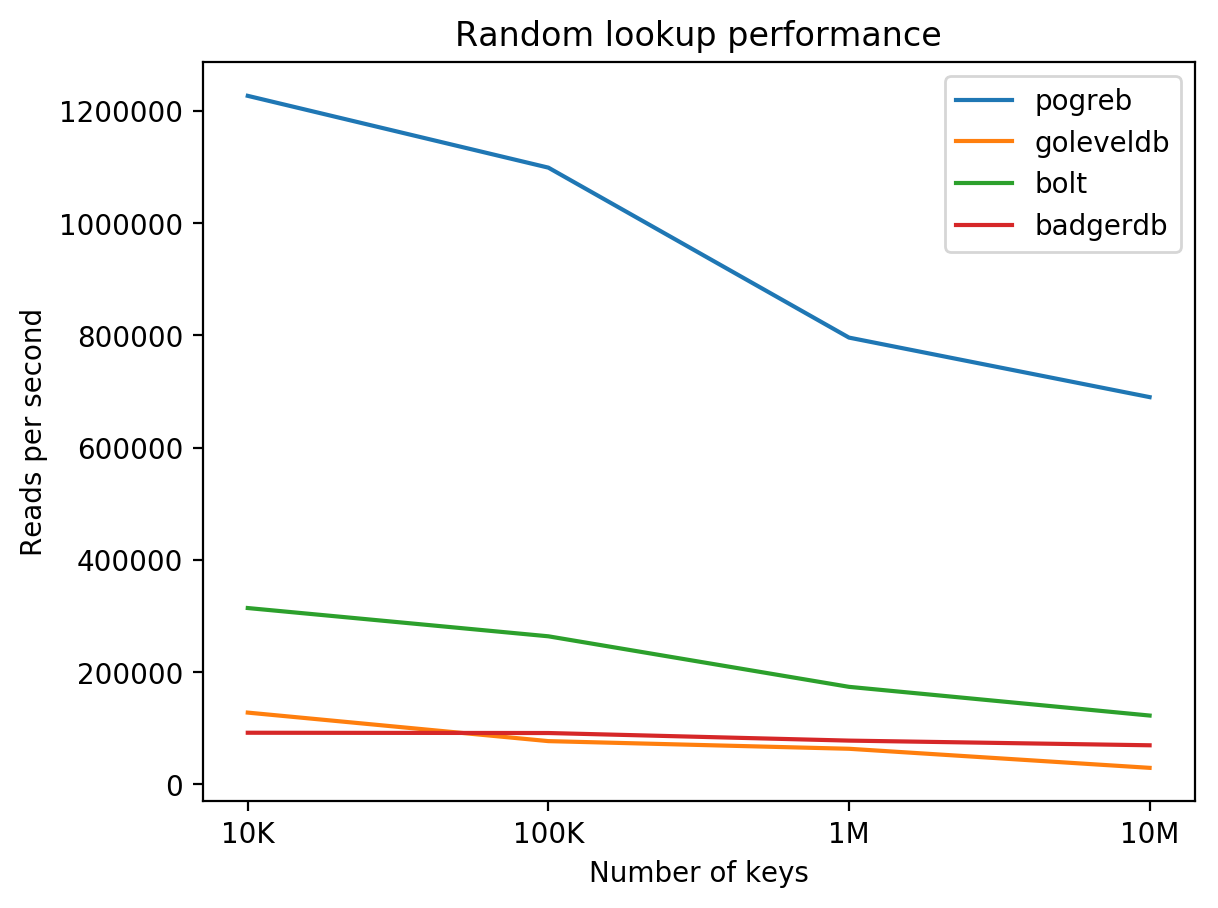
Results of read performance benchmark of pogreb, goleveldb, bolt and badgerdb on DigitalOcean 8 CPUs / 16 GB RAM / 160 GB SSD + Ubuntu 16.04.3 (higher is better):
Internals
 Documentation

Overview 
Package pogreb implements an embedded key-value store for read-heavy workloads.
Example 
package main

import (
	"log"

	"github.com/akrylysov/pogreb"
)

func main() {
	db, err := pogreb.Open("pogreb.test", nil)
	if err != nil {
		log.Fatal(err)
		return
	}
	defer db.Close()

	// Insert a new key-value pair.
	if err := db.Put([]byte("testKey"), []byte("testValue")); err != nil {
		log.Fatal(err)
	}

	// Retrieve the inserted value.
	val, err := db.Get([]byte("testKey"))
	if err != nil {
		log.Fatal(err)
	}
	log.Printf("%s", val)

	// Iterate over items.
	it := db.Items()
	for {
		key, val, err := it.Next()
		if err == pogreb.ErrIterationDone {
			break
		}
		if err != nil {
			log.Fatal(err)
		}
		log.Printf("%s %s", key, val)
	}
}
Output:
Index 
- Constants
- Variables
- func SetLogger(l *log.Logger)
- type CompactionResult
- type DB
- func (db *DB) Close() error
- func (db *DB) Compact() (CompactionResult, error)
- func (db *DB) Count() uint32
- func (db *DB) Delete(key []byte) error
- func (db *DB) FileSize() (int64, error)
- func (db *DB) Get(key []byte) ([]byte, error)
- func (db *DB) Has(key []byte) (bool, error)
- func (db *DB) Items() *ItemIterator
- func (db *DB) Metrics() *Metrics
- func (db *DB) Put(key []byte, value []byte) error
- func (db *DB) Sync() error
- type ItemIterator
- type Metrics
- type Options
Examples 
Constants 
const (
	// MaxKeyLength is the maximum size of a key in bytes.
	MaxKeyLength = math.MaxUint16

	// MaxValueLength is the maximum size of a value in bytes.
	MaxValueLength = 512 << 20 // 512 MiB

	// MaxKeys is the maximum numbers of keys in the DB.
	MaxKeys = math.MaxUint32
)
Variables 
var ErrIterationDone = errors.New("no more items in iterator")
ErrIterationDone is returned by ItemIterator.Next calls when there are no more items to return.
Functions 
Types 
type CompactionResult ¶ added in v0.9.0
CompactionResult holds the compaction result.
type DB 
type DB struct {
	// contains filtered or unexported fields
}
DB represents the key-value storage. All DB methods are safe for concurrent use by multiple goroutines.
func Open 
Open opens or creates a new DB. The DB must be closed after use, by calling Close method.
func (*DB) Compact ¶ added in v0.9.0
func (db *DB) Compact() (CompactionResult, error)
Compact compacts the DB. Deleted and overwritten items are discarded. Returns an error if compaction is already in progress.
func (*DB) Get 
Get returns the value for the given key stored in the DB or nil if the key doesn't exist.
type ItemIterator 
type ItemIterator struct {
	// contains filtered or unexported fields
}
ItemIterator is an iterator over DB key-value pairs. It iterates the items in an unspecified order.
type Options 
type Options struct {
	// BackgroundSyncInterval sets the amount of time between background Sync() calls.
	//
	// Setting the value to 0 disables the automatic background synchronization.
	// Setting the value to -1 makes the DB call Sync() after every write operation.
	BackgroundSyncInterval time.Duration

	// BackgroundCompactionInterval sets the amount of time between background Compact() calls.
	//
	// Setting the value to 0 disables the automatic background compaction.
	BackgroundCompactionInterval time.Duration

	// FileSystem sets the file system implementation.
	//
	// Default: fs.OSMMap.
	FileSystem fs.FileSystem
	// contains filtered or unexported fields
}
Options holds the optional DB parameters.
 Source Files
 Directories