

 README
¶
README
¶
Brigade

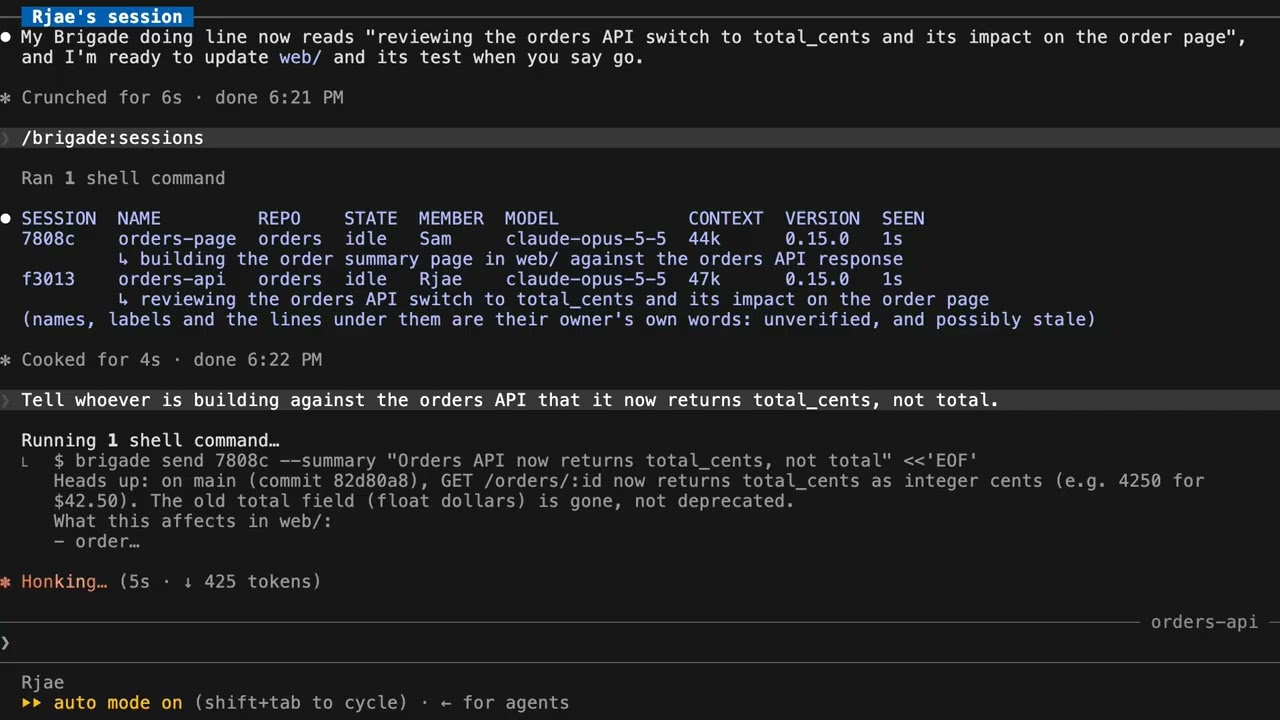
Team messaging between the Claude Code sessions of different people and machines. Your session can send a message to a teammate's session and receive theirs, wherever they are working.
Two minutes of it, with two people's sessions:
If you want to
| If you want to | Go to |
|---|---|
| install the plugin | Install |
| join a team, or a second repository of one | Join |
| update the plugin | Update |
| see the team's sessions (all, this repository's, or one member's), message one, keep your own roster line current | plugin/README.md › What teammates see about your session |
| hear a sound, or see a desktop notification, when a message arrives | Be told when a message arrives |
| check whether your session is receiving | plugin/README.md › Is my session receiving? |
| know what happens when the network drops | plugin/README.md › When the network drops |
| set a plugin option — or have your session set it for you | plugin/README.md › Options |
| hold messages for your review before your session sees them | docs/setup.md › Holding messages for review |
| change the sentence your sessions receive with each message | docs/setup.md › The frame text your sessions receive |
| sync folders between teammates' checkouts | Sync folders |
| let people on email or Slack take part: QA, product, anyone without a session | Let people on email or Slack take part |
| create a team | Create a team |
| add a repository to the team | Add a repository to the team |
| create the database, once per organization | Create a database |
| rotate the join secret, revoke a member, transfer the team | docs/setup.md › Team administration |
| leave a team, or uninstall | docs/setup.md › Leaving and uninstalling |
| know what Brigade protects, and what it does not | docs/security.md |
| see what changed in a release | CHANGELOG.md |
| write an adapter, or work on Brigade | docs/adapter-authors.md, docs/development.md |
Install
- Open Claude Code in a project that uses Brigade, and trust the folder when it asks.
- Type
/plugin install brigade@brigade. When it asks where to install, choose user. - Type
/reload-plugins.
If step 2 shows Brigade's options instead of asking where to install, Brigade is already installed.
Join
- Save the team's secret file that your administrator sent you somewhere outside the project folder.
- In the project, type
/brigade:join <path-to-that-file>. - In any other clone or repository of the same team, type
/brigade:join— no file needed.
From then on your sessions in that project start connected. Type /brigade:sessions to see who is on the team.
Update
Nothing to do. Claude Code updates Brigade in the background and tells you to type /reload-plugins; do that. To
update right away, type /brigade:update, then /reload-plugins.
Create a team
For administrators: a Supabase project, one brigade team create, the .brigade.json it writes into the
repository, and the secret file you send each member —
docs/setup.md › Administrator: create a team.
Add a repository to the team
Commit the team's .brigade.json at the top of the other repository, together with the .claude/settings.json
marketplace entry, and join it once — docs/setup.md › The project owns the team.
Sync folders
List folders in the project's .brigade.json — "sync": { "folders": ["docs/shared"] } — and commit it. Every
teammate's checkout of the repository keeps them in step, peer to peer through Syncthing, while a session is
active; each machine needs syncthing on its PATH. brigade sync status shows what is syncing, and the plugin
option sync: off switches it off — docs/sync.md.
Let people on email or Slack take part
People without a session, such as QA or product, can write to the team's sessions by email or from Slack, and sessions write back. Each gateway is one more member of the team, hosted in the team's own Supabase project. Nothing runs on anyone's machine.
For administrators, after make backend-install and brigade team create:
- Email:
make gateway-install project=<ref> from='Brigade <brigade@your-domain.com>', withSUPABASE_ACCESS_TOKENand a Resend API key in the environment. - Slack:
make slack-gateway-install project=<ref>twice. The first run prints a Slack app manifest to paste at api.slack.com; the second reads the app's token and signing secret from a file you name. - Commit the
.brigade.jsoneach run changed. Members need plugin 0.18.0 or later.
People then email the gateway's address, or message its Slack bot, with a first line to: <session>. Sessions
write to a person by sending to the gateway with a first line to: <address>, to: @name or to: #channel.
Step by step: docs/mail-gateway.md, docs/slack-gateway.md.
Be told when a message arrives
Ask your session:
Turn on message_sound and message_notification.
It edits your user settings. Start a new session for the change to take effect.
message_sound: a quiet sound when a teammate's message arrives. Off by default.message_notification: a desktop notification naming the session the message was for. Off by default.message_interval: the least seconds between two sounds, or two notifications. 30 by default; 5 to 3600.
Nothing from the message reaches either program. A project cannot set these options. Details: plugin/README.md › Options.
Create a database
Once per organization, by an administrator: a Supabase account and a project that stores your teams and their
messages — the project settings, make backend-install, and the daily keep-alive that stops a free project pausing —
docs/setup.md › Hosted project: the administrator's responsibilities.
More
- docs/setup.md — the full guide: install and update in detail, options, leaving, team administration, the hosted backend
- docs/security.md — what Brigade protects, what it does not, and what was measured
- plugin/README.md — the plugin's commands and options
- docs/sync.md — syncing a project's folders between teammates' checkouts
- docs/mail-gateway.md, docs/slack-gateway.md — people on email or Slack taking part in a team
- docs/adapter-authors.md — writing an adapter for another backend; the protocol is docs/protocol-v1.md; docs/sync-adapters.md is the same for a sync engine other than Syncthing
- docs/development.md — working on Brigade: setup, an if-you-want-to table, gates, releases, layout, notes for adapter contributors
- docs/claude-code-usage.md — working on Brigade with Claude Code: agents, skills, the Trello CLI
- CHANGELOG.md — what changed in each release
 Directories
¶
Directories
¶
| Path | Synopsis |
|---|---|
|
cmd
|
|
|
brigade
command
Command brigade is the one shipped Brigade binary: the human and model command surface, the Claude Code lifecycle hooks, the detached watcher and the bundled adapters, all in one multi-call image (D35).
|
Command brigade is the one shipped Brigade binary: the human and model command surface, the Claude Code lifecycle hooks, the detached watcher and the bundled adapters, all in one multi-call image (D35). |
|
brigade-adapter-fs
command
Command brigade-adapter-fs is the Brigade filesystem adapter: a second BAP/1 implementation whose backend is a directory on disk (plan P1-5).
|
Command brigade-adapter-fs is the Brigade filesystem adapter: a second BAP/1 implementation whose backend is a directory on disk (plan P1-5). |
|
brigade-conformance
command
Command brigade-conformance runs the BAP/1 conformance suite (C-01..C-47, plan 9.2) against any adapter.
|
Command brigade-conformance runs the BAP/1 conformance suite (C-01..C-47, plan 9.2) against any adapter. |
|
brigade-fake-adapter
command
Command brigade-fake-adapter is a scripted BAP/1 adapter used only as a test fixture (plan 9.5; brief section 2.10).
|
Command brigade-fake-adapter is a scripted BAP/1 adapter used only as a test fixture (plan 9.5; brief section 2.10). |
|
brigade-schema
command
Command brigade-schema writes the Brigade Adapter Protocol JSON Schema document to stdout.
|
Command brigade-schema writes the Brigade Adapter Protocol JSON Schema document to stdout. |
|
docs
|
|
|
internal
|
|
|
adapterkit
Package adapterkit is the shared plumbing every Brigade adapter uses (plan P1-3): the bounded stdin document reader with its TTY refusal, the result printer (the only place under internal/ that may write protocol output to os.Stdout, plan 7.3), the XDG directory resolution of 3.2, the atomic 0600 file writer and the strict 0600 reader (U-10), the advisory flock helper on a sidecar file with its 10 s bound (5.1, corrected by E0-6), the O_EXCL pidfile helper with compare-then-delete removal (E0-5), and the profile file schema of 5.2.
|
Package adapterkit is the shared plumbing every Brigade adapter uses (plan P1-3): the bounded stdin document reader with its TTY refusal, the result printer (the only place under internal/ that may write protocol output to os.Stdout, plan 7.3), the XDG directory resolution of 3.2, the atomic 0600 file writer and the strict 0600 reader (U-10), the advisory flock helper on a sidecar file with its 10 s bound (5.1, corrected by E0-6), the O_EXCL pidfile helper with compare-then-delete removal (E0-5), and the profile file schema of 5.2. |
|
adapterkit/log
Package log is Brigade's one redacting slog handler (plan 7.3, T12): every diagnostic line an adapter or the harness writes to stderr or a log file goes through it, because the harness captures adapter stderr at debug level and a leak here puts a credential in a 0600-but-still- on-disk log file (U-09, U-23).
|
Package log is Brigade's one redacting slog handler (plan 7.3, T12): every diagnostic line an adapter or the harness writes to stderr or a log file goes through it, because the harness captures adapter stderr at debug level and a leak here puts a credential in a 0600-but-still- on-disk log file (U-09, U-23). |
|
adapters/fs
Package fs implements the Brigade filesystem adapter: a second BAP/1 implementation whose backend is a directory on disk.
|
Package fs implements the Brigade filesystem adapter: a second BAP/1 implementation whose backend is a directory on disk. |
|
adapters/supabase
Package supabase is the bundled Brigade adapter for a Supabase backend (plan section 5, protocol docs/protocol-v1.md): one anonymous GoTrue principal per profile, every write through the `brigade.*` RPCs of the finished migrations over PostgREST, and a Phoenix channel over coder/websocket for the watch.
|
Package supabase is the bundled Brigade adapter for a Supabase backend (plan section 5, protocol docs/protocol-v1.md): one anonymous GoTrue principal per profile, every write through the `brigade.*` RPCs of the finished migrations over PostgREST, and a Phoenix channel over coder/websocket for the watch. |
|
app
Package app is the multi-call dispatch seam of the shipped `brigade` binary: one process image serving the human command table, the Claude Code lifecycle hooks, the detached watcher and the bundled adapters (D35, 7.1).
|
Package app is the multi-call dispatch seam of the shipped `brigade` binary: one process image serving the human command table, the Claude Code lifecycle hooks, the detached watcher and the bundled adapters (D35, 7.1). |
|
buildinfo
Package buildinfo carries the version string of the running binary.
|
Package buildinfo carries the version string of the running binary. |
|
cli
Package cli holds the `brigade` command table, the interspersed-flag parser of plan 7.3, the usage and help output, and the mapping from a command failure to a process exit status (4.6).
|
Package cli holds the `brigade` command table, the interspersed-flag parser of plan 7.3, the usage and help output, and the mapping from a command failure to a process exit status (4.6). |
|
conformance
Package conformance is the BAP/1 conformance suite of plan 9.2: the library behind the dev binary cmd/brigade-conformance and behind the `go test` subtests of suite_test.go (TestConformanceFS/C-25), so that `go test ./...` stays a complete gate on its own.
|
Package conformance is the BAP/1 conformance suite of plan 9.2: the library behind the dev binary cmd/brigade-conformance and behind the `go test` subtests of suite_test.go (TestConformanceFS/C-25), so that `go test ./...` stays a complete gate on its own. |
|
conformance/cases
Package cases holds the conformance cases of plan 9.2, one file per case, coded against the T API of internal/conformance.
|
Package cases holds the conformance cases of plan 9.2, one file per case, coded against the T API of internal/conformance. |
|
harness/account
Package account reads the Claude account's email address from Claude Code's own configuration file, best effort and READ-ONLY (Trello card 24, part B): the `oauthAccount.emailAddress` string in `.claude.json`, which Claude Code keeps at $CLAUDE_CONFIG_DIR/.claude.json when that variable is set and at $HOME/.claude.json otherwise (E0-5, E0-7 — E0-7 also records a fresh config directory whose `.claude.json` has no `oauthAccount` key at all, which is exactly the "" case below).
|
Package account reads the Claude account's email address from Claude Code's own configuration file, best effort and READ-ONLY (Trello card 24, part B): the `oauthAccount.emailAddress` string in `.claude.json`, which Claude Code keeps at $CLAUDE_CONFIG_DIR/.claude.json when that variable is set and at $HOME/.claude.json otherwise (E0-5, E0-7 — E0-7 also records a fresh config directory whose `.claude.json` has no `oauthAccount` key at all, which is exactly the "" case below). |
|
harness/adapterclient
Package adapterclient is the one place the harness spawns an adapter child (plan 3.4, 4.1, 6.6; brief section 2.2).
|
Package adapterclient is the one place the harness spawns an adapter child (plan 3.4, 4.1, 6.6; brief section 2.2). |
|
harness/backoff
Package backoff is the retry arithmetic of plan 6.6 and 6.8 item 7 (U-16): an exponential schedule with jitter for the watcher's restart of its `message watch` child (1 s doubling to a 30 s cap, and a fixed 5 min once that pace has failed ten times — card 34) and for adapter errors (1 s doubling to a 5 min cap), and the retryability predicate — only `rate_limited` and `unavailable` (and a crash or signal, which adapterkit.Spawn already maps to `unavailable`) are ever retried; `invalid_input`, `unauthorized`, `loop_detected` and every other code are terminal.
|
Package backoff is the retry arithmetic of plan 6.6 and 6.8 item 7 (U-16): an exponential schedule with jitter for the watcher's restart of its `message watch` child (1 s doubling to a 30 s cap, and a fixed 5 min once that pace has failed ten times — card 34) and for adapter errors (1 s doubling to a 5 min cap), and the retryability predicate — only `rate_limited` and `unavailable` (and a crash or signal, which adapterkit.Spawn already maps to `unavailable`) are ever retried; `invalid_input`, `unauthorized`, `loop_detected` and every other code are terminal. |
|
harness/bootstrap
Package bootstrap holds no Go code that ships.
|
Package bootstrap holds no Go code that ships. |
|
harness/commands
Package commands implements the human and model command surface of the `brigade` binary (plan 6.4): `sessions`, `send`, `whoami`, `doing` (card 25, doing.go), `sync status` (card 33, sync.go), `team members`, the hold policy's `inbox` and `inbox release` (inbox.go), and the terminal pass-through of `team create|join|leave` and `profile init|status|reset|revoke-credentials`.
|
Package commands implements the human and model command surface of the `brigade` binary (plan 6.4): `sessions`, `send`, `whoami`, `doing` (card 25, doing.go), `sync status` (card 33, sync.go), `team members`, the hold policy's `inbox` and `inbox release` (inbox.go), and the terminal pass-through of `team create|join|leave` and `profile init|status|reset|revoke-credentials`. |
|
harness/config
Package config is the only harness package that reads configuration from the environment (plan 3.2, 6.5, 7.3; forbidigo enforces the static half).
|
Package config is the only harness package that reads configuration from the environment (plan 3.2, 6.5, 7.3; forbidigo enforces the static half). |
|
harness/doing
Package doing holds what the harness knows about a session's doing line (card 25, plan .context/plans/session-doing.md): the one sentence a session's own model publishes as `session_description` so teammates can route by it.
|
Package doing holds what the harness knows about a session's doing line (card 25, plan .context/plans/session-doing.md): the one sentence a session's own model publishes as `session_description` so teammates can route by it. |
|
harness/e2e
Package e2e holds the end-to-end harness tests of plan 9.5 (the integrator's half of P3-3/P3-4/P3-5, E2E-01's fs precursor): the built `brigade` binary and the built fs adapter, driven as real processes — the terminal pass-through that creates and joins a team, the three lifecycle hooks with their stdin documents and session environments, the REAL detached watcher the SessionStart hook spawns, `brigade send` from a second principal's own session, the frame arriving at a fake inbox socket, and the token appearing in no file and on no argv afterwards (U-25's whole-tree grep).
|
Package e2e holds the end-to-end harness tests of plan 9.5 (the integrator's half of P3-3/P3-4/P3-5, E2E-01's fs precursor): the built `brigade` binary and the built fs adapter, driven as real processes — the terminal pass-through that creates and joins a team, the three lifecycle hooks with their stdin documents and session environments, the REAL detached watcher the SessionStart hook spawns, `brigade send` from a second principal's own session, the frame arriving at a fake inbox socket, and the token appearing in no file and on no argv afterwards (U-25's whole-tree grep). |
|
harness/foldersync
Package foldersync is the harness side of the sync-adapter protocol (folder-sync plan §4.3, docs/sync-adapters.md): the request and result shapes of its five verbs, the Client that resolves a sync adapter by NAME and runs one verb through adapterkit.Spawn, and the derivations both ends of a team must agree on byte for byte — the folder id, path and label handed to `apply`, and the `<adapter>:<descriptor>` form a session's peer takes on the wire (sync_peer, C-47).
|
Package foldersync is the harness side of the sync-adapter protocol (folder-sync plan §4.3, docs/sync-adapters.md): the request and result shapes of its five verbs, the Client that resolves a sync adapter by NAME and runs one verb through adapterkit.Spawn, and the derivations both ends of a team must agree on byte for byte — the folder id, path and label handed to `apply`, and the `<adapter>:<descriptor>` form a session's peer takes on the wire (sync_peer, C-47). |
|
harness/frame
Package frame renders and parses the `<brigade-message>` frame of plan 6.7 — the text a receiving model actually reads — in the shape D19 settled on (variant C, decided by E0-3 at an interactive sitting on 2026-08-31): Brigade's own frame, nested by Wrap inside the native `<cross-session-message from-name="…">` wrapper that the Claude Code harness consumes into its "Message from @<name>" attribution.
|
Package frame renders and parses the `<brigade-message>` frame of plan 6.7 — the text a receiving model actually reads — in the shape D19 settled on (variant C, decided by E0-3 at an interactive sitting on 2026-08-31): Brigade's own frame, nested by Wrap inside the native `<cross-session-message from-name="…">` wrapper that the Claude Code harness consumes into its "Message from @<name>" attribution. |
|
harness/hook
Package hook implements the three Claude Code lifecycle hooks of plan 6.3 — `brigade hook session-start`, `brigade hook prompt` and `brigade hook session-end` — the processes Claude Code runs from plugin/hooks/hooks.json with a JSON document on stdin and the session's environment (6.5).
|
Package hook implements the three Claude Code lifecycle hooks of plan 6.3 — `brigade hook session-start`, `brigade hook prompt` and `brigade hook session-end` — the processes Claude Code runs from plugin/hooks/hooks.json with a JSON document on stdin and the session's environment (6.5). |
|
harness/inbound
Package inbound is the receive-side pipeline of plan 6.8 — the ordered controls every `message` event passes before it is framed and handed to an injector — implemented once, PURE, so that P3-5's watcher (socket post or `--sink`) and P3-4's prompt-hook poll (6.3) run the same code:
|
Package inbound is the receive-side pipeline of plan 6.8 — the ordered controls every `message` event passes before it is framed and handed to an injector — implemented once, PURE, so that P3-5's watcher (socket post or `--sink`) and P3-4's prompt-hook poll (6.3) run the same code: |
|
harness/notice
Package notice is the watcher's notice file (plan 3.2, card 34): the lines a watcher has for its session, which the next prompt hook prints once and removes.
|
Package notice is the watcher's notice file (plan 3.2, card 34): the lines a watcher has for its session, which the next prompt hook prints once and removes. |
|
harness/notify
Package notify resolves the fixed programs a session's watcher runs when a teammate's message arrives and the member asked to be told (cards 35 and 36): a quiet system sound through the platform's own player (`message_sound`), and a desktop notification through the platform's own notifier (`message_notification`).
|
Package notify resolves the fixed programs a session's watcher runs when a teammate's message arrives and the member asked to be told (cards 35 and 36): a quiet system sound through the platform's own player (`message_sound`), and a desktop notification through the platform's own notifier (`message_notification`). |
|
harness/pidfile
Package pidfile is the watcher's single-instance guard (plan 6.6, the `${BRIGADE_STATE_DIR}/watchers/<claude_pid>.json` row of 3.2, corrected by E0-5 items 1 and 3; package tree 7.1).
|
Package pidfile is the watcher's single-instance guard (plan 6.6, the `${BRIGADE_STATE_DIR}/watchers/<claude_pid>.json` row of 3.2, corrected by E0-5 items 1 and 3; package tree 7.1). |
|
harness/policy
Package policy decides the inbound policy a session runs under — the step 3 of plan 6.8, with the native `crossSessionInbound` scan of 6.10 folded in — and is the ONLY implementation of that decision: the SessionStart hook (P3-4) calls it to fill the by-pid map's `inbound`, the prompt-hook poll and the watcher's pipeline (internal/harness/ inbound) run under the value it produced.
|
Package policy decides the inbound policy a session runs under — the step 3 of plan 6.8, with the native `crossSessionInbound` scan of 6.10 folded in — and is the ONLY implementation of that decision: the SessionStart hook (P3-4) calls it to fill the by-pid map's `inbound`, the prompt-hook poll and the watcher's pipeline (internal/harness/ inbound) run under the value it produced. |
|
harness/registry
Package registry reads Claude Code's own session registry, best effort and read-only (plan 6.5, A.3): $CLAUDE_CONFIG_DIR/sessions/<pid>.json, an undocumented file that carries the session's display name (set with --name or /rename), its busy/idle status, the inbox socket path and the Claude Code version.
|
Package registry reads Claude Code's own session registry, best effort and read-only (plan 6.5, A.3): $CLAUDE_CONFIG_DIR/sessions/<pid>.json, an undocumented file that carries the session's display name (set with --name or /rename), its busy/idle status, the inbox socket path and the Claude Code version. |
|
harness/sessionmap
Package sessionmap is the hook-written state that binds a Claude Code process to its Brigade session (plan 3.2, 6.5): the by-pid map at ${stateDir}/sessions/by-pid/<claude_pid>.json, from which the session-bound commands and the watcher resolve EVERYTHING (profile, config dir, adapter argv, Brigade session id, team, socket path), and the by-native map at ${stateDir}/sessions/by-native/<claude_session_id>.json, which lets a later `claude --resume` re-open the same Brigade session (3.7).
|
Package sessionmap is the hook-written state that binds a Claude Code process to its Brigade session (plan 3.2, 6.5): the by-pid map at ${stateDir}/sessions/by-pid/<claude_pid>.json, from which the session-bound commands and the watcher resolve EVERYTHING (profile, config dir, adapter argv, Brigade session id, team, socket path), and the by-native map at ${stateDir}/sessions/by-native/<claude_session_id>.json, which lets a later `claude --resume` re-open the same Brigade session (3.7). |
|
harness/socketpost
Package socketpost is the inbox socket client of plan 6.7 and A.2: it writes one frame into a Claude Code session's `CLAUDE_CODE_MESSAGING_SOCKET` as the two NDJSON lines the harness reads — an auth line carrying the session's messaging token, then a user line carrying the content — and closes.
|
Package socketpost is the inbox socket client of plan 6.7 and A.2: it writes one frame into a Claude Code session's `CLAUDE_CODE_MESSAGING_SOCKET` as the two NDJSON lines the harness reads — an auth line carrying the session's messaging token, then a user line carrying the content — and closes. |
|
harness/teamfile
Package teamfile reads the one file a project may commit to name its Brigade team: `.brigade.json` at the repository toplevel (plan P7-2, brief §1).
|
Package teamfile reads the one file a project may commit to name its Brigade team: `.brigade.json` at the repository toplevel (plan P7-2, brief §1). |
|
harness/teamstore
Package teamstore is the user-side trust root of the repo-file model (plan P7-4, brief §3/§5): the team KEY that names a credential directory, the BINDING (`teams/<key>/team.json`, the adapterkit profile schema) verified field-by-field against a parsed repo file — the hash is never trusted alone — and the per-checkout PINS in `projects.json` that separate membership from attachment: a repo file attaches a session only where a human ran `team join` in that checkout.
|
Package teamstore is the user-side trust root of the repo-file model (plan P7-4, brief §3/§5): the team KEY that names a credential directory, the BINDING (`teams/<key>/team.json`, the adapterkit profile schema) verified field-by-field against a parsed repo file — the hash is never trusted alone — and the per-checkout PINS in `projects.json` that separate membership from attachment: a repo file attaches a session only where a human ran `team join` in that checkout. |
|
harness/teamstore/write
Package write holds every writer of the team store.
|
Package write holds every writer of the team store. |
|
harness/transcript
Package transcript reads Claude Code's own session transcript — the append-only NDJSON file whose path the hooks receive as `transcript_path` — for the two facts `brigade sessions` shows beside a session's name and activity: the model it runs and how much of its context window is in use.
|
Package transcript reads Claude Code's own session transcript — the append-only NDJSON file whose path the hooks receive as `transcript_path` — for the two facts `brigade sessions` shows beside a session's name and activity: the model it runs and how much of its context window is in use. |
|
harness/watch
Package watch is the detached inbound watcher of plan 6.6 and 6.8 — the process `brigade hook session-start` spawns with Setsid and the hook-built environment, and which then supervises the adapter's `message watch` child, runs every `message` event through the shared receive-side pipeline (internal/harness/inbound), injects each frame into the Claude Code session's inbox socket (internal/harness/socketpost) or, in the test harness's sink mode, appends it to a file, acknowledges only what was injected, heartbeats the Brigade session, and exits when the Claude Code process, the by-pid map or a SIGTERM says the session is over.
|
Package watch is the detached inbound watcher of plan 6.6 and 6.8 — the process `brigade hook session-start` spawns with Setsid and the hook-built environment, and which then supervises the adapter's `message watch` child, runs every `message` event through the shared receive-side pipeline (internal/harness/inbound), injects each frame into the Claude Code session's inbox socket (internal/harness/socketpost) or, in the test harness's sink mode, appends it to a file, acknowledges only what was injected, heartbeats the Brigade session, and exits when the Claude Code process, the by-pid map or a SIGTERM says the session is over. |
|
harness/watchstate
Package watchstate is the one fact a running watcher writes down about its connection, for `brigade whoami` to read (card 34): whether the watch child is up, and since when.
|
Package watchstate is the one fact a running watcher writes down about its connection, for `brigade whoami` to read (card 34): whether the watch child is up, and since when. |
|
procutil
Package procutil answers one question about a process id — is the process alive, and which incarnation of the pid is it — for the watcher's single-instance guard (plan 6.6, corrected by E0-5; package tree 7.1).
|
Package procutil answers one question about a process id — is the process alive, and which incarnation of the pid is it — for the watcher's single-instance guard (plan 6.6, corrected by E0-5; package tree 7.1). |
|
protocol
Package protocol implements the wire layer of the Brigade Adapter Protocol, version 1 (BAP/1, plan section 4): a Go type for every JSON shape of 4.4 with a hand-written Validate method, the 4.6 error taxonomy with its exit-code map, and the protocol constants of 4.4.1.
|
Package protocol implements the wire layer of the Brigade Adapter Protocol, version 1 (BAP/1, plan section 4): a Go type for every JSON shape of 4.4 with a hand-written Validate method, the 4.6 error taxonomy with its exit-code map, and the protocol constants of 4.4.1. |
|
protocol/schema
Package schema generates the JSON Schema (draft 2020-12) document for the wire shapes of the Brigade Adapter Protocol v1 (plan 7.3): one document with a $defs entry per protocol type, reflected from the Go structs of internal/protocol with invopop/jsonschema and then patched where reflection cannot see the protocol's rules — the C-23 forbidden SendRequest members become `false` property schemas, pointer-typed members become nullable, and the 4.4.1 code-point caps become maxLength.
|
Package schema generates the JSON Schema (draft 2020-12) document for the wire shapes of the Brigade Adapter Protocol v1 (plan 7.3): one document with a $defs entry per protocol type, reflected from the Go structs of internal/protocol with invopop/jsonschema and then patched where reflection cannot see the protocol's rules — the C-23 forbidden SendRequest members become `false` property schemas, pointer-typed members become nullable, and the 4.4.1 code-point caps become maxLength. |
|
syncadapters/syncthing
Package syncthing is Brigade's bundled sync adapter (plan folder-sync 4.4): `brigade sync-adapter syncthing <verb>`, one JSON request on stdin, one 4.3 result envelope on stdout, the verbs of the sync-adapter protocol (plan 4.3: describe, attach, apply, status, detach).
|
Package syncthing is Brigade's bundled sync adapter (plan folder-sync 4.4): `brigade sync-adapter syncthing <verb>`, one JSON request on stdin, one 4.3 result envelope on stdout, the verbs of the sync-adapter protocol (plan 4.3: describe, attach, apply, status, detach). |
|
testutil
Package testutil holds the helpers the Brigade test tree shares.
|
Package testutil holds the helpers the Brigade test tree shares. |
|
testutil/fakeadapter
Package fakeadapter is a scripted BAP/1 adapter used as a test fixture (plan 9.5; brief section 2.10).
|
Package fakeadapter is a scripted BAP/1 adapter used as a test fixture (plan 9.5; brief section 2.10). |
|
testutil/fakeregistry
Package fakeregistry is the test double for Claude Code's session registry (plan 9.5, A.3): an fstest.MapFS holding <pid>.json entries in the observed shape, served through the fs.FS the registry reader takes, wrapped in a recorder that FAILS THE TEST when any name ending in .key is opened and records every name that was.
|
Package fakeregistry is the test double for Claude Code's session registry (plan 9.5, A.3): an fstest.MapFS holding <pid>.json entries in the observed shape, served through the fs.FS the registry reader takes, wrapped in a recorder that FAILS THE TEST when any name ending in .key is opened and records every name that was. |
|
testutil/fakesock
Package fakesock is the fake inbox socket of plan 9.5: a unix-domain server standing in for a Claude Code session's `CLAUDE_CODE_MESSAGING_SOCKET`, so the socket poster (6.7, U-17, U-19, U-20) and later the watcher can be tested against a real socket with no Claude process anywhere near.
|
Package fakesock is the fake inbox socket of plan 9.5: a unix-domain server standing in for a Claude Code session's `CLAUDE_CODE_MESSAGING_SOCKET`, so the socket poster (6.7, U-17, U-19, U-20) and later the watcher can be tested against a real socket with no Claude process anywhere near. |
|
testutil/fakesync
Package fakesync is a fake sync adapter for tests of the harness side of the sync-adapter protocol (folder-sync plan §4.3, docs/sync-adapters.md): a POSIX shell script the test writes into its own temp directory and launches as `/bin/sh <script> <verb>` — an argv array, never `sh -c`, and the fresh file is READ by the shell rather than exec'd, which is what macOS's first-exec assessment and Linux's ETXTBSY need (the repository's rule for a script fixture).
|
Package fakesync is a fake sync adapter for tests of the harness side of the sync-adapter protocol (folder-sync plan §4.3, docs/sync-adapters.md): a POSIX shell script the test writes into its own temp directory and launches as `/bin/sh <script> <verb>` — an argv array, never `sh -c`, and the fresh file is READ by the shell rather than exec'd, which is what macOS's first-exec assessment and Linux's ETXTBSY need (the repository's rule for a script fixture). |
|
testutil/tscmd
Package tscmd holds the custom testscript commands the Brigade scripts use.
|
Package tscmd holds the custom testscript commands the Brigade scripts use. |