

 README

README

DynLimits
A proxy server to enforce per user/api key and endpoint rate limits.
DynLimits allows to define different rate limits for each http verb and endpoint that is defined.
Overview

DynLimits works by loading into memory a catalog of available endpoints (verb + path) to use, and loading into redis a catalog of per endpoint and api key rate limit to apply.
The catalogs can be provided at startup time, but can also be updated by polling a Catalog Server.
Another option to request a catalog update is sending an a request with an special header that forces to fetch updates from the catalog server.
The proxy is designed to have several instances running concurrently, with the shared limits stored in a Redis instance.
You can have a look at a draft example in the
examples/restatsrv folder, where you can find a
README.md with instructions
to run the tests, or you can watch:
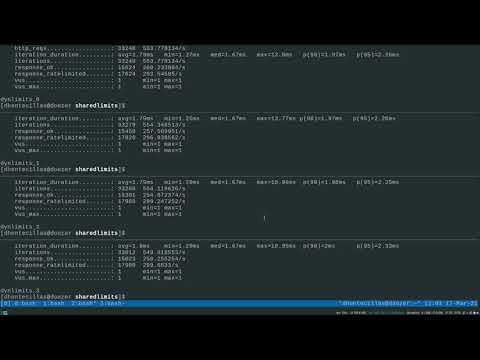
Configuration
Configuration is done through a JSON file (that maps to the
APIIndexedLimits structure)
with the following sections:
version
The version fields can be found in
APICatalogVersion structure, and contains
three fields:
semver: A semantic versionhash: the actual string used in internal code for comparisonreleased: the RFC3339 timestamp for when this version was created
methods
A list of all the http verbs that will / can be used be the list of endpoints
paths
A list of all the paths that we want to limit, with variable parts of the
paths enclosed in brackets (like /foo/{var}/bar)
endpoints
The endpoints are a list of (http verb, path) pairs, that in order to
avoid repeating data are indices to the previous paths (p field)
and methods (m field) lists.
apilimits
This field has a list of structures that holds an API key with its limits.
Limits are a list of endpoint indices (ep) with its ratelimit value (rl).
Example configuration file
{
    "version": {
        "semver": "v1.0.1",
        "hash": "a831829b8c92dfb92834",
        "released": "2020-04-12T23:20:50.52Z",
    },
    "methods": ["GET", "POST", "DELETE", "PUT", "PATCH", "HEAD", "OPTIONS"],
    "paths": [
        "\/api\/filipid\/recipients\/{recipient_id}\/preferences",
        "\/api\/filipid\/recipients"
    ],
    "endpoints": [
        {"p": 0, "m": 0},
        {"p": 1, "m": 0}
    ],
    "apilimits": [
        {
            "key": "7H6AMB0FXQKQBG3JKPW1PXTTNW",
            "limits": [
                { "ep": 0, "rl": 20 },
                { "ep": 1, "rl": 5 }
            ]
        }
    ]
}
Middleware
Rate limit algorithm: Sliding Window Counters
The algorithm is easy to implement (you can find an article about rate limiting at Figma, and the approach here is pretty similar at what is described in its "Sliding windows counters" section with some changes).
It is also based in the very efficient hash map structure. But instead of having a single hash map for each Limits Key (in the article 'user') in DynLimits the Limits Key and minute are concatenated to create the redis key, and a 3 minutes expiration time (to allow for servers drifting a few seconds to still use the window).

When DynLimits wants to check the rate limits it only has to fetch the hash map for the current minute and the previous one to reconstruct the current counters window.
Alternatives
-
Token Bucket: To implement with redis, we need some lua logic in the redis server: we need a single service that takes care of adding tokens to the keys, and we need to increment "with saturation" (with a max upper limit to "top" the token bucket), something that is by now not supported by
INCR/INCRBY.
The Path Matcher
The DynLimits have a single shared path matcher structure, that is local to the instance.
At server startup it is loaded with the initial configuration. However, it also can launch an "updates poller", that can check redis and an a "control" server for updates.
The Updated Poller
There are three GET endpoints that a control server must support:
/latest: to fetch the full catalog (TODO)./catalog_diff: to get the differences from a previous catalog version (so it just gives a list of things to delete, and a list of things to add) (TODO)./indexed_limits: that, given that the endpoints catalog has not changed, can update limits for a set of api keys.
currently, only the last endpoint is used, to obtain an APIIndexedLimits
catalog, that is then passed to the UpdateSharedMatcher function
(in ./pkg/catalog/matcher.go file), and
then to RedisUpdate (in [
How to adapt it to different use cases
Not using an API but a userID
There can be the case that a given user/account can have severl API keys. If we do not want to have a rate limit quota per api key but per user quota, we need to create a middleware that converts any api key / cookie / auth method, to a user / account unique ID , and puts that into the request header.
Requests per hour, instead of requests per minute
We can just use the timestampSecs modulo 60, and use that for the sliding counters window. But that would mean that all use the same "window".
The Local API Key Catalog
TODO: this is a planned feature, that is not being used right now
This serves as an optimization to avoid having to fetch the sliding window from redis, when we know that a key will need to wait several seconds before is able to perform a new requests to that endpoint.
 Directories