

 README

README

go-task-management
Go api for trello tasks, clean architecture implementation See swagger and postman collection in root directory for the requests
A makefile has been provided
Create task, issues and bug in the to do list of a board
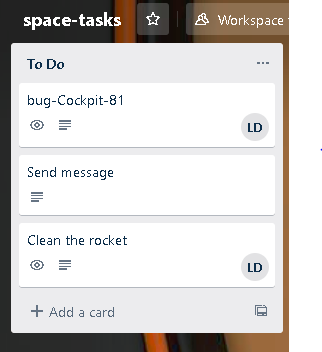
Content
Quick start
To run it's needed to enter the trello config in config.yml or to set those environment variables (ideally you would set the secrets somewhere else like kubernetes secrets or vault)
  trello_developer_public_key:
  trello_member_token:
  trello_username:
  trello_board: 'space-tasks'
Local development:
$ make run
API
Create task
curl --location --request POST 'localhost:8082/v1/management/task' \
--header 'Content-Type: application/json' \
--data-raw '{
    "type": "task",
    "title": "Clean the rocket",
    "category": "Maintenance"
}'
Create issue
curl --location --request POST 'localhost:8082/v1/management/task' \
--header 'Content-Type: application/json' \
--data-raw '{
    "type": "issue",
    "title": "Send message",
    "description": "Let pilots send messages to central"
}'
Create bug
curl --location --request POST 'localhost:8082/v1/management/task' \
--header 'Content-Type: application/json' \
--data-raw '{
    "type": "bug",
    "description": "Cockpit is not depressurising correctly"
}'
Project structure
cmd/app/main.go
Configuration and logger initialization. Then the main function "continues" in
internal/app/app.go.
config
Configuration. First, config.yml is read, then environment variables overwrite the yaml config if they match.
The config structure is in the config.go.
The env-required: true tag obliges you to specify a value (either in yaml, or in environment variables).
docs
Swagger documentation. Auto-generated by swag library.
integration-test
Integration tests. They are launched as a separate container, next to the application container.
internal/app
This is where all the main objects are created. Dependency injection occurs through the "New ..." constructors (see Dependency Injection). This technique allows us to layer the application using the Dependency Injection principle. This makes the business logic independent from other layers.
Next, we start the server and wait for signals in select for graceful completion.
If app.go starts to grow, you can split it into multiple files.
For a large number of injections, wire can be used.
internal/controller
Server handler layer (MVC controllers). The template shows a server:
- REST http (Gin framework)
Server routers are written in the same style:
- Handlers are grouped by area of application (by a common basis)
- For each group, its own router structure is created, the methods of which process paths
- The structure of the business logic is injected into the router structure, which will be called by the handlers
internal/controller/http
For v2, we will need to add the http/v2 folder with the same content.
And in the file internal/app add the line:
handler := gin.New()
v1.NewRouter(handler, t)
In v1/router.go and above the handler methods, there are comments for generating swagger documentation using swag.
internal/entity
Entities of business logic (models) can be used in any layer. There can also be methods, for example, for validation.
internal/usecase
Business logic.
- Methods are grouped by area of application (on a common basis)
- Each group has its own structure
- One file - one structure
Repositories and other business logic structures are injected into business logic structures (see Dependency Injection).
internal/usecase/repo
A repository is an abstract storage that business logic works with.
Dependency Injection
In order to remove the dependence of business logic on external packages, dependency injection is used.
For example, through the New constructor, we inject the dependency into the structure of the business logic.
This makes the business logic independent (and portable).
We can override the implementation of the interface without making changes to the usecase package.
package usecase

import (
    // Nothing!
)

type Repository interface {
    Get()
}

type UseCase struct {
    repo Repository
}

func New(r Repository) *UseCase{
    return &UseCase{
        repo: r,
    }
}

func (uc *UseCase) Do()  {
    uc.repo.Get()
}
It will also allow us to do auto-generation of mocks and easily write unit tests. https://github.com/golang/mock
 Directories

Directories

| Path | Synopsis |
|---|---|
|
cmd
|
|
|
app
command
|
|
|
internal
|
|
|
app
Package app configures and runs application.
|
Package app configures and runs application. |
|
controller/http/v1
Package v1 implements routing paths.
|
Package v1 implements routing paths. |
|
pkg
|
|
|
httpserver
Package httpserver implements HTTP server.
|
Package httpserver implements HTTP server. |