

 README

README

Docs
faker
Struct Data Fake Generator
Faker will generate you a fake data based on your Struct.




Index
Support
You can file an Issue. See documentation in Godoc
Getting Started
Download
go get -u github.com/bxcodec/faker
Example
With Tag
Supported tag:
Internet :
- Mac address
- Domain name
- URL
- UserName
- IP Address (IPv4, IPv6 )
- Password
Payment :
- Credit Card Type (VISA, MASTERCARD, AMERICAN EXPRESS, DISCOVER)
- Credit Card Number
Address :
- Latitude and Longitude
Phone :
- Phone number
- Toll free phone number
- E164PhoneNumber
Person :
- Title male
- Title female
- FirstName
- FirstName male
- FirstName female
- LastName
- Name
DateTime :
- UnixTime
- Date
- Time
- MonthName
- Year
- DayOfWeek
- DayOfMonth
- Timestamp
- Century
- TimeZone
- TimePeriod
Lorem :
- Word
- Sentence
- Paragraph
Price :
- Currency
- Amount
- Amount with Currency
UUID :
- UUID Digit (32 bytes)
- UUID Hyphenated (36 bytes)
Skip :
- -
package main

import (
	"fmt"

	"github.com/bxcodec/faker"
)

// SomeStruct ...
type SomeStruct struct {
	Latitude           float32 `faker:"lat"`
	Longitude          float32 `faker:"long"`
	CreditCardNumber   string  `faker:"cc_number"`
	CreditCardType     string  `faker:"cc_type"`
	Email              string  `faker:"email"`
	IPV4               string  `faker:"ipv4"`
	IPV6               string  `faker:"ipv6"`
	Password           string  `faker:"password"`
	PhoneNumber        string  `faker:"phone_number"`
	MacAddress         string  `faker:"mac_address"`
	URL                string  `faker:"url"`
	UserName           string  `faker:"username"`
	ToolFreeNumber     string  `faker:"tool_free_number"`
	E164PhoneNumber    string  `faker:"e_164_phone_number"`
	TitleMale          string  `faker:"title_male"`
	TitleFemale        string  `faker:"title_female"`
	FirstName          string  `faker:"first_name"`
	FirstNameMale      string  `faker:"first_name_male"`
	FirstNameFemale    string  `faker:"first_name_female"`
	LastName           string  `faker:"last_name"`
	Name               string  `faker:"name"`
	UnixTime           int64   `faker:"unix_time"`
	Date               string  `faker:"date"`
	Time               string  `faker:"time"`
	MonthName          string  `faker:"month_name"`
	Year               string  `faker:"year"`
	DayOfWeek          string  `faker:"day_of_week"`
	DayOfMonth         string  `faker:"day_of_month"`
	Timestamp          string  `faker:"timestamp"`
	Century            string  `faker:"century"`
	TimeZone           string  `faker:"timezone"`
	TimePeriod         string  `faker:"time_period"`
	Word               string  `faker:"word"`
	Sentence           string  `faker:"sentence"`
	Paragraph          string  `faker:"paragraph"`
	Currency           string  `faker:"currency"`
	Amount             float64 `faker:"amount"`
	AmountWithCurrency string  `faker:"amount_with_currency"`
	UUIDHypenated	   string  `faker:"uuid_hyphenated"`
	UUID	           string  `faker:"uuid_digit"`
	Skip		   string  `faker:"-"`
}

func main() {

	a := SomeStruct{}
	err := faker.FakeData(&a)
	if err != nil {
		fmt.Println(err)
	}
	fmt.Printf("%+v", a)
	/*
		Output  :
		{
			Latitude: 81.12195
			Longitude: -84.38158
			CreditCardType: American Express
			CreditCardNumber: 373641309057568
			Email: mJBJtbv@OSAaT.ru
			IPV4: 99.23.42.63
			IPV6: 975c:fb2c:2133:fbdd:beda:282e:1e0a:ec7d
			Password: dfJdyHGuVkHBgnHLQQgpINApynzexnRpgIKBpiIjpTPOmNyMFb
			PhoneNumber: 792-153-4861
			MacAddress: cd:65:e1:d4:76:c6
			URL: https://www.oEuqqAY.org/QgqfOhd
			UserName: lVxELHS
			ToolFreeNumber: (777) 831-964572
			E164PhoneNumber: +724891571063
			TitleMale: Mr.
			TitleFemale: Queen
			FirstName: Whitney
			FirstNameMale: Kenny
			FirstNameFemale: Jana
			LastName: Rohan
			Name: Miss Casandra Kiehn
			UnixTime: 1197930901
			Date: 1982-02-27
			Time: 03:10:25
			MonthName: February
			Year: 1996
			DayOfWeek: Sunday
			DayOfMonth: 20
			Timestamp: 1973-06-21 14:50:46
			Century: IV
			TimeZone: Canada/Eastern
			TimePeriod: AM
			Word: nesciunt
			Sentence: Consequatur perferendis aut sit voluptatem accusantium.
			Paragraph: Aut consequatur sit perferendis accusantium voluptatem. Accusantium perferendis consequatur voluptatem sit aut. Aut sit accusantium consequatur voluptatem perferendis. Perferendis voluptatem aut accusantium consequatur sit.
			Currency: IRR,
			Amount: 88.990000,
			AmountWithCurrency: XBB 49257.100000,
			UUIDHypenated: 8f8e4463-9560-4a38-9b0c-ef24481e4e27,
			UUID: 90ea6479fd0e4940af741f0a87596b73,
			Skip:
		}
	*/
}
Custom Generator Provider
You can also add your own generator function to your own defined tags. See example below
type Gondoruwo struct {
	Name       string
	Locatadata int
}

type Sample struct {
	ID                 int64     `faker:"customIdFaker"`
	Gondoruwo          Gondoruwo `faker:"gondoruwo"`
	Danger             string    `faker:"danger"`
}

func CustomGenerator() {
	faker.AddProvider("customIdFaker", func(v reflect.Value) (interface{}, error) {
		 return int64(43), nil
	})
	faker.AddProvider("danger", func(v reflect.Value) (interface{}, error) {
		return "danger-ranger", nil
	})

	faker.AddProvider("gondoruwo", func(v reflect.Value) (interface{}, error) {
		obj := Gondoruwo{
			Name:       "Power",
			Locatadata: 324,
		}
		return obj, nil
	})
}

func main() {
	CustomGenerator()
	var sample Sample
	faker.FakeData(&sample)
	fmt.Printf("%+v", sample)
}
Results:
{ID:43 Gondoruwo:{Name:Power Locatadata:324} Danger:danger-ranger}
Without Tag
You also can use faker to generate your structs data randomly without any tag. And it will fill the data based on its data-type.
package main

import (
	"fmt"

	"github.com/bxcodec/faker"
)

type SomeStruct struct {
	Int      int
	Int8     int8
	Int16    int16
	Int32    int32
	Int64    int64
	String   string
	Bool     bool
	SString  []string
	SInt     []int
	SInt8    []int8
	SInt16   []int16
	SInt32   []int32
	SInt64   []int64
	SFloat32 []float32
	SFloat64 []float64
	SBool    []bool
	Struct   AStruct
}
type AStruct struct {
	Number        int64
	Height        int64
	AnotherStruct BStruct
}

type BStruct struct {
	Image string
}

func main() {

	a := SomeStruct{}
	err := faker.FakeData(&a)
	if err != nil {
		fmt.Println(err)
	}
	fmt.Printf("%+v", a)
	/*
		Output:
		{
		    Int:5231564546548329
		    Int8:52
		    Int16:8
		    Int32:2046951236
		    Int64:1486554863682234423
		    String:ELIQhSfhHmWxyzRPOTNblEQsp
		    Bool:false
		    SString:[bzYwplRGUAXPwatnpVMWSYjep zmeuJVGHHgmIsuyWmLJnDmbTI FqtejCwoDyMBWatoykIzorCJZ]
		    SInt:[11661230973193 626062851427 12674621422454 5566279673347]
		    SInt8:[12 2 58 22 11 66 5 88]
		    SInt16:[29295225 8411281 69902706328]
		    SInt32:[60525685140 2733640366211 278043484637 5167734561481]
		    SInt64:[81684520429188374184 9917955420365482658170 996818723778286568 163646873275501565]
		    SFloat32:[0.556428 0.7692596 0.6779895 0.29171365 0.95445055]
		    SFloat64:[0.44829454895586585 0.5495675898536803 0.6584538253883265]
		    SBool:[true false true false true true false]
		    Struct:{
		        Number:1
		        Height:26
		        AnotherStruct:{
		            Image:RmmaaHkAkrWHldVbBNuQSKlRb
		        }
		    }
		}
	*/
}
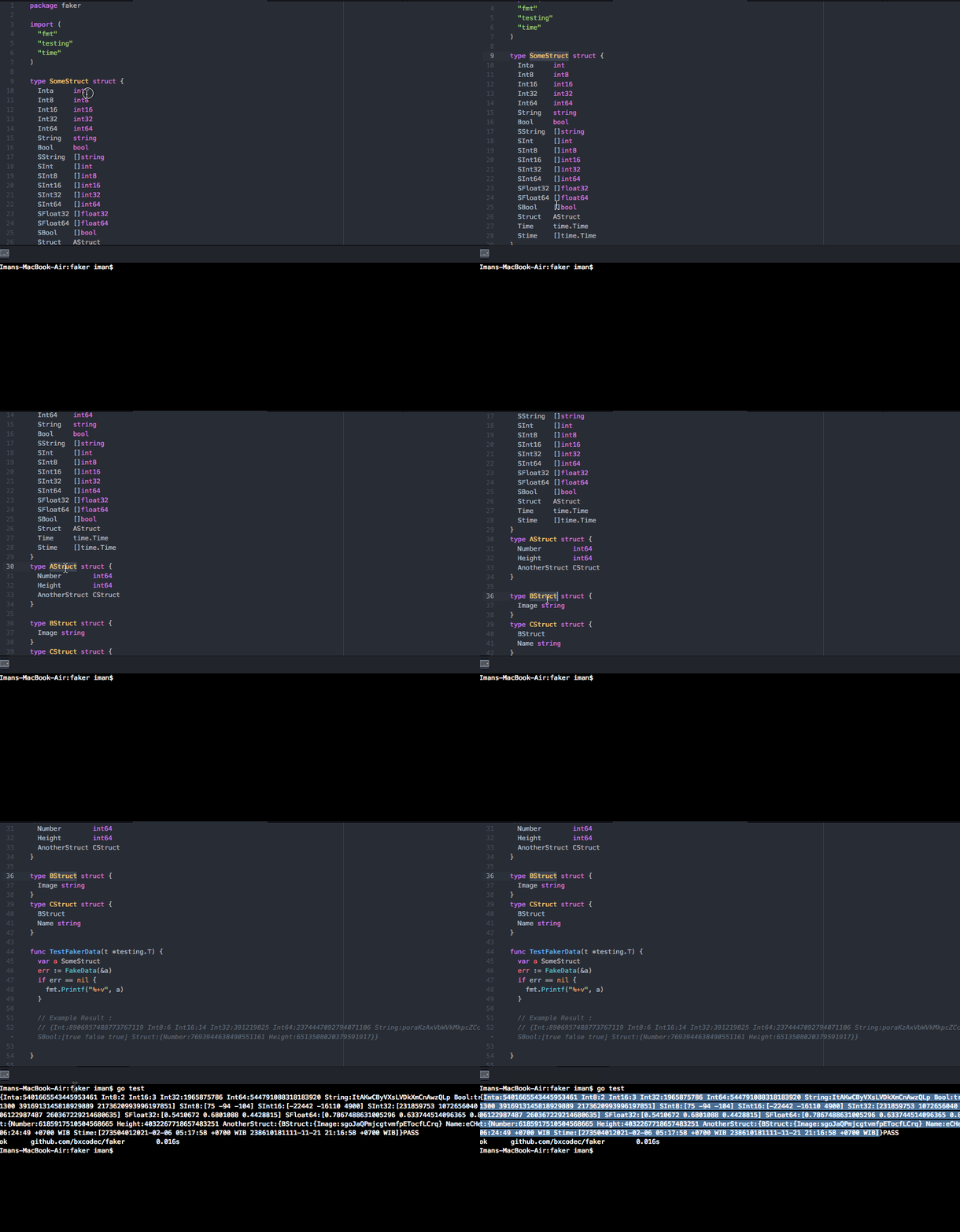
DEMO
Benchmark
Bench To Generate Fake Data
Without Tag
BenchmarkFakerDataNOTTagged-4 500000 3049 ns/op 488 B/op 20 allocs/op
Using Tag
BenchmarkFakerDataTagged-4 100000 17470 ns/op 380 B/op 26 allocs/op
MUST KNOW
The Struct Field must PUBLIC.
Support Only For :
- int int8 int16 int32 int64
- []int []int8 []int16 []int32 []int64
- bool []bool
- string []string
- float32 float64 []float32 []float64
- Nested Struct Field
- time.Time []time.Time
Limitation
Unfortunately this library has some limitation
- Not support for private field. Just make sure your field's struct is public. If not, it will throw panic error. You can avoid panic using tag skip
faker:"-"in the private field. - Not support for
interface{}data type. How we can generate if we don't know what is the data type? - Not support for
map[interface{}]interface{}, map[any_type]interface{}, map[interface{}]any_type. Still, it's about interface. We can't give you something if we don't know what really you want. - Not fully support for custom type, but a few custom type already supported, still investigating how to do this in the correct ways. For now, if you use
faker, it's safer not to use any custom type to avoid panic.
Contribution
To contrib on this project, you can make a PR or just an issue.
Maintainer
 Documentation

Documentation

Index 
- Constants
- Variables
- func AddProvider(tag string, provider TaggedFunction) error
- func FakeData(a interface{}) error
- func RandomInt(parameters ...int) (p []int, err error)
- func RandomUnixTime() int64
- func SetAddress(net Addresser)
- func SetDataFaker(d DataFaker)
- func SetDateTimer(d DateTimer)
- func SetDowser(d Dowser)
- func SetNetwork(net Networker)
- func SetPayment(p Render)
- func SetPhoner(p Phoner)
- func SetPrice(p Money)
- type Address
- type Addresser
- type DataFaker
- type DateTime
- func (d DateTime) Century(v reflect.Value) (interface{}, error)
- func (d DateTime) Date(v reflect.Value) (interface{}, error)
- func (d DateTime) DayOfMonth(v reflect.Value) (interface{}, error)
- func (d DateTime) DayOfWeek(v reflect.Value) (interface{}, error)
- func (d DateTime) MonthName(v reflect.Value) (interface{}, error)
- func (d DateTime) Time(v reflect.Value) (interface{}, error)
- func (d DateTime) TimePeriod(v reflect.Value) (interface{}, error)
- func (d DateTime) TimeZone(v reflect.Value) (interface{}, error)
- func (d DateTime) Timestamp(v reflect.Value) (interface{}, error)
- func (d DateTime) UnixTime(v reflect.Value) (interface{}, error)
- func (d DateTime) Year(v reflect.Value) (interface{}, error)
- type DateTimer
- type Dowser
- type Identifier
- type Internet
- func (internet Internet) DomainName(v reflect.Value) (interface{}, error)
- func (internet Internet) Email(v reflect.Value) (interface{}, error)
- func (internet Internet) IPv4(v reflect.Value) (interface{}, error)
- func (internet Internet) IPv6(v reflect.Value) (interface{}, error)
- func (internet Internet) MacAddress(v reflect.Value) (interface{}, error)
- func (internet Internet) Password(v reflect.Value) (interface{}, error)
- func (internet Internet) URL(v reflect.Value) (interface{}, error)
- func (internet Internet) UserName(v reflect.Value) (interface{}, error)
- type Lorem
- type Money
- type Networker
- type Payment
- type Person
- func (p Person) FirstName(v reflect.Value) (interface{}, error)
- func (p Person) FirstNameFemale(v reflect.Value) (interface{}, error)
- func (p Person) FirstNameMale(v reflect.Value) (interface{}, error)
- func (p Person) LastName(v reflect.Value) (interface{}, error)
- func (p Person) Name(v reflect.Value) (interface{}, error)
- func (p Person) TitleFeMale(v reflect.Value) (interface{}, error)
- func (p Person) TitleMale(v reflect.Value) (interface{}, error)
- type Phone
- type Phoner
- type Price
- type Render
- type TaggedFunction
- type UUID
Constants 
const (
	BaseDate   = "2006-01-02"
	Time       = "15:04:05"
	Month      = "January"
	Year       = "2006"
	Day        = "Monday"
	DayOfMonth = "_2"
	TimePeriod = "PM"
)
These example values must use the reference time "Mon Jan 2 15:04:05 MST 2006" as described at https://gobyexample.com/time-formatting-parsing
const (
	ID                 = "uuid_digit"
	HyphenatedID       = "uuid_hyphenated"
	Email              = "email"
	MacAddress         = "mac_address"
	DomainName         = "domain_name"
	UserName           = "username"
	URL                = "url"
	IPV4               = "ipv4"
	IPV6               = "ipv6"
	PASSWORD           = "password"
	LATITUDE           = "lat"
	LONGITUDE          = "long"
	CreditCardNumber   = "cc_number"
	CreditCardType     = "cc_type"
	PhoneNumber        = "phone_number"
	TollFreeNumber     = "tool_free_number"
	E164PhoneNumber    = "e_164_phone_number"
	TitleMale          = "title_male"
	TitleFemale        = "title_female"
	FirstName          = "first_name"
	FirstNameMale      = "first_name_male"
	FirstNameFemale    = "first_name_female"
	LastName           = "last_name"
	NAME               = "name"
	UnixTime           = "unix_time"
	DATE               = "date"
	TIME               = "time"
	MonthName          = "month_name"
	YEAR               = "year"
	DayOfWeek          = "day_of_week"
	DayOfMonthTag      = "day_of_month"
	TIMESTAMP          = "timestamp"
	CENTURY            = "century"
	TIMEZONE           = "timezone"
	TimePeriodTag      = "time_period"
	WORD               = "word"
	SENTENCE           = "sentence"
	PARAGRAPH          = "paragraph"
	Currency           = "currency"
	Amount             = "amount"
	AmountWithCurrency = "amount_with_currency"
	SKIP               = "-"
)
Supported tags
Variables 
var (
	ErrUnsupportedKindPtr  = "Unsupported kind: %s Change Without using * (pointer) in Field of %s"
	ErrUnsupportedKind     = "Unsupported kind: %s"
	ErrValueNotPtr         = "Not a pointer value"
	ErrTagNotSupported     = "Tag unsupported"
	ErrTagAlreadyExists    = "Tag exists"
	ErrMoreArguments       = "Passed more arguments than is possible : (%d)"
	ErrNotSupportedPointer = "Use sample:=new(%s)\n faker.FakeData(sample) instead"
)
Generic Error Messages for tags
ErrUnsupportedKindPtr: Error when get fake from ptr
ErrUnsupportedKind: Error on passing unsupported kind
ErrValueNotPtr: Error when value is not pointer
ErrTagNotSupported: Error when tag is not supported
ErrTagAlreadyExists: Error when tag exists and call AddProvider
ErrMoreArguments: Error on passing more arguments
ErrNotSupportedPointer: Error when passing unsupported pointer
Functions 
func AddProvider 
func AddProvider(tag string, provider TaggedFunction) error
AddProvider extend faker with tag to generate fake data with specified custom algoritm
func FakeData 
func FakeData(a interface{}) error
FakeData is the main function. Will generate a fake data based on your struct. You can use this for automation testing, or anything that need automated data. You don't need to Create your own data for your testing.
func RandomInt 
RandomInt Get three parameters , only first mandatory and the rest are optional
If only set one parameter :  This means the minimum number of digits and the total number
If only set two parameters : First this is min digit and second max digit and the total number the difference between them
If only three parameters: the third argument set Max count Digit
func RandomUnixTime 
func RandomUnixTime() int64
RandomUnixTime is a helper function returning random Unix time
Types 
type Address 
type Address struct{}
Address struct
type Addresser 
type Addresser interface {
	Latitude(v reflect.Value) (interface{}, error)
	Longitude(v reflect.Value) (interface{}, error)
}
Addresser is logical layer for Address
func GetAddress 
func GetAddress() Addresser
GetAddress returns a new Addresser interface of Address
type DataFaker 
type DataFaker interface {
	Word(v reflect.Value) (interface{}, error)
	Sentence(v reflect.Value) (interface{}, error)
	Paragraph(v reflect.Value) (interface{}, error)
}
DataFaker generates randomized Words, Sentences and Paragraphs
type DateTime 
type DateTime struct {
}
DateTime struct
func (DateTime) DayOfMonth 
DayOfMonth formats DateTime using example DayOfMonth const
func (DateTime) TimePeriod 
TimePeriod formats DateTime using example TimePeriod const
type DateTimer 
type DateTimer interface {
	UnixTime(v reflect.Value) (interface{}, error)
	Date(v reflect.Value) (interface{}, error)
	Time(v reflect.Value) (interface{}, error)
	MonthName(v reflect.Value) (interface{}, error)
	Year(v reflect.Value) (interface{}, error)
	DayOfWeek(v reflect.Value) (interface{}, error)
	DayOfMonth(v reflect.Value) (interface{}, error)
	Timestamp(v reflect.Value) (interface{}, error)
	Century(v reflect.Value) (interface{}, error)
	TimeZone(v reflect.Value) (interface{}, error)
	TimePeriod(v reflect.Value) (interface{}, error)
}
A DateTimer contains random Time generators, returning time string in certain particular format
func GetDateTimer 
func GetDateTimer() DateTimer
GetDateTimer returns a new DateTimer interface of DateTime
type Dowser 
type Dowser interface {
	TitleMale(v reflect.Value) (interface{}, error)
	TitleFeMale(v reflect.Value) (interface{}, error)
	FirstName(v reflect.Value) (interface{}, error)
	FirstNameMale(v reflect.Value) (interface{}, error)
	FirstNameFemale(v reflect.Value) (interface{}, error)
	LastName(v reflect.Value) (interface{}, error)
	Name(v reflect.Value) (interface{}, error)
}
Dowser provides interfaces to generate random logical Names with their initials
type Identifier 
type Identifier interface {
	Digit(v reflect.Value) (interface{}, error)
	Hyphenated(v reflect.Value) (interface{}, error)
}
Identifier ...
type Internet 
type Internet struct{}
Internet struct
func (Internet) DomainName 
DomainName generates random domain name
func (Internet) MacAddress 
MacAddress generates random MacAddress
type Lorem 
type Lorem struct {
}
Lorem struct
func (Lorem) Paragraph 
Paragraph returns a series of sentences as a paragraph using the wordList const
type Money 
type Money interface {
	Currency(v reflect.Value) (interface{}, error)
	Amount(v reflect.Value) (interface{}, error)
	AmountWithCurrency(v reflect.Value) (interface{}, error)
}
Money provides an interface to generate a custom price with or without a random currency code
type Networker 
type Networker interface {
	Email(v reflect.Value) (interface{}, error)
	MacAddress(v reflect.Value) (interface{}, error)
	DomainName(v reflect.Value) (interface{}, error)
	URL(v reflect.Value) (interface{}, error)
	UserName(v reflect.Value) (interface{}, error)
	IPv4(v reflect.Value) (interface{}, error)
	IPv6(v reflect.Value) (interface{}, error)
	Password(v reflect.Value) (interface{}, error)
}
Networker is logical layer for Internet
func GetNetworker 
func GetNetworker() Networker
GetNetworker returns a new Networker interface of Internet
type Payment 
type Payment struct{}
Payment struct
func (Payment) CreditCardNumber 
CreditCardNumber generated credit card number according to the card number rules
type Person 
type Person struct {
}
Person struct
func (Person) FirstNameFemale 
FirstNameFemale retuns first names for females
func (Person) FirstNameMale 
FirstNameMale retuns first names for males
func (Person) TitleFeMale 
TitleFeMale generates random titles for females
type Phone 
type Phone struct {
}
Phone struct
func (Phone) E164PhoneNumber 
E164PhoneNumber generates phone numbers of type: "+27113456789"
func (Phone) PhoneNumber 
PhoneNumber generates phone numbers of type: "201-886-0269"
type Phoner 
type Phoner interface {
	PhoneNumber(v reflect.Value) (interface{}, error)
	TollFreePhoneNumber(v reflect.Value) (interface{}, error)
	E164PhoneNumber(v reflect.Value) (interface{}, error)
}
Phoner serves overall tele-phonic contact generator
type Price 
type Price struct {
}
Price struct
func (Price) Amount 
Amount returns a random floating price amount with a random precision of [1,2] up to (10**8 - 1)
func (Price) AmountWithCurrency 
AmountWithCurrency combines both price and currency together
type Render 
type Render interface {
	CreditCardType(v reflect.Value) (interface{}, error)
	CreditCardNumber(v reflect.Value) (interface{}, error)
}
Render contains Whole Random Credit Card Generators with their types
func GetPayment 
func GetPayment() Render
GetPayment returns a new Render interface of Payment struct
type TaggedFunction 
TaggedFunction ...
 Source Files
 Directories