

 README

README

woke
I stay woke - Erykah Badu



woke is a text file analysis tool that detects non-inclusive language in your source code.
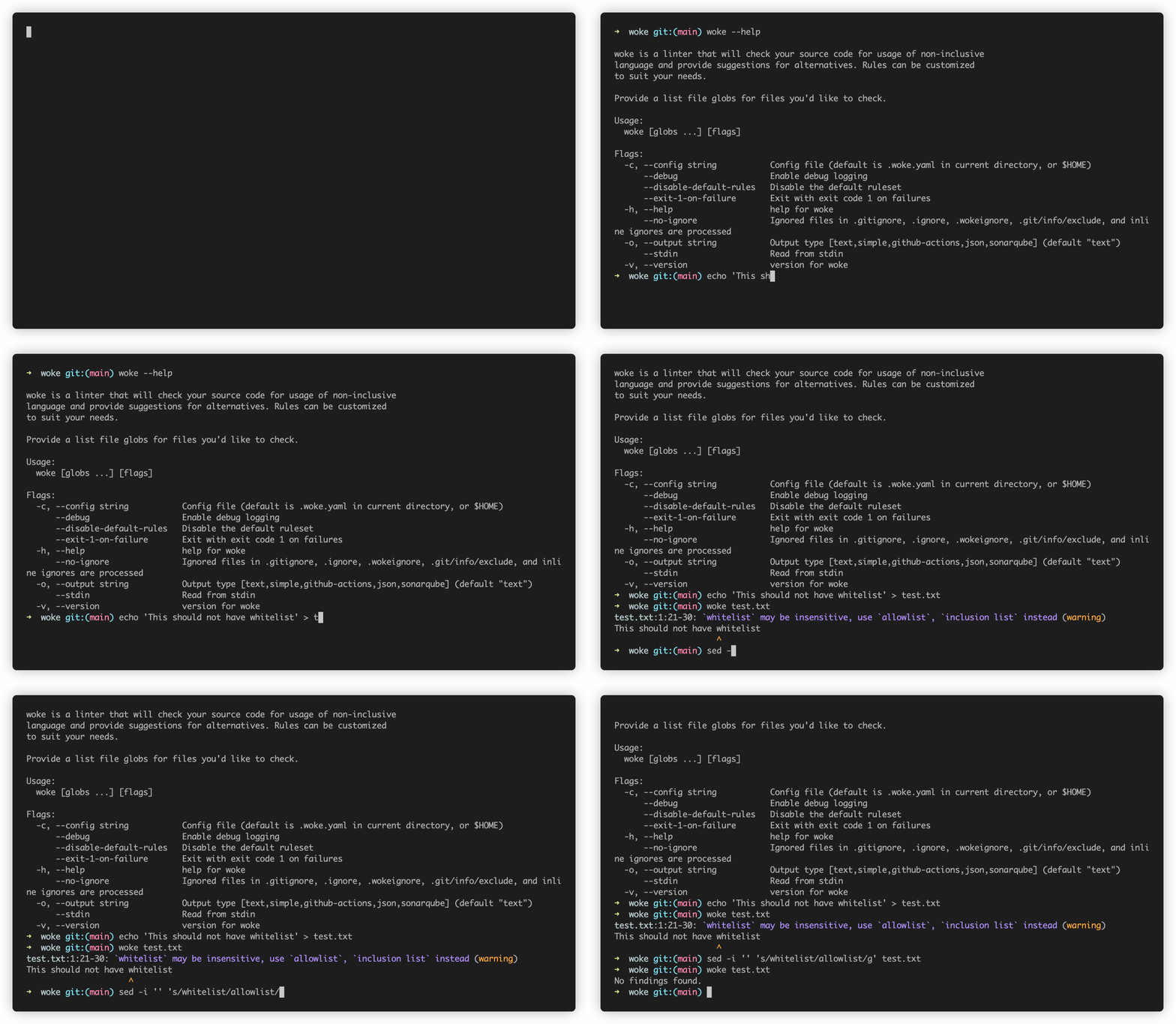
Table of Contents
About
Creating an inclusive work environment is imperitive to a healthy, supportive, and productive culture, and an environment where everyone feels welcome and included.
woke's purpose is to point out places where improvements can be made by removing
non-inclusive language and replacing it with more inclusive alternatives.
Companies like GitHub, Twitter, and Apple are already pushing these changes.
Installation
macOS
You can install a binary release on macOS using brew
brew install get-woke/tap/woke
brew upgrade get-woke/tap/woke
Simple installation
curl -sSfL https://git.io/getwoke | \
  bash -s -- -b /usr/local/bin
Feel free to change the path from /usr/local/bin, just make sure woke
is available on your $PATH (check with woke --version).
Build from source
Install the go toolchain: https://golang.org/doc/install
go get -u github.com/get-woke/woke
woke will be installed to $GOPATH/bin/woke.
Releases
Download the latest binary from Releases
Docker
You can run woke within docker. You will need to mount a volume that contains your source code and/or rules.
## Run with all defaults, within the mounted /src directory
docker run -v $(pwd):/src -w /src getwoke/woke

## Provide rules config
docker run -v $(pwd):/src -w /src getwoke/woke \
  woke -c my-rules.yaml
Usage
$ woke --help

woke is a linter that will check your source code for usage of non-inclusive
language and provide suggestions for alternatives. Rules can be customized
to suit your needs.

Provide a list file globs for files you'd like to check.

Usage:
  woke [globs ...] [flags]

Flags:
  -c, --config string       YAML file with list of rules
      --debug               Enable debug logging
      --exit-1-on-failure   Exit with exit code 1 on failures
  -h, --help                help for woke
  -o, --output string       Output type [text,simple,github-actions] (default "text")
      --stdin               Read from stdin
  -v, --version             version for woke
File globs
By default, woke will run against all text files in your current directory.
To change this, supply a space-separated list of globs as the first argument.
This can be something like **/*.go, or a space-separated list of filenames.
$ woke test.txt
test.txt:2:2-11: `Blacklist` may be insensitive, use `denylist`, `blocklist` instead (warn)
* Blacklist
  ^
test.txt:3:2-12: `White-list` may be insensitive, use `allowlist` instead (warn)
* White-list
  ^
test.txt:4:2-11: `whitelist` may be insensitive, use `allowlist` instead (warn)
* whitelist
  ^
test.txt:5:2-11: `blacklist` may be insensitive, use `denylist`, `blocklist` instead (warn)
* blacklist
  ^
stdin
You can also provide text to woke via stdin
$ echo "This has whitelist from stdin" | woke --stdin
/dev/stdin:1:9-18: `whitelist` may be insensitive, use `allowlist` instead (warn)
This has whitelist from stdin
         ^
Rules
A set of default rules is provided in pkg/rule/default.go.
See example.yaml for an example of adding custom rules.
You can supply your own rules with -c path/to/rules.yaml
The syntax for rules is very basic. You just need a name, a list of terms to match that violate the rule, and a list of alternative suggestions.
rules:
  - name: whitelist
    terms:
      - whitelist
      - white-list
    alternatives:
      - allowlist
Ignoring
Files
In your config file, you can ignore files by adding:
ignore_files:
  - .git/*
  - other/files/in/repo
  - globs/too/*
woke will also automatically ignore anything listed in .gitignore.
woke uses go-gitignore to ignores.
This follows the common .gitignore convention. See link for more details on matching.
.wokeignore
You may also specify a .wokeignore file at the root of the directory to add additional ignore files.
This also follows the .gitignore convention.
In-line ignoring
There may be times where you don't want to ignore an entire file. You may ignore a specific line for one or more rules by creating an in-line comment.
This functionality is very rudimentary, it does a simple search for the phrase. Since
woke is just a text file analyzer, it has no concept of the comment syntax for every file
type it might encounter.
Simply add the following to the line you wish to ignore, using comment syntax that is supported for your file type.
(woke is not responsible for broken code due to in-line ignoring. Make sure you comment correctly!)
# wokeignore:rule=RULE_NAME

# for example, to ignore the following line for the whitelist rule
whitelist # wokeignore:rule=whitelist

# or for multiple rules
whitelist and blacklist # wokeignore:rule=whitelist,blacklist
Here's an example in go:
func main() {
  fmt.Println("here is the whitelist") // wokeignore:rule=whitelist
}
Exit Code
By default, woke will exit with a successful exit code when there are any rule failures.
The idea is, if you run woke on PRs, you may not want to block a merge, but you do
want to inform the author that they can make better word choices.
If you're using woke on PRs, you can choose to enforce these rules with a non-zero
exit code, but running woke --exit-1-on-failure.
Tools
Resources
- https://buffer.com/resources/inclusive-language-tech/
- https://medium.com/pm101/inclusive-language-guide-for-tech-companies-and-startups-f5b254d4a5b7
- https://www.marketplace.org/2020/06/17/tech-companies-update-language-to-avoid-offensive-terms/
- https://tools.ietf.org/html/draft-knodel-terminology-02
License
This application is licensed under the MIT License, you may obtain a copy of it here.
 Documentation

Documentation

Overview 
Copyright © 2020 Caitlin Elfring <celfring@gmail.com>
Permission is hereby granted, free of charge, to any person obtaining a copy of this software and associated documentation files (the "Software"), to deal in the Software without restriction, including without limitation the rights to use, copy, modify, merge, publish, distribute, sublicense, and/or sell copies of the Software, and to permit persons to whom the Software is furnished to do so, subject to the following conditions:
The above copyright notice and this permission notice shall be included in all copies or substantial portions of the Software.
THE SOFTWARE IS PROVIDED "AS IS", WITHOUT WARRANTY OF ANY KIND, EXPRESS OR IMPLIED, INCLUDING BUT NOT LIMITED TO THE WARRANTIES OF MERCHANTABILITY, FITNESS FOR A PARTICULAR PURPOSE AND NONINFRINGEMENT. IN NO EVENT SHALL THE AUTHORS OR COPYRIGHT HOLDERS BE LIABLE FOR ANY CLAIM, DAMAGES OR OTHER LIABILITY, WHETHER IN AN ACTION OF CONTRACT, TORT OR OTHERWISE, ARISING FROM, OUT OF OR IN CONNECTION WITH THE SOFTWARE OR THE USE OR OTHER DEALINGS IN THE SOFTWARE.
 Source Files
 Directories