

 README

README

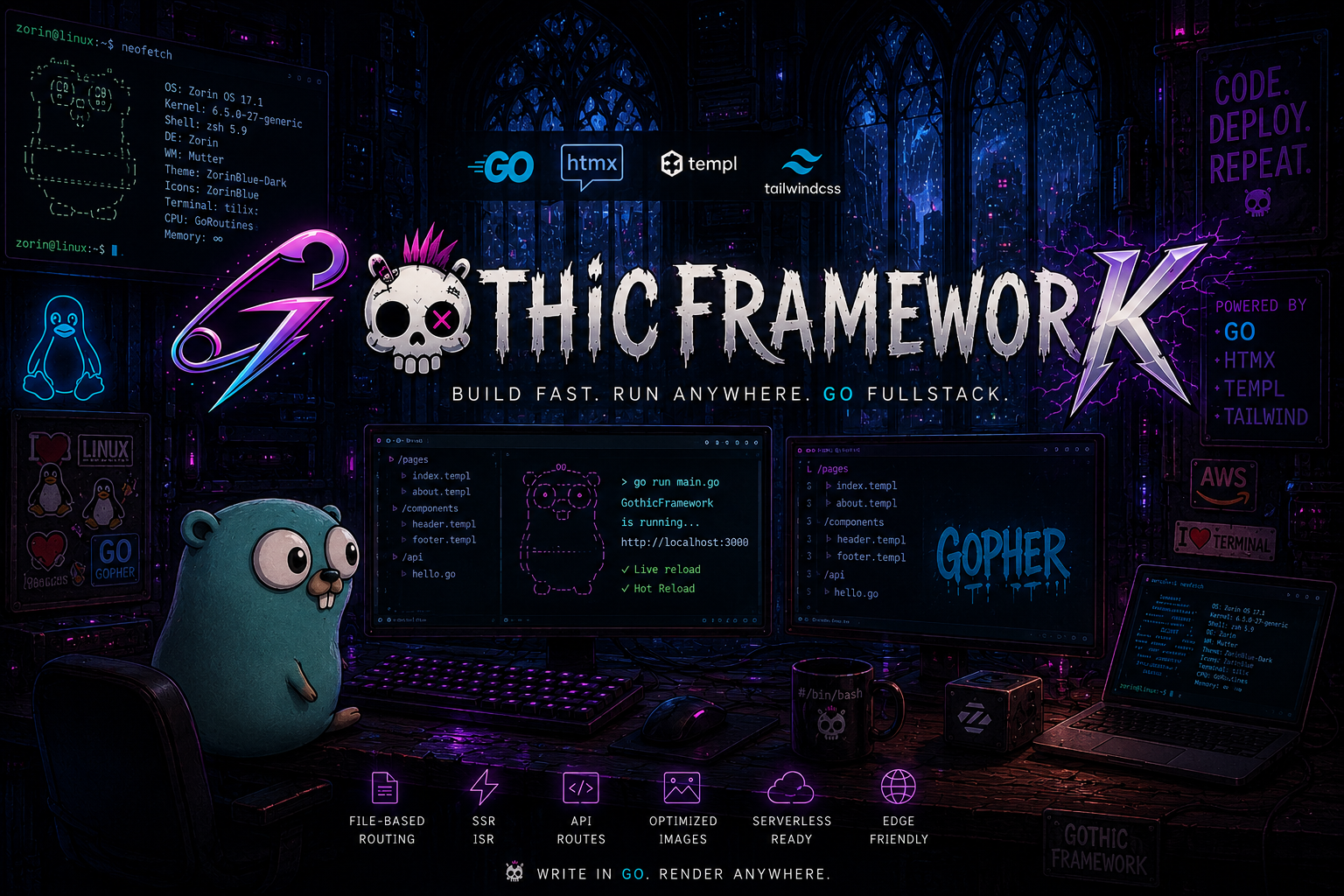

Gothic Framework — CLI (gothic)
Gothic Framework is a developer-first toolset for building fast, scalable, modern web apps in Go with the GOTTH stack: Go, TailwindCSS, Templ, and HTMX. Inspired by Next.js, it brings full-stack ergonomics — file-based routing, edge-ready static caching, ISR, image optimization, link prefetching, hot reloading, and one-command cloud deploys — to Go developers.
This module (github.com/gothicframework/cli/v3) is the gothic command-line tool: scaffolding, dev server, build pipeline, WASM/CSS/image tooling, and deploy. It is the only piece you install; the code your app imports lives in the companion modules:
github.com/gothicframework/core— the runtime library (config,router,wasm,runtimeassets,render, …).github.com/gothicframework/components— reusable UI components (RuntimeScripts,Styles,StatefulComponentOf,OptimizedImage).github.com/gothicframework/middlewares— the one-line chi runtime middleware.
gothic init wires all of these into a new project for you.
Installation
Install the gothic binary with the Go toolchain:
go install github.com/gothicframework/cli/v3/cmd/gothic@latest
This puts a gothic executable on your PATH (in $(go env GOPATH)/bin). Verify it:
gothic version
The binary is named
gothic(notcli) because the entrypoint lives incmd/gothic/—go installnames the binary after that leaf directory. The/v3in the module path is Go's major-version suffix and is independent of the binary name.
Scaffold a new project
gothic init github.com/you/my-app
Pass your Go module path and init runs fully non-interactively: the module is used as-is and the project name is derived from it — the last path segment, minus any /vN major-version suffix (so github.com/you/my-app/v3 → my-app). Omit the argument to be prompted for the module. init scaffolds the project, pins the framework libraries in go.mod, and runs go mod tidy so the project is ready to build. The derived ProjectName is written into gothic.config.go and can be edited afterward.
Prerequisites
- Go 1.25+ — used to build your app and run deploy lifecycle hooks.
- Docker daemon running (deploy-time only) — Gothic builds your Lambda container image via the Docker SDK and pushes it to ECR. The daemon must be reachable at deploy time.
- AWS credentials configured (deploy-time only) — via the shared config file (
~/.aws/config/~/.aws/credentials) or environment variables (AWS_ACCESS_KEY_ID,AWS_SECRET_ACCESS_KEY,AWS_REGION). TheProfilefield ingothic.config.goselects the shared profile. - OpenTofu — no manual install required. The CLI downloads a pinned OpenTofu release to
.gothicCli/bin/tofuon the first deploy and reuses it afterward. PointTofuBinaryPathat a pre-installed binary to skip the download.
Local development (
gothic build,gothic hot-reload,gothic wasm,gothic css) needs only Go — Docker and AWS credentials are deploy-time concerns.
The gothic command
| Command | What it does |
|---|---|
gothic init [module-path] |
Scaffold a new project. Module path optional (prompted if omitted); project name derived from it. |
gothic hot-reload |
Dev server. Watches .templ, .go, and CSS; rebuilds templ, emits runtime assets, recompiles WASM, and live-reloads. |
gothic build |
Compile .templ files to their _templ.go equivalents. Does not emit runtime WASM assets or CSS. |
gothic wasm |
Compile per-component ClientSideState to TinyGo WASM and emit the shared runtime/core assets. |
gothic css |
Generate the Tailwind stylesheet from classes found in .templ files. |
gothic optimize-images |
Produce low-res blurred placeholders for lazy-loaded images referenced in templates. |
gothic deploy |
Build + push the container image and apply infrastructure with OpenTofu (see below). |
gothic migrate-v2 |
Migrate a v1 project to v2 conventions. |
gothic migrate-v3 |
Migrate a v2 project to v3 (config → Go, imports, SAM cleanup, topic mounts). |
gothic version |
Print the installed CLI version. |
Typical loop: gothic init … → gothic hot-reload (develop) → gothic deploy --stage dev.
Configuration (gothic.config.go)
Gothic projects are configured with a type-safe Go source file, gothic.config.go, at the project root. It is parsed by the CLI via Go's AST (no type-checker, no runtime JSON), so you get IDE completion and compile-time validation. gothic init scaffolds it for you.
package main

import (
	gothic "github.com/gothicframework/core/config"
)

var Config = gothic.Config{
	ProjectName: "my-app", // used to derive deterministic cloud resource names
	// Your Go module name is read automatically from go.mod — it is NOT a field here.

	// Optional binary overrides — leave empty to use the CLI-managed defaults:
	TofuBinaryPath: "", // absolute path to a pre-installed OpenTofu binary (skips auto-download)
	DockerfilePath: "", // absolute path to a custom deploy Dockerfile (overrides the embedded one)
	WasmBinary:     "", // absolute path to a tinygo binary override
	TailwindBinary: "", // absolute path to a tailwind binary override

	OptimizeImages: gothic.OptimizeImagesConfig{
		LowResolutionRate: 20, // low-res placeholder quality for lazy-loaded images
	},

	// Runtime router config: cache backend + static-file serving. The zero value
	// equals the defaults below, so this block can be omitted entirely.
	Runtime: gothic.RuntimeConfig{
		CacheStrategy:         gothic.CACHE_CONTROL_HEADERS,
		LocalDevelopmentCache: gothic.IN_MEMORY,
		ServeStaticFiles:      gothic.CDN,
	},

	Deploy: &gothic.DeployConfig{
		Provider: gothic.AWS, // which cloud to deploy to — v3 ships AWS only
		Providers: gothic.Providers{
			AWS: gothic.AWSProvider{
				ServerMemory:  512,         // Lambda memory (MB)
				ServerTimeout: 30,          // Lambda timeout (seconds)
				Region:        "us-east-1", // AWS region to deploy into
				Profile:       "default",   // shared-config profile for credentials

				Stages: map[string]gothic.Stage{
					"dev": {
						ENV: map[string]gothic.EnvValue{
							"PORT":    gothic.Env("8080"),                          // plain string value
							"DB_URL":  gothic.SSMParam("/my-app/dev/db-url"),       // resolved from SSM Parameter Store
							"API_KEY": gothic.SecretsManager("/my-app/dev/api-key"), // resolved from Secrets Manager
						},
					},
				},
			},
		},
	},
}
Deploy providers
Deploy is provider-based. Deploy.Provider (an enum) selects the target cloud, and Deploy.Providers.<name> holds that provider's settings.
gothic.AWSis the only provider available in v3. Its settings live underProviders.AWS(region, profile, Lambda memory/timeout, and the per-stage config).- The
Providerenum +Providersstruct are the extension point for future clouds (GCP, Azure). Selecting an unimplemented provider fails fast with a clear error rather than silently deploying to AWS.
ENV value builders
Each entry in a stage's ENV map is produced by one of three builders. Secrets resolved from SSM or Secrets Manager are pulled by OpenTofu data sources at apply time and never land in plain text in your config:
| Builder | Source | Use for |
|---|---|---|
gothic.Env("8080") |
Plain string | Non-sensitive config values |
gothic.SSMParam("/path") |
AWS SSM Parameter Store | Config / secrets stored in SSM |
gothic.SecretsManager("/path") |
AWS Secrets Manager | Secrets stored in Secrets Manager |
For a JSON secret, chain .Get("field") to pull a single key: gothic.SecretsManager("/my-app/dev/creds").Get("api-key"). Any other function in an ENV value is rejected by the parser with an actionable error.
Lifecycle hooks
Declare top-level BeforeDeploy and/or AfterDeploy functions in gothic.config.go to run custom Go code around a deploy. Both are optional.
func BeforeDeploy(ctx context.Context, gctx *gothic.GothicContext) error
func AfterDeploy(ctx context.Context, gctx *gothic.GothicContext) error
BeforeDeployruns synchronously before the image build andtofu apply. A non-nil error aborts the deploy.AfterDeployruns aftertofu applyand the S3 asset sync, withgctx.Outputscarrying stack outputs (cloudfront_distribution_id,cloudfront_domain_name,s3_bucket_arn,lambda_function_arn). TheGothicContextalso carriesStage,ProjectName,Suffix,Region, andEnv.
Deploying
gothic deploy --stage dev                 # build, push, apply, sync assets, invalidate CDN
gothic deploy --stage dev --action delete # tear the stack down
Infrastructure is managed as code from embedded OpenTofu .tf.json stack files — no template.yaml, no SAM CLI. On the first deploy the CLI:
- Runs
BeforeDeploy(if declared). - Downloads and caches the OpenTofu binary to
.gothicCli/bin/tofu(reused afterward). - Builds your Lambda container image via the Docker SDK and pushes it to ECR.
- Bootstraps the OpenTofu S3 state backend + DynamoDB lock table (skipped if they exist).
- Generates the
.tf.jsonstack into.gothicCli/tofu/<stage>/and runstofu init+tofu apply(Lambda + Function URL + CloudFront + S3). - Syncs the
public/folder to S3 and invalidates the CloudFront distribution. - Runs
AfterDeploy(if declared) with stack outputs populated.
--action delete removes the stack, then prompts before deleting the remote state bucket and lock table (answer N to preserve them).
Custom infrastructure (infra/)
Need a DynamoDB table, an SQS queue, an extra IAM policy, or any other AWS resource alongside your app? Drop .tf or .tf.json files into an infra/ folder at your project root. On every deploy the CLI merges them flat into the same OpenTofu working directory — so your resources live in the same module and state as the Gothic stack (gothic deploy provisions them, --action delete tears them down, all in one plan/apply).
Rules:
-
Only
*.tfand*.tf.jsonfiles directly insideinfra/are merged; anything else (READMEs,.gitkeep, subfolders) is ignored. -
A file whose name collides with a Gothic-generated file (
main.tf.json,variables.tf.json,resources.tf.json,outputs.tf.json,gothic_outputs.tf.json,gothic_vars.auto.tfvars.json,env_resolved.tf.json,gothic_image.auto.tfvars.json) is rejected — rename it. -
Reference the Gothic stack through the stable
local.gothic_*contract instead of Gothic's internal resource addresses (which may change between versions):Local Value local.gothic_lambda_role_namethe app Lambda's IAM role name local.gothic_lambda_role_arnthe app Lambda's IAM role ARN local.gothic_lambda_function_namethe app Lambda's function name local.gothic_lambda_function_arnthe app Lambda's function ARN local.gothic_s3_bucket_namethe assets S3 bucket name local.gothic_s3_bucket_arnthe assets S3 bucket ARN local.gothic_cloudfront_distribution_idthe CloudFront distribution ID local.gothic_cloudfront_domain_namethe CloudFront domain name
Example: a DynamoDB table your app can read/write
infra/dynamodb.tf.json — declare the table and grant the Gothic Lambda role read/write on it via an inline role policy:
{
  "resource": {
    "aws_dynamodb_table": {
      "my_table": {
        "name": "my-table",
        "billing_mode": "PAY_PER_REQUEST",
        "hash_key": "id",
        "attribute": [
          { "name": "id", "type": "S" }
        ]
      }
    },
    "aws_iam_role_policy": {
      "lambda_my_table": {
        "name": "my-table-access",
        "role": "${local.gothic_lambda_role_name}",
        "policy": "${jsonencode({\"Version\":\"2012-10-17\",\"Statement\":[{\"Effect\":\"Allow\",\"Action\":[\"dynamodb:GetItem\",\"dynamodb:PutItem\",\"dynamodb:UpdateItem\",\"dynamodb:DeleteItem\",\"dynamodb:Query\",\"dynamodb:Scan\"],\"Resource\":[\"${aws_dynamodb_table.my_table.arn}\",\"${aws_dynamodb_table.my_table.arn}/index/*\"]}]})}"
      }
    }
  }
}
Pass the table name to your app as an environment variable in gothic.config.go:
ENV: map[string]gothic.EnvValue{
    "TABLE_NAME": gothic.Env("my-table"),
}
Then read it at runtime and use the AWS SDK — the Lambda already has credentials via its execution role (the same one your infra/ policy attaches to), so no keys are needed:
tableName := os.Getenv("TABLE_NAME")
cfg, _ := awsconfig.LoadDefaultConfig(ctx) // picks up the Lambda role automatically
ddb := dynamodb.NewFromConfig(cfg)
// ddb.PutItem(ctx, &dynamodb.PutItemInput{TableName: aws.String(tableName), ...})
Migrating from v2
If you have an existing v2 project (with gothic-config.json and SAM templates), convert it to v3 with one command:
gothic migrate-v3           # migrate the current directory
gothic migrate-v3 --dry-run # preview the changes without writing
It backs up gothic-config.json, generates gothic.config.go, removes SAM artifacts, rewrites the v2 imports to the new org module paths, cleans up the removed topic-mount API, updates go.mod, and runs go mod tidy. It is idempotent.
The v3 CLI has no runtime JSON fallback. If
GetConfig()finds agothic-config.json, it directs you to rungothic migrate-v3.
Design docs
The framework's design records ship with the core module: docs/DESIGN-INSPIRATIONS.md, docs/adr/ (custom codec, schema seam, two-tier protocol, static full-Go core), and RELEASE_NOTES_v3.md.
Maintainer docs
docs/patched-tinygo-channel.md— routing Gothic temporarily to a patched TinyGo build, the‹base›-gothic.‹n›version convention, and how to cut and retire a patched release.
 Directories

Directories

| Path | Synopsis |
|---|---|
|
cmd
|
|
|
gothic
command
Command gothic is the Gothic Framework CLI entrypoint.
|
Command gothic is the Gothic Framework CLI entrypoint. |
|
internal
|
|
|
astconfig
Package astconfig reads gothic.config.go via go/parser (no type checker) and produces the same cli.Config struct that v2 loaded from gothic-config.json.
|
Package astconfig reads gothic.config.go via go/parser (no type checker) and produces the same cli.Config struct that v2 loaded from gothic-config.json. |
|
deploy
Package tofu — binary.go implements the OpenTofu binary manager.
|
Package tofu — binary.go implements the OpenTofu binary manager. |
|
deploy/docker
Package docker wraps the Docker engine SDK and the AWS ECR SDK to build the Gothic Lambda image and push it to Elastic Container Registry.
|
Package docker wraps the Docker engine SDK and the AWS ECR SDK to build the Gothic Lambda image and push it to Elastic Container Registry. |
|
deploy/tfgen
Package tfgen generates a fully-formed OpenTofu working directory for the Gothic AWS stack.
|
Package tfgen generates a fully-formed OpenTofu working directory for the Gothic AWS stack. |
|
output
Package output provides shared helpers for formatted CLI output with consistent timestamping and deduplication of consecutive identical messages.
|
Package output provides shared helpers for formatted CLI output with consistent timestamping and deduplication of consecutive identical messages. |
|
scaffold/src/components
templ: version: v0.3.1020
|
templ: version: v0.3.1020 |
|
scaffold/src/layouts
templ: version: v0.3.1020
|
templ: version: v0.3.1020 |
|
scaffold/src/pages
templ: version: v0.3.1020
|
templ: version: v0.3.1020 |
|
termcolor
Package termcolor is the single source of truth for the Gothic CLI's terminal colors.
|
Package termcolor is the single source of truth for the Gothic CLI's terminal colors. |