

 Documentation

Documentation

Index 
- Constants
- Variables
- func AsSingleChannelCache(cacheValue interface{}) *singleChannelCacheImpl
- func AssertEqualBodies(t *testing.T, expected, actual Body)
- func AttachmentDigests(attachments AttachmentsMeta) []string
- func ChannelsFromQueryParams(queryParams interface{}) (channels []string, err error)
- func ConnectToBucket(spec base.BucketSpec) (bucket base.Bucket, err error)
- func CreateRevIDWithBytes(generation int, parentRevID string, bodyBytes []byte) string
- func DecodeAttachment(att interface{}) ([]byte, error)
- func DesignDocSyncGateway() string
- func DesignDocSyncHousekeeping() string
- func ErrorToOttoValue(runner *sgbucket.JSRunner, err error) otto.Value
- func GenerateChanges(cancelCtx context.Context, database *Database, inChannels base.Set, ...) (err error, forceClose bool)
- func GenerateProofOfAttachment(attachmentData []byte) (nonce []byte, proof string)
- func GetStringArrayProperty(body map[string]interface{}, property string) ([]string, error)
- func InitializeIndexes(bucket base.Bucket, useXattrs bool, numReplicas uint) error
- func InitializeViews(bucket base.Bucket) error
- func IsMissingDDocError(err error) bool
- func NewBackgroundTask(taskName string, dbName string, task BackgroundTaskFunc, ...) error
- func NewChannelCacheForContext(terminator chan bool, options ChannelCacheOptions, context *DatabaseContext) (*channelCacheImpl, error)
- func NewImportListener() *importListener
- func NewNoRevMessage() *noRevMessage
- func NewReplicationCheckpoint(revID string, body Body) *replicationCheckpoint
- func NewSGBlipContext(ctx context.Context, id string) (bc *blip.Context)
- func NewSGReplicateManager(dbContext *DatabaseContext, cfg *base.CfgSG) (*sgReplicateManager, error)
- func ParseIntSequenceComponent(component string, allowEmpty bool) (uint64, error)
- func ParseRevID(revid string) (int, string)
- func ParseRevisions(body Body) []string
- func ProveAttachment(attachmentData, nonce []byte) (proof string)
- func RealSpecialDocID(doctype string, docid string) string
- func RepairJobRevTreeCycles(docId string, originalCBDoc []byte) (transformedCBDoc []byte, transformed bool, err error)
- func ResultsEmpty(results gocb.QueryResults) (resultsEmpty bool)
- func Sha1DigestKey(data []byte) string
- func VacuumAttachments(bucket base.Bucket) (int, error)
- func ValidateDatabaseName(dbName string) error
- func WaitForIndexEmpty(bucket *base.CouchbaseBucketGoCB, useXattrs bool) error
- func WaitForUserWaiterChange(userWaiter *ChangeWaiter) bool
- func WaitForViews(bucket base.Bucket) error
- type APIEndpoints
- type ActivePullReplicator
- type ActivePushReplicator
- type ActiveReplicator
- type ActiveReplicatorConfig
- type ActiveReplicatorDirection
- type AllDocsIndexQueryRow
- type AllDocsViewQueryRow
- type AsyncEvent
- type AsyncEventHandler
- type AttachmentCallback
- type AttachmentData
- type AttachmentKey
- type AttachmentMap
- type AttachmentsMeta
- type BLIPMessageSender
- type BackgroundTaskError
- type BackgroundTaskFunc
- type BlipSyncContext
- type BlipSyncStats
- type Body
- func (body Body) Copy(copyType BodyCopyType) Body
- func (body Body) DeepCopy() Body
- func (body Body) ExtractDeleted() bool
- func (body Body) ExtractExpiry() (uint32, error)
- func (body Body) ExtractRev() string
- func (body Body) FixJSONNumbers()
- func (body Body) ShallowCopy() Body
- func (b *Body) Unmarshal(data []byte) error
- type BodyCopyType
- type BypassRevisionCache
- func (rc *BypassRevisionCache) Get(docID, revID string, includeBody bool, includeDelta bool) (docRev DocumentRevision, err error)
- func (rc *BypassRevisionCache) GetActive(docID string, includeBody bool) (docRev DocumentRevision, err error)
- func (rc *BypassRevisionCache) Peek(docID, revID string) (docRev DocumentRevision, found bool)
- func (rc *BypassRevisionCache) Put(docRev DocumentRevision)
- func (rc *BypassRevisionCache) UpdateDelta(docID, revID string, toDelta RevisionDelta)
- type CacheOptions
- type ChangeEntry
- type ChangeRev
- type ChangeWaiter
- func (waiter *ChangeWaiter) CurrentUserCount() uint64
- func (waiter *ChangeWaiter) GetUserKeys() (result []string)
- func (waiter *ChangeWaiter) RefreshUserCount() bool
- func (waiter *ChangeWaiter) RefreshUserKeys(user auth.User)
- func (waiter *ChangeWaiter) UpdateChannels(chans channels.TimedSet)
- func (waiter *ChangeWaiter) Wait() uint32
- type ChangesOptions
- type ChangesSendErr
- type ChannelCache
- type ChannelCacheOptions
- type ChannelQueryHandler
- type Checkpointer
- func (c *Checkpointer) AddAlreadyKnownSeq(seq ...string)
- func (c *Checkpointer) AddExpectedSeqIDAndRevs(seqs map[IDAndRev]string)
- func (c *Checkpointer) AddExpectedSeqs(seqs ...string)
- func (c *Checkpointer) AddProcessedSeq(seq string)
- func (c *Checkpointer) AddProcessedSeqIDAndRev(seq string, idAndRev IDAndRev)
- func (c *Checkpointer) CheckpointNow()
- func (c *Checkpointer) Start()
- func (c *Checkpointer) Stats() CheckpointerStats
- type CheckpointerStats
- type ClusterUpdateFunc
- type Conflict
- type ConflictResolutionType
- type ConflictResolver
- type ConflictResolverFunc
- type ConflictResolverJSServer
- type ConflictResolverStats
- type ConflictResolverType
- type DBOnlineCallback
- type DBStateChangeEvent
- type Database
- func (db *Database) AddDocInstanceToChangeEntry(entry *ChangeEntry, doc *Document, options ChangesOptions)
- func (db *Database) AddDocToChangeEntry(entry *ChangeEntry, options ChangesOptions)
- func (db *Database) AddDocToChangeEntryUsingRevCache(entry *ChangeEntry, revID string) (err error)
- func (db *Database) CheckProposedRev(docid string, revid string, parentRevID string) ProposedRevStatus
- func (db *Database) Compact() (int, error)
- func (db *Database) DeleteDesignDoc(ddocName string) (err error)
- func (db *Database) DeleteDoc(docid string, revid string) (string, error)
- func (db *Database) DeleteSpecial(doctype string, docid string, revid string) error
- func (db *Database) DocIDChangesFeed(userChannels base.Set, explicitDocIds []string, options ChangesOptions) (<-chan *ChangeEntry, error)
- func (db *Database) ForEachDocID(callback ForEachDocIDFunc, resultsOpts ForEachDocIDOptions) error
- func (db *Database) ForEachStubAttachment(body Body, minRevpos int, callback AttachmentCallback) error
- func (db *Database) Get1xBody(docid string) (Body, error)
- func (db *Database) Get1xRevAndChannels(docID string, revID string, listRevisions bool) (bodyBytes []byte, channels channels.ChannelMap, access UserAccessMap, ...)
- func (db *Database) Get1xRevBody(docid, revid string, history bool, attachmentsSince []string) (Body, error)
- func (db *Database) Get1xRevBodyWithHistory(docid, revid string, maxHistory int, historyFrom []string, ...) (Body, error)
- func (db *Database) GetAttachment(key AttachmentKey) ([]byte, error)
- func (db *Database) GetChangeLog(channelName string, afterSeq uint64) (entries []*LogEntry)
- func (db *Database) GetChanges(channels base.Set, options ChangesOptions) ([]*ChangeEntry, error)
- func (db *Database) GetDelta(docID, fromRevID, toRevID string) (delta *RevisionDelta, redactedRev *DocumentRevision, err error)
- func (db *Database) GetDesignDoc(ddocName string, result interface{}) (err error)
- func (db *Database) GetRev(docID, revID string, history bool, attachmentsSince []string) (DocumentRevision, error)
- func (db *Database) GetSpecial(doctype string, docid string) (Body, error)
- func (db *Database) GetSpecialBytes(doctype string, docid string) ([]byte, error)
- func (db *Database) ImportDoc(docid string, existingDoc *Document, isDelete bool, expiry *uint32, ...) (docOut *Document, err error)
- func (db *Database) ImportDocRaw(docid string, value []byte, xattrValue []byte, isDelete bool, cas uint64, ...) (docOut *Document, err error)
- func (db *Database) IsCompactRunning() bool
- func (db *Database) IsIllegalConflict(doc *Document, parentRevID string, deleted, noConflicts bool) bool
- func (db *Database) MarkPrincipalsChanged(docid string, newRevID string, changedPrincipals, changedRoleUsers []string)
- func (db *Database) MultiChangesFeed(chans base.Set, options ChangesOptions) (<-chan *ChangeEntry, error)
- func (db *Database) NewUserWaiter() *ChangeWaiter
- func (db *Database) OnDemandImportForWrite(docid string, doc *Document, deleted bool) error
- func (db *Database) Post(body Body) (string, string, *Document, error)
- func (db *Database) Purge(key string) error
- func (db *Database) Put(docid string, body Body) (newRevID string, doc *Document, err error)
- func (db *Database) PutDesignDoc(ddocName string, ddoc sgbucket.DesignDoc) (err error)
- func (db *Database) PutExistingRev(newDoc *Document, docHistory []string, noConflicts bool) (doc *Document, newRevID string, err error)
- func (db *Database) PutExistingRevWithBody(docid string, body Body, docHistory []string, noConflicts bool) (doc *Document, newRev string, err error)
- func (db *Database) PutExistingRevWithConflictResolution(newDoc *Document, docHistory []string, noConflicts bool, ...) (doc *Document, newRevID string, err error)
- func (db *Database) PutSpecial(doctype string, docid string, body Body) (string, error)
- func (db *Database) QueryDesignDoc(ddocName string, viewName string, options map[string]interface{}) (*sgbucket.ViewResult, error)
- func (db *Database) ReloadUser() error
- func (db *Database) RevDiff(docid string, revids []string) (missing, possible []string)
- func (db *Database) SameAs(otherdb *Database) bool
- func (db *Database) SetUser(user auth.User)
- func (db *Database) SimpleMultiChangesFeed(chans base.Set, options ChangesOptions) (<-chan *ChangeEntry, error)
- func (db *Database) UpdateAllDocChannels() (int, error)
- func (db *Database) User() auth.User
- type DatabaseContext
- func (db *DatabaseContext) AllPrincipalIDs() (users, roles []string, err error)
- func (context *DatabaseContext) AllowConflicts() bool
- func (context *DatabaseContext) AllowExternalRevBodyStorage() bool
- func (context *DatabaseContext) AllowFlushNonCouchbaseBuckets() bool
- func (context *DatabaseContext) Authenticator() *auth.Authenticator
- func (db *DatabaseContext) CacheCompactActive() bool
- func (dbc *DatabaseContext) ChannelViewTest(channelName string, startSeq, endSeq uint64) (LogEntries, error)
- func (context *DatabaseContext) Close()
- func (context *DatabaseContext) ComputeChannelsForPrincipal(princ auth.Principal) (channels.TimedSet, error)
- func (context *DatabaseContext) ComputeRolesForUser(user auth.User) (channels.TimedSet, error)
- func (context *DatabaseContext) ComputeSequenceChannelsForPrincipal(princ auth.Principal) (channels.TimedSet, error)
- func (context *DatabaseContext) ComputeSequenceRolesForUser(user auth.User) (channels.TimedSet, error)
- func (context *DatabaseContext) CreateZeroSinceValue() SequenceID
- func (db *DatabaseContext) DeleteUserSessions(userName string) error
- func (context *DatabaseContext) DeltaSyncEnabled() bool
- func (context *DatabaseContext) FlushChannelCache() error
- func (context *DatabaseContext) FlushRevisionCacheForTest()
- func (context *DatabaseContext) GetChangeCache() *changeCache
- func (db *DatabaseContext) GetChannelQueryCount() int64
- func (db *DatabaseContext) GetDocSyncData(docid string) (SyncData, error)
- func (db *DatabaseContext) GetDocWithXattr(key string, unmarshalLevel DocumentUnmarshalLevel) (doc *Document, rawBucketDoc *sgbucket.BucketDocument, err error)
- func (db *DatabaseContext) GetDocument(docid string, unmarshalLevel DocumentUnmarshalLevel) (doc *Document, err error)
- func (context *DatabaseContext) GetOIDCProvider(providerName string) (*auth.OIDCProvider, error)
- func (dbc *DatabaseContext) GetPrincipal(name string, isUser bool) (info *PrincipalConfig, err error)
- func (context *DatabaseContext) GetRevisionCacheForTest() RevisionCache
- func (context *DatabaseContext) GetServerUUID() string
- func (context *DatabaseContext) GetUserViewsEnabled() bool
- func (context *DatabaseContext) IsClosed() bool
- func (context *DatabaseContext) LastSequence() (uint64, error)
- func (context *DatabaseContext) N1QLQueryWithStats(queryName string, statement string, params interface{}, ...) (results gocb.QueryResults, err error)
- func (db *DatabaseContext) NewCacheRevsActiveWaiter(tb testing.TB) *StatWaiter
- func (db *DatabaseContext) NewDCPCachingCountWaiter(tb testing.TB) *StatWaiter
- func (db *DatabaseContext) NewPullReplicationCaughtUpWaiter(tb testing.TB) *StatWaiter
- func (db *DatabaseContext) NewStatWaiter(stat *expvar.Int, tb testing.TB) *StatWaiter
- func (context *DatabaseContext) NotifyTerminatedChanges(username string)
- func (db *DatabaseContext) OnDemandImportForGet(docid string, rawDoc []byte, rawXattr []byte, cas uint64) (docOut *Document, err error)
- func (dbc *DatabaseContext) ParseSequenceID(str string) (s SequenceID, err error)
- func (context *DatabaseContext) QueryAccess(username string) (sgbucket.QueryResultIterator, error)
- func (context *DatabaseContext) QueryAllDocs(startKey string, endKey string) (sgbucket.QueryResultIterator, error)
- func (context *DatabaseContext) QueryChannels(channelName string, startSeq uint64, endSeq uint64, limit int, activeOnly bool) (sgbucket.QueryResultIterator, error)
- func (context *DatabaseContext) QueryPrincipals() (sgbucket.QueryResultIterator, error)
- func (context *DatabaseContext) QueryResync() (sgbucket.QueryResultIterator, error)
- func (context *DatabaseContext) QueryRoleAccess(username string) (sgbucket.QueryResultIterator, error)
- func (context *DatabaseContext) QuerySequences(sequences []uint64) (sgbucket.QueryResultIterator, error)
- func (context *DatabaseContext) QuerySessions(userName string) (sgbucket.QueryResultIterator, error)
- func (context *DatabaseContext) QueryTombstones(olderThan time.Time, limit int) (sgbucket.QueryResultIterator, error)
- func (context *DatabaseContext) RemoveObsoleteDesignDocs(previewOnly bool) (removedDesignDocs []string, err error)
- func (context *DatabaseContext) RemoveObsoleteIndexes(previewOnly bool) (removedIndexes []string, err error)
- func (context *DatabaseContext) RestartListener() error
- func (db *DatabaseContext) RevisionBodyLoader(key string) ([]byte, error)
- func (context *DatabaseContext) SetOnChangeCallback(callback DocChangedFunc)
- func (context *DatabaseContext) SetUserViewsEnabled(value bool)
- func (dc *DatabaseContext) TakeDbOffline(reason string) error
- func (db *DatabaseContext) UpdateCalculatedStats()
- func (dbc *DatabaseContext) UpdatePrincipal(newInfo PrincipalConfig, isUser bool, allowReplace bool) (replaced bool, err error)
- func (context *DatabaseContext) UpdateSyncFun(syncFun string) (changed bool, err error)
- func (context *DatabaseContext) UseViews() bool
- func (context *DatabaseContext) UseXattrs() bool
- func (context *DatabaseContext) ViewQueryWithStats(ddoc string, viewName string, params map[string]interface{}) (results sgbucket.QueryResultIterator, err error)
- func (db *DatabaseContext) WaitForCaughtUp(targetCount int64) error
- func (dbc *DatabaseContext) WaitForPendingChanges(ctx context.Context) (err error)
- func (dbc *DatabaseContext) WaitForSequence(ctx context.Context, sequence uint64) (err error)
- func (dbc *DatabaseContext) WaitForSequenceNotSkipped(ctx context.Context, sequence uint64) (err error)
- type DatabaseContextOptions
- type DatabaseStats
- func (d *DatabaseStats) ExpvarMap() *expvar.Map
- func (d *DatabaseStats) StatsByKey(key string) (stats *expvar.Map)
- func (d *DatabaseStats) StatsCache() (stats *expvar.Map)
- func (d *DatabaseStats) StatsCblReplicationPull() (stats *expvar.Map)
- func (d *DatabaseStats) StatsCblReplicationPush() (stats *expvar.Map)
- func (d *DatabaseStats) StatsDatabase() (stats *expvar.Map)
- func (d *DatabaseStats) StatsDeltaSync() (stats *expvar.Map)
- func (d *DatabaseStats) StatsGsiViews() (stats *expvar.Map)
- func (d *DatabaseStats) StatsReplications() (stats *expvar.Map)
- func (d *DatabaseStats) StatsSecurity() (stats *expvar.Map)
- func (d *DatabaseStats) StatsSharedBucketImport() (stats *expvar.Map)
- type DeltaSyncOptions
- type DocAttachment
- type DocChangedFunc
- type DocTransformer
- type Document
- func (doc *Document) Body() Body
- func (doc *Document) BodyBytes() ([]byte, error)
- func (doc *Document) BodyWithSpecialProperties() ([]byte, error)
- func (doc *Document) GetDeepMutableBody() Body
- func (doc *Document) HasBody() bool
- func (doc *Document) IsChannelRemoval(revID string) (bodyBytes []byte, history Revisions, channels base.Set, isRemoval bool, ...)
- func (doc *Document) IsDeleted() bool
- func (doc *Document) IsSGWrite(rawBody []byte) (isSGWrite bool, crc32Match bool)
- func (doc *Document) MarshalBodyAndSync() (retBytes []byte, err error)
- func (doc *Document) MarshalJSON() (data []byte, err error)
- func (doc *Document) MarshalWithXattr() (data []byte, xdata []byte, err error)
- func (doc *Document) RemoveBody()
- func (doc *Document) UnmarshalJSON(data []byte) error
- func (doc *Document) UnmarshalWithXattr(data []byte, xdata []byte, unmarshalLevel DocumentUnmarshalLevel) error
- func (doc *Document) UpdateBody(body Body)
- func (doc *Document) UpdateBodyBytes(bodyBytes []byte)
- func (doc *Document) UpdateExpiry(expiry uint32)
- type DocumentChangeEvent
- type DocumentRevision
- func (rev *DocumentRevision) As1xBytes(db *Database, requestedHistory Revisions, attachmentsSince []string, ...) (b []byte, err error)
- func (rev *DocumentRevision) DeepMutableBody() (b Body, err error)
- func (rev *DocumentRevision) Mutable1xBody(db *Database, requestedHistory Revisions, attachmentsSince []string, ...) (b Body, err error)
- func (rev *DocumentRevision) MutableBody() (b Body, err error)
- type DocumentUnmarshalLevel
- type EmptyResultIterator
- type Event
- type EventHandler
- type EventManager
- func (em *EventManager) GetEventsProcessedFail() int64
- func (em *EventManager) GetEventsProcessedSuccess() int64
- func (em *EventManager) HasHandlerForEvent(eventType EventType) bool
- func (em *EventManager) IncrementEventsProcessedFail(delta int64) int64
- func (em *EventManager) IncrementEventsProcessedSuccess(delta int64) int64
- func (em *EventManager) ProcessEvent(event Event)
- func (em *EventManager) RaiseDBStateChangeEvent(dbName string, state string, reason string, adminInterface string) error
- func (em *EventManager) RaiseDocumentChangeEvent(docBytes []byte, docID string, oldBodyJSON string, channels base.Set) error
- func (em *EventManager) RegisterEventHandler(handler EventHandler, eventType EventType)
- func (em *EventManager) Start(maxProcesses uint, waitTime int)
- type EventType
- type ForEachDocIDFunc
- type ForEachDocIDOptions
- type GetSGR2CheckpointRequest
- type IDAndRev
- type IDRevAndSequence
- type ImportFilterFunction
- type ImportMode
- type ImportOptions
- type JSEventFunction
- type LRURevisionCache
- func (rc *LRURevisionCache) Get(docID, revID string, includeBody bool, includeDelta bool) (DocumentRevision, error)
- func (rc *LRURevisionCache) GetActive(docID string, includeBody bool) (DocumentRevision, error)
- func (rc *LRURevisionCache) Peek(docID, revID string) (docRev DocumentRevision, found bool)
- func (rc *LRURevisionCache) Put(docRev DocumentRevision)
- func (rc *LRURevisionCache) UpdateDelta(docID, revID string, toDelta RevisionDelta)
- type LogEntries
- type LogEntry
- type LogPriorityQueue
- type NodesByReplicationCount
- type OidcTestProviderOptions
- type OnCompleteFunc
- type PrincipalConfig
- type ProposedRevStatus
- type QueryAccessRow
- type QueryChannelsRow
- type QueryIdRow
- type RepairBucket
- func (r *RepairBucket) AddRepairJob(repairJob DocTransformer) *RepairBucket
- func (r *RepairBucket) InitFrom(params RepairBucketParams) *RepairBucket
- func (r RepairBucket) RepairBucket() (results []RepairBucketResult, err error)
- func (r *RepairBucket) SetDryRun(dryRun bool) *RepairBucket
- func (r RepairBucket) TransformBucketDoc(docId string, originalCBDoc []byte) (transformedCBDoc []byte, transformed bool, repairJobs []RepairJobType, ...)
- func (r RepairBucket) WriteRepairedDocsToBucket(docId string, originalDoc, updatedDoc []byte) (backupOrDryRunDocId string, err error)
- type RepairBucketParams
- type RepairBucketResult
- type RepairJobParams
- type RepairJobType
- type ReplicationCfg
- type ReplicationConfig
- type ReplicationHeartbeatListener
- type ReplicationStatus
- type ReplicationStatusOptions
- type ReplicationUpsertConfig
- type ReplicatorCompleteFunc
- type ResponseType
- type RevInfo
- type RevKey
- type RevLoaderFunc
- type RevMessage
- func (rm *RevMessage) Deleted() bool
- func (rm *RevMessage) DeltaSrc() (deltaSrc string, found bool)
- func (rm *RevMessage) HasDeletedProperty() bool
- func (rm *RevMessage) ID() (id string, found bool)
- func (rm *RevMessage) Rev() (rev string, found bool)
- func (rm *RevMessage) Sequence() (sequence string, found bool)
- func (rm *RevMessage) SetID(id string)
- func (rm *RevMessage) SetNoConflicts(noConflicts bool)
- func (rm *RevMessage) SetProperties(properties blip.Properties)
- func (rm *RevMessage) SetRev(rev string)
- func (rm *RevMessage) String() string
- type RevTree
- func (tree RevTree) ContainsCycles() bool
- func (tree RevTree) DeleteBranch(node *RevInfo) (pruned int)
- func (tree RevTree) FindLongestTombstonedBranch() (generation int)
- func (tree RevTree) FindLongestTombstonedBranchFromLeaves(leaves []string) (generation int)
- func (tree RevTree) FindShortestNonTombstonedBranch() (generation int, found bool)
- func (tree RevTree) FindShortestNonTombstonedBranchFromLeaves(leaves []string) (generation int, found bool)
- func (tree RevTree) GetLeaves() []string
- func (tree RevTree) GetLeavesFiltered(filter func(revId string) bool) []string
- func (tree RevTree) MarshalJSON() ([]byte, error)
- func (tree RevTree) RenderGraphvizDot() string
- func (tree RevTree) RepairCycles() (err error)
- func (tree RevTree) UnmarshalJSON(inputjson []byte) (err error)
- type RevisionCache
- type RevisionCacheBackingStore
- type RevisionCacheOptions
- type RevisionDelta
- type Revisions
- type SGIndex
- type SGIndexFlags
- type SGIndexType
- type SGNode
- type SGQuery
- type SGR2Checkpoint
- type SGRCluster
- type SGReplicateOptions
- type SequenceID
- func (s SequenceID) Before(s2 SequenceID) bool
- func (s SequenceID) Equals(s2 SequenceID) bool
- func (s SequenceID) IsNonZero() bool
- func (s SequenceID) MarshalJSON() ([]byte, error)
- func (s SequenceID) SafeSequence() uint64
- func (s SequenceID) String() string
- func (s *SequenceID) UnmarshalJSON(data []byte) error
- type SequenceIDParser
- type SetCheckpointMessage
- type SetCheckpointResponse
- type SetSGR2CheckpointRequest
- type SetSGR2CheckpointResponse
- type ShardedLRURevisionCache
- func (sc *ShardedLRURevisionCache) Get(docID, revID string, includeBody bool, includeDelta bool) (docRev DocumentRevision, err error)
- func (sc *ShardedLRURevisionCache) GetActive(docID string, includeBody bool) (docRev DocumentRevision, err error)
- func (sc *ShardedLRURevisionCache) Peek(docID, revID string) (docRev DocumentRevision, found bool)
- func (sc *ShardedLRURevisionCache) Put(docRev DocumentRevision)
- func (sc *ShardedLRURevisionCache) UpdateDelta(docID, revID string, toDelta RevisionDelta)
- type SingleChannelCache
- type SkippedSequence
- type SkippedSequenceList
- type StableSequenceCallbackFunc
- type StatWaiter
- type SubChangesBody
- type SubChangesParams
- type SubChangesRequest
- type SyncData
- type UnsupportedOptions
- type UserAccessMap
- type UserViewsOptions
- type ViewDoc
- type WarningThresholds
- type Webhook
Constants 
const (
	// Blip default vals
	BlipDefaultBatchSize = uint64(200)
	BlipMinimumBatchSize = uint64(10) // Not in the replication spec - is this required?
)
const (
	MessageSetCheckpoint   = "setCheckpoint"
	MessageGetCheckpoint   = "getCheckpoint"
	MessageSubChanges      = "subChanges"
	MessageChanges         = "changes"
	MessageRev             = "rev"
	MessageNoRev           = "norev"
	MessageGetAttachment   = "getAttachment"
	MessageProposeChanges  = "proposeChanges"
	MessageProveAttachment = "proveAttachment"
)
Message types
const (

	// Common message properties
	BlipClient   = "client"
	BlipCompress = "compress"
	BlipProfile  = "Profile"

	// setCheckpoint message properties
	SetCheckpointRev         = "rev"
	SetCheckpointClient      = "client"
	SetCheckpointResponseRev = "rev"

	// getCheckpoint message properties
	GetCheckpointResponseRev = "rev"
	GetCheckpointClient      = "client"

	// subChanges message properties
	SubChangesActiveOnly = "activeOnly"
	SubChangesFilter     = "filter"
	SubChangesChannels   = "channels"
	SubChangesSince      = "since"
	SubChangesContinuous = "continuous"
	SubChangesBatch      = "batch"

	// rev message properties
	RevMessageId          = "id"
	RevMessageRev         = "rev"
	RevMessageDeleted     = "deleted"
	RevMessageSequence    = "sequence"
	RevMessageHistory     = "history"
	RevMessageNoConflicts = "noconflicts"
	RevMessageDeltaSrc    = "deltaSrc"

	// norev message properties
	NorevMessageId     = "id"
	NorevMessageRev    = "rev"
	NorevMessageSeq    = "seq"
	NorevMessageError  = "error"
	NorevMessageReason = "reason"

	// changes message properties
	ChangesMessageIgnoreNoConflicts = "ignoreNoConflicts"

	// changes response properties
	ChangesResponseMaxHistory = "maxHistory"
	ChangesResponseDeltas     = "deltas"

	// proposeChanges message properties
	ProposeChangesResponseDeltas = "deltas"

	// getAttachment message properties
	GetAttachmentDigest = "digest"

	// proveAttachment
	ProveAttachmentDigest = "digest"

	// Sync Gateway specific properties (used for testing)
	SGShowHandler = "sgShowHandler" // Used to request a response with sgHandler
	SGHandler     = "sgHandler"     // Used to show which handler processed the message
)
Message properties
const (
	DefaultCachePendingSeqMaxNum  = 10000            // Max number of waiting sequences
	DefaultCachePendingSeqMaxWait = 5 * time.Second  // Max time we'll wait for a pending sequence before sending to missed queue
	DefaultSkippedSeqMaxWait      = 60 * time.Minute // Max time we'll wait for an entry in the missing before purging
	QueryTombstoneBatch           = 250              // Max number of tombstones checked per query during Compact
)
const (
	WaiterClosed uint32 = iota
	WaiterHasChanges
	WaiterCheckTerminated
)
const (
	BackfillFlag_None backfillFlag = iota
	BackfillFlag_Pending
	BackfillFlag_Complete
)
const (
	DBOffline uint32 = iota
	DBStarting
	DBOnline
	DBStopping
	DBResyncing
)
const (
	DBCompactNotRunning uint32 = iota
	DBCompactRunning
)
const (
	DefaultRevsLimitNoConflicts             = 50
	DefaultRevsLimitConflicts               = 100
	DefaultPurgeInterval                    = 30 // Default metadata purge interval, in days.  Used if server's purge interval is unavailable
	DefaultSGReplicateEnabled               = true
	DefaultSGReplicateWebsocketPingInterval = time.Minute * 5
)
const (
	CompactIntervalMinDays = float32(0.04) // ~1 Hour in days
	CompactIntervalMaxDays = float32(60)   // 60 Days in days
)
const (
	DesignDocSyncGatewayPrefix      = "sync_gateway"
	DesignDocSyncHousekeepingPrefix = "sync_housekeeping"
	ViewPrincipals                  = "principals"
	ViewChannels                    = "channels"
	ViewAccess                      = "access"
	ViewAccessVbSeq                 = "access_vbseq"
	ViewRoleAccess                  = "role_access"
	ViewRoleAccessVbSeq             = "role_access_vbseq"
	ViewAllDocs                     = "all_docs"
	ViewImport                      = "import"
	ViewSessions                    = "sessions"
	ViewTombstones                  = "tombstones"
)
const (
	DocUnmarshalAll       = DocumentUnmarshalLevel(iota) // Unmarshals sync metadata and body
	DocUnmarshalSync                                     // Unmarshals all sync metadata
	DocUnmarshalNoHistory                                // Unmarshals sync metadata excluding history
	DocUnmarshalRev                                      // Unmarshals rev + CAS only
	DocUnmarshalCAS                                      // Unmarshals CAS (for import check) only
	DocUnmarshalNone                                     // No unmarshalling (skips import/upgrade check)
)
const (
	// RemovedRedactedDocument is returned by SG when a given document has been dropped out of a channel
	RemovedRedactedDocument = `{"` + BodyRemoved + `":true}`
	// DeletedDocument is returned by SG when a given document has been deleted
	DeletedDocument = `{"` + BodyDeleted + `":true}`
)
const (
	ImportFromFeed = ImportMode(iota) // Feed-based import.  Attempt to import once - cancels import on cas write failure of the imported doc.
	ImportOnDemand                    // On-demand import. Reattempt import on cas write failure of the imported doc until either the import succeeds, or existing doc is an SG write.
)
const (
	IdxFlagXattrOnly       = SGIndexFlags(1 << iota) // Index should only be created when running w/ xattrs=true
	IdxFlagIndexTombstones                           // When xattrs=true, index should be created with {“retain_deleted_xattr”:true} in order to index tombstones
)
const (
	QueryTypeAccess       = "access"
	QueryTypeRoleAccess   = "roleAccess"
	QueryTypeChannels     = "channels"
	QueryTypeChannelsStar = "channelsStar"
	QueryTypeSequences    = "sequences"
	QueryTypePrincipals   = "principals"
	QueryTypeSessions     = "sessions"
	QueryTypeTombstones   = "tombstones"
	QueryTypeResync       = "resync"
	QueryTypeAllDocs      = "allDocs"
)
const (
	QueryParamChannelName = "channelName"
	QueryParamStartSeq    = "startSeq"
	QueryParamEndSeq      = "endSeq"
	QueryParamUserName    = "userName"
	QueryParamOlderThan   = "olderThan"
	QueryParamInSequences = "inSequences"
	QueryParamStartKey    = "startkey"
	QueryParamEndKey      = "endkey"
	QueryParamLimit       = "limit"

	// Variables in the select clause can't be parameterized, require additional handling
	QuerySelectUserName = "$$selectUserName"
)
Query Parameters used as parameters in prepared statements. Note that these are hardcoded into the query definitions above, for improved query readability.
const (
	BodyDeleted     = "_deleted"
	BodyRev         = "_rev"
	BodyId          = "_id"
	BodyRevisions   = "_revisions"
	BodyAttachments = "_attachments"
	BodyPurged      = "_purged"
	BodyExpiry      = "_exp"
	BodyRemoved     = "_removed"
)
const (
	RevisionsStart = "start"
	RevisionsIds   = "ids"
)
const (
	// DefaultRevisionCacheSize is the number of recently-accessed doc revisions to cache in RAM
	DefaultRevisionCacheSize = 5000

	// DefaultRevisionCacheShardCount is the default number of shards to use for the revision cache
	DefaultRevisionCacheShardCount = 16
)
const (
	RevCacheIncludeBody  = true
	RevCacheOmitBody     = false
	RevCacheIncludeDelta = true
	RevCacheOmitDelta    = false
)
const (
	ReplicationStateStopped      = "stopped"
	ReplicationStateRunning      = "running"
	ReplicationStateReconnecting = "reconnecting"
	ReplicationStateResetting    = "resetting"
	ReplicationStateError        = "error"
)
const (
	ConfigErrorIDTooLong            = "Replication ID must be less than 160 characters"
	ConfigErrorUnknownFilter        = "Unknown replication filter; try sync_gateway/bychannel"
	ConfigErrorMissingQueryParams   = "Replication specifies sync_gateway/bychannel filter but is missing query_params"
	ConfigErrorMissingRemote        = "Replication remote must be specified"
	ConfigErrorMissingDirection     = "Replication direction must be specified"
	ConfigErrorDuplicateCredentials = "Auth credentials can be specified using username/password config properties or remote URL, but not both"
	ConfigErrorConfigBasedAdhoc     = "adhoc=true is invalid for replication in Sync Gateway configuration"
	ConfigErrorConfigBasedCancel    = "cancel=true is invalid for replication in Sync Gateway configuration"
	ConfigErrorInvalidDirectionFmt  = "Invalid replication direction %q, valid values are %s/%s/%s"
	ConfigErrorBadChannelsArray     = "Bad channels array in query_params for sync_gateway/bychannel filter"
)
Replication config validation error messages
const DesignDocFormat = "%s_%s" // Design doc prefix, view version
const DesignDocVersion = "2.1"
ViewVersion should be incremented every time any view definition changes. Currently both Sync Gateway design docs share the same view version, but this is subject to change if the update schedule diverges
const DocTypeLocal = "local"
const MaximumInlineBodySize = 250
When external revision storage is used, maximum body size (in bytes) to store inline. Non-winning bodies smaller than this size are more efficient to store inline.
const (
	MinimumChannelCacheMaxNumber = 100 // Minimum size for channel cache capacity
)
const (
	RepairRevTreeCycles = RepairJobType("RepairRevTreeCycles")
)
const (

	// N1ql-encoded wildcard expression matching the '_sync:' prefix used for all sync gateway's system documents.
	// Need to escape the underscore in '_sync' to prevent it being treated as a N1QL wildcard
	SyncDocWildcard = `\\_sync:%`
)
const (
	// 10 minute expiry for unused sequence docs.
	UnusedSequenceTTL = 10 * 60
)
Variables 
var (
	DefaultChannelCacheMinLength       = 50               // Keep at least this many entries in cache
	DefaultChannelCacheMaxLength       = 500              // Don't put more than this many entries in cache
	DefaultChannelCacheAge             = 60 * time.Second // Keep entries at least this long
	DefaultChannelCacheMaxNumber       = 50000            // Default of 50k channel caches
	DefaultCompactHighWatermarkPercent = 80               // Default compaction high watermark (percent of MaxNumber)
	DefaultCompactLowWatermarkPercent  = 60               // Default compaction low watermark (percent of MaxNumber)
	DefaultChannelQueryLimit           = 5000             // Default channel query limit
)
var (
	DefaultDeltaSyncEnabled   = false
	DefaultDeltaSyncRevMaxAge = uint32(60 * 60 * 24) // 24 hours in seconds
)
Default values for delta sync
var DefaultCompactInterval = uint32(60 * 60 * 24) // Default compact interval in seconds = 1 Day
var DesignDocPreviousVersions = []string{"", "2.0"}
DesignDocPreviousVersions defines the set of versions included during removal of obsolete design docs. Must be updated whenever DesignDocVersion is incremented. Uses a hardcoded list instead of version comparison to simpify the processing (particularly since there aren't expected to be many view versions before moving to GSI).
var EnableStarChannelLog = true
Enable keeping a channel-log for the "*" channel (channel.UserStarChannel). The only time this channel is needed is if someone has access to "*" (e.g. admin-party) and tracks its changes feed.
var ErrClosedBLIPSender = errors.New("use of closed BLIP sender")
var ErrForbidden = base.HTTPErrorf(403, "forbidden")
ErrForbidden is returned when the user requests a document without a revision that they do not have access to. this is different from a client specifically requesting a revision they know about, which are treated as a _removal.
var MaxSequenceID = SequenceID{
	Seq: math.MaxUint64,
}
var MaxSequenceIncrFrequency = 1000 * time.Millisecond
MaxSequenceIncrFrequency is the maximum frequency we want to perform incr operations. Incr operations occurring more frequently that this value trigger an increase in batch size. Defined as var to simplify test usage
var QueryAccess = SGQuery{
	// contains filtered or unexported fields
}
var QueryAllDocs = SGQuery{
	// contains filtered or unexported fields
}
QueryAllDocs is using the star channel's index, which is indexed by sequence, then ordering the results by doc id. We currently don't have a performance-tuned use of AllDocs today - if needed, should create a custom index indexed by doc id. Note: QueryAllDocs function may appends additional filter and ordering of the form:
AND META(`bucket`).id >= '%s'
AND META(`bucket`).id <= '%s'
ORDER BY META(`bucket`).id
var QueryChannels = SGQuery{
	// contains filtered or unexported fields
}
var QueryPrincipals = SGQuery{
	// contains filtered or unexported fields
}
var QueryResync = SGQuery{
	// contains filtered or unexported fields
}
QueryResync and QueryImport both use IndexAllDocs. If these need to be revisited for performance reasons, they could be retooled to use covering indexes, where the id filtering is done at indexing time. Given that this code doesn't even do pagination currently, it's likely that this functionality should just be replaced by an ad-hoc DCP stream.
var QueryRoleAccess = SGQuery{
	// contains filtered or unexported fields
}
var QuerySequences = SGQuery{
	// contains filtered or unexported fields
}
var QuerySessions = SGQuery{
	// contains filtered or unexported fields
}
var QueryStarChannel = SGQuery{
	// contains filtered or unexported fields
}
var QueryTombstones = SGQuery{
	// contains filtered or unexported fields
}
var RunStateString = []string{
	DBOffline:   "Offline",
	DBStarting:  "Starting",
	DBOnline:    "Online",
	DBStopping:  "Stopping",
	DBResyncing: "Resyncing",
}
var SkippedSeqCleanViewBatch = 50 // Max number of sequences checked per query during CleanSkippedSequence. Var to support testing
var ViewsAndGSIBucketInit base.TBPBucketInitFunc = func(ctx context.Context, b base.Bucket, tbp *base.TestBucketPool) error {
	gocbBucket, ok := base.AsGoCBBucket(b)
	if !ok {

		if base.TestUseXattrs() {
			return fmt.Errorf("xattrs not supported when using Walrus buckets")
		}

		tbp.Logf(ctx, "bucket not a gocb bucket... skipping GSI setup")
		return viewBucketReadier(ctx, b, tbp)
	}

	if base.TestsDisableGSI() {
		return nil
	}

	if empty, err := isIndexEmpty(gocbBucket, base.TestUseXattrs()); empty && err == nil {
		tbp.Logf(ctx, "indexes already created, and already empty - skipping")
		return nil
	} else {
		tbp.Logf(ctx, "indexes not empty (or doesn't exist) - %v %v", empty, err)
	}

	tbp.Logf(ctx, "dropping existing bucket indexes")
	if err := base.DropAllBucketIndexes(gocbBucket); err != nil {
		tbp.Logf(ctx, "Failed to drop bucket indexes: %v", err)
		return err
	}

	tbp.Logf(ctx, "creating SG bucket indexes")
	if err := InitializeIndexes(gocbBucket, base.TestUseXattrs(), 0); err != nil {
		return err
	}

	err := gocbBucket.CreatePrimaryIndex(base.PrimaryIndexName, nil)
	if err != nil {
		return err
	}

	return nil
}
ViewsAndGSIBucketInit is run synchronously only once per-bucket to do any initial setup. For non-integration Walrus buckets, this is run for each new Walrus bucket.
var ViewsAndGSIBucketReadier base.TBPBucketReadierFunc = func(ctx context.Context, b *base.CouchbaseBucketGoCB, tbp *base.TestBucketPool) error {

	if base.TestsDisableGSI() {
		tbp.Logf(ctx, "flushing bucket and readying views only")
		if err := base.FlushBucketEmptierFunc(ctx, b, tbp); err != nil {
			return err
		}

		return viewBucketReadier(ctx, b, tbp)
	}

	tbp.Logf(ctx, "emptying bucket via N1QL, readying views and indexes")
	if err := base.N1QLBucketEmptierFunc(ctx, b, tbp); err != nil {
		return err
	}
	if err := viewBucketReadier(ctx, b, tbp); err != nil {
		return err
	}

	tbp.Logf(ctx, "waiting for empty bucket indexes")

	if err := WaitForIndexEmpty(b, base.TestUseXattrs()); err != nil {
		tbp.Logf(ctx, "WaitForIndexEmpty returned an error: %v", err)
		return err
	}
	tbp.Logf(ctx, "bucket indexes empty")

	return nil
}
ViewsAndGSIBucketReadier empties the bucket, initializes Views, and waits until GSI indexes are empty. It is run asynchronously as soon as a test is finished with a bucket.
Functions 
func AsSingleChannelCache 
func AsSingleChannelCache(cacheValue interface{}) *singleChannelCacheImpl
Converts an RangeSafeCollection value to a singleChannelCacheImpl. On type conversion error, logs a warning and returns nil.
func AssertEqualBodies 
func AttachmentDigests 
func AttachmentDigests(attachments AttachmentsMeta) []string
AttachmentDigests returns a list of attachment digests contained in the given AttachmentsMeta
func ChannelsFromQueryParams 
QueryParams retrieves the channels associated with the byChannels a replication filter from the generic queryParams interface{}. The Channels may be passed as a JSON array of strings directly, or embedded in a JSON object with the "channels" property and array value
func ConnectToBucket 
func ConnectToBucket(spec base.BucketSpec) (bucket base.Bucket, err error)
Helper function to open a Couchbase connection and return a specific bucket.
func CreateRevIDWithBytes 
func DecodeAttachment 
func DesignDocSyncGateway 
func DesignDocSyncGateway() string
func DesignDocSyncHousekeeping 
func DesignDocSyncHousekeeping() string
func ErrorToOttoValue 
Converts an error to an otto value, to support native functions returning errors.
func GenerateChanges 
func GenerateChanges(cancelCtx context.Context, database *Database, inChannels base.Set, options ChangesOptions, docIDFilter []string, send func([]*ChangeEntry) error) (err error, forceClose bool)
Shell of the continuous changes feed -- calls out to a `send` function to deliver the change. This is called from BLIP connections as well as HTTP handlers, which is why this is not a method on `handler`.
func GenerateProofOfAttachment 
GenerateProofOfAttachment returns a nonce and proof for an attachment body.
func GetStringArrayProperty 
func InitializeIndexes 
Initializes Sync Gateway indexes for bucket. Creates required indexes if not found, then waits for index readiness.
func InitializeViews 
func IsMissingDDocError 
Similar to IsKeyNotFoundError(), but for the specific error returned by GetDDoc/DeleteDDoc
func NewBackgroundTask 
func NewBackgroundTask(taskName string, dbName string, task BackgroundTaskFunc, interval time.Duration,
	c chan bool) error
backgroundTask runs task at the specified time interval in its own goroutine until stopped or an error is thrown by the BackgroundTaskFunc
func NewChannelCacheForContext 
func NewChannelCacheForContext(terminator chan bool, options ChannelCacheOptions, context *DatabaseContext) (*channelCacheImpl, error)
func NewImportListener 
func NewImportListener() *importListener
func NewNoRevMessage 
func NewNoRevMessage() *noRevMessage
func NewReplicationCheckpoint 
NewReplicationCheckpoint converts a revID and checkpoint body into a replicationCheckpoint
func NewSGBlipContext 
NewSGBlipContext returns a go-blip context with the given ID, initialized for use in Sync Gateway.
func NewSGReplicateManager 
func NewSGReplicateManager(dbContext *DatabaseContext, cfg *base.CfgSG) (*sgReplicateManager, error)
func ParseRevID 
Splits a revision ID into generation number and hex digest.
func ParseRevisions 
Parses a CouchDB _rev or _revisions property into a list of revision IDs
func ProveAttachment 
ProveAttachment returns the proof for an attachment body and nonce pair.
func RealSpecialDocID 
func RepairJobRevTreeCycles 
func RepairJobRevTreeCycles(docId string, originalCBDoc []byte) (transformedCBDoc []byte, transformed bool, err error)
Repairs rev tree cycles (see SG issue #2847)
func ResultsEmpty 
func ResultsEmpty(results gocb.QueryResults) (resultsEmpty bool)
Count how many rows are in gocb.QueryResults
func Sha1DigestKey 
func VacuumAttachments 
Deletes all orphaned CouchDB attachments not used by any revisions.
func ValidateDatabaseName 
func WaitForIndexEmpty 
func WaitForIndexEmpty(bucket *base.CouchbaseBucketGoCB, useXattrs bool) error
Workaround SG #3570 by doing a polling loop until the star channel query returns 0 results. Uses the star channel index as a proxy to indicate that _all_ indexes are empty (which might not be true)
func WaitForUserWaiterChange 
func WaitForUserWaiterChange(userWaiter *ChangeWaiter) bool
func WaitForViews 
Issue a stale=false queries against critical views to guarantee indexing is complete and views are ready
Types 
type APIEndpoints 
type APIEndpoints struct {

	// This setting is only needed for testing purposes.  In the Couchbase Lite unit tests that run in "integration mode"
	// against a running Sync Gateway, the tests need to be able to flush the data in between tests to start with a clean DB.
	EnableCouchbaseBucketFlush bool `json:"enable_couchbase_bucket_flush,omitempty"` // Whether Couchbase buckets can be flushed via Admin REST API
}
type ActivePullReplicator 
type ActivePullReplicator struct {
	// contains filtered or unexported fields
}
ActivePullReplicator is a unidirectional pull active replicator.
func NewPullReplicator 
func NewPullReplicator(config *ActiveReplicatorConfig) *ActivePullReplicator
func (*ActivePullReplicator) CheckpointID 
func (apr *ActivePullReplicator) CheckpointID() string
CheckpointID returns a unique ID to be used for the checkpoint client (which is used as part of the checkpoint Doc ID on the recipient)
func (*ActivePullReplicator) Complete 
func (apr *ActivePullReplicator) Complete()
Complete gracefully shuts down a replication, waiting for all in-flight revisions to be processed before stopping the replication
func (ActivePullReplicator) GetStats 
func (a ActivePullReplicator) GetStats() *BlipSyncStats
func (*ActivePullReplicator) Start 
func (apr *ActivePullReplicator) Start() error
type ActivePushReplicator 
type ActivePushReplicator struct {
	// contains filtered or unexported fields
}
ActivePushReplicator is a unidirectional push active replicator.
func NewPushReplicator 
func NewPushReplicator(config *ActiveReplicatorConfig) *ActivePushReplicator
func (*ActivePushReplicator) CheckpointID 
func (apr *ActivePushReplicator) CheckpointID() string
CheckpointID returns a unique ID to be used for the checkpoint client (which is used as part of the checkpoint Doc ID on the recipient)
func (*ActivePushReplicator) Complete 
func (apr *ActivePushReplicator) Complete()
Complete gracefully shuts down a replication, waiting for all in-flight revisions to be processed before stopping the replication
func (ActivePushReplicator) GetStats 
func (a ActivePushReplicator) GetStats() *BlipSyncStats
func (*ActivePushReplicator) Start 
func (apr *ActivePushReplicator) Start() error
type ActiveReplicator 
type ActiveReplicator struct {
	ID   string
	Push *ActivePushReplicator
	Pull *ActivePullReplicator
	// contains filtered or unexported fields
}
ActiveReplicator is a wrapper to encapsulate separate push and pull active replicators.
func NewActiveReplicator 
func NewActiveReplicator(config *ActiveReplicatorConfig) *ActiveReplicator
NewActiveReplicator returns a bidirectional active replicator for the given config.
func (*ActiveReplicator) GetStatus 
func (ar *ActiveReplicator) GetStatus() *ReplicationStatus
func (*ActiveReplicator) Reset 
func (ar *ActiveReplicator) Reset() error
func (*ActiveReplicator) Start 
func (ar *ActiveReplicator) Start() error
func (*ActiveReplicator) State 
func (ar *ActiveReplicator) State() (state string, errorMessage string)
func (*ActiveReplicator) Stop 
func (ar *ActiveReplicator) Stop() error
type ActiveReplicatorConfig 
type ActiveReplicatorConfig struct {
	ID string
	// Filter is a predetermined filter name (e.g. sync_gateway/bychannel)
	Filter string
	// FilterChannels are a set of channels to be used by the sync_gateway/bychannel filter.
	FilterChannels []string
	// DocIDs limits the changes to only those doc IDs specified.
	DocIDs []string
	// ActiveOnly when true prevents changes being sent for tombstones on the initial replication.
	ActiveOnly bool
	// ChangesBatchSize controls how many revisions may be batched per changes message.
	ChangesBatchSize uint16
	// CheckpointInterval triggers a checkpoint to be set this often.
	CheckpointInterval time.Duration
	// CheckpointRevCount controls how many revs to store before attempting to save a checkpoint.
	Direction ActiveReplicatorDirection
	// Continuous specifies whether the replication should be continuous or one-shot.
	Continuous bool
	// RemoteDBURL represents the full Sync Gateway URL, including database path, and basic auth credentials of the target.
	RemoteDBURL *url.URL
	// PurgeOnRemoval will purge the document on the active side if we pull a removal from the remote.
	PurgeOnRemoval bool
	// ActiveDB is a reference to the active database context.
	ActiveDB *Database
	// WebsocketPingInterval is the time between websocket heartbeats sent by the active replicator.
	WebsocketPingInterval time.Duration
	// Conflict resolver
	ConflictResolverFunc ConflictResolverFunc
	// SGR1CheckpointID can be used as a fallback when SGR2 checkpoints can't be found.
	SGR1CheckpointID string
	// InitialReconnectInterval is the initial time to wait for exponential backoff reconnects.
	InitialReconnectInterval time.Duration
	// MaxReconnectInterval is the maximum amount of time to wait between exponential backoff reconnect attempts.
	MaxReconnectInterval time.Duration
	// TotalReconnectTimeout, if non-zero, is the amount of time to wait before giving up trying to reconnect.
	TotalReconnectTimeout time.Duration

	// Delta sync enabled
	DeltasEnabled bool

	// InsecureSkipVerify determines whether the TLS certificate verification should be
	// disabled during replication. TLS certificate verification is enabled by default.
	InsecureSkipVerify bool

	// Map corresponding to db.replications.[replicationID] in Sync Gateway's expvars.  Populated with
	// replication stats in blip_sync_stats.go
	ReplicationStatsMap *expvar.Map
	// contains filtered or unexported fields
}
ActiveReplicatorConfig controls the behaviour of the active replicator. TODO: This might be replaced with ReplicatorConfig in the future.
func (ActiveReplicatorConfig) CheckpointHash 
func (arc ActiveReplicatorConfig) CheckpointHash() (string, error)
CheckpointHash returns a deterministic hash of the given config to be used as a checkpoint ID. TODO: Might be a way of caching this value? But need to be sure no config values wil change without clearing the cached hash.
type ActiveReplicatorDirection 
type ActiveReplicatorDirection string
const (
	ActiveReplicatorTypePushAndPull ActiveReplicatorDirection = "pushAndPull"
	ActiveReplicatorTypePush        ActiveReplicatorDirection = "push"
	ActiveReplicatorTypePull        ActiveReplicatorDirection = "pull"
)
func (ActiveReplicatorDirection) IsValid 
func (d ActiveReplicatorDirection) IsValid() bool
type AllDocsIndexQueryRow 
type AllDocsIndexQueryRow struct {
	Id       string
	RevID    string              `json:"r"`
	Sequence uint64              `json:"s"`
	Channels channels.ChannelMap `json:"c"`
}
type AllDocsViewQueryRow 
type AsyncEvent 
type AsyncEvent struct {
}
Currently the AsyncEvent type only manages the Synchronous() check. Future enhancements around async processing would leverage this type.
func (AsyncEvent) Synchronous 
func (ae AsyncEvent) Synchronous() bool
type AsyncEventHandler 
type AsyncEventHandler struct{}
type AttachmentCallback 
type AttachmentData 
type AttachmentData map[AttachmentKey][]byte
type AttachmentsMeta 
type AttachmentsMeta map[string]interface{} // AttachmentsMeta metadata as included in sync metadata
func GetBodyAttachments 
func GetBodyAttachments(body Body) AttachmentsMeta
////// HELPERS: Returns _attachments property from body, when found. Checks for either map[string]interface{} (unmarshalled with body), or AttachmentsMeta (written by body by SG)
func (AttachmentsMeta) ShallowCopy 
func (attachments AttachmentsMeta) ShallowCopy() AttachmentsMeta
type BLIPMessageSender 
type BackgroundTaskError 
func (*BackgroundTaskError) Error 
func (err *BackgroundTaskError) Error() string
type BackgroundTaskFunc 
type BlipSyncContext 
type BlipSyncContext struct {
	// contains filtered or unexported fields
}
BlipSyncContext represents one BLIP connection (socket) opened by a client. This connection remains open until the client closes it, and can receive any number of requests.
func NewBlipSyncContext 
func NewBlipSyncContext(bc *blip.Context, db *Database, contextID string, replicationStats *BlipSyncStats) *BlipSyncContext
func (*BlipSyncContext) Close 
func (bsc *BlipSyncContext) Close()
func (*BlipSyncContext) NotFoundHandler 
func (bsc *BlipSyncContext) NotFoundHandler(rq *blip.Message)
NotFoundHandler is used for unknown requests
type BlipSyncStats 
type BlipSyncStats struct {
	DeltaEnabledPullReplicationCount *expvar.Int // global
	HandleRevCount                   *expvar.Int // handleRev
	HandleRevErrorCount              *expvar.Int
	HandleRevDeltaRecvCount          *expvar.Int
	HandleRevBytes                   *expvar.Int
	HandleRevProcessingTime          *expvar.Int
	HandleRevDocsPurgedCount         *expvar.Int
	SendRevCount                     *expvar.Int // sendRev
	SendRevDeltaRequestedCount       *expvar.Int
	SendRevDeltaSentCount            *expvar.Int
	SendRevBytes                     *expvar.Int
	SendRevErrorTotal                *expvar.Int
	SendRevErrorConflictCount        *expvar.Int
	SendRevErrorRejectedCount        *expvar.Int
	SendRevErrorOtherCount           *expvar.Int
	HandleChangesCount               *expvar.Int // handleChanges/handleProposeChanges
	HandleChangesTime                *expvar.Int
	HandleChangesDeltaRequestedCount *expvar.Int
	HandleGetAttachment              *expvar.Int // handleGetAttachment
	HandleGetAttachmentBytes         *expvar.Int
	GetAttachment                    *expvar.Int // getAttachment
	GetAttachmentBytes               *expvar.Int
	HandleChangesResponseCount       *expvar.Int // handleChangesResponse
	HandleChangesResponseTime        *expvar.Int
	HandleChangesSendRevCount        *expvar.Int //  - (duplicates SendRevCount, included for support of CBL expvars)
	HandleChangesSendRevLatency      *expvar.Int
	HandleChangesSendRevTime         *expvar.Int
	SubChangesContinuousActive       *expvar.Int // subChanges
	SubChangesContinuousTotal        *expvar.Int
	SubChangesOneShotActive          *expvar.Int
	SubChangesOneShotTotal           *expvar.Int
	SendChangesCount                 *expvar.Int // sendChagnes
	NumConnectAttempts               *expvar.Int
	NumReconnectsAborted             *expvar.Int
}
func BlipSyncStatsForCBL 
func BlipSyncStatsForCBL(dbStats *DatabaseStats) *BlipSyncStats
Stats mappings Create BlipSyncStats mapped to the corresponding CBL replication stats from DatabaseStats
func BlipSyncStatsForSGRPull 
func BlipSyncStatsForSGRPull(statsMap *expvar.Map) *BlipSyncStats
func BlipSyncStatsForSGRPush 
func BlipSyncStatsForSGRPush(statsMap *expvar.Map) *BlipSyncStats
func NewBlipSyncStats 
func NewBlipSyncStats() *BlipSyncStats
type Body 
type Body map[string]interface{}
The body of a CouchDB document/revision as decoded from JSON.
func DefaultConflictResolver 
DefaultConflictResolver uses the same logic as revTree.WinningRevision: the revision whose (!deleted, generation, hash) tuple compares the highest. Returns error to satisfy ConflictResolverFunc signature
func LocalWinsConflictResolver 
LocalWinsConflictResolver returns the local document as winner
func RemoteWinsConflictResolver 
RemoteWinsConflictResolver returns the local document as-is
func (Body) Copy 
func (body Body) Copy(copyType BodyCopyType) Body
func (Body) ExtractDeleted 
func (Body) ExtractExpiry 
Returns the expiry as uint32 (using getExpiry), and removes the _exp property from the body
func (Body) ExtractRev 
func (Body) FixJSONNumbers 
func (body Body) FixJSONNumbers()
Version of FixJSONNumbers (see base/util.go) that operates on a Body
func (Body) ShallowCopy 
type BodyCopyType 
type BodyCopyType int
const (
	BodyDeepCopy    BodyCopyType = iota // Performs a deep copy (json marshal/unmarshal)
	BodyShallowCopy                     // Performs a shallow copy (copies top level properties, doesn't iterate into nested properties)
	BodyNoCopy                          // Doesn't copy - callers must not mutate the response
)
type BypassRevisionCache 
type BypassRevisionCache struct {
	// contains filtered or unexported fields
}
BypassRevisionCache is an implementation of the RevisionCache interface that does not perform any caching. For any Get operation, it will always immediately fetch the requested revision from the backing store.
func NewBypassRevisionCache 
func NewBypassRevisionCache(backingStore RevisionCacheBackingStore, bypassStat *expvar.Int) *BypassRevisionCache
func (*BypassRevisionCache) Get 
func (rc *BypassRevisionCache) Get(docID, revID string, includeBody bool, includeDelta bool) (docRev DocumentRevision, err error)
Get fetches the revision for the given docID and revID immediately from the bucket.
func (*BypassRevisionCache) GetActive 
func (rc *BypassRevisionCache) GetActive(docID string, includeBody bool) (docRev DocumentRevision, err error)
GetActive fetches the active revision for the given docID immediately from the bucket.
func (*BypassRevisionCache) Peek 
func (rc *BypassRevisionCache) Peek(docID, revID string) (docRev DocumentRevision, found bool)
Peek is a no-op for a BypassRevisionCache, and always returns a false 'found' value.
func (*BypassRevisionCache) Put 
func (rc *BypassRevisionCache) Put(docRev DocumentRevision)
Put is a no-op for a BypassRevisionCache
func (*BypassRevisionCache) UpdateDelta 
func (rc *BypassRevisionCache) UpdateDelta(docID, revID string, toDelta RevisionDelta)
UpdateDelta is a no-op for a BypassRevisionCache
type CacheOptions 
type CacheOptions struct {
	ChannelCacheOptions
	CachePendingSeqMaxWait time.Duration // Max wait for pending sequence before skipping
	CachePendingSeqMaxNum  int           // Max number of pending sequences before skipping
	CacheSkippedSeqMaxWait time.Duration // Max wait for skipped sequence before abandoning
}
func DefaultCacheOptions 
func DefaultCacheOptions() CacheOptions
type ChangeEntry 
type ChangeEntry struct {
	Seq     SequenceID      `json:"seq"`
	ID      string          `json:"id"`
	Deleted bool            `json:"deleted,omitempty"`
	Removed base.Set        `json:"removed,omitempty"`
	Doc     json.RawMessage `json:"doc,omitempty"`
	Changes []ChangeRev     `json:"changes"`
	Err     error           `json:"err,omitempty"` // Used to notify feed consumer of errors
	// contains filtered or unexported fields
}
A changes entry; Database.GetChanges returns an array of these. Marshals into the standard CouchDB _changes format.
func (*ChangeEntry) SetBranched 
func (ce *ChangeEntry) SetBranched(isBranched bool)
func (*ChangeEntry) String 
func (ce *ChangeEntry) String() string
type ChangeWaiter 
type ChangeWaiter struct {
	// contains filtered or unexported fields
}
Helper for waiting on a changeListener. Every call to wait() will wait for the listener's counter to increment from the value at the last call.
func (*ChangeWaiter) CurrentUserCount 
func (waiter *ChangeWaiter) CurrentUserCount() uint64
Returns the current counter value for the waiter's user (and roles). If this value changes, it means the user or roles have been updated.
func (*ChangeWaiter) GetUserKeys 
func (waiter *ChangeWaiter) GetUserKeys() (result []string)
Returns the set of user keys for this ChangeWaiter
func (*ChangeWaiter) RefreshUserCount 
func (waiter *ChangeWaiter) RefreshUserCount() bool
Refreshes the last user count from the listener (without Wait being triggered). Returns true if the count has changed
func (*ChangeWaiter) RefreshUserKeys 
func (waiter *ChangeWaiter) RefreshUserKeys(user auth.User)
Refresh user keys refreshes the waiter's userKeys (users and roles). Required when the user associated with a waiter has roles, and the user doc is updated. Does NOT add the keys to waiter.keys - UpdateChannels must be invoked if that's required.
func (*ChangeWaiter) UpdateChannels 
func (waiter *ChangeWaiter) UpdateChannels(chans channels.TimedSet)
Updates the set of channel keys in the ChangeWaiter (maintains the existing set of user keys)
func (*ChangeWaiter) Wait 
func (waiter *ChangeWaiter) Wait() uint32
Waits for the changeListener's counter to change from the last time Wait() was called.
type ChangesOptions 
type ChangesOptions struct {
	Since       SequenceID // sequence # to start _after_
	Limit       int        // Max number of changes to return, if nonzero
	Conflicts   bool       // Show all conflicting revision IDs, not just winning one?
	IncludeDocs bool       // Include doc body of each change?
	Wait        bool       // Wait for results, instead of immediately returning empty result?
	Continuous  bool       // Run continuously until terminated?
	Terminator  chan bool  // Caller can close this channel to terminate the feed
	HeartbeatMs uint64     // How often to send a heartbeat to the client
	TimeoutMs   uint64     // After this amount of time, close the longpoll connection
	ActiveOnly  bool       // If true, only return information on non-deleted, non-removed revisions

	Ctx context.Context // Used for adding context to logs
	// contains filtered or unexported fields
}
Options for changes-feeds. ChangesOptions must not contain any mutable pointer references, as changes processing currently assumes a deep copy when doing chanOpts := changesOptions.
func (ChangesOptions) String 
func (options ChangesOptions) String() string
type ChangesSendErr 
type ChangesSendErr struct {
	// contains filtered or unexported fields
}
type ChannelCache 
type ChannelCache interface {

	// Initializes the cache high sequence value
	Init(initialSequence uint64)

	// Adds an entry to the cache, returns set of channels it was added to
	AddToCache(change *LogEntry) []string

	// Notifies the cache of a principal update.  Updates the cache's high sequence
	AddPrincipal(change *LogEntry)

	// Remove purges the given doc IDs from all channel caches and returns the number of items removed.
	Remove(docIDs []string, startTime time.Time) (count int)

	// Returns set of changes for a given channel, within the bounds specified in options
	GetChanges(channelName string, options ChangesOptions) ([]*LogEntry, error)

	// Returns the set of all cached data for a given channel (intended for diagnostic usage)
	GetCachedChanges(channelName string) []*LogEntry

	// Clear reinitializes the cache to an empty state
	Clear()

	// Size of the the largest individual channel cache, invoked for stats reporting
	//// TODO: let the cache manage its own stats internally (maybe take an updateStats call)
	MaxCacheSize() int

	// Returns the highest cached sequence, used for changes synchronization
	GetHighCacheSequence() uint64
	// contains filtered or unexported methods
}
type ChannelCacheOptions 
type ChannelCacheOptions struct {
	ChannelCacheMinLength       int           // Keep at least this many entries in each per-channel cache
	ChannelCacheMaxLength       int           // Don't put more than this many entries in each per-channel cache
	ChannelCacheAge             time.Duration // Keep entries at least this long
	MaxNumChannels              int           // Maximum number of per-channel caches which will exist at any one point
	CompactHighWatermarkPercent int           // Compact HWM (as percent of MaxNumChannels)
	CompactLowWatermarkPercent  int           // Compact LWM (as percent of MaxNumChannels)
	ChannelQueryLimit           int           // Query limit
}
type ChannelQueryHandler 
type ChannelQueryHandler interface {
	// contains filtered or unexported methods
}
ChannelQueryHandler interface is implemented by databaseContext.
type Checkpointer 
type Checkpointer struct {
	// contains filtered or unexported fields
}
Checkpointer implements replicator checkpointing, by keeping two lists of sequences. Those which we expect to be processing revs for (either push or pull), and a map for those which we have done so on. Periodically (based on a time interval), these two lists are used to calculate the highest sequence number which we've not had a gap for yet, and send a SetCheckpoint message for this sequence.
func NewCheckpointer 
func NewCheckpointer(ctx context.Context, clientID string, configHash string, blipSender *blip.Sender, replicatorConfig *ActiveReplicatorConfig) *Checkpointer
func (*Checkpointer) AddAlreadyKnownSeq 
func (c *Checkpointer) AddAlreadyKnownSeq(seq ...string)
func (*Checkpointer) AddExpectedSeqIDAndRevs 
func (c *Checkpointer) AddExpectedSeqIDAndRevs(seqs map[IDAndRev]string)
func (*Checkpointer) AddExpectedSeqs 
func (c *Checkpointer) AddExpectedSeqs(seqs ...string)
func (*Checkpointer) AddProcessedSeq 
func (c *Checkpointer) AddProcessedSeq(seq string)
func (*Checkpointer) AddProcessedSeqIDAndRev 
func (c *Checkpointer) AddProcessedSeqIDAndRev(seq string, idAndRev IDAndRev)
func (*Checkpointer) CheckpointNow 
func (c *Checkpointer) CheckpointNow()
CheckpointNow forces the checkpointer to send a checkpoint, and blocks until it has finished.
func (*Checkpointer) Start 
func (c *Checkpointer) Start()
func (*Checkpointer) Stats 
func (c *Checkpointer) Stats() CheckpointerStats
Stats returns a copy of the checkpointer stats. Intended for test use - non-test usage may have performance implications associated with locking
type CheckpointerStats 
type ClusterUpdateFunc 
type ClusterUpdateFunc func(cluster *SGRCluster) (cancel bool, err error)
ClusterUpdateFunc is callback signature used when updating the cluster configuration
type Conflict 
type Conflict struct {
	LocalDocument  Body `json:"LocalDocument"`
	RemoteDocument Body `json:"RemoteDocument"`
}
Conflict is the input to all conflict resolvers. LocalDocument and RemoteDocument are expected to be document bodies with metadata injected into the body following the same approach used for doc and oldDoc in the Sync Function
type ConflictResolutionType 
type ConflictResolutionType string
ConflictResolutionType is used to identify the Body returned by a conflict resolution function as local, remote, or merge
const (
	ConflictResolutionLocal  ConflictResolutionType = "local"
	ConflictResolutionRemote ConflictResolutionType = "remote"
	ConflictResolutionMerge  ConflictResolutionType = "merge"
)
type ConflictResolver 
type ConflictResolver struct {
	// contains filtered or unexported fields
}
func NewConflictResolver 
func NewConflictResolver(crf ConflictResolverFunc, statsContainer *expvar.Map) *ConflictResolver
func (*ConflictResolver) Resolve 
func (c *ConflictResolver) Resolve(conflict Conflict) (winner Body, resolutionType ConflictResolutionType, err error)
Wrapper for ConflictResolverFunc that evaluates whether conflict resolution resulted in localWins, remoteWins, or merge
type ConflictResolverFunc 
Definition of the ConflictResolverFunc API. Winner may be one of conflict.LocalDocument or conflict.RemoteDocument, or a new Body based on a merge of the two.
- In the merge case, winner[revid] must be empty.
- If an nil Body is returned, the conflict should be resolved as a deletion/tombstone.
func NewConflictResolverFunc 
func NewConflictResolverFunc(resolverType ConflictResolverType, customResolverSource string) (ConflictResolverFunc, error)
func NewCustomConflictResolver 
func NewCustomConflictResolver(source string) (ConflictResolverFunc, error)
NewCustomConflictResolver returns a ConflictResolverFunc that executes the javascript conflict resolver specified by source
type ConflictResolverJSServer 
ConflictResolverJSServer manages the compiled javascript function runner instance
func NewConflictResolverJSServer 
func NewConflictResolverJSServer(fnSource string) *ConflictResolverJSServer
func (*ConflictResolverJSServer) EvaluateFunction 
func (i *ConflictResolverJSServer) EvaluateFunction(conflict Conflict) (Body, error)
EvaluateFunction executes the conflict resolver with the provided conflict and returns the result.
type ConflictResolverStats 
type ConflictResolverStats struct {
	ConflictResultMergeCount  *expvar.Int
	ConflictResultLocalCount  *expvar.Int
	ConflictResultRemoteCount *expvar.Int
}
func DefaultConflictResolverStats 
func DefaultConflictResolverStats() *ConflictResolverStats
func NewConflictResolverStats 
func NewConflictResolverStats(container *expvar.Map) *ConflictResolverStats
NewConflictResolverStats initializes the replications stats inside the provided container, and returns a ConflictResolverStats to manage interaction with those stats. If the container is not specified, expvar stats will not be published.
type ConflictResolverType 
type ConflictResolverType string
const (
	ConflictResolverLocalWins  ConflictResolverType = "localWins"
	ConflictResolverRemoteWins ConflictResolverType = "remoteWins"
	ConflictResolverDefault    ConflictResolverType = "default"
	ConflictResolverCustom     ConflictResolverType = "custom"
)
func (ConflictResolverType) IsValid 
func (d ConflictResolverType) IsValid() bool
type DBOnlineCallback 
type DBOnlineCallback func(dbContext *DatabaseContext)
Function type for something that calls NewDatabaseContext and wants a callback when the DB is detected to come back online. A rest.ServerContext package cannot be passed since it would introduce a circular dependency
type DBStateChangeEvent 
type DBStateChangeEvent struct {
	AsyncEvent
	Doc Body
}
DBStateChangeEvent is raised when a DB goes online or offline. Event has name of DB that is firing event, the admin interface address for interacting with the db. The new state, the reason for the state change, the local system time of the change
func (*DBStateChangeEvent) EventType 
func (dsce *DBStateChangeEvent) EventType() EventType
func (*DBStateChangeEvent) String 
func (dsce *DBStateChangeEvent) String() string
type Database 
type Database struct {
	*DatabaseContext

	Ctx context.Context
	// contains filtered or unexported fields
}
Represents a simulated CouchDB database. A new instance is created for each HTTP request, so this struct does not have to be thread-safe.
func CreateDatabase 
func CreateDatabase(context *DatabaseContext) (*Database, error)
func GetDatabase 
func GetDatabase(context *DatabaseContext, user auth.User) (*Database, error)
Makes a Database object given its name and bucket.
func (*Database) AddDocInstanceToChangeEntry 
func (db *Database) AddDocInstanceToChangeEntry(entry *ChangeEntry, doc *Document, options ChangesOptions)
Adds a document body and/or its conflicts to a ChangeEntry
func (*Database) AddDocToChangeEntry 
func (db *Database) AddDocToChangeEntry(entry *ChangeEntry, options ChangesOptions)
func (*Database) AddDocToChangeEntryUsingRevCache 
func (db *Database) AddDocToChangeEntryUsingRevCache(entry *ChangeEntry, revID string) (err error)
func (*Database) CheckProposedRev 
func (db *Database) CheckProposedRev(docid string, revid string, parentRevID string) ProposedRevStatus
Given a docID/revID to be pushed by a client, check whether it can be added _without conflict_. This is used by the BLIP replication code in "allow_conflicts=false" mode.
func (*Database) Compact 
Trigger tombstone compaction from view and/or GSI indexes. Several Sync Gateway indexes server tombstones (deleted documents with an xattr). There currently isn't a mechanism for server to remove these docs from the index when the tombstone is purged by the server during metadata purge, because metadata purge doesn't trigger a DCP event. When compact is run, Sync Gateway initiates a normal delete operation for the document and xattr (a Sync Gateway purge). This triggers removal of the document from the index. In the event that the document has already been purged by server, we need to recreate and delete the document to accomplish the same result.
func (*Database) DeleteDesignDoc 
func (*Database) DeleteDoc 
Deletes a document, by adding a new revision whose _deleted property is true.
func (*Database) DeleteSpecial 
func (*Database) DocIDChangesFeed 
func (db *Database) DocIDChangesFeed(userChannels base.Set, explicitDocIds []string, options ChangesOptions) (<-chan *ChangeEntry, error)
Generate the changes for a specific list of doc ID's, only documents accessible to the user will generate results. Only supports non-continuous changes, closes buffered channel before returning.
func (*Database) ForEachDocID 
func (db *Database) ForEachDocID(callback ForEachDocIDFunc, resultsOpts ForEachDocIDOptions) error
Iterates over all documents in the database, calling the callback function on each
func (*Database) ForEachStubAttachment 
func (db *Database) ForEachStubAttachment(body Body, minRevpos int, callback AttachmentCallback) error
Given a document body, invokes the callback once for each attachment that doesn't include its data. The callback is told whether the attachment body is known to the database, according to its digest. If the attachment isn't known, the callback can return data for it, which will be added to the metadata as a "data" property.
func (*Database) Get1xRevAndChannels 
func (db *Database) Get1xRevAndChannels(docID string, revID string, listRevisions bool) (bodyBytes []byte, channels channels.ChannelMap, access UserAccessMap, roleAccess UserAccessMap, flags uint8, sequence uint64, gotRevID string, removed bool, err error)
Returns the body of a revision of a document, as well as the document's current channels and the user/roles it grants channel access to.
func (*Database) Get1xRevBody 
func (db *Database) Get1xRevBody(docid, revid string, history bool, attachmentsSince []string) (Body, error)
Get Rev with all-or-none history based on specified 'history' flag
func (*Database) Get1xRevBodyWithHistory 
func (db *Database) Get1xRevBodyWithHistory(docid, revid string, maxHistory int, historyFrom []string, attachmentsSince []string, showExp bool) (Body, error)
Retrieves rev with request history specified as collection of revids (historyFrom)
func (*Database) GetAttachment 
func (db *Database) GetAttachment(key AttachmentKey) ([]byte, error)
Retrieves an attachment given its key.
func (*Database) GetChangeLog 
Returns the set of cached log entries for a given channel
func (*Database) GetChanges 
func (db *Database) GetChanges(channels base.Set, options ChangesOptions) ([]*ChangeEntry, error)
Synchronous convenience function that returns all changes as a simple array, FOR TEST USE ONLY Returns error if initial feed creation fails, or if an error is returned with the changes entries
func (*Database) GetDelta 
func (db *Database) GetDelta(docID, fromRevID, toRevID string) (delta *RevisionDelta, redactedRev *DocumentRevision, err error)
GetDelta attempts to return the delta between fromRevId and toRevId. If the delta can't be generated, returns nil.
func (*Database) GetDesignDoc 
func (*Database) GetRev 
func (db *Database) GetRev(docID, revID string, history bool, attachmentsSince []string) (DocumentRevision, error)
GetRev returns the revision for the given docID and revID, or the current active revision if revID is empty.
func (*Database) GetSpecial 
func (*Database) GetSpecialBytes 
func (*Database) ImportDoc 
func (db *Database) ImportDoc(docid string, existingDoc *Document, isDelete bool, expiry *uint32, mode ImportMode) (docOut *Document, err error)
Import a document, given the existing state of the doc in *document format.
func (*Database) ImportDocRaw 
func (db *Database) ImportDocRaw(docid string, value []byte, xattrValue []byte, isDelete bool, cas uint64, expiry *uint32, mode ImportMode) (docOut *Document, err error)
Imports a document that was written by someone other than sync gateway, given the existing state of the doc in raw bytes
func (*Database) IsCompactRunning 
func (*Database) IsIllegalConflict 
func (db *Database) IsIllegalConflict(doc *Document, parentRevID string, deleted, noConflicts bool) bool
IsIllegalConflict returns true if the given operation is forbidden due to conflicts. AllowConflicts is whether or not the database allows conflicts, and 'noConflicts' is whether or not the request should allow conflicts to occurr.
Truth table for AllowConflicts and noConflicts combinations:
                    AllowConflicts=true     AllowConflicts=false
noConflicts=true    continue checks         continue checks
noConflicts=false   return false            continue checks
func (*Database) MarkPrincipalsChanged 
func (*Database) MultiChangesFeed 
func (db *Database) MultiChangesFeed(chans base.Set, options ChangesOptions) (<-chan *ChangeEntry, error)
func (*Database) NewUserWaiter 
func (db *Database) NewUserWaiter() *ChangeWaiter
func (*Database) OnDemandImportForWrite 
func (*Database) Put 
Updates or creates a document. The new body's BodyRev property must match the current revision's, if any.
func (*Database) PutDesignDoc 
func (*Database) PutExistingRev 
func (db *Database) PutExistingRev(newDoc *Document, docHistory []string, noConflicts bool) (doc *Document, newRevID string, err error)
Adds an existing revision to a document along with its history (list of rev IDs.)
func (*Database) PutExistingRevWithBody 
func (*Database) PutExistingRevWithConflictResolution 
func (db *Database) PutExistingRevWithConflictResolution(newDoc *Document, docHistory []string, noConflicts bool, conflictResolver *ConflictResolver) (doc *Document, newRevID string, err error)
Adds an existing revision to a document along with its history (list of rev IDs.) If this new revision would result in a conflict:
- If noConflicts == false, the revision will be added to the rev tree as a conflict
- If noConflicts == true and a conflictResolverFunc is not provided, a 409 conflict error will be returned
- If noConflicts == true and a conflictResolverFunc is provided, conflicts will be resolved and the result added to the document.
func (*Database) PutSpecial 
func (*Database) QueryDesignDoc 
func (*Database) ReloadUser 
Reloads the database's User object, in case its persistent properties have been changed.
func (*Database) RevDiff 
Given a document ID and a set of revision IDs, looks up which ones are not known. Returns an array of the unknown revisions, and an array of known revisions that might be recent ancestors.
func (*Database) SimpleMultiChangesFeed 
func (db *Database) SimpleMultiChangesFeed(chans base.Set, options ChangesOptions) (<-chan *ChangeEntry, error)
Returns the (ordered) union of all of the changes made to multiple channels.
func (*Database) UpdateAllDocChannels 
Re-runs the sync function on every current document in the database (if doCurrentDocs==true) and/or imports docs in the bucket not known to the gateway (if doImportDocs==true). To be used when the JavaScript sync function changes.
type DatabaseContext 
type DatabaseContext struct {
	Name       string          // Database name
	UUID       string          // UUID for this database instance. Used by cbgt and sgr
	Bucket     base.Bucket     // Storage
	BucketSpec base.BucketSpec // The BucketSpec
	BucketLock sync.RWMutex    // Control Access to the underlying bucket object

	ImportListener *importListener // Import feed listener

	ChannelMapper *channels.ChannelMapper // Runs JS 'sync' function
	StartTime     time.Time               // Timestamp when context was instantiated
	RevsLimit     uint32                  // Max depth a document's revision tree can grow to

	EventMgr           *EventManager          // Manages notification events
	AllowEmptyPassword bool                   // Allow empty passwords?  Defaults to false
	Options            DatabaseContextOptions // Database Context Options
	AccessLock         sync.RWMutex           // Allows DB offline to block until synchronous calls have completed
	State              uint32                 // The runtime state of the DB from a service perspective
	ExitChanges        chan struct{}          // Active _changes feeds on the DB will close when this channel is closed
	OIDCProviders      auth.OIDCProviderMap   // OIDC clients
	PurgeInterval      int                    // Metadata purge interval, in hours

	DbStats      *DatabaseStats // stats that correspond to this database context
	CompactState uint32         // Status of database compaction

	CfgSG                        *base.CfgSG         // Sync Gateway cluster shared config
	SGReplicateMgr               *sgReplicateManager // Manages interactions with sg-replicate replications
	Heartbeater                  base.Heartbeater    // Node heartbeater for SG cluster awareness
	ServeInsecureAttachmentTypes bool                // Attachment content type will bypass the content-disposition handling, default false
	// contains filtered or unexported fields
}
Basic description of a database. Shared between all Database objects on the same database. This object is thread-safe so it can be shared between HTTP handlers.
func NewDatabaseContext 
func NewDatabaseContext(dbName string, bucket base.Bucket, autoImport bool, options DatabaseContextOptions) (*DatabaseContext, error)
Creates a new DatabaseContext on a bucket. The bucket will be closed when this context closes.
func (*DatabaseContext) AllPrincipalIDs 
func (db *DatabaseContext) AllPrincipalIDs() (users, roles []string, err error)
Returns the IDs of all users and roles
func (*DatabaseContext) AllowConflicts 
func (context *DatabaseContext) AllowConflicts() bool
func (*DatabaseContext) AllowExternalRevBodyStorage 
func (context *DatabaseContext) AllowExternalRevBodyStorage() bool
func (*DatabaseContext) AllowFlushNonCouchbaseBuckets 
func (context *DatabaseContext) AllowFlushNonCouchbaseBuckets() bool
func (*DatabaseContext) Authenticator 
func (context *DatabaseContext) Authenticator() *auth.Authenticator
func (*DatabaseContext) CacheCompactActive 
func (db *DatabaseContext) CacheCompactActive() bool
func (*DatabaseContext) ChannelViewTest 
func (dbc *DatabaseContext) ChannelViewTest(channelName string, startSeq, endSeq uint64) (LogEntries, error)
Public channel view call - for unit test support
func (*DatabaseContext) Close 
func (context *DatabaseContext) Close()
func (*DatabaseContext) ComputeChannelsForPrincipal 
func (context *DatabaseContext) ComputeChannelsForPrincipal(princ auth.Principal) (channels.TimedSet, error)
Recomputes the set of channels a User/Role has been granted access to by sync() functions. This is part of the ChannelComputer interface defined by the Authenticator.
func (*DatabaseContext) ComputeRolesForUser 
Recomputes the set of channels a User/Role has been granted access to by sync() functions. This is part of the ChannelComputer interface defined by the Authenticator.
func (*DatabaseContext) ComputeSequenceChannelsForPrincipal 
func (context *DatabaseContext) ComputeSequenceChannelsForPrincipal(princ auth.Principal) (channels.TimedSet, error)
Recomputes the set of channels a User/Role has been granted access to by sync() functions. This is part of the ChannelComputer interface defined by the Authenticator.
func (*DatabaseContext) ComputeSequenceRolesForUser 
func (context *DatabaseContext) ComputeSequenceRolesForUser(user auth.User) (channels.TimedSet, error)
Recomputes the set of roles a User has been granted access to by sync() functions. This is part of the ChannelComputer interface defined by the Authenticator.
func (*DatabaseContext) CreateZeroSinceValue 
func (context *DatabaseContext) CreateZeroSinceValue() SequenceID
Create a zero'd out since value (eg, initial since value) based on the sequence type of the database (int or vector clock)
func (*DatabaseContext) DeleteUserSessions 
func (db *DatabaseContext) DeleteUserSessions(userName string) error
Deletes all session documents for a user
func (*DatabaseContext) DeltaSyncEnabled 
func (context *DatabaseContext) DeltaSyncEnabled() bool
func (*DatabaseContext) FlushChannelCache 
func (context *DatabaseContext) FlushChannelCache() error
Cache flush support. Currently test-only - added for unit test access from rest package
func (*DatabaseContext) FlushRevisionCacheForTest 
func (context *DatabaseContext) FlushRevisionCacheForTest()
For test usage
func (*DatabaseContext) GetChangeCache 
func (context *DatabaseContext) GetChangeCache() *changeCache
Utility function to support cache testing from outside db package
func (*DatabaseContext) GetChannelQueryCount 
func (db *DatabaseContext) GetChannelQueryCount() int64
func (*DatabaseContext) GetDocSyncData 
func (db *DatabaseContext) GetDocSyncData(docid string) (SyncData, error)
This gets *just* the Sync Metadata (_sync field) rather than the entire doc, for efficiency reasons.
func (*DatabaseContext) GetDocWithXattr 
func (db *DatabaseContext) GetDocWithXattr(key string, unmarshalLevel DocumentUnmarshalLevel) (doc *Document, rawBucketDoc *sgbucket.BucketDocument, err error)
func (*DatabaseContext) GetDocument 
func (db *DatabaseContext) GetDocument(docid string, unmarshalLevel DocumentUnmarshalLevel) (doc *Document, err error)
Lowest-level method that reads a document from the bucket
func (*DatabaseContext) GetOIDCProvider 
func (context *DatabaseContext) GetOIDCProvider(providerName string) (*auth.OIDCProvider, error)
func (*DatabaseContext) GetPrincipal 
func (dbc *DatabaseContext) GetPrincipal(name string, isUser bool) (info *PrincipalConfig, err error)
Test-only version of GetPrincipal that doesn't trigger channel/role recalculation
func (*DatabaseContext) GetRevisionCacheForTest 
func (context *DatabaseContext) GetRevisionCacheForTest() RevisionCache
For test usage
func (*DatabaseContext) GetServerUUID 
func (context *DatabaseContext) GetServerUUID() string
func (*DatabaseContext) GetUserViewsEnabled 
func (context *DatabaseContext) GetUserViewsEnabled() bool
func (*DatabaseContext) IsClosed 
func (context *DatabaseContext) IsClosed() bool
func (*DatabaseContext) LastSequence 
func (context *DatabaseContext) LastSequence() (uint64, error)
func (*DatabaseContext) N1QLQueryWithStats 
func (context *DatabaseContext) N1QLQueryWithStats(queryName string, statement string, params interface{}, consistency gocb.ConsistencyMode, adhoc bool) (results gocb.QueryResults, err error)
N1QlQueryWithStats is a wrapper for gocbBucket.Query that performs additional diagnostic processing (expvars, slow query logging)
func (*DatabaseContext) NewCacheRevsActiveWaiter 
func (db *DatabaseContext) NewCacheRevsActiveWaiter(tb testing.TB) *StatWaiter
func (*DatabaseContext) NewDCPCachingCountWaiter 
func (db *DatabaseContext) NewDCPCachingCountWaiter(tb testing.TB) *StatWaiter
func (*DatabaseContext) NewPullReplicationCaughtUpWaiter 
func (db *DatabaseContext) NewPullReplicationCaughtUpWaiter(tb testing.TB) *StatWaiter
func (*DatabaseContext) NewStatWaiter 
func (db *DatabaseContext) NewStatWaiter(stat *expvar.Int, tb testing.TB) *StatWaiter
func (*DatabaseContext) NotifyTerminatedChanges 
func (context *DatabaseContext) NotifyTerminatedChanges(username string)
Trigger terminate check handling for connected continuous replications. TODO: The underlying code (NotifyCheckForTermination) doesn't actually leverage the specific username - should be refactored
to remove
func (*DatabaseContext) OnDemandImportForGet 
func (db *DatabaseContext) OnDemandImportForGet(docid string, rawDoc []byte, rawXattr []byte, cas uint64) (docOut *Document, err error)
OnDemandImportForGet. Attempts to import the doc based on the provided id, contents and cas. ImportDocRaw does cas retry handling if the document gets updated after the initial retrieval attempt that triggered this.
func (*DatabaseContext) ParseSequenceID 
func (dbc *DatabaseContext) ParseSequenceID(str string) (s SequenceID, err error)
Currently accepts a plain string, but in the future might accept generic JSON objects. Calling this with a JSON string will result in an error.
func (*DatabaseContext) QueryAccess 
func (context *DatabaseContext) QueryAccess(username string) (sgbucket.QueryResultIterator, error)
Query to compute the set of channels granted to the specified user via the Sync Function
func (*DatabaseContext) QueryAllDocs 
func (context *DatabaseContext) QueryAllDocs(startKey string, endKey string) (sgbucket.QueryResultIterator, error)
AllDocs returns all non-deleted documents in the bucket between startKey and endKey
func (*DatabaseContext) QueryChannels 
func (context *DatabaseContext) QueryChannels(channelName string, startSeq uint64, endSeq uint64, limit int,
	activeOnly bool) (sgbucket.QueryResultIterator, error)
Query to compute the set of documents assigned to the specified channel within the sequence range
func (*DatabaseContext) QueryPrincipals 
func (context *DatabaseContext) QueryPrincipals() (sgbucket.QueryResultIterator, error)
Query to retrieve the set of user and role doc ids, using the primary index
func (*DatabaseContext) QueryResync 
func (context *DatabaseContext) QueryResync() (sgbucket.QueryResultIterator, error)
func (*DatabaseContext) QueryRoleAccess 
func (context *DatabaseContext) QueryRoleAccess(username string) (sgbucket.QueryResultIterator, error)
Query to compute the set of roles granted to the specified user via the Sync Function
func (*DatabaseContext) QuerySequences 
func (context *DatabaseContext) QuerySequences(sequences []uint64) (sgbucket.QueryResultIterator, error)
Query to retrieve keys for the specified sequences. View query uses star channel, N1QL query uses IndexAllDocs
func (*DatabaseContext) QuerySessions 
func (context *DatabaseContext) QuerySessions(userName string) (sgbucket.QueryResultIterator, error)
Query to retrieve the set of user and role doc ids, using the primary index
func (*DatabaseContext) QueryTombstones 
func (context *DatabaseContext) QueryTombstones(olderThan time.Time, limit int) (sgbucket.QueryResultIterator, error)
func (*DatabaseContext) RemoveObsoleteDesignDocs 
func (context *DatabaseContext) RemoveObsoleteDesignDocs(previewOnly bool) (removedDesignDocs []string, err error)
Removes previous versions of Sync Gateway's design docs found on the server
func (*DatabaseContext) RemoveObsoleteIndexes 
func (context *DatabaseContext) RemoveObsoleteIndexes(previewOnly bool) (removedIndexes []string, err error)
Removes previous versions of Sync Gateway's indexes found on the server
func (*DatabaseContext) RestartListener 
func (context *DatabaseContext) RestartListener() error
For testing only!
func (*DatabaseContext) RevisionBodyLoader 
func (db *DatabaseContext) RevisionBodyLoader(key string) ([]byte, error)
RevisionBodyLoader retrieves a non-winning revision body stored outside the document metadata
func (*DatabaseContext) SetOnChangeCallback 
func (context *DatabaseContext) SetOnChangeCallback(callback DocChangedFunc)
func (*DatabaseContext) SetUserViewsEnabled 
func (context *DatabaseContext) SetUserViewsEnabled(value bool)
func (*DatabaseContext) TakeDbOffline 
func (dc *DatabaseContext) TakeDbOffline(reason string) error
func (*DatabaseContext) UpdateCalculatedStats 
func (db *DatabaseContext) UpdateCalculatedStats()
Update database-specific stats that are more efficiently calculated at stats collection time
func (*DatabaseContext) UpdatePrincipal 
func (dbc *DatabaseContext) UpdatePrincipal(newInfo PrincipalConfig, isUser bool, allowReplace bool) (replaced bool, err error)
Updates or creates a principal from a PrincipalConfig structure.
func (*DatabaseContext) UpdateSyncFun 
func (context *DatabaseContext) UpdateSyncFun(syncFun string) (changed bool, err error)
Sets the database context's sync function based on the JS code from config. Returns a boolean indicating whether the function is different from the saved one. If multiple gateway instances try to update the function at the same time (to the same new value) only one of them will get a changed=true result.
func (*DatabaseContext) UseViews 
func (context *DatabaseContext) UseViews() bool
func (*DatabaseContext) UseXattrs 
func (context *DatabaseContext) UseXattrs() bool
func (*DatabaseContext) ViewQueryWithStats 
func (context *DatabaseContext) ViewQueryWithStats(ddoc string, viewName string, params map[string]interface{}) (results sgbucket.QueryResultIterator, err error)
N1QlQueryWithStats is a wrapper for gocbBucket.Query that performs additional diagnostic processing (expvars, slow query logging)
func (*DatabaseContext) WaitForCaughtUp 
func (db *DatabaseContext) WaitForCaughtUp(targetCount int64) error
func (*DatabaseContext) WaitForPendingChanges 
func (dbc *DatabaseContext) WaitForPendingChanges(ctx context.Context) (err error)
WaitForPendingChanges blocks until the change-cache has caught up with the latest writes to the database.
func (*DatabaseContext) WaitForSequence 
func (dbc *DatabaseContext) WaitForSequence(ctx context.Context, sequence uint64) (err error)
WaitForSequenceNotSkipped blocks until the given sequence has been received or skipped by the change cache.
func (*DatabaseContext) WaitForSequenceNotSkipped 
func (dbc *DatabaseContext) WaitForSequenceNotSkipped(ctx context.Context, sequence uint64) (err error)
WaitForSequenceNotSkipped blocks until the given sequence has been received by the change cache without being skipped.
type DatabaseContextOptions 
type DatabaseContextOptions struct {
	CacheOptions              *CacheOptions
	RevisionCacheOptions      *RevisionCacheOptions
	OldRevExpirySeconds       uint32
	AdminInterface            *string
	UnsupportedOptions        UnsupportedOptions
	OIDCOptions               *auth.OIDCOptions
	DBOnlineCallback          DBOnlineCallback // Callback function to take the DB back online
	ImportOptions             ImportOptions
	EnableXattr               bool             // Use xattr for _sync
	LocalDocExpirySecs        uint32           // The _local doc expiry time in seconds
	SecureCookieOverride      bool             // Pass-through DBConfig.SecureCookieOverride
	SessionCookieName         string           // Pass-through DbConfig.SessionCookieName
	SessionCookieHttpOnly     bool             // Pass-through DbConfig.SessionCookieHTTPOnly
	AllowConflicts            *bool            // False forbids creating conflicts
	SendWWWAuthenticateHeader *bool            // False disables setting of 'WWW-Authenticate' header
	UseViews                  bool             // Force use of views
	DeltaSyncOptions          DeltaSyncOptions // Delta Sync Options
	CompactInterval           uint32           // Interval in seconds between compaction is automatically ran - 0 means don't run
	SGReplicateOptions        SGReplicateOptions
	SlowQueryWarningThreshold time.Duration
}
type DatabaseStats 
type DatabaseStats struct {
	// contains filtered or unexported fields
}
Wrapper around *expvars.Map for database stats that provide:
- A lazy loading mechanism
- Initialize all stats in a stat group to their zero values
func NewDatabaseStats 
func NewDatabaseStats() *DatabaseStats
func (*DatabaseStats) ExpvarMap 
func (d *DatabaseStats) ExpvarMap() *expvar.Map
Convert the entire dbstats structure into an expvar map to embed into a parent expvar map
func (*DatabaseStats) StatsByKey 
func (d *DatabaseStats) StatsByKey(key string) (stats *expvar.Map)
func (*DatabaseStats) StatsCache 
func (d *DatabaseStats) StatsCache() (stats *expvar.Map)
func (*DatabaseStats) StatsCblReplicationPull 
func (d *DatabaseStats) StatsCblReplicationPull() (stats *expvar.Map)
func (*DatabaseStats) StatsCblReplicationPush 
func (d *DatabaseStats) StatsCblReplicationPush() (stats *expvar.Map)
func (*DatabaseStats) StatsDatabase 
func (d *DatabaseStats) StatsDatabase() (stats *expvar.Map)
func (*DatabaseStats) StatsDeltaSync 
func (d *DatabaseStats) StatsDeltaSync() (stats *expvar.Map)
func (*DatabaseStats) StatsGsiViews 
func (d *DatabaseStats) StatsGsiViews() (stats *expvar.Map)
func (*DatabaseStats) StatsReplications 
func (d *DatabaseStats) StatsReplications() (stats *expvar.Map)
func (*DatabaseStats) StatsSecurity 
func (d *DatabaseStats) StatsSecurity() (stats *expvar.Map)
func (*DatabaseStats) StatsSharedBucketImport 
func (d *DatabaseStats) StatsSharedBucketImport() (stats *expvar.Map)
type DeltaSyncOptions 
type DocAttachment 
type DocAttachment struct {
	ContentType string `json:"content_type,omitempty"`
	Digest      string `json:"digest,omitempty"`
	Length      int    `json:"length,omitempty"`
	Revpos      int    `json:"revpos,omitempty"`
	Stub        bool   `json:"stub,omitempty"`
	Data        []byte `json:"-"` // tell json marshal/unmarshal to ignore this field
}
A struct which models an attachment. Currently only used by test code, however new code or refactoring in the main codebase should try to use where appropriate.
type DocChangedFunc 
type DocTransformer 
type DocTransformer func(docId string, originalCBDoc []byte) (transformedCBDoc []byte, transformed bool, err error)
Given a Couchbase Bucket doc, transform the doc in some way to produce a new doc. Also return a boolean to indicate whether a transformation took place, or any errors occurred.
type Document 
type Document struct {
	SyncData // Sync metadata

	ID  string `json:"-"` // Doc id.  (We're already using a custom MarshalJSON for *document that's based on body, so the json:"-" probably isn't needed here)
	Cas uint64 // Document cas

	Deleted        bool
	DocExpiry      uint32
	RevID          string
	DocAttachments AttachmentsMeta
	// contains filtered or unexported fields
}
A document as stored in Couchbase. Contains the body of the current revision plus metadata. In its JSON form, the body's properties are at top-level while the SyncData is in a special "_sync" property. Document doesn't do any locking - document instances aren't intended to be shared across multiple goroutines.
func (*Document) Body 
Accessors for document properties. To support lazy unmarshalling of document contents, all access should be done through accessors
func (*Document) BodyWithSpecialProperties 
func (*Document) GetDeepMutableBody 
Get a deep mutable copy of the body, using _rawBody. Initializes _rawBody based on _body if not already present.
func (*Document) HasBody 
HasBody returns true if the given document has either an unmarshalled body, or raw bytes available.
func (*Document) IsChannelRemoval 
func (doc *Document) IsChannelRemoval(revID string) (bodyBytes []byte, history Revisions, channels base.Set, isRemoval bool, isDelete bool, err error)
Determine whether the specified revision was a channel removal, based on doc.Channels. If so, construct the standard document body for a removal notification (_removed=true)
func (*Document) IsSGWrite 
doc.IsSGWrite - used during on-demand import. Doesn't invoke SyncData.IsSGWrite so that we can complete the inexpensive cas check before the (potential) doc marshalling.
func (*Document) MarshalBodyAndSync 
Marshals both the body and sync data for a given document. If there is no rawbody already available then we will marshall it all in one go. Otherwise we will reduce marshalling as much as possible by only marshalling the sync data and injecting it into the existing raw body.
func (*Document) MarshalJSON 
func (*Document) MarshalWithXattr 
func (*Document) RemoveBody 
func (doc *Document) RemoveBody()
func (*Document) UnmarshalJSON 
func (*Document) UnmarshalWithXattr 
func (doc *Document) UnmarshalWithXattr(data []byte, xdata []byte, unmarshalLevel DocumentUnmarshalLevel) error
UnmarshalWithXattr unmarshals the provided raw document and xattr bytes. The provided DocumentUnmarshalLevel (unmarshalLevel) specifies how much of the provided document/xattr needs to be initially unmarshalled. If unmarshalLevel is anything less than the full document + metadata, the raw data is retained for subsequent lazy unmarshalling as needed.
func (*Document) UpdateBody 
func (*Document) UpdateBodyBytes 
func (*Document) UpdateExpiry 
Updates the expiry for a document
type DocumentChangeEvent 
type DocumentChangeEvent struct {
	AsyncEvent
	DocBytes []byte
	DocID    string
	OldDoc   string
	Channels base.Set
}
DocumentChangeEvent is raised when a document has been successfully written to the backing data store. Event has the document body and channel set as properties.
func (*DocumentChangeEvent) EventType 
func (dce *DocumentChangeEvent) EventType() EventType
func (*DocumentChangeEvent) String 
func (dce *DocumentChangeEvent) String() string
type DocumentRevision 
type DocumentRevision struct {
	DocID string
	RevID string
	// BodyBytes contains the raw document, with no special properties.
	BodyBytes   []byte
	History     Revisions
	Channels    base.Set
	Expiry      *time.Time
	Attachments AttachmentsMeta
	Delta       *RevisionDelta
	Deleted     bool
	// contains filtered or unexported fields
}
DocumentRevision stored and returned by the rev cache
func (*DocumentRevision) As1xBytes 
func (rev *DocumentRevision) As1xBytes(db *Database, requestedHistory Revisions, attachmentsSince []string, showExp bool) (b []byte, err error)
As1xBytes returns a byte slice representing the 1.x style body, containing special properties (i.e. _id, _rev, _attachments, etc.)
func (*DocumentRevision) DeepMutableBody 
func (rev *DocumentRevision) DeepMutableBody() (b Body, err error)
DeepMutableBody returns a deep copy of the given document revision as a plain body (without any special properties) Callers are free to modify any of this body without affecting the document revision.
func (*DocumentRevision) Mutable1xBody 
func (rev *DocumentRevision) Mutable1xBody(db *Database, requestedHistory Revisions, attachmentsSince []string, showExp bool) (b Body, err error)
Mutable1xBody returns a copy of the given document revision as a 1.x style body (with special properties) Callers are free to modify this body without affecting the document revision.
func (*DocumentRevision) MutableBody 
func (rev *DocumentRevision) MutableBody() (b Body, err error)
MutableBody returns a shallow copy of the given document revision as a plain body (without any special properties) Callers are only free to modify top-level properties of this body without affecting the document revision.
type DocumentUnmarshalLevel 
type DocumentUnmarshalLevel uint8
type EmptyResultIterator 
type EmptyResultIterator struct{}
func (*EmptyResultIterator) Close 
func (e *EmptyResultIterator) Close() error
func (*EmptyResultIterator) Next 
func (e *EmptyResultIterator) Next(valuePtr interface{}) bool
func (*EmptyResultIterator) NextBytes 
func (e *EmptyResultIterator) NextBytes() []byte
func (*EmptyResultIterator) One 
func (e *EmptyResultIterator) One(valuePtr interface{}) error
type EventHandler 
EventHandler interface represents an instance of an event handler defined in the database config
type EventManager 
type EventManager struct {
	// contains filtered or unexported fields
}
EventManager routes raised events to corresponding event handlers. Incoming events are just dumped in the eventChannel to minimize time spent blocking whatever process is raising the event. The event queue worker goroutine works the event channel and sends events to the appropriate handlers
func NewEventManager 
func NewEventManager() *EventManager
Creates a new event manager. Sets up the event channel for async events, and the goroutine to monitor and process that channel.
func (*EventManager) GetEventsProcessedFail 
func (em *EventManager) GetEventsProcessedFail() int64
func (*EventManager) GetEventsProcessedSuccess 
func (em *EventManager) GetEventsProcessedSuccess() int64
func (*EventManager) HasHandlerForEvent 
func (em *EventManager) HasHandlerForEvent(eventType EventType) bool
Checks whether a handler of the given type has been registered to the event manager.
func (*EventManager) IncrementEventsProcessedFail 
func (em *EventManager) IncrementEventsProcessedFail(delta int64) int64
func (*EventManager) IncrementEventsProcessedSuccess 
func (em *EventManager) IncrementEventsProcessedSuccess(delta int64) int64
func (*EventManager) ProcessEvent 
func (em *EventManager) ProcessEvent(event Event)
Concurrent processing of all async event handlers registered for the event type
func (*EventManager) RaiseDBStateChangeEvent 
func (em *EventManager) RaiseDBStateChangeEvent(dbName string, state string, reason string, adminInterface string) error
Raises a DB state change event based on the db name, admininterface, new state, reason and local system time. If the event manager doesn't have a listener for this event, ignores.
func (*EventManager) RaiseDocumentChangeEvent 
func (em *EventManager) RaiseDocumentChangeEvent(docBytes []byte, docID string, oldBodyJSON string, channels base.Set) error
Raises a document change event based on the the document body and channel set. If the event manager doesn't have a listener for this event, ignores.
func (*EventManager) RegisterEventHandler 
func (em *EventManager) RegisterEventHandler(handler EventHandler, eventType EventType)
Register a new event handler to the EventManager. The event manager will route events of type eventType to the handler.
func (*EventManager) Start 
func (em *EventManager) Start(maxProcesses uint, waitTime int)
Starts the listener queue for the event manager
type ForEachDocIDFunc 
type ForEachDocIDFunc func(id IDRevAndSequence, channels []string) (bool, error)
type ForEachDocIDOptions 
The ForEachDocID options for limiting query results
type GetSGR2CheckpointRequest 
type GetSGR2CheckpointRequest struct {
	Client string // Client is the unique ID of client checkpoint to retrieve
	// contains filtered or unexported fields
}
GetSGR2CheckpointRequest is a strongly typed 'getCheckpoint' request for SG-Replicate 2.
func (*GetSGR2CheckpointRequest) Response 
func (rq *GetSGR2CheckpointRequest) Response() (*SGR2Checkpoint, error)
type IDRevAndSequence 
type ImportFilterFunction 
func NewImportFilterFunction 
func NewImportFilterFunction(fnSource string) *ImportFilterFunction
func (*ImportFilterFunction) EvaluateFunction 
func (i *ImportFilterFunction) EvaluateFunction(doc Body) (bool, error)
Calls a jsEventFunction returning an interface{}
type ImportMode 
type ImportMode uint8
type ImportOptions 
type ImportOptions struct {
	ImportFilter     *ImportFilterFunction // Opt-in filter for document import
	BackupOldRev     bool                  // Create temporary backup of old revision body when available
	ImportPartitions uint16                // Number of partitions for import
}
Options associated with the import of documents not written by Sync Gateway
type JSEventFunction 
A thread-safe wrapper around a jsEventTask, i.e. an event function.
func NewJSEventFunction 
func NewJSEventFunction(fnSource string) *JSEventFunction
func (*JSEventFunction) CallFunction 
func (ef *JSEventFunction) CallFunction(event Event) (interface{}, error)
Calls a jsEventFunction returning an interface{}
func (*JSEventFunction) CallValidateFunction 
func (ef *JSEventFunction) CallValidateFunction(event Event) (bool, error)
Calls a jsEventFunction returning bool.
type LRURevisionCache 
type LRURevisionCache struct {
	// contains filtered or unexported fields
}
An LRU cache of document revision bodies, together with their channel access.
func NewLRURevisionCache 
func NewLRURevisionCache(capacity uint32, backingStore RevisionCacheBackingStore, cacheHitStat, cacheMissStat *expvar.Int) *LRURevisionCache
Creates a revision cache with the given capacity and an optional loader function.
func (*LRURevisionCache) Get 
func (rc *LRURevisionCache) Get(docID, revID string, includeBody bool, includeDelta bool) (DocumentRevision, error)
Looks up a revision from the cache. Returns the body of the revision, its history, and the set of channels it's in. If the cache has a loaderFunction, it will be called if the revision isn't in the cache; any error returned by the loaderFunction will be returned from Get.
func (*LRURevisionCache) GetActive 
func (rc *LRURevisionCache) GetActive(docID string, includeBody bool) (DocumentRevision, error)
Attempts to retrieve the active revision for a document from the cache. Requires retrieval of the document from the bucket to guarantee the current active revision, but does minimal unmarshalling of the retrieved document to get the current rev from _sync metadata. If active rev is already in the rev cache, will use it. Otherwise will add to the rev cache using the raw document obtained in the initial retrieval.
func (*LRURevisionCache) Peek 
func (rc *LRURevisionCache) Peek(docID, revID string) (docRev DocumentRevision, found bool)
Looks up a revision from the cache only. Will not fall back to loader function if not present in the cache.
func (*LRURevisionCache) Put 
func (rc *LRURevisionCache) Put(docRev DocumentRevision)
Adds a revision to the cache.
func (*LRURevisionCache) UpdateDelta 
func (rc *LRURevisionCache) UpdateDelta(docID, revID string, toDelta RevisionDelta)
Attempt to update the delta on a revision cache entry. If the entry is no longer resident in the cache, fails silently
type LogEntries 
type LogEntries []*LogEntry
type LogEntry 
func (*LogEntry) SetDeleted 
func (entry *LogEntry) SetDeleted()
func (*LogEntry) SetRemoved 
func (entry *LogEntry) SetRemoved()
type LogPriorityQueue 
type LogPriorityQueue []*LogEntry
A priority-queue of LogEntries, kept ordered by increasing sequence #.
func (LogPriorityQueue) Len 
func (h LogPriorityQueue) Len() int
func (LogPriorityQueue) Less 
func (h LogPriorityQueue) Less(i, j int) bool
func (*LogPriorityQueue) Pop 
func (h *LogPriorityQueue) Pop() interface{}
func (*LogPriorityQueue) Push 
func (h *LogPriorityQueue) Push(x interface{})
func (LogPriorityQueue) Swap 
func (h LogPriorityQueue) Swap(i, j int)
type NodesByReplicationCount 
type NodesByReplicationCount []*sortableSGNode
func (NodesByReplicationCount) Len 
func (a NodesByReplicationCount) Len() int
func (NodesByReplicationCount) Less 
func (a NodesByReplicationCount) Less(i, j int) bool
func (NodesByReplicationCount) Swap 
func (a NodesByReplicationCount) Swap(i, j int)
type OidcTestProviderOptions 
type OidcTestProviderOptions struct {
	Enabled bool `json:"enabled,omitempty"` // Whether the oidc_test_provider endpoints should be exposed on the public API
}
type OnCompleteFunc 
type OnCompleteFunc func(replicationID string)
type PrincipalConfig 
type PrincipalConfig struct {
	Name             *string  `json:"name,omitempty"`
	ExplicitChannels base.Set `json:"admin_channels,omitempty"`
	Channels         base.Set `json:"all_channels"`
	// Fields below only apply to Users, not Roles:
	Email             string   `json:"email,omitempty"`
	Disabled          bool     `json:"disabled,omitempty"`
	Password          *string  `json:"password,omitempty"`
	ExplicitRoleNames []string `json:"admin_roles,omitempty"`
	RoleNames         []string `json:"roles,omitempty"`
}
Struct that configures settings of a User/Role, for UpdatePrincipal. Also used in the rest package as a JSON object that defines a User/Role within a DbConfig and structures the request/response body in the admin REST API for /db/_user/*
func (PrincipalConfig) IsPasswordValid 
func (p PrincipalConfig) IsPasswordValid(allowEmptyPass bool) (isValid bool, reason string)
Check if the password in this PrincipalConfig is valid. Only allow empty passwords if allowEmptyPass is true.
type ProposedRevStatus 
type ProposedRevStatus int
Status code returned by CheckProposedRev
const (
	ProposedRev_OK       ProposedRevStatus = 0   // Rev can be added without conflict
	ProposedRev_Exists   ProposedRevStatus = 304 // Rev already exists locally
	ProposedRev_Conflict ProposedRevStatus = 409 // Rev would cause conflict
	ProposedRev_Error    ProposedRevStatus = 500 // Error occurred reading local doc
)
type QueryAccessRow 
QueryAccessRow used for response from both QueryAccess and QueryRoleAccess
type QueryChannelsRow 
type RepairBucket 
type RepairBucket struct {
	DryRun            bool // If true, will only output what changes it *would* have made, but not make any changes
	RepairedFileTTL   time.Duration
	ViewQueryPageSize int
	Bucket            base.Bucket
	RepairJobs        []DocTransformer
}
A RepairBucket struct is the main API entrypoint to call for repairing documents in buckets
func NewRepairBucket 
func NewRepairBucket(bucket base.Bucket) *RepairBucket
func (*RepairBucket) AddRepairJob 
func (r *RepairBucket) AddRepairJob(repairJob DocTransformer) *RepairBucket
func (*RepairBucket) InitFrom 
func (r *RepairBucket) InitFrom(params RepairBucketParams) *RepairBucket
func (RepairBucket) RepairBucket 
func (r RepairBucket) RepairBucket() (results []RepairBucketResult, err error)
This is how the view is iterated:
┌ ─ ─ ─ ─ ─ ─ ─ ─ ─ ─ ─
┌ ─ ─ ─│─ ─ ─ ─ ─ ─ ─ ─
│ ┌ ─ ─ ─│─ ─ ─ ─ ─ ─ ─ ┐
│ │ ┌ ─ ─ ─ ─ ─ ─ ─ ─ ─ ─ ┐
│┌────┐ ┌────┐ ┌────┐ ┌────┐ │┌────┐│ ┌────┐ │
│doc1│ │doc2│ ││doc3││ │doc4│ │doc5│ ││doc6│ │
│└────┘ └────┘ └────┘ └────┘ │└────┘│ └────┘ │
│ │ │ │
└ ─ ─ ─ ─ ─ ▲ ─ ─ ─ ─ ─ │ │ │
        │   └ ─ ─ ─ ─ ─ ▲ ─ ─ ─ ─ ─ │                     │
        │               │   └ ─ ─ ─ ─ ─▲─ ─ ─ ─ ─ ┘
  StartKey: ""          │           └ ─│─ ─ ─ ─ ─ ─ ─ ─ ─ ┘
    Limit: 3            │              │       ▲
NumProcessed: 3         │              │       │
                StartKey: "doc3"       │       │
                    Limit: 3           │       │
                NumProcessed: 2        │       └────────┐
                                       │                │
                               StartKey: "doc5"         │
                                   Limit: 3             │
                               NumProcessed: 1          │
                                                        │
                                                StartKey: "doc6"
                                                    Limit: 3
                                                NumProcessed: 0
* It starts with an empty start key * For the next page, it uses the last key processed as the new start key * Since the start key is inclusive, it will see the start key twice (on first page, and on next page) * If it's iterating a result page and sees a doc with the start key (eg, doc3 in above), it will ignore it so it doesn't process it twice * Stop condition: if NumProcessed is 0, because the only doc in result set had already been processed. *
func (*RepairBucket) SetDryRun 
func (r *RepairBucket) SetDryRun(dryRun bool) *RepairBucket
func (RepairBucket) TransformBucketDoc 
func (r RepairBucket) TransformBucketDoc(docId string, originalCBDoc []byte) (transformedCBDoc []byte, transformed bool, repairJobs []RepairJobType, err error)
Loops over all repair jobs and applies them
func (RepairBucket) WriteRepairedDocsToBucket 
func (r RepairBucket) WriteRepairedDocsToBucket(docId string, originalDoc, updatedDoc []byte) (backupOrDryRunDocId string, err error)
type RepairBucketParams 
type RepairBucketParams struct {
	DryRun            bool              `json:"dry_run"`
	ViewQueryPageSize *int              `json:"view_query_page_size"`
	RepairedFileTTL   *int              `json:"repair_output_ttl_seconds"`
	RepairJobs        []RepairJobParams `json:"repair_jobs"`
}
Params suitable for external (eg, HTTP) invocations to describe a RepairBucket operation
type RepairBucketResult 
type RepairBucketResult struct {
	DryRun              bool            `json:"dry_run"`
	BackupOrDryRunDocId string          `json:"backup_or_dryrun_doc_id"`
	DocId               string          `json:"id"`
	RepairJobTypes      []RepairJobType `json:"repair_job_type"`
}
Record details about the result of a bucket repair that was made on a doc
type RepairJobParams 
type RepairJobParams struct {
	RepairJobType   RepairJobType          `json:"type"`
	RepairJobParams map[string]interface{} `json:"params"`
}
Params suitable for external (eg, HTTP) invocations to describe a specific RepairJob operation
type RepairJobType 
type RepairJobType string
Enum for the different repair jobs (eg, repairing rev tree cycles)
type ReplicationCfg 
type ReplicationCfg struct {
	ReplicationConfig
	SGR1CheckpointID string `json:"sgr1_checkpoint_id,omitempty"` // can be set to fall back to when SGR2 checkpoints can't be found
	AssignedNode     string `json:"assigned_node"`                // UUID of node assigned to this replication
}
ReplicationCfg represents a replication definition as stored in the cluster config.
type ReplicationConfig 
type ReplicationConfig struct {
	ID                     string                    `json:"replication_id"`
	Remote                 string                    `json:"remote"`
	Username               string                    `json:"username,omitempty"`
	Password               string                    `json:"password,omitempty"`
	Direction              ActiveReplicatorDirection `json:"direction"`
	ConflictResolutionType ConflictResolverType      `json:"conflict_resolution_type,omitempty"`
	ConflictResolutionFn   string                    `json:"custom_conflict_resolver,omitempty"`
	PurgeOnRemoval         bool                      `json:"purge_on_removal,omitempty"`
	DeltaSyncEnabled       bool                      `json:"enable_delta_sync,omitempty"`
	MaxBackoff             int                       `json:"max_backoff_time,omitempty"`
	State                  string                    `json:"state,omitempty"`
	Continuous             bool                      `json:"continuous"`
	Filter                 string                    `json:"filter,omitempty"`
	QueryParams            interface{}               `json:"query_params,omitempty"`
	Cancel                 bool                      `json:"cancel,omitempty"`
	Adhoc                  bool                      `json:"adhoc,omitempty"`
	BatchSize              int                       `json:"batch_size,omitempty"`
}
ReplicationConfig is a replication definition as stored in the Sync Gateway config
func DefaultReplicationConfig 
func DefaultReplicationConfig() ReplicationConfig
func (*ReplicationConfig) Equals 
func (rc *ReplicationConfig) Equals(compareToCfg *ReplicationConfig) (bool, error)
Equals is doing a relatively expensive json-based equality computation, so shouldn't be used in performance-sensitive scenarios
func (*ReplicationConfig) Redacted 
func (r *ReplicationConfig) Redacted() *ReplicationConfig
Redacted returns the ReplicationCfg with password of the remote database redacted from both replication config and remote URL, i.e., any password will be replaced with xxxxx.
func (*ReplicationConfig) Upsert 
func (rc *ReplicationConfig) Upsert(c *ReplicationUpsertConfig)
Upsert updates ReplicationConfig with any non-empty properties specified in the incoming replication config. Note that if the intention is to reset the value to default, empty values must be specified.
func (*ReplicationConfig) ValidateReplication 
func (rc *ReplicationConfig) ValidateReplication(fromConfig bool) (err error)
type ReplicationHeartbeatListener 
type ReplicationHeartbeatListener struct {
	// contains filtered or unexported fields
}
ImportHeartbeatListener uses replication cfg to manage node list
func NewReplicationHeartbeatListener 
func NewReplicationHeartbeatListener(mgr *sgReplicateManager) (*ReplicationHeartbeatListener, error)
func (*ReplicationHeartbeatListener) GetNodes 
func (l *ReplicationHeartbeatListener) GetNodes() ([]string, error)
GetNodes returns a copy of the in-memory node set
func (*ReplicationHeartbeatListener) Name 
func (l *ReplicationHeartbeatListener) Name() string
func (*ReplicationHeartbeatListener) StaleHeartbeatDetected 
func (l *ReplicationHeartbeatListener) StaleHeartbeatDetected(nodeUUID string)
When we detect other nodes have stopped pushing heartbeats, use manager to remove from cfg
func (*ReplicationHeartbeatListener) Stop 
func (l *ReplicationHeartbeatListener) Stop()
type ReplicationStatus 
type ReplicationStatus struct {
	ID               string             `json:"replication_id"`
	DocsRead         int64              `json:"docs_read"`
	DocsWritten      int64              `json:"docs_written"`
	DocsPurged       int64              `json:"docs_purged,omitempty"`
	DocWriteFailures int64              `json:"doc_write_failures"`
	DocWriteConflict int64              `json:"doc_write_conflict"`
	Status           string             `json:"status"`
	RejectedRemote   int64              `json:"rejected_by_remote"`
	RejectedLocal    int64              `json:"rejected_by_local"`
	LastSeqPull      string             `json:"last_seq_pull,omitempty"`
	LastSeqPush      string             `json:"last_seq_push,omitempty"`
	ErrorMessage     string             `json:"error_message,omitempty"`
	DeltasSent       int64              `json:"deltas_sent,omitempty"`
	DeltasRecv       int64              `json:"deltas_recv,omitempty"`
	DeltasRequested  int64              `json:"deltas_requested,omitempty"`
	Config           *ReplicationConfig `json:"config,omitempty"`
}
ReplicationStatus is used by the _replicationStatus REST API endpoints
func LoadReplicationStatus 
func LoadReplicationStatus(dbContext *DatabaseContext, replicationID string) (status *ReplicationStatus, err error)
type ReplicationStatusOptions 
type ReplicationStatusOptions struct {
	IncludeConfig bool // Include replication config
	LocalOnly     bool // Local replications only
	ActiveOnly    bool // Active replications only (
	IncludeError  bool // Exclude replication in error state
}
func DefaultReplicationStatusOptions 
func DefaultReplicationStatusOptions() ReplicationStatusOptions
type ReplicationUpsertConfig 
type ReplicationUpsertConfig struct {
	ID                     string      `json:"replication_id"`
	Remote                 *string     `json:"remote"`
	Username               *string     `json:"username,omitempty"`
	Password               *string     `json:"password,omitempty"`
	Direction              *string     `json:"direction"`
	ConflictResolutionType *string     `json:"conflict_resolution_type,omitempty"`
	ConflictResolutionFn   *string     `json:"custom_conflict_resolver,omitempty"`
	PurgeOnRemoval         *bool       `json:"purge_on_removal,omitempty"`
	DeltaSyncEnabled       *bool       `json:"enable_delta_sync,omitempty"`
	MaxBackoff             *int        `json:"max_backoff_time,omitempty"`
	State                  *string     `json:"state,omitempty"`
	Continuous             *bool       `json:"continuous"`
	Filter                 *string     `json:"filter,omitempty"`
	QueryParams            interface{} `json:"query_params,omitempty"`
	Cancel                 *bool       `json:"cancel,omitempty"`
	Adhoc                  *bool       `json:"adhoc,omitempty"`
	BatchSize              *int        `json:"batch_size,omitempty"`
	SGR1CheckpointID       *string     `json:"sgr1_checkpoint_id,omitempty"`
}
ReplicationUpsertConfig is used for operations that support upsert of a subset of replication properties.
type ReplicatorCompleteFunc 
type ReplicatorCompleteFunc func()
type ResponseType 
type ResponseType uint8
const (
	StringResponse ResponseType = iota
	JSObjectResponse
)
type RevInfo 
type RevInfo struct {
	ID       string
	Parent   string
	Deleted  bool
	Body     []byte // Used when revision body stored inline (stores bodies)
	BodyKey  string // Used when revision body stored externally (doc key used for external storage)
	Channels base.Set
	// contains filtered or unexported fields
}
Information about a single revision.
func (RevInfo) ParentGenGTENodeGen 
Detect situations like:
node: &{ID:10-684759c169c75629d02b90fe10b56925 Parent:184-a6b3f72a2bc1f988bfb720fec8db3a1d Deleted:fa...
where the parent generation is *higher* than the node generation, which is never a valid scenario. Likewise, detect situations where the parent generation is equal to the node generation, which is also invalid.
type RevLoaderFunc 
RevLoaderFunc and RevWriterFunc manage persistence of non-winning revision bodies that are stored outside the document.
type RevMessage 
Rev message
func NewRevMessage 
func NewRevMessage() *RevMessage
func (*RevMessage) Deleted 
func (rm *RevMessage) Deleted() bool
func (*RevMessage) DeltaSrc 
func (rm *RevMessage) DeltaSrc() (deltaSrc string, found bool)
func (*RevMessage) HasDeletedProperty 
func (rm *RevMessage) HasDeletedProperty() bool
func (*RevMessage) ID 
func (rm *RevMessage) ID() (id string, found bool)
func (*RevMessage) Rev 
func (rm *RevMessage) Rev() (rev string, found bool)
func (*RevMessage) Sequence 
func (rm *RevMessage) Sequence() (sequence string, found bool)
func (*RevMessage) SetID 
func (rm *RevMessage) SetID(id string)
func (*RevMessage) SetNoConflicts 
func (rm *RevMessage) SetNoConflicts(noConflicts bool)
func (*RevMessage) SetProperties 
func (rm *RevMessage) SetProperties(properties blip.Properties)
setProperties will add the given properties to the blip message, overwriting any that already exist.
func (*RevMessage) SetRev 
func (rm *RevMessage) SetRev(rev string)
func (*RevMessage) String 
func (rm *RevMessage) String() string
type RevTree 
A revision tree maps each revision ID to its RevInfo.
func (RevTree) ContainsCycles 
func (RevTree) DeleteBranch 
func (RevTree) FindLongestTombstonedBranch 
Find the generation of the longest deleted branch. For example in this rev tree:
http://cbmobile-bucket.s3.amazonaws.com/diagrams/example-sync-gateway-revtrees/four_branches_two_tombstoned.png
The longest deleted branch has a generation of 10
func (RevTree) FindLongestTombstonedBranchFromLeaves 
func (RevTree) FindShortestNonTombstonedBranch 
Find the minimum generation that has a non-deleted leaf. For example in this rev tree:
http://cbmobile-bucket.s3.amazonaws.com/diagrams/example-sync-gateway-revtrees/three_branches.png
The minimim generation that has a non-deleted leaf is "7-non-winning unresolved"
func (RevTree) FindShortestNonTombstonedBranchFromLeaves 
func (RevTree) GetLeavesFiltered 
func (RevTree) MarshalJSON 
func (RevTree) RenderGraphvizDot 
Render the RevTree in Graphviz Dot format, which can then be used to generate a PNG diagram like http://cbmobile-bucket.s3.amazonaws.com/diagrams/example-sync-gateway-revtrees/three_branches.png using the command: dot -Tpng revtree.dot > revtree.png or an online tool such as webgraphviz.com
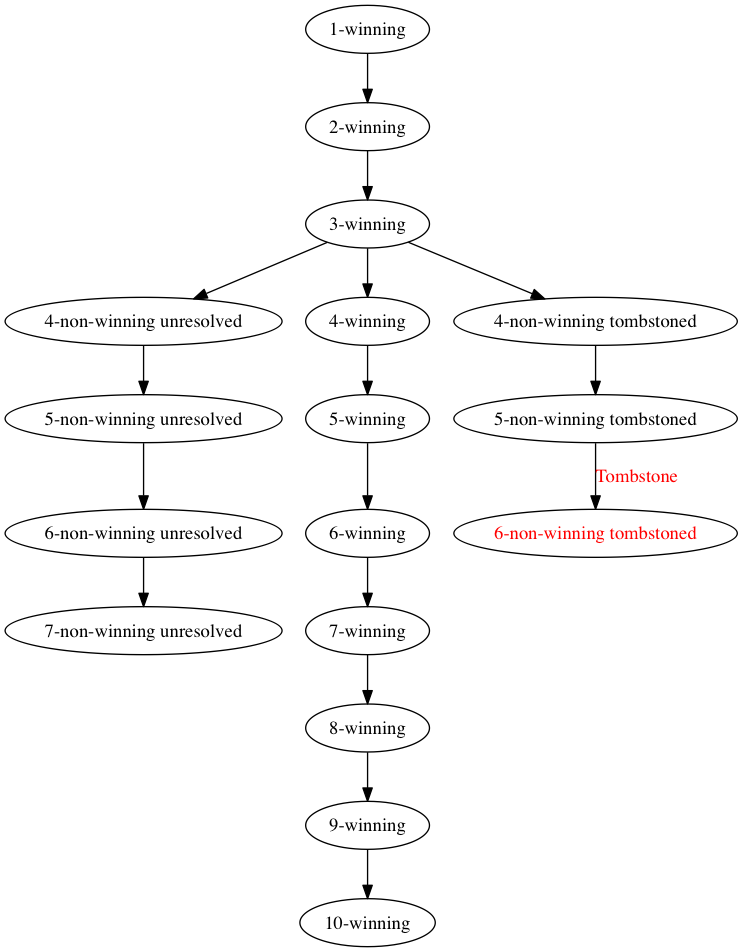
func (RevTree) RepairCycles 
Repair rev trees that have cycles introduced by SG Issue #2847
func (RevTree) UnmarshalJSON 
type RevisionCache 
type RevisionCache interface {
	// Get returns the given revision, and stores if not already cached.
	// When includeBody=true, the returned DocumentRevision will include a mutable shallow copy of the marshaled body.
	// When includeDelta=true, the returned DocumentRevision will include delta - requires additional locking during retrieval.
	Get(docID, revID string, includeBody bool, includeDelta bool) (DocumentRevision, error)

	// GetActive returns the current revision for the given doc ID, and stores if not already cached.
	// When includeBody=true, the returned DocumentRevision will include a mutable shallow copy of the marshaled body.
	GetActive(docID string, includeBody bool) (docRev DocumentRevision, err error)

	// Peek returns the given revision if present in the cache
	Peek(docID, revID string) (docRev DocumentRevision, found bool)

	// Put will store the given docRev in the cache
	Put(docRev DocumentRevision)

	// UpdateDelta stores the given toDelta value in the given rev if cached
	UpdateDelta(docID, revID string, toDelta RevisionDelta)
}
RevisionCache is an interface that can be used to fetch a DocumentRevision for a Doc ID and Rev ID pair.
func NewRevisionCache 
func NewRevisionCache(cacheOptions *RevisionCacheOptions, backingStore RevisionCacheBackingStore, statsCache *expvar.Map) RevisionCache
NewRevisionCache returns a RevisionCache implementation for the given config options.
type RevisionCacheBackingStore 
type RevisionCacheBackingStore interface {
	GetDocument(docid string, unmarshalLevel DocumentUnmarshalLevel) (doc *Document, err error)
	// contains filtered or unexported methods
}
RevisionCacheBackingStore is the interface required to be passed into a RevisionCache constructor to provide a backing store for loading documents.
type RevisionCacheOptions 
func DefaultRevisionCacheOptions 
func DefaultRevisionCacheOptions() *RevisionCacheOptions
type RevisionDelta 
type RevisionDelta struct {
	ToRevID           string   // Target revID for the delta
	DeltaBytes        []byte   // The actual delta
	AttachmentDigests []string // Digests for all attachments present on ToRevID
	ToChannels        base.Set // Full list of channels for the to revision
	RevisionHistory   []string // Revision history from parent of ToRevID to source revID, in descending order
	ToDeleted         bool     // Flag if ToRevID is a tombstone
}
RevisionDelta stores data about a delta between a revision and ToRevID.
type Revisions 
type Revisions map[string]interface{}
A revisions property found within a Body. Expected to be of the form:
Revisions["start"]: int64, starting generation number
Revisions["ids"]: []string, list of digests
Used as map[string]interface{} instead of Revisions struct because it's unmarshalled along with Body, and we don't need the overhead of allocating a new object
func (Revisions) ParseRevisions 
ParseRevisions returns revisions as a slice of revids.
func (Revisions) ShallowCopy 
type SGIndex 
type SGIndex struct {
	// contains filtered or unexported fields
}
SGIndex is used to manage the set of constants associated with each index definition
type SGIndexFlags 
type SGIndexFlags uint8
type SGIndexType 
type SGIndexType int
const (
	IndexAccess SGIndexType = iota
	IndexRoleAccess
	IndexChannels
	IndexAllDocs
	IndexTombstones
	IndexSyncDocs
)
type SGNode 
type SGNode struct {
	UUID string `json:"uuid"` // Node UUID
	Host string `json:"host"` // Host name
}
SGNode represents a single Sync Gateway node in the cluster
type SGR2Checkpoint 
type SGRCluster 
type SGRCluster struct {
	Replications map[string]*ReplicationCfg `json:"replications"` // Set of replications defined for the cluster, indexed by replicationID
	Nodes        map[string]*SGNode         `json:"nodes"`        // Set of nodes, indexed by host name
	// contains filtered or unexported fields
}
SGRCluster defines sg-replicate configuration and distribution for a collection of Sync Gateway nodes
func NewSGRCluster 
func NewSGRCluster() *SGRCluster
func (*SGRCluster) GetReplicationIDsForNode 
func (c *SGRCluster) GetReplicationIDsForNode(nodeUUID string) (replicationIDs []string)
func (*SGRCluster) RebalanceReplications 
func (c *SGRCluster) RebalanceReplications()
RebalanceReplications distributes the set of defined replications across the set of available nodes
type SGReplicateOptions 
type SequenceID 
type SequenceID struct {
	TriggeredBy uint64 // Int sequence: The sequence # that triggered this (0 if none)
	LowSeq      uint64 // Int sequence: Lowest contiguous sequence seen on the feed
	Seq         uint64 // Int sequence: The actual internal sequence
}
SequenceID doesn't do any clock hash management - it's expected that hashing has already been done (if required) when the clock is set.
func (SequenceID) Before 
func (s SequenceID) Before(s2 SequenceID) bool
The most significant value is TriggeredBy, unless it's zero, in which case use Seq. The tricky part is that "n" sorts after "n:m" for any nonzero m
func (SequenceID) Equals 
func (s SequenceID) Equals(s2 SequenceID) bool
Equality of sequences, based on seq, triggered by and low hash
func (SequenceID) IsNonZero 
func (s SequenceID) IsNonZero() bool
func (SequenceID) MarshalJSON 
func (s SequenceID) MarshalJSON() ([]byte, error)
func (SequenceID) SafeSequence 
func (s SequenceID) SafeSequence() uint64
func (SequenceID) String 
func (s SequenceID) String() string
Format sequence ID to send to clients. Sequence IDs can be in one of the following formats:
Seq                    - simple sequence
TriggeredBy:Seq        - when TriggeredBy is non-zero, LowSeq is zero
LowSeq:TriggeredBy:Seq - when LowSeq is non-zero.
When LowSeq is non-zero but TriggeredBy is zero, will appear as LowSeq::Seq. When LowSeq is non-zero but is greater than s.Seq (occurs when sending previously skipped sequences), ignore LowSeq.
func (*SequenceID) UnmarshalJSON 
func (s *SequenceID) UnmarshalJSON(data []byte) error
type SequenceIDParser 
type SequenceIDParser func(since string) (SequenceID, error)
Function signature for something that parses a sequence id from a string
type SetCheckpointMessage 
setCheckpoint message
func NewSetCheckpointMessage 
func NewSetCheckpointMessage() *SetCheckpointMessage
func (*SetCheckpointMessage) SetClient 
func (scm *SetCheckpointMessage) SetClient(client string)
func (*SetCheckpointMessage) SetRev 
func (scm *SetCheckpointMessage) SetRev(rev string)
func (*SetCheckpointMessage) String 
func (scm *SetCheckpointMessage) String() string
type SetCheckpointResponse 
func (*SetCheckpointResponse) Rev 
func (scr *SetCheckpointResponse) Rev() (rev string)
type SetSGR2CheckpointRequest 
type SetSGR2CheckpointRequest struct {
	Client     string  // Client is the unique ID of client checkpoint to retrieve
	RevID      *string // RevID of the previous checkpoint, if known.
	Checkpoint Body    // Checkpoint is the actual checkpoint body we're sending.
	// contains filtered or unexported fields
}
SetSGR2CheckpointRequest is a strongly typed 'setCheckpoint' request for SG-Replicate 2.
func (*SetSGR2CheckpointRequest) Response 
func (rq *SetSGR2CheckpointRequest) Response() (*SetSGR2CheckpointResponse, error)
type SetSGR2CheckpointResponse 
type SetSGR2CheckpointResponse struct {
	RevID string // The RevID of the sent checkpoint.
}
type ShardedLRURevisionCache 
type ShardedLRURevisionCache struct {
	// contains filtered or unexported fields
}
func NewShardedLRURevisionCache 
func NewShardedLRURevisionCache(shardCount uint16, capacity uint32, backingStore RevisionCacheBackingStore, cacheHitStat, cacheMissStat *expvar.Int) *ShardedLRURevisionCache
Creates a sharded revision cache with the given capacity and an optional loader function.
func (*ShardedLRURevisionCache) Get 
func (sc *ShardedLRURevisionCache) Get(docID, revID string, includeBody bool, includeDelta bool) (docRev DocumentRevision, err error)
func (*ShardedLRURevisionCache) GetActive 
func (sc *ShardedLRURevisionCache) GetActive(docID string, includeBody bool) (docRev DocumentRevision, err error)
func (*ShardedLRURevisionCache) Peek 
func (sc *ShardedLRURevisionCache) Peek(docID, revID string) (docRev DocumentRevision, found bool)
func (*ShardedLRURevisionCache) Put 
func (sc *ShardedLRURevisionCache) Put(docRev DocumentRevision)
func (*ShardedLRURevisionCache) UpdateDelta 
func (sc *ShardedLRURevisionCache) UpdateDelta(docID, revID string, toDelta RevisionDelta)
type SingleChannelCache 
type SingleChannelCache interface {
	GetChanges(options ChangesOptions) ([]*LogEntry, error)
	GetCachedChanges(options ChangesOptions) (validFrom uint64, result []*LogEntry)
	ChannelName() string
	SupportsLateFeed() bool
	LateSequenceUUID() uuid.UUID
	GetLateSequencesSince(sinceSequence uint64) (entries []*LogEntry, lastSequence uint64, err error)
	RegisterLateSequenceClient() (latestLateSeq uint64)
	ReleaseLateSequenceClient(sequence uint64) (success bool)
}
Minimizes need to perform GSI/View queries to respond to the changes feed by keeping a per-channel cache of the most recent changes in the channel. Changes might be received over DCP won't necessarily be in sequence order, but the changes are buffered and re-ordered before inserting into the cache, and so the cache is always kept in ascending order by sequence. (this is the global sync sequence, not the per-vbucket sequence).
Uniqueness guarantee: a given document should only have _one_ entry in the cache, which represents the most recent revision (the revision with the highest sequence number).
Completeness guarantee: the cache is guaranteed to have _every_ change in a channel from the validFrom sequence up to the current known latest change in that channel. Eg, there are no gaps/holes.
The validFrom state variable tracks the oldest sequence for which the cache is complete. This may be earlier than the oldest entry in the cache. Used to determine whether a GSI/View query is required for a given getChanges request.
Shortly after startup and receiving a few changes from DCP, the cache might look something like this:
┌───────────────────────────────────────────────────────────────────────────────────────┐ │ Changes for Channel X (CBServer + Cache) │ │ ┌─────────────────────────────────────────────────┐ │ │ │ Cache Subset (MaxSize=3) │ │ │ │ │ │ │ │ ┌─────────┐ ┌─────────┐ │ │ │ │ │ Seq: 8 │ │ Seq: 25 │ │ │ │ │ ▲ │ Doc: A │ │ Doc: B │ │ │ │ │ │ │ Rev: 1 │ │ Rev: 4 │ │ │ │ │ │ └─────────┘ └─────────┘ │ │ │ │ │ │ │ │ ValidFrom = Seq 5 │ │ │ │ (_sync:Seq at Startup) │ │ │ │ │ │ │ └─────────────────────────────────────────────────┘ │ │ │ └───────────────────────────────────────────────────────────────────────────────────────┘
All changes for the channel currently fit in the cache. The validFrom is set to the value of the _sync:Seq that was read on startup.
Later after more data has been added that will fit in the cache, it will look more like this:
┌───────────────────────────────────────────────────────────────────────────────────────┐ │ Changes for Channel X (CBServer + Cache) │ │ ┌─────────────────────────────────────────────┐ │ │ │ Cache Subset (MaxSize=3) │ │ │ │ │ │ │ ┌─────────┐ ┌─────────┐ ┌─────────┐ │ ┌─────────┐┌─────────┐ ┌─────────┐ │ │ │ │ Seq: 8 │ │ Seq: 25 │ │Seq: ... │ │ │Seq: 6002││Seq: 7022│ │Seq: 7027│ │ │ │ │ Doc: A │ │ Doc: B │ │Doc: ... │ │ ▲ │ Doc: A ││ Doc: H │ │ Doc: M │ │ │ │ │ Rev: 1 │ │ Rev: 4 │ │Rev: ... │ │ │ │Rev: 345 ││ Rev: 4 │ │ Rev: 47 │ │ │ │ └─────────┘ └─────────┘ └─────────┘ │ │ └─────────┘└─────────┘ └─────────┘ │ │ │ │ │ │ │ │ ValidFrom = Seq 5989 (cache known │ │ │ │ to be complete + valid from seq) │ │ │ │ │ │ │ └─────────────────────────────────────────────┘ │ │ │ └───────────────────────────────────────────────────────────────────────────────────────┘
If a calling function wanted to get all of the changes for the channel since Seq 3000, they would be forced to issue a GSI/View backfill query for changes is in the channel between 3000 and 5989, since the cache is only validFrom the sequence 5989. In this case, none of those backfilled values will fit in the cache, which is already full, however if it did have capacity available, then those values would be _prepended_ to the front of the cache and the validFrom sequence would be lowered to account for the fact that it's now valid from a lower sequence value. Entries that violated the guarantees described above would possibly be discarded.
type SkippedSequence 
type SkippedSequence struct {
	// contains filtered or unexported fields
}
type SkippedSequenceList 
type SkippedSequenceList struct {
	// contains filtered or unexported fields
}
SkippedSequenceList stores the set of skipped sequences as an ordered list of *SkippedSequence with an associated map for sequence-based lookup.
func NewSkippedSequenceList 
func NewSkippedSequenceList() *SkippedSequenceList
func (*SkippedSequenceList) Contains 
func (l *SkippedSequenceList) Contains(x uint64) bool
Contains does a simple search to detect presence
func (*SkippedSequenceList) Push 
func (l *SkippedSequenceList) Push(x *SkippedSequence) (err error)
Push sequence to the end of SkippedSequenceList. Validates sequence ordering in list.
func (*SkippedSequenceList) Remove 
func (l *SkippedSequenceList) Remove(x uint64) error
Removes a single entry from the list.
func (*SkippedSequenceList) RemoveSequences 
func (l *SkippedSequenceList) RemoveSequences(ctx context.Context, sequences []uint64) (removedCount int64)
type StableSequenceCallbackFunc 
type StableSequenceCallbackFunc func() uint64
type StatWaiter 
type StatWaiter struct {
	// contains filtered or unexported fields
}
func (*StatWaiter) Add 
func (sw *StatWaiter) Add(count int)
func (*StatWaiter) AddAndWait 
func (sw *StatWaiter) AddAndWait(count int)
type SubChangesBody 
type SubChangesBody struct {
	DocIDs []string `json:"docIDs"`
}
type SubChangesParams 
type SubChangesParams struct {
	// contains filtered or unexported fields
}
Helper for handling BLIP subChanges requests. Supports Stringer() interface to log aspects of the request.
func NewSubChangesParams 
func NewSubChangesParams(logCtx context.Context, rq *blip.Message, zeroSeq SequenceID, sequenceIDParser SequenceIDParser) (*SubChangesParams, error)
Create a new subChanges helper
func (*SubChangesParams) Since 
func (s *SubChangesParams) Since() SequenceID
func (*SubChangesParams) String 
func (s *SubChangesParams) String() string
Satisfy fmt.Stringer interface for dumping attributes of this subChanges request to logs
type SubChangesRequest 
type SubChangesRequest struct {
	Continuous     bool     // Continuous can be set to true if the requester wants change notifications to be sent indefinitely (optional)
	Batch          uint16   // Batch controls the maximum number of changes to send in a single change message (optional)
	Since          string   // Since represents the latest sequence ID already known to the requester (optional)
	Filter         string   // Filter is the name of a filter function known to the recipient (optional)
	FilterChannels []string // FilterChannels are a set of channels used with a 'sync_gateway/bychannel' filter (optional)
	DocIDs         []string // DocIDs specifies which doc IDs the recipient should send changes for (optional)
	ActiveOnly     bool     // ActiveOnly is set to `true` if the requester doesn't want to be sent tombstones. (optional)
	// contains filtered or unexported fields
}
SubChangesRequest is a strongly typed 'subChanges' request.
type SyncData 
type SyncData struct {
	CurrentRev      string              `json:"rev"`
	NewestRev       string              `json:"new_rev,omitempty"` // Newest rev, if different from CurrentRev
	Flags           uint8               `json:"flags,omitempty"`
	Sequence        uint64              `json:"sequence,omitempty"`
	UnusedSequences []uint64            `json:"unused_sequences,omitempty"` // unused sequences due to update conflicts/CAS retry
	RecentSequences []uint64            `json:"recent_sequences,omitempty"` // recent sequences for this doc - used in server dedup handling
	History         RevTree             `json:"history"`
	Channels        channels.ChannelMap `json:"channels,omitempty"`
	Access          UserAccessMap       `json:"access,omitempty"`
	RoleAccess      UserAccessMap       `json:"role_access,omitempty"`
	Expiry          *time.Time          `json:"exp,omitempty"`           // Document expiry.  Information only - actual expiry/delete handling is done by bucket storage.  Needs to be pointer for omitempty to work (see https://github.com/golang/go/issues/4357)
	Cas             string              `json:"cas"`                     // String representation of a cas value, populated via macro expansion
	Crc32c          string              `json:"value_crc32c"`            // String representation of crc32c hash of doc body, populated via macro expansion
	TombstonedAt    int64               `json:"tombstoned_at,omitempty"` // Time the document was tombstoned.  Used for view compaction
	Attachments     AttachmentsMeta     `json:"attachments,omitempty"`

	// Only used for performance metrics:
	TimeSaved time.Time `json:"time_saved,omitempty"` // Timestamp of save.

	// Backward compatibility (the "deleted" field was, um, deleted in commit 4194f81, 2/17/14)
	Deleted_OLD bool `json:"deleted,omitempty"`
	// contains filtered or unexported fields
}
The sync-gateway metadata stored in the "_sync" property of a Couchbase document.
func UnmarshalDocumentSyncData 
Unmarshals just a document's sync metadata from JSON data. (This is somewhat faster, if all you need is the sync data without the doc body.)
func UnmarshalDocumentSyncDataFromFeed 
func UnmarshalDocumentSyncDataFromFeed(data []byte, dataType uint8, needHistory bool) (result *SyncData, rawBody []byte, rawXattr []byte, err error)
TODO: Using a pool of unmarshal workers may help prevent memory spikes under load
func (*SyncData) GetSyncCas 
Converts the string hex encoding that's stored in the sync metadata to a uint64 cas value
func (*SyncData) HasValidSyncData 
func (*SyncData) HashRedact 
type UnsupportedOptions 
type UnsupportedOptions struct {
	UserViews                UserViewsOptions        `json:"user_views,omitempty"`                  // Config settings for user views
	OidcTestProvider         OidcTestProviderOptions `json:"oidc_test_provider,omitempty"`          // Config settings for OIDC Provider
	APIEndpoints             APIEndpoints            `json:"api_endpoints,omitempty"`               // Config settings for API endpoints
	WarningThresholds        WarningThresholds       `json:"warning_thresholds,omitempty"`          // Warning thresholds related to _sync size
	DisableCleanSkippedQuery bool                    `json:"disable_clean_skipped_query,omitempty"` // Clean skipped sequence processing bypasses final check
	OidcTlsSkipVerify        bool                    `json:"oidc_tls_skip_verify"`                  // Config option to enable self-signed certs for OIDC testing.
	SgrTlsSkipVerify         bool                    `json:"sgr_tls_skip_verify"`                   // Config option to enable self-signed certs for SG-Replicate testing.
}
type UserAccessMap 
Maps what users have access to what channels or roles, and when they got that access.
type UserViewsOptions 
type UserViewsOptions struct {
	Enabled *bool `json:"enabled,omitempty"` // Whether pass-through view query is supported through public API
}
type ViewDoc 
type ViewDoc struct {
	Json json.RawMessage // should be type 'document', but that fails to unmarshal correctly
}
type WarningThresholds 
type WarningThresholds struct {
	XattrSize      *uint32 `json:"xattr_size_bytes,omitempty"`               // Number of bytes to be used as a threshold for xattr size limit warnings
	ChannelsPerDoc *uint32 `json:"channels_per_doc,omitempty"`               // Number of channels per document to be used as a threshold for channel count warnings
	GrantsPerDoc   *uint32 `json:"access_and_role_grants_per_doc,omitempty"` // Number of access and role grants per document to be used as a threshold for grant count warnings
}
type Webhook 
type Webhook struct {
	AsyncEventHandler
	// contains filtered or unexported fields
}
Webhook is an implementation of EventHandler that sends an asynchronous HTTP POST
func NewWebhook 
Creates a new webhook handler based on the url and filter function.
func (*Webhook) HandleEvent 
Performs an HTTP POST to the url defined for the handler. If a filter function is defined, calls it to determine whether to POST. The payload for the POST is depends on the event type.
func (*Webhook) SanitizedUrl 
 Source Files

Source Files

- active_replicator.go
- active_replicator_checkpointer.go
- active_replicator_common.go
- active_replicator_config.go
- active_replicator_pull.go
- active_replicator_push.go
- attachment.go
- blip.go
- blip_handler.go
- blip_messages.go
- blip_messages_utils.go
- blip_sync_context.go
- blip_sync_messages.go
- blip_sync_stats.go
- change_cache.go
- change_listener.go
- changes.go
- changes_view.go
- channel_cache.go
- channel_cache_single.go
- crud.go
- database.go
- database_stats.go
- design_doc.go
- document.go
- event.go
- event_handler.go
- event_manager.go
- import.go
- import_listener.go
- import_pindex.go
- indexes.go
- query.go
- repair_bucket.go
- revision.go
- revision_cache_bypass.go
- revision_cache_interface.go
- revision_cache_lru.go
- revtree.go
- sequence_allocator.go
- sequence_id.go
- sg_replicate_cfg.go
- sg_replicate_conflict_resolver.go
- sg_replicate_util.go
- special_docs.go
- users.go
- util_testing.go
- utils.go