

 README

README

Godis



Godis is a simple implementation of Redis Server, which intents to provide an example of writing a high concurrent
middleware using golang.
Gods implemented most features of redis, including 5 data structures, ttl, publish/subscribe, geo and AOF persistence.
Godis can run as a server side cluster which is transparent to client. You can connect to any node in the cluster to access all data in the cluster:
If you could read Chinese, you can find more details in My Blog.
Get Started
You can get runnable program in the releases of this repository, which supports Linux and Darwin system.
./godis-darwin
./godis-linux
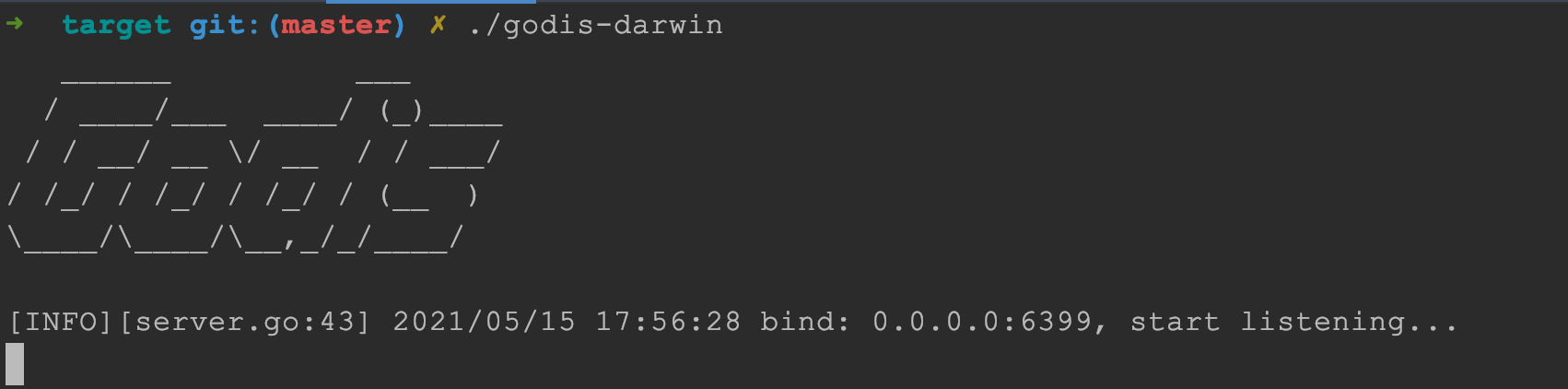
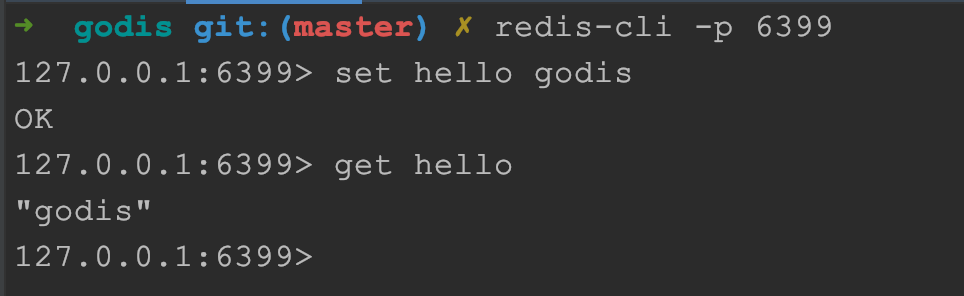
You could use redis-cli or other redis client to connect godis server, which listens on 0.0.0.0:6399 on default mode.
The program will try to read config file path from environment variable CONFIG.
If environment variable is not set, then the program try to read redis.conf in the working directory.
If there is no such file, then the program will run with default config.
cluster mode
Godis can work in cluster mode, please append following lines to redis.conf file
peers localhost:7379,localhost:7389 // other node in cluster
self  localhost:6399 // self address
We provide node1.conf and node2.conf for demonstration. use following command line to start a two-node-cluster:
CONFIG=node1.conf ./godis-darwin &
CONFIG=node2.conf ./godis-darwin &
Connect to a node in the cluster to access all data in the cluster:
redis-cli -p 6399
Commands
Supported Commands:
- Keys
- del
- expire
- expireat
- pexpire
- pexpireat
- ttl
- pttl
- persist
- exists
- type
- rename
- renamenx
- Server
- flushdb
- flushall
- keys
- bgrewriteaof
- String
- set
- setnx
- setex
- psetex
- mset
- mget
- msetnx
- get
- getset
- incr
- incrby
- incrbyfloat
- decr
- decrby
- List
- lpush
- lpushx
- rpush
- rpushx
- lpop
- rpop
- rpoplpush
- lrem
- llen
- lindex
- lset
- lrange
- Hash
- hset
- hsetnx
- hget
- hexists
- hdel
- hlen
- hmget
- hmset
- hkeys
- hvals
- hgetall
- hincrby
- hincrbyfloat
- Set
- sadd
- sismember
- srem
- scard
- smembers
- sinter
- sinterstore
- sunion
- sunionstore
- sdiff
- sdiffstore
- srandmember
- SortedSet
- zadd
- zscore
- zincrby
- zrank
- zcount
- zrevrank
- zcard
- zrange
- zrevrange
- zrangebyscore
- zrevrangebyscore
- zrem
- zremrangebyscore
- zremrangebyrank
- Pub / Sub
- publish
- subscribe
- unsubscribe
- Geo
- GeoAdd
- GeoPos
- GeoDist
- GeoHash
- GeoRadius
- GeoRadiusByMember
Read My Code
If you want to read my code in this repository, here is a simple guidance.
- cmd: only the entry point
- config: config parser
- interface: some interface definitions
- lib: some utils, such as logger, sync utils and wildcard
I suggest focusing on the following directories:
- tcp: the tcp server
- redis: the redis protocol parser
- datastruct: the implements of data structures
- dict: a concurrent hash map
- list: a linked list
- lock: it is used to lock keys to ensure thread safety
- set: a hash set based on map
- sortedset: a sorted set implements based on skiplist
- db: the implements of the redis db
- db.go: the basement of database
- router.go: it find handler for commands
- keys.go: handlers for keys commands
- string.go: handlers for string commands
- list.go: handlers for list commands
- hash.go: handlers for hash commands
- set.go: handlers for set commands
- sortedset.go: handlers for sorted set commands
- pubsub.go: implements of publish / subscribe
- aof.go: implements of AOF persistence and rewrite
License
This project is licensed under the GPL license.
 Documentation

Documentation

Overview 
Package godis is a memory database with redis compatible interface
Index 
- func Auth(db *DB, c redis.Connection, args [][]byte) redis.Reply
- func BGRewriteAOF(db *DB, args [][]byte) redis.Reply
- func Decr(db *DB, args [][]byte) redis.Reply
- func DecrBy(db *DB, args [][]byte) redis.Reply
- func Del(db *DB, args [][]byte) redis.Reply
- func EntityToCmd(key string, entity *DataEntity) *reply.MultiBulkReply
- func Exists(db *DB, args [][]byte) redis.Reply
- func Expire(db *DB, args [][]byte) redis.Reply
- func ExpireAt(db *DB, args [][]byte) redis.Reply
- func FlushAll(db *DB, args [][]byte) redis.Reply
- func FlushDB(db *DB, args [][]byte) redis.Reply
- func GeoAdd(db *DB, args [][]byte) redis.Reply
- func GeoDist(db *DB, args [][]byte) redis.Reply
- func GeoHash(db *DB, args [][]byte) redis.Reply
- func GeoPos(db *DB, args [][]byte) redis.Reply
- func GeoRadius(db *DB, args [][]byte) redis.Reply
- func GeoRadiusByMember(db *DB, args [][]byte) redis.Reply
- func Get(db *DB, args [][]byte) redis.Reply
- func GetSet(db *DB, args [][]byte) redis.Reply
- func HDel(db *DB, args [][]byte) redis.Reply
- func HExists(db *DB, args [][]byte) redis.Reply
- func HGet(db *DB, args [][]byte) redis.Reply
- func HGetAll(db *DB, args [][]byte) redis.Reply
- func HIncrBy(db *DB, args [][]byte) redis.Reply
- func HIncrByFloat(db *DB, args [][]byte) redis.Reply
- func HKeys(db *DB, args [][]byte) redis.Reply
- func HLen(db *DB, args [][]byte) redis.Reply
- func HMGet(db *DB, args [][]byte) redis.Reply
- func HMSet(db *DB, args [][]byte) redis.Reply
- func HSet(db *DB, args [][]byte) redis.Reply
- func HSetNX(db *DB, args [][]byte) redis.Reply
- func HVals(db *DB, args [][]byte) redis.Reply
- func Incr(db *DB, args [][]byte) redis.Reply
- func IncrBy(db *DB, args [][]byte) redis.Reply
- func IncrByFloat(db *DB, args [][]byte) redis.Reply
- func Keys(db *DB, args [][]byte) redis.Reply
- func LIndex(db *DB, args [][]byte) redis.Reply
- func LLen(db *DB, args [][]byte) redis.Reply
- func LPop(db *DB, args [][]byte) redis.Reply
- func LPush(db *DB, args [][]byte) redis.Reply
- func LPushX(db *DB, args [][]byte) redis.Reply
- func LRange(db *DB, args [][]byte) redis.Reply
- func LRem(db *DB, args [][]byte) redis.Reply
- func LSet(db *DB, args [][]byte) redis.Reply
- func MGet(db *DB, args [][]byte) redis.Reply
- func MSet(db *DB, args [][]byte) redis.Reply
- func MSetNX(db *DB, args [][]byte) redis.Reply
- func PExpire(db *DB, args [][]byte) redis.Reply
- func PExpireAt(db *DB, args [][]byte) redis.Reply
- func PSetEX(db *DB, args [][]byte) redis.Reply
- func PTTL(db *DB, args [][]byte) redis.Reply
- func Persist(db *DB, args [][]byte) redis.Reply
- func Ping(db *DB, args [][]byte) redis.Reply
- func RPop(db *DB, args [][]byte) redis.Reply
- func RPopLPush(db *DB, args [][]byte) redis.Reply
- func RPush(db *DB, args [][]byte) redis.Reply
- func RPushX(db *DB, args [][]byte) redis.Reply
- func Rename(db *DB, args [][]byte) redis.Reply
- func RenameNx(db *DB, args [][]byte) redis.Reply
- func SAdd(db *DB, args [][]byte) redis.Reply
- func SCard(db *DB, args [][]byte) redis.Reply
- func SDiff(db *DB, args [][]byte) redis.Reply
- func SDiffStore(db *DB, args [][]byte) redis.Reply
- func SInter(db *DB, args [][]byte) redis.Reply
- func SInterStore(db *DB, args [][]byte) redis.Reply
- func SIsMember(db *DB, args [][]byte) redis.Reply
- func SMembers(db *DB, args [][]byte) redis.Reply
- func SRandMember(db *DB, args [][]byte) redis.Reply
- func SRem(db *DB, args [][]byte) redis.Reply
- func SUnion(db *DB, args [][]byte) redis.Reply
- func SUnionStore(db *DB, args [][]byte) redis.Reply
- func Set(db *DB, args [][]byte) redis.Reply
- func SetEX(db *DB, args [][]byte) redis.Reply
- func SetNX(db *DB, args [][]byte) redis.Reply
- func TTL(db *DB, args [][]byte) redis.Reply
- func Type(db *DB, args [][]byte) redis.Reply
- func ZAdd(db *DB, args [][]byte) redis.Reply
- func ZCard(db *DB, args [][]byte) redis.Reply
- func ZCount(db *DB, args [][]byte) redis.Reply
- func ZIncrBy(db *DB, args [][]byte) redis.Reply
- func ZRange(db *DB, args [][]byte) redis.Reply
- func ZRangeByScore(db *DB, args [][]byte) redis.Reply
- func ZRank(db *DB, args [][]byte) redis.Reply
- func ZRem(db *DB, args [][]byte) redis.Reply
- func ZRemRangeByRank(db *DB, args [][]byte) redis.Reply
- func ZRemRangeByScore(db *DB, args [][]byte) redis.Reply
- func ZRevRange(db *DB, args [][]byte) redis.Reply
- func ZRevRangeByScore(db *DB, args [][]byte) redis.Reply
- func ZRevRank(db *DB, args [][]byte) redis.Reply
- func ZScore(db *DB, args [][]byte) redis.Reply
- type DB
- func (db *DB) AddAof(args *reply.MultiBulkReply)
- func (db *DB) AfterClientClose(c redis.Connection)
- func (db *DB) Close()
- func (db *DB) Exec(c redis.Connection, cmdArgs [][]byte) (result redis.Reply)
- func (db *DB) Expire(key string, expireTime time.Time)
- func (db *DB) Flush()
- func (db *DB) GetEntity(key string) (*DataEntity, bool)
- func (db *DB) IsExpired(key string) bool
- func (db *DB) Lock(key string)
- func (db *DB) Locks(keys ...string)
- func (db *DB) Persist(key string)
- func (db *DB) PutEntity(key string, entity *DataEntity) int
- func (db *DB) PutIfAbsent(key string, entity *DataEntity) int
- func (db *DB) PutIfExists(key string, entity *DataEntity) int
- func (db *DB) RLock(key string)
- func (db *DB) RLocks(keys ...string)
- func (db *DB) RUnLock(key string)
- func (db *DB) RUnLocks(keys ...string)
- func (db *DB) Remove(key string)
- func (db *DB) Removes(keys ...string) (deleted int)
- func (db *DB) UnLock(key string)
- func (db *DB) UnLocks(keys ...string)
- type DataEntity
Constants 
This section is empty.
Variables 
This section is empty.
Functions 
func BGRewriteAOF 
BGRewriteAOF asynchronously rewrites Append-Only-File
func EntityToCmd 
func EntityToCmd(key string, entity *DataEntity) *reply.MultiBulkReply
EntityToCmd serialize data entity to redis command
func GeoRadiusByMember 
GeoRadiusByMember returns members within max distance of given member's location
func HIncrByFloat 
HIncrByFloat increments the float value of a hash field by the given number
func IncrByFloat 
IncrByFloat increments the float value of a key by given value
func SDiffStore 
SDiffStore subtracts multiple sets and store the result in a key
func SInterStore 
SInterStore intersects multiple sets and store the result in a key
func SRandMember 
SRandMember gets random members from set
func SUnionStore 
SUnionStore adds multiple sets and store the result in a key
func ZRangeByScore 
ZRangeByScore gets members which score within given range, in ascending order
func ZRemRangeByRank 
ZRemRangeByRank removes members within given indexes
func ZRemRangeByScore 
ZRemRangeByScore removes members which score within given range
func ZRevRangeByScore 
ZRevRangeByScore gets number of members which score within given range, in descending order
Types 
type DB 
type DB struct {
	// contains filtered or unexported fields
}
DB stores data and execute user's commands
func (*DB) AddAof 
func (db *DB) AddAof(args *reply.MultiBulkReply)
AddAof send command to aof goroutine through channel
func (*DB) AfterClientClose 
func (db *DB) AfterClientClose(c redis.Connection)
AfterClientClose does some clean after client close connection
func (*DB) Exec 
Exec executes command parameter `cmdArgs` contains command and its arguments, for example: "set key value"
func (*DB) GetEntity 
func (db *DB) GetEntity(key string) (*DataEntity, bool)
GetEntity returns DataEntity bind to given key
func (*DB) PutEntity 
func (db *DB) PutEntity(key string, entity *DataEntity) int
PutEntity a DataEntity into DB
func (*DB) PutIfAbsent 
func (db *DB) PutIfAbsent(key string, entity *DataEntity) int
PutIfAbsent insert an DataEntity only if the key not exists
func (*DB) PutIfExists 
func (db *DB) PutIfExists(key string, entity *DataEntity) int
PutIfExists edit an existing DataEntity
type DataEntity 
type DataEntity struct {
	Data interface{}
}
DataEntity stores data bound to a key, including a string, list, hash, set and so on
 Source Files

Source Files

 Directories

Directories

| Path | Synopsis |
|---|---|
|
Package cluster provides a server side cluster which is transparent to client.
|
Package cluster provides a server side cluster which is transparent to client. |
|
datastruct
|
|
|
interface
|
|
|
lib
|
|
|
redis
|
|