

 README

README

herald
HTML-inspired typography for terminal UIs in Go.






Quick Start | Elements | Customization | Themes | Examples
Herald maps familiar HTML elements (H1–H6, P, Blockquote, UL, OL, Code, HR, Alerts, and inline styles) to styled terminal output, built on lipgloss v2.
It ships with a Rose Pine-inspired default theme, built-in themes matching the Charm ecosystem (Dracula, Catppuccin, Base16, Charm) for seamless pairing with huh and other Charm-based TUIs, and full style customization via functional options and ColorPalette.
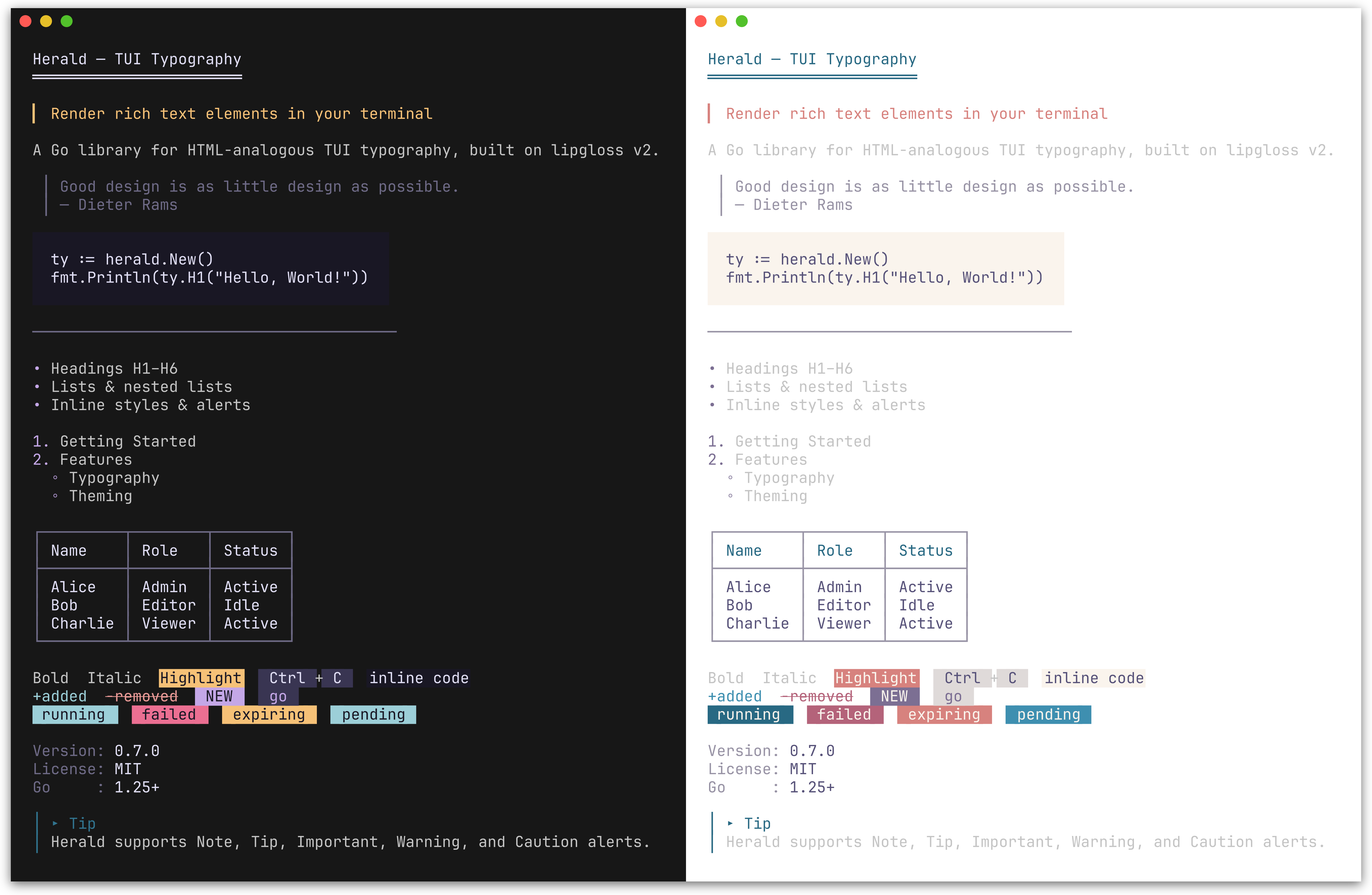
Default Rose Pine theme (dark and light). Herald also ships with Dracula, Catppuccin, Base16, and Charm themes.
Installation
go get github.com/indaco/herald
Requires Go 1.25 or later.
Quick start
package main

import (
    "fmt"
    "github.com/indaco/herald"
)

func main() {
    ty := herald.New()

    fmt.Println(ty.H1("Getting Started"))
    fmt.Println(ty.P("Herald renders terminal typography using lipgloss styles."))
    fmt.Println(ty.UL("Headings", "Block elements", "Inline styles"))
}
Available elements
Headings
Preview
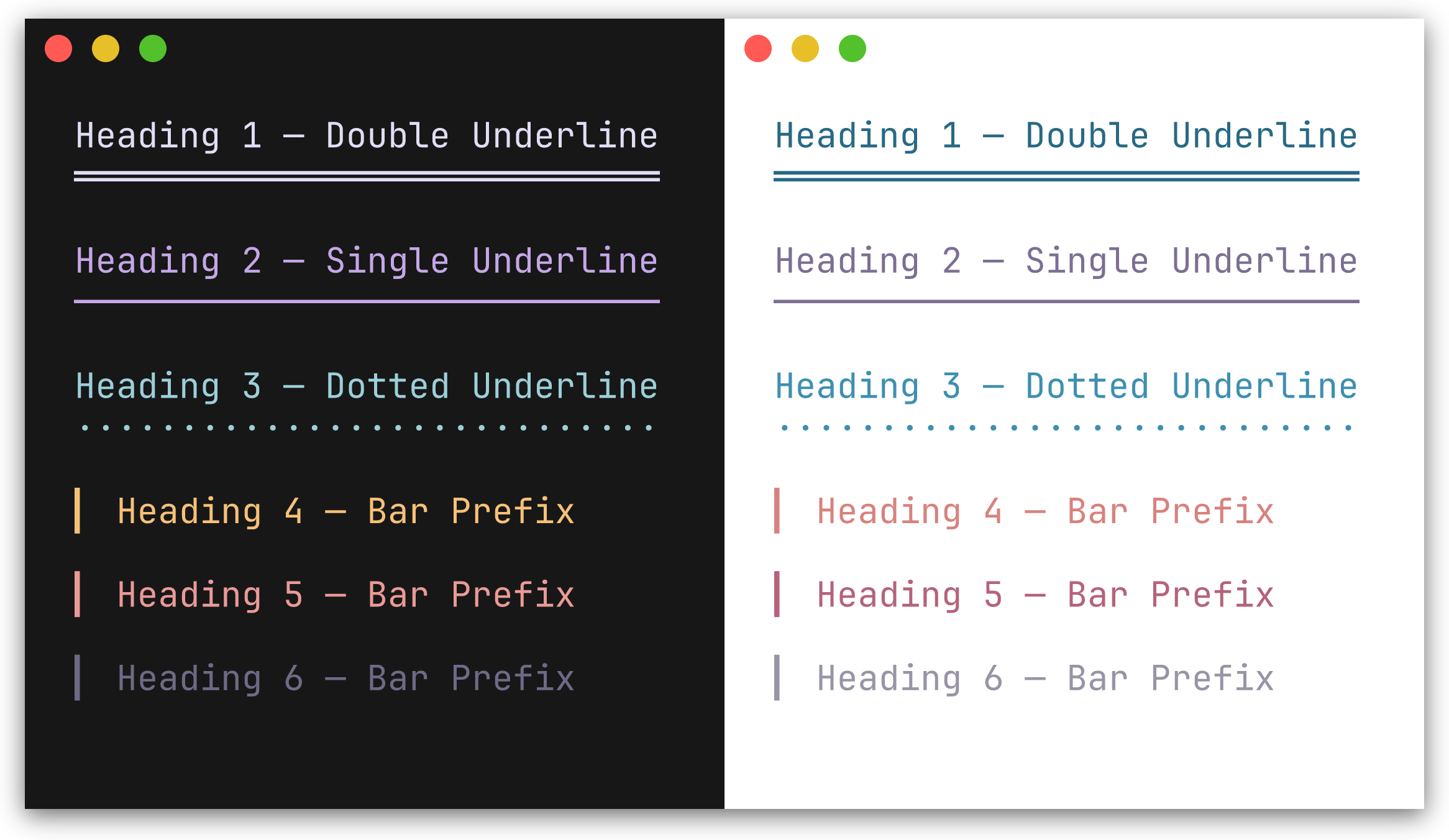
H1–H3 render with a repeated underline character beneath the text. H4–H6 render with a left bar prefix.
| Method | Decoration | Default character |
|---|---|---|
H1(text) |
underline | ═ |
H2(text) |
underline | ─ |
H3(text) |
underline | · |
H4(text) |
bar prefix | ▎ |
H5(text) |
bar prefix | ▎ |
H6(text) |
bar prefix | ▎ |
Block elements
Preview
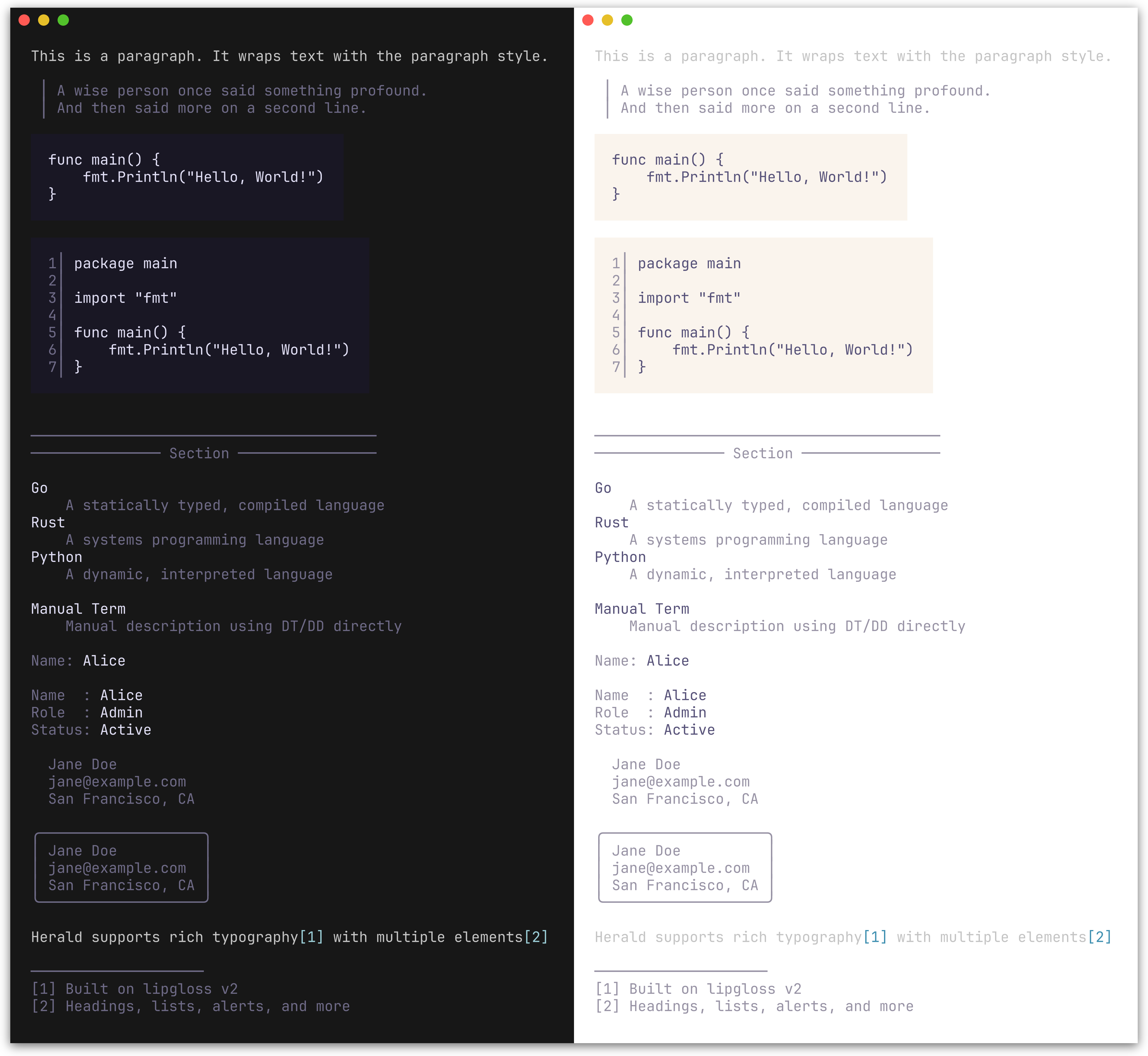
| Method | Description |
|---|---|
P(text) |
Paragraph |
Blockquote(text) |
Indented block with a left bar; supports multi-line input |
Code(text, lang) |
Inline code with background highlight; lang is optional, used when a CodeFormatter is set |
CodeBlock(text, lang) |
Fenced code block with padding; lang is optional, used when a CodeFormatter is set |
HR() |
Horizontal rule, configurable width and character |
DL(pairs) |
Definition list from [][2]string pairs (term, description) |
DT(text) |
Definition term (standalone) |
DD(text) |
Definition description (standalone) |
fmt.Println(ty.Blockquote("First line.\nSecond line."))
fmt.Println(ty.Code("os.Exit(1)"))
fmt.Println(ty.CodeBlock("func main() {\n\tfmt.Println(\"hello\")\n}"))
fmt.Println(ty.HR())

fmt.Println(ty.DL([][2]string{
    {"Go", "A statically typed, compiled language"},
    {"Rust", "A systems programming language"},
}))
Lists
Preview
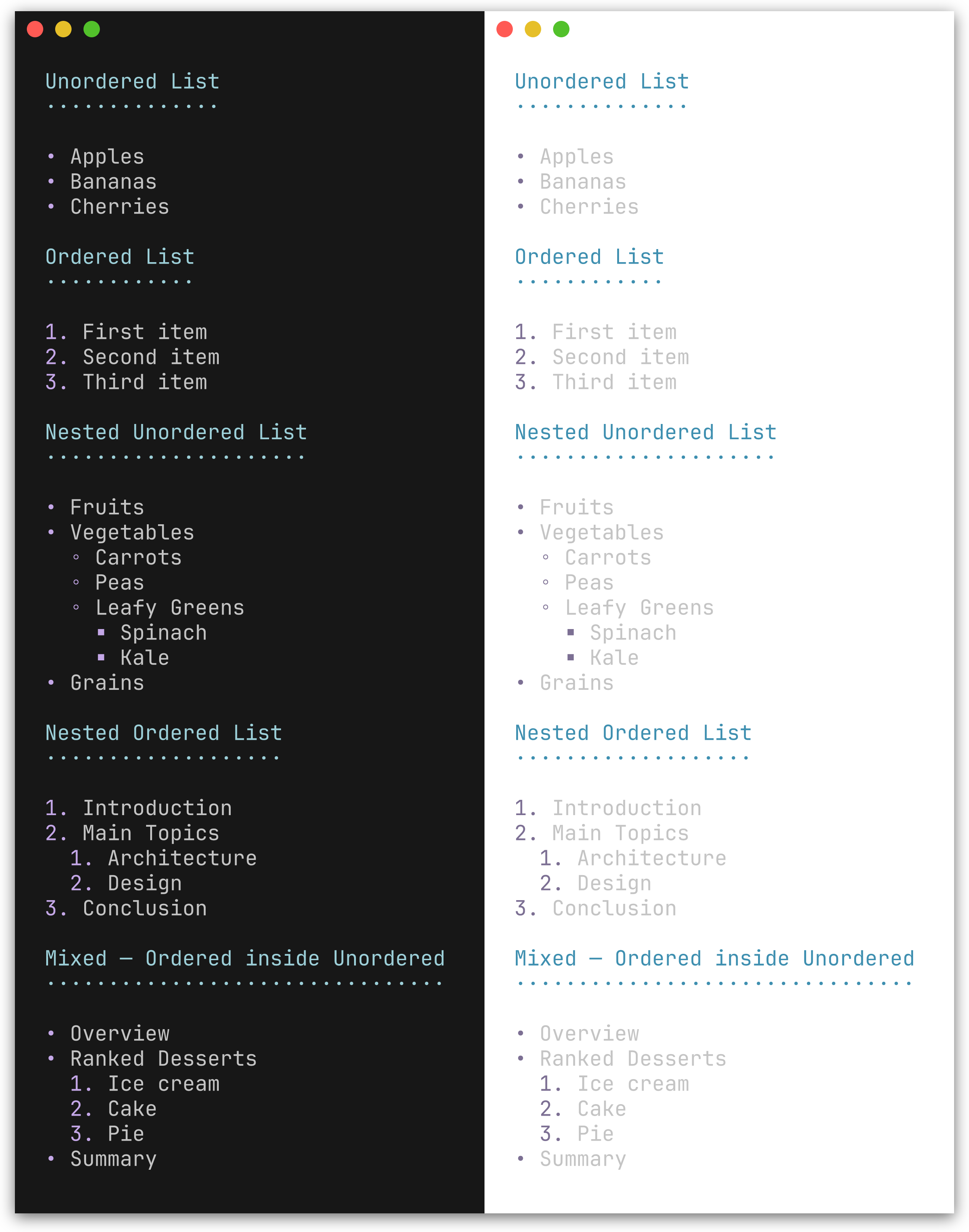
fmt.Println(ty.UL("Apples", "Bananas", "Cherries"))
fmt.Println(ty.OL("First", "Second", "Third"))
UL uses a bullet character (default •). OL uses 1., 2., 3. markers.
Nested lists
NestUL and NestOL render hierarchical lists with configurable indentation, bullet cycling, and mixed nesting.
Constructors:
| Function | Description |
|---|---|
Item(text) |
Leaf item (no children) |
Items(texts...) |
Batch-convert strings to leaf items |
ItemWithChildren(text, children...) |
Item with unordered sub-list |
ItemWithOLChildren(text, children...) |
Item with ordered sub-list |
// Nested unordered list with mixed sub-lists
fmt.Println(ty.NestUL(
    herald.Item("Fruits"),
    herald.ItemWithChildren("Vegetables",
        herald.Item("Carrots"),
        herald.Item("Peas"),
    ),
    herald.ItemWithOLChildren("Ranked Desserts",
        herald.Item("Ice cream"),
        herald.Item("Cake"),
    ),
))
• Fruits
• Vegetables
  ◦ Carrots
  ◦ Peas
• Ranked Desserts
  1. Ice cream
  2. Cake
// Nested ordered list
fmt.Println(ty.NestOL(
    herald.Item("Introduction"),
    herald.ItemWithOLChildren("Main Topics",
        herald.Item("Architecture"),
        herald.Item("Design"),
    ),
    herald.Item("Conclusion"),
))
1. Introduction
2. Main Topics
  1. Architecture
  2. Design
3. Conclusion
Enable WithHierarchicalNumbers(true) for outline-style numbering (2.1., 2.2.):
ty := herald.New(herald.WithHierarchicalNumbers(true))

fmt.Println(ty.NestOL(
    herald.Item("Introduction"),
    herald.ItemWithOLChildren("Main Topics",
        herald.Item("Architecture"),
        herald.Item("Design"),
    ),
    herald.Item("Conclusion"),
))
1. Introduction
2. Main Topics
  2.1. Architecture
  2.2. Design
3. Conclusion
Inline styles
Preview
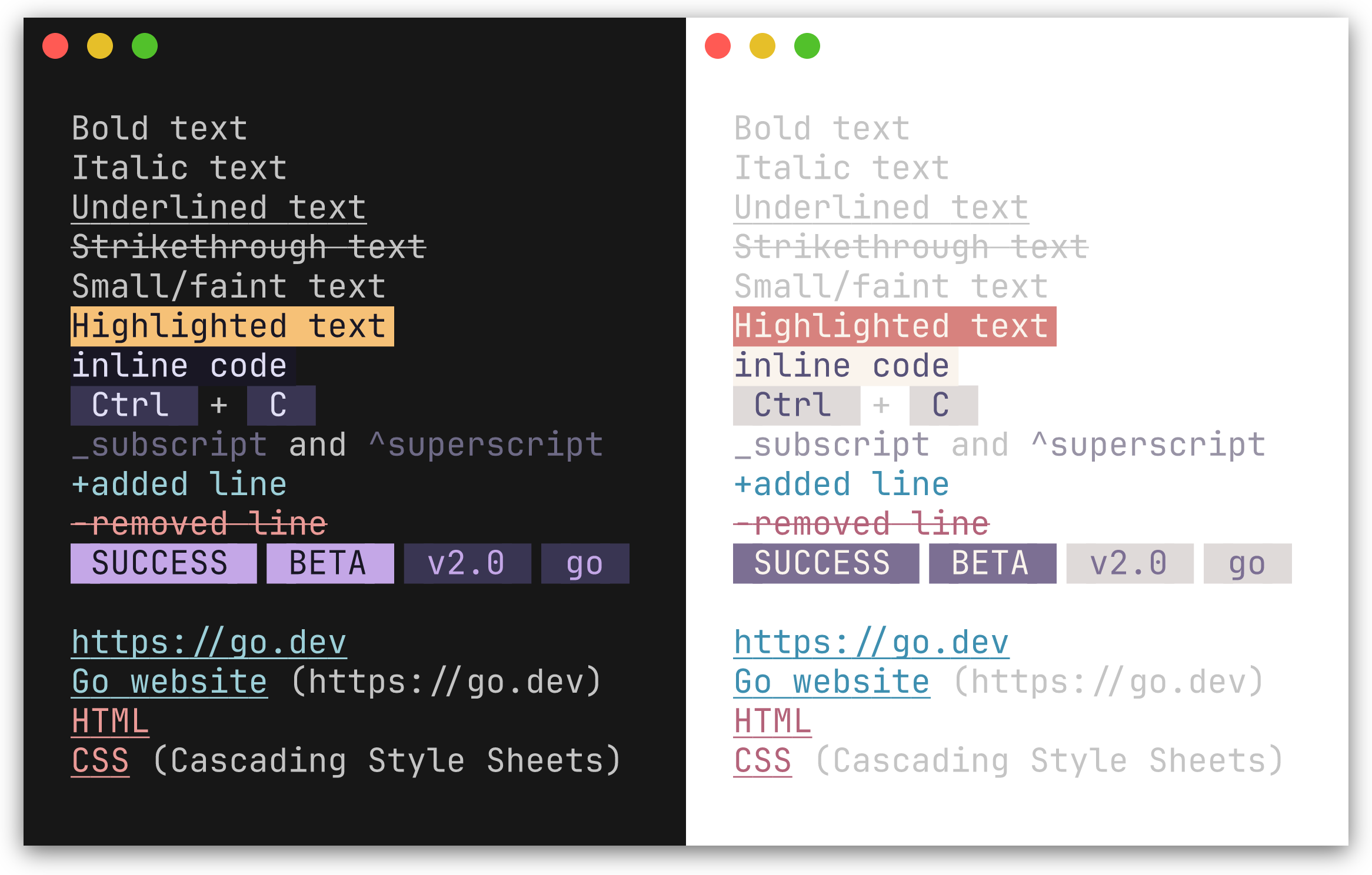
| Method | Renders as |
|---|---|
Bold(text) |
Bold |
Italic(text) |
Italic |
Underline(text) |
Underlined |
Strikethrough(text) |
Strikethrough |
Small(text) |
Faint |
Mark(text) |
Highlighted background |
Link(label, url) |
Styled link; url is optional — when both differ, renders as label (url) |
Kbd(text) |
Keyboard key indicator |
Abbr(abbr, desc) |
Abbreviation; desc is optional, appended in parentheses |
Sub(text) |
Subscript, prefixed with _ |
Sup(text) |
Superscript, prefixed with ^ |
fmt.Println(ty.Bold("important") + " and " + ty.Italic("nuanced"))
fmt.Println(ty.Kbd("Ctrl") + " + " + ty.Kbd("C"))
fmt.Println(ty.Link("Go website", "https://go.dev"))
fmt.Println(ty.Abbr("CSS", "Cascading Style Sheets"))
fmt.Println(ty.Sub("2") + "O" + ty.Sup("n"))
Alerts
Preview
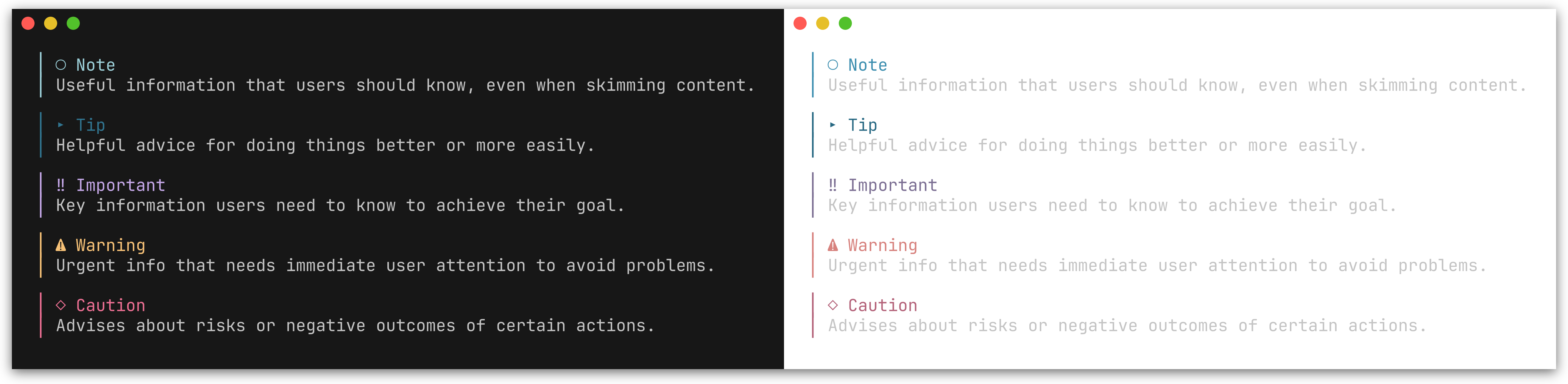
GitHub-style alert callouts with colored bars, icons, and labels. Five types are supported: Note, Tip, Important, Warning, and Caution.
| Method | Icon | Color | Description |
|---|---|---|---|
Note(text) |
○ |
Blue | Useful information for the reader |
Tip(text) |
▸ |
Green | Helpful advice |
Important(text) |
‼ |
Purple | Key information |
Warning(text) |
⚠ |
Amber | Urgent attention needed |
Caution(text) |
◇ |
Red | Risk or negative outcomes |
fmt.Println(ty.Note("Useful information that users should know."))
fmt.Println(ty.Tip("Helpful advice for doing things better."))
fmt.Println(ty.Important("Key information users need to know."))
fmt.Println(ty.Warning("Urgent info that needs immediate attention."))
fmt.Println(ty.Caution("Advises about risks or negative outcomes."))
│ ○ Note
│ Useful information that users should know.

│ ⚠ Warning
│ Urgent info that needs immediate attention.
You can also use the generic Alert method with an AlertType:
fmt.Println(ty.Alert(herald.AlertNote, "Generic alert call."))
Customization
Functional options
Pass options to herald.New() to override individual styles or tokens.
ty := herald.New(
    herald.WithHRWidth(60),
    herald.WithBulletChar("-"),
    herald.WithH1Style(
        lipgloss.NewStyle().Bold(true).Foreground(lipgloss.Color("#FF0000")),
    ),
)
Style options — each accepts a lipgloss.Style:
| Option | Targets |
|---|---|
WithH1Style – WithH6Style |
Heading levels 1–6 |
WithParagraphStyle |
P |
WithBlockquoteStyle |
Blockquote |
WithCodeInlineStyle |
Code |
WithCodeBlockStyle |
CodeBlock |
WithHRStyle |
HR |
WithBoldStyle |
Bold |
WithItalicStyle |
Italic |
WithUnderlineStyle |
Underline |
WithStrikethroughStyle |
Strikethrough |
WithSmallStyle |
Small |
WithMarkStyle |
Mark |
WithLinkStyle |
Link |
WithKbdStyle |
Kbd |
WithAbbrStyle |
Abbr |
WithListBulletStyle |
Bullet/number marker |
WithListItemStyle |
List item text |
WithDTStyle |
Definition term |
WithDDStyle |
Definition description |
WithAlertStyle(type, style) |
Alert of given type |
Token options — each accepts a string or int:
| Option | Default | Description |
|---|---|---|
WithH1UnderlineChar(c) |
═ |
Underline character for H1 |
WithH2UnderlineChar(c) |
─ |
Underline character for H2 |
WithH3UnderlineChar(c) |
· |
Underline character for H3 |
WithHeadingBarChar(c) |
▎ |
Bar prefix character for H4–H6 |
WithBulletChar(c) |
• |
Bullet character for UL |
WithNestedBulletChars(chars) |
•, ◦, ▪, ▹ |
Bullet characters cycling per depth for NestUL |
WithListIndent(n) |
2 |
Spaces per nesting level for NestUL/NestOL |
WithHierarchicalNumbers(b) |
false |
Outline-style numbering for nested OL (e.g. 2.1.) |
WithHRChar(c) |
─ |
Character repeated for HR |
WithHRWidth(w) |
40 |
Width of HR in characters |
WithBlockquoteBar(c) |
│ |
Left bar character for Blockquote |
WithAlertBar(c) |
│ |
Left bar character for alerts |
WithAlertIcon(type, icon) |
per-type | Override icon for a specific alert type |
WithAlertLabel(type, label) |
per-type | Override label for a specific alert type |
Code formatting
WithCodeFormatter accepts a func(code, language string) string callback. When set, Code() and CodeBlock() pass the raw text and language string to the formatter before applying the lipgloss style. When not set (the default), behavior is unchanged.
import (
    "strings"

    "github.com/alecthomas/chroma/v2/quick"
    "github.com/indaco/herald"
)

func chromaFormatter(style string) func(code, language string) string {
    return func(code, language string) string {
        var buf strings.Builder
        err := quick.Highlight(&buf, code, language, "terminal256", style)
        if err != nil {
            return code
        }
        return strings.TrimRight(buf.String(), "\n")
    }
}

ty := herald.New(
    herald.WithCodeFormatter(chromaFormatter("catppuccin-mocha")),
)

fmt.Println(ty.CodeBlock(`func main() { fmt.Println("hello") }`, "go"))
See examples/07_syntax-highlighting/ for a chroma-based example, or examples/08_tree-sitter-highlighting/ for a tree-sitter-based alternative.
Color palette
ColorPalette lets you define 9 colors and derive a complete theme from them. All style fields map from this palette; configurable tokens use the same defaults as DefaultTheme.
| Field | Maps to |
|---|---|
Primary |
H1 headings |
Secondary |
H2, list bullets |
Tertiary |
H3, links |
Accent |
H4, mark background |
Highlight |
H5, Abbr |
Muted |
H6, blockquote, HR, sub/sup, DD |
Text |
Body text, paragraphs, list items, inline code, DT |
Surface |
Background for inline code and Kbd |
Base |
Background for code blocks; mark foreground |
Pass the palette to New() via WithPalette, or call ThemeFromPalette to construct a Theme value directly.
// Dracula-inspired palette
palette := herald.ColorPalette{
    Primary:   lipgloss.Color("#bd93f9"), // purple
    Secondary: lipgloss.Color("#ff79c6"), // pink
    Tertiary:  lipgloss.Color("#8be9fd"), // cyan
    Accent:    lipgloss.Color("#ffb86c"), // orange
    Highlight: lipgloss.Color("#ff5555"), // red
    Muted:     lipgloss.Color("#6272a4"), // comment gray
    Text:      lipgloss.Color("#f8f8f2"), // foreground
    Surface:   lipgloss.Color("#44475a"), // current line
    Base:      lipgloss.Color("#282a36"), // background
}

ty := herald.New(herald.WithPalette(palette))
Alert palette
AlertPalette lets you override the 5 alert colors independently from the main ColorPalette:
ty := herald.New(
    herald.WithAlertPalette(herald.AlertPalette{
        Note:      lipgloss.Color("#0969DA"),
        Tip:       lipgloss.Color("#1A7F37"),
        Important: lipgloss.Color("#8250DF"),
        Warning:   lipgloss.Color("#9A6700"),
        Caution:   lipgloss.Color("#CF222E"),
    }),
)
Individual alert icons and labels can also be customized:
ty := herald.New(
    herald.WithAlertIcon(herald.AlertTip, "💡"),
    herald.WithAlertLabel(herald.AlertNote, "Info"),
)
You can combine WithPalette with other options to override specific fields after the palette is applied:
ty := herald.New(
    herald.WithPalette(palette),
    herald.WithHRWidth(60),
    herald.WithBulletChar("-"),
)
Built-in themes
Herald ships with named themes that match huh's built-in color palettes. Colors auto-adapt to light/dark terminal backgrounds using lipgloss.HasDarkBackground.
| Function | Palette |
|---|---|
DraculaTheme() |
Dracula |
CatppuccinTheme() |
Catppuccin Mocha (dark) / Latte (light) |
Base16Theme() |
ANSI base16 terminal colors |
CharmTheme() |
Charm brand colors |
ty := herald.New(herald.WithTheme(herald.DraculaTheme()))
Pair with the corresponding huh theme for consistent styling across forms and typography:
form := huh.NewForm(...).WithTheme(huh.ThemeDracula())
ty := herald.New(herald.WithTheme(herald.DraculaTheme()))
Custom theme
The easiest way to customize is to start from an existing theme and modify specific fields:
custom := herald.DefaultTheme()
custom.H1 = lipgloss.NewStyle().Bold(true).Foreground(lipgloss.Color("#FF0000")).MarginBottom(1)
custom.BulletChar = "-"

ty := herald.New(herald.WithTheme(custom))
For a fully custom theme, construct a Theme struct directly:
custom := herald.Theme{
    H1:        lipgloss.NewStyle().Bold(true).Foreground(lipgloss.Color("#FFFFFF")),
    H2:        lipgloss.NewStyle().Bold(true).Foreground(lipgloss.Color("#AAAAAA")),
    Paragraph: lipgloss.NewStyle().MarginBottom(1),
    // set remaining Theme fields as needed...

    H1UnderlineChar: "=",
    H2UnderlineChar: "-",
    H3UnderlineChar: ".",
    HeadingBarChar:  ">",
    BulletChar:      "*",
    HRChar:          "-",
    HRWidth:         40,
    BlockquoteBar:   "|",
}

ty := herald.New(herald.WithTheme(custom))
Examples
Runnable examples are in the examples/ directory:
| Example | Description | Run |
|---|---|---|
| 00_default-theme | All elements with the default Rose Pine theme | go run ./examples/00_default-theme/ |
| 01_lists | Flat, nested, mixed, and hierarchical lists | go run ./examples/01_lists/ |
| 02_alerts | GitHub-style alert callouts (Note, Tip, Important, Warning, Caution) | go run ./examples/02_alerts/ |
| 03_custom-options | Override styles, decoration chars, and tokens via functional options | go run ./examples/03_custom-options/ |
| 04_palette | Generate a full theme from 9 colors using ColorPalette |
go run ./examples/04_palette/ |
| 05_builtin-themes | Built-in themes (Dracula, Catppuccin, Base16, Charm) matching huh | go run ./examples/05_builtin-themes/ |
| 06_catppuccin-theme | Build a full theme from the Catppuccin palette (separate module) | cd examples/06_catppuccin-theme && go run . |
| 07_syntax-highlighting | Plug in chroma for syntax-highlighted code blocks (separate module) | cd examples/07_syntax-highlighting && go run . |
| 08_tree-sitter-highlighting | Plug in tree-sitter for AST-based syntax highlighting (separate module) | cd examples/08_tree-sitter-highlighting && go run . |
The 06_catppuccin-theme, 07_syntax-highlighting, and 08_tree-sitter-highlighting examples each have their own go.mod to keep external dependencies out of herald's core module.
License
This project is licensed under the MIT License - see the LICENSE file for details.
 Documentation

Documentation

Overview 
Package herald provides a reusable TUI typography library inspired by CSS frameworks such as Tailwind Typography, Bootstrap, and Pico CSS.
It offers HTML-analogous rendering functions (H1-H6, P, Blockquote, lists, inline styles, etc.) that output styled strings via lipgloss v2.
Quick start:
ty := herald.New()                    // default theme
fmt.Println(ty.H1("Hello, World!"))
fmt.Println(ty.P("Some body text."))
fmt.Println(ty.UL("Apples", "Bananas", "Cherries"))
Customization via functional options:
ty := herald.New(
    herald.WithHRWidth(60),
    herald.WithBulletChar("-"),
    herald.WithH1Style(lipgloss.NewStyle().Bold(true).Foreground(lipgloss.Color("#FF0000"))),
)
Index 
- Constants
- Variables
- func DefaultAlertConfigs(ap AlertPalette) map[AlertType]AlertConfig
- type AlertConfig
- type AlertPalette
- type AlertType
- type ColorPalette
- type ListItem
- type ListKind
- type Option
- func WithAbbrStyle(s lipgloss.Style) Option
- func WithAlertBar(c string) Option
- func WithAlertIcon(at AlertType, icon string) Option
- func WithAlertLabel(at AlertType, label string) Option
- func WithAlertPalette(ap AlertPalette) Option
- func WithAlertStyle(at AlertType, s lipgloss.Style) Option
- func WithBlockquoteBar(c string) Option
- func WithBlockquoteStyle(s lipgloss.Style) Option
- func WithBoldStyle(s lipgloss.Style) Option
- func WithBulletChar(c string) Option
- func WithCodeBlockStyle(s lipgloss.Style) Option
- func WithCodeFormatter(fn func(code, language string) string) Option
- func WithCodeInlineStyle(s lipgloss.Style) Option
- func WithDDStyle(s lipgloss.Style) Option
- func WithDTStyle(s lipgloss.Style) Option
- func WithH1Style(s lipgloss.Style) Option
- func WithH1UnderlineChar(c string) Option
- func WithH2Style(s lipgloss.Style) Option
- func WithH2UnderlineChar(c string) Option
- func WithH3Style(s lipgloss.Style) Option
- func WithH3UnderlineChar(c string) Option
- func WithH4Style(s lipgloss.Style) Option
- func WithH5Style(s lipgloss.Style) Option
- func WithH6Style(s lipgloss.Style) Option
- func WithHRChar(c string) Option
- func WithHRStyle(s lipgloss.Style) Option
- func WithHRWidth(w int) Option
- func WithHeadingBarChar(c string) Option
- func WithHierarchicalNumbers(enabled bool) Option
- func WithItalicStyle(s lipgloss.Style) Option
- func WithKbdStyle(s lipgloss.Style) Option
- func WithLinkStyle(s lipgloss.Style) Option
- func WithListBulletStyle(s lipgloss.Style) Option
- func WithListIndent(n int) Option
- func WithListItemStyle(s lipgloss.Style) Option
- func WithMarkStyle(s lipgloss.Style) Option
- func WithNestedBulletChars(chars []string) Option
- func WithPalette(p ColorPalette) Option
- func WithParagraphStyle(s lipgloss.Style) Option
- func WithSmallStyle(s lipgloss.Style) Option
- func WithStrikethroughStyle(s lipgloss.Style) Option
- func WithTheme(t Theme) Option
- func WithUnderlineStyle(s lipgloss.Style) Option
- type Theme
- type Typography
- func (t *Typography) Abbr(abbr string, desc ...string) string
- func (t *Typography) Alert(at AlertType, text string) string
- func (t *Typography) Blockquote(text string) string
- func (t *Typography) Bold(text string) string
- func (t *Typography) Caution(text string) string
- func (t *Typography) Code(text string, lang ...string) string
- func (t *Typography) CodeBlock(text string, lang ...string) string
- func (t *Typography) DD(text string) string
- func (t *Typography) DL(pairs [][2]string) string
- func (t *Typography) DT(text string) string
- func (t *Typography) H1(text string) string
- func (t *Typography) H2(text string) string
- func (t *Typography) H3(text string) string
- func (t *Typography) H4(text string) string
- func (t *Typography) H5(text string) string
- func (t *Typography) H6(text string) string
- func (t *Typography) HR() string
- func (t *Typography) Important(text string) string
- func (t *Typography) Italic(text string) string
- func (t *Typography) Kbd(text string) string
- func (t *Typography) Link(label string, url ...string) string
- func (t *Typography) Mark(text string) string
- func (t *Typography) NestOL(items ...ListItem) string
- func (t *Typography) NestUL(items ...ListItem) string
- func (t *Typography) Note(text string) string
- func (t *Typography) OL(items ...string) string
- func (t *Typography) P(text string) string
- func (t *Typography) Small(text string) string
- func (t *Typography) Strikethrough(text string) string
- func (t *Typography) Sub(text string) string
- func (t *Typography) Sup(text string) string
- func (t *Typography) Theme() Theme
- func (t *Typography) Tip(text string) string
- func (t *Typography) UL(items ...string) string
- func (t *Typography) Underline(text string) string
- func (t *Typography) Warning(text string) string
Constants 
const (
	DefaultAlertNoteIcon      = "○"
	DefaultAlertTipIcon       = "▸"
	DefaultAlertImportantIcon = "‼"
	DefaultAlertWarningIcon   = "⚠"
	DefaultAlertCautionIcon   = "◇"
)
Default icon constants for each alert type. All are plain Unicode (no emoji) for broad terminal compatibility.
const (
	DefaultAlertNoteLabel      = "Note"
	DefaultAlertTipLabel       = "Tip"
	DefaultAlertImportantLabel = "Important"
	DefaultAlertWarningLabel   = "Warning"
	DefaultAlertCautionLabel   = "Caution"
)
Default label constants for each alert type.
const (
	DefaultH1UnderlineChar = "═"
	DefaultH2UnderlineChar = "─"
	DefaultH3UnderlineChar = "·"
	DefaultHeadingBarChar  = "▎"
	DefaultBulletChar      = "•"
	DefaultListIndent      = 2
	DefaultHRChar          = "─"
	DefaultHRWidth         = 40
	DefaultBlockquoteBar   = "│"
	DefaultAlertBar        = "│"
)
Default token values used by DefaultTheme and ThemeFromPalette.
Variables 
var DefaultNestedBulletChars = []string{"•", "◦", "▪", "▹"}
DefaultNestedBulletChars is the default set of bullet characters that cycle through nesting levels in nested unordered lists.
Functions 
func DefaultAlertConfigs ¶ added in v0.3.0
func DefaultAlertConfigs(ap AlertPalette) map[AlertType]AlertConfig
DefaultAlertConfigs builds a full map[AlertType]AlertConfig from an AlertPalette, using default icons and labels and creating a lipgloss.Style with the palette color as foreground.
Types 
type AlertConfig ¶ added in v0.3.0
type AlertConfig struct {
	Icon  string         // Unicode icon for the header line
	Label string         // Text label (e.g. "Note")
	Style lipgloss.Style // Foreground color applied to bar, icon, label, and content
}
AlertConfig holds the display properties for a single alert type.
type AlertPalette ¶ added in v0.3.0
type AlertPalette struct {
	Note      color.Color // blue
	Tip       color.Color // green
	Important color.Color // purple
	Warning   color.Color // yellow/amber
	Caution   color.Color // red
}
AlertPalette defines the five colors used to derive alert styles. It is separate from ColorPalette because the existing 9-color palette does not cleanly map to 5 alert semantics.
type AlertType ¶ added in v0.3.0
type AlertType int
AlertType identifies a GitHub-style alert category.
const (
	// AlertNote renders a blue informational alert.
	AlertNote AlertType = iota
	// AlertTip renders a green helpful-hint alert.
	AlertTip
	// AlertImportant renders a purple important-information alert.
	AlertImportant
	// AlertWarning renders a yellow/amber warning alert.
	AlertWarning
	// AlertCaution renders a red caution/danger alert.
	AlertCaution
)
type ColorPalette ¶ added in v0.2.0
type ColorPalette struct {
	Primary   color.Color // main text, H1 headings
	Secondary color.Color // H2, list bullets, accents
	Tertiary  color.Color // H3, links
	Accent    color.Color // H4, marks/highlights
	Highlight color.Color // H5, abbreviations
	Muted     color.Color // H6, comments, sub/sup, blockquote, DD, HR
	Text      color.Color // default body text, paragraphs, list items, DT
	Surface   color.Color // background for code inline, kbd
	Base      color.Color // background for code blocks, mark foreground
}
ColorPalette defines a minimal set of colors from which a full Theme can be derived. This allows users to share a single color palette across herald and other Charm ecosystem libraries (e.g. huh).
type ListItem ¶ added in v0.2.0
type ListItem struct {
	Text     string
	Children []ListItem
	Kind     ListKind // how Children are rendered (UL vs OL)
}
ListItem represents a single entry in a nested list. It may contain children to create hierarchical lists.
func ItemWithChildren ¶ added in v0.2.0
ItemWithChildren creates a ListItem whose children are rendered as an unordered sub-list.
func ItemWithOLChildren ¶ added in v0.2.0
ItemWithOLChildren creates a ListItem whose children are rendered as an ordered sub-list.
type ListKind ¶ added in v0.2.0
type ListKind int
ListKind determines whether a list is rendered as unordered or ordered.
type Option 
type Option func(*Typography)
Option is a functional option for configuring a Typography instance.
func WithAbbrStyle 
WithAbbrStyle overrides the abbreviation style.
func WithAlertBar ¶ added in v0.3.0
WithAlertBar sets the left-bar character for alerts.
func WithAlertIcon ¶ added in v0.3.0
WithAlertIcon overrides the icon for a specific alert type.
func WithAlertLabel ¶ added in v0.3.0
WithAlertLabel overrides the label for a specific alert type.
func WithAlertPalette ¶ added in v0.3.0
func WithAlertPalette(ap AlertPalette) Option
WithAlertPalette rebuilds all alert configs from the given AlertPalette, using default icons and labels.
func WithAlertStyle ¶ added in v0.3.0
WithAlertStyle overrides the style for a specific alert type.
func WithBlockquoteBar 
WithBlockquoteBar sets the left-bar character for blockquotes.
func WithBlockquoteStyle 
WithBlockquoteStyle overrides the blockquote style.
func WithBoldStyle 
WithBoldStyle overrides the bold style.
func WithBulletChar 
WithBulletChar sets the bullet character for unordered lists.
func WithCodeBlockStyle 
WithCodeBlockStyle overrides the code block style.
func WithCodeFormatter ¶ added in v0.2.0
WithCodeFormatter sets a callback that receives raw code and a language hint, returning syntax-highlighted text. The highlighted text is then wrapped in the CodeInline or CodeBlock style for consistent padding/margins.
func WithCodeInlineStyle 
WithCodeInlineStyle overrides the inline code style.
func WithDDStyle 
WithDDStyle overrides the definition description style.
func WithDTStyle 
WithDTStyle overrides the definition term style.
func WithH1Style 
WithH1Style overrides the H1 heading style.
func WithH1UnderlineChar 
WithH1UnderlineChar sets the character used for the H1 underline.
func WithH2Style 
WithH2Style overrides the H2 heading style.
func WithH2UnderlineChar 
WithH2UnderlineChar sets the character used for the H2 underline.
func WithH3Style 
WithH3Style overrides the H3 heading style.
func WithH3UnderlineChar 
WithH3UnderlineChar sets the character used for the H3 underline.
func WithH4Style 
WithH4Style overrides the H4 heading style.
func WithH5Style 
WithH5Style overrides the H5 heading style.
func WithH6Style 
WithH6Style overrides the H6 heading style.
func WithHRChar 
WithHRChar sets the character used for horizontal rules.
func WithHRStyle 
WithHRStyle overrides the horizontal rule style.
func WithHRWidth 
WithHRWidth sets the width of horizontal rules in characters.
func WithHeadingBarChar 
WithHeadingBarChar sets the bar prefix character for H4-H6.
func WithHierarchicalNumbers ¶ added in v0.2.0
WithHierarchicalNumbers enables hierarchical numbering for nested ordered lists (e.g. 1., 1.1, 1.2, 2., 2.1). When false (default), each nested sub-list restarts numbering at 1.
func WithItalicStyle 
WithItalicStyle overrides the italic style.
func WithKbdStyle 
WithKbdStyle overrides the keyboard key style.
func WithLinkStyle 
WithLinkStyle overrides the link style.
func WithListBulletStyle 
WithListBulletStyle overrides the bullet/number marker style.
func WithListIndent ¶ added in v0.2.0
WithListIndent sets the number of spaces per nesting level for nested lists.
func WithListItemStyle 
WithListItemStyle overrides the list item text style.
func WithMarkStyle 
WithMarkStyle overrides the highlight/mark style.
func WithNestedBulletChars ¶ added in v0.2.0
WithNestedBulletChars sets the bullet characters that cycle through nesting levels in nested unordered lists.
func WithPalette ¶ added in v0.2.0
func WithPalette(p ColorPalette) Option
WithPalette derives a complete theme from a ColorPalette and sets it. It is a convenience shortcut for WithTheme(ThemeFromPalette(p)).
func WithParagraphStyle 
WithParagraphStyle overrides the paragraph style.
func WithSmallStyle 
WithSmallStyle overrides the small/faint style.
func WithStrikethroughStyle 
WithStrikethroughStyle overrides the strikethrough style.
func WithUnderlineStyle 
WithUnderlineStyle overrides the underline style.
type Theme 
type Theme struct {
	// Headings H1-H6
	H1 lipgloss.Style
	H2 lipgloss.Style
	H3 lipgloss.Style
	H4 lipgloss.Style
	H5 lipgloss.Style
	H6 lipgloss.Style

	// Text block elements
	Paragraph  lipgloss.Style
	Blockquote lipgloss.Style
	CodeInline lipgloss.Style
	CodeBlock  lipgloss.Style
	HR         lipgloss.Style

	// List elements
	ListBullet lipgloss.Style // style for the bullet/number marker
	ListItem   lipgloss.Style // style for list item text

	// Inline styles
	Bold          lipgloss.Style
	Italic        lipgloss.Style
	Underline     lipgloss.Style
	Strikethrough lipgloss.Style
	Small         lipgloss.Style
	Mark          lipgloss.Style
	Link          lipgloss.Style
	Kbd           lipgloss.Style
	Abbr          lipgloss.Style
	Sub           lipgloss.Style
	Sup           lipgloss.Style

	// Definition list
	DT lipgloss.Style // definition term
	DD lipgloss.Style // definition description

	// Callbacks
	CodeFormatter func(code, language string) string // optional syntax highlighter

	// Heading decoration
	H1UnderlineChar string // character repeated under H1 (e.g. "═")
	H2UnderlineChar string // character repeated under H2 (e.g. "─")
	H3UnderlineChar string // character repeated under H3 (e.g. "·")
	HeadingBarChar  string // left-bar prefix for H4-H6 (e.g. "▎")

	// Configurable tokens
	BulletChar          string   // character used for unordered list bullets
	NestedBulletChars   []string // bullet chars cycling per depth for nested lists
	ListIndent          int      // spaces per nesting level for nested lists
	HierarchicalNumbers bool     // use hierarchical numbering (e.g. 2.1, 2.2) for nested OL
	HRChar              string   // character repeated for horizontal rules
	HRWidth             int      // width of horizontal rule in characters
	BlockquoteBar       string   // left-bar character for blockquotes

	// Alert elements
	Alerts   map[AlertType]AlertConfig // per-type icon, label, and style
	AlertBar string                    // left-bar character for alerts
}
Theme holds all style definitions used by Typography to render elements. Each field corresponds to a visual element and is a lipgloss.Style.
func Base16Theme ¶ added in v0.2.0
func Base16Theme() Theme
Base16Theme returns a Theme based on ANSI base16 terminal colors. Colors match huh's ThemeBase16. Base16 uses standard ANSI color indices; adaptive colors are used for API consistency.
func CatppuccinTheme ¶ added in v0.2.0
func CatppuccinTheme() Theme
CatppuccinTheme returns a Theme based on the Catppuccin color palette. Adapts to the terminal background: Mocha on dark, Latte on light. Colors match huh's ThemeCatppuccin.
func CharmTheme ¶ added in v0.2.0
func CharmTheme() Theme
CharmTheme returns a Theme based on Charm's brand color palette. Auto-detects terminal background for light/dark variants. Colors match huh's ThemeCharm.
func DefaultTheme 
func DefaultTheme() Theme
DefaultTheme returns a Theme based on the Rose Pine color palette.
func DraculaTheme ¶ added in v0.2.0
func DraculaTheme() Theme
DraculaTheme returns a Theme based on the Dracula color palette. Colors match huh's ThemeDracula. Dracula is a dark-only palette; adaptive colors are used for API consistency.
func ThemeFromPalette ¶ added in v0.2.0
func ThemeFromPalette(p ColorPalette) Theme
ThemeFromPalette constructs a complete Theme by mapping palette colors to all style fields. Configurable tokens use the same defaults as DefaultTheme.
type Typography 
type Typography struct {
	// contains filtered or unexported fields
}
Typography is the central renderer. It holds a Theme and exposes methods for every supported typographic element.
func New 
func New(opts ...Option) *Typography
New creates a new Typography instance with the default theme, then applies any provided functional options.
func (*Typography) Abbr 
func (t *Typography) Abbr(abbr string, desc ...string) string
Abbr renders an abbreviation. If a description is provided it is shown in parentheses after the abbreviation.
func (*Typography) Alert ¶ added in v0.3.0
func (t *Typography) Alert(at AlertType, text string) string
Alert renders a GitHub-style alert callout. The header line (bar + icon + label) is bold + colored; content lines have a colored bar but unstyled text, matching GitHub's visual style. If the alert type is not configured, it falls back to blockquote rendering.
func (*Typography) Blockquote 
func (t *Typography) Blockquote(text string) string
Blockquote renders a blockquote with a left border bar. Multi-line text is handled by prepending the bar to every line.
func (*Typography) Caution ¶ added in v0.3.0
func (t *Typography) Caution(text string) string
Caution renders a red caution/danger alert.
func (*Typography) Code 
func (t *Typography) Code(text string, lang ...string) string
Code renders inline code. If a language is provided and a CodeFormatter is set on the theme, the formatter is applied before wrapping in the style.
func (*Typography) CodeBlock 
func (t *Typography) CodeBlock(text string, lang ...string) string
CodeBlock renders a fenced code block. If a language is provided and a CodeFormatter is set on the theme, the formatter is applied before wrapping in the style.
func (*Typography) DD 
func (t *Typography) DD(text string) string
DD renders a single definition description.
func (*Typography) DL 
func (t *Typography) DL(pairs [][2]string) string
DL renders a definition list from term-description pairs. Each pair is a two-element array: [term, description]. Odd-length slices ignore the last unpaired element.
func (*Typography) DT 
func (t *Typography) DT(text string) string
DT renders a single definition term.
func (*Typography) H1 
func (t *Typography) H1(text string) string
H1 renders text as a level-1 heading with a double-line underline.
func (*Typography) H2 
func (t *Typography) H2(text string) string
H2 renders text as a level-2 heading with a single-line underline.
func (*Typography) H3 
func (t *Typography) H3(text string) string
H3 renders text as a level-3 heading with a dotted underline.
func (*Typography) H4 
func (t *Typography) H4(text string) string
H4 renders text as a level-4 heading with a bar prefix.
func (*Typography) H5 
func (t *Typography) H5(text string) string
H5 renders text as a level-5 heading with a bar prefix.
func (*Typography) H6 
func (t *Typography) H6(text string) string
H6 renders text as a level-6 heading with a bar prefix.
func (*Typography) Important ¶ added in v0.3.0
func (t *Typography) Important(text string) string
Important renders a purple important-information alert.
func (*Typography) Italic 
func (t *Typography) Italic(text string) string
Italic renders italic text.
func (*Typography) Kbd 
func (t *Typography) Kbd(text string) string
Kbd renders a keyboard key indicator.
func (*Typography) Link 
func (t *Typography) Link(label string, url ...string) string
Link renders a styled URL or link text. If both label and url are provided, it renders as "label (url)". If only one argument is given, it is treated as both the label and the URL.
func (*Typography) Mark 
func (t *Typography) Mark(text string) string
Mark renders highlighted text.
func (*Typography) NestOL ¶ added in v0.2.0
func (t *Typography) NestOL(items ...ListItem) string
NestOL renders a nested ordered list from the provided ListItems.
func (*Typography) NestUL ¶ added in v0.2.0
func (t *Typography) NestUL(items ...ListItem) string
NestUL renders a nested unordered list from the provided ListItems.
func (*Typography) Note ¶ added in v0.3.0
func (t *Typography) Note(text string) string
Note renders a blue informational alert.
func (*Typography) OL 
func (t *Typography) OL(items ...string) string
OL renders an ordered (numbered) list from the provided items.
func (*Typography) Small 
func (t *Typography) Small(text string) string
Small renders small/faint text.
func (*Typography) Strikethrough 
func (t *Typography) Strikethrough(text string) string
Strikethrough renders strikethrough text.
func (*Typography) Sub 
func (t *Typography) Sub(text string) string
Sub renders a subscript marker. In a terminal we prefix with an underscore to visually indicate subscript.
func (*Typography) Sup 
func (t *Typography) Sup(text string) string
Sup renders a superscript marker. In a terminal we prefix with a caret to visually indicate superscript.
func (*Typography) Theme 
func (t *Typography) Theme() Theme
Theme returns a copy of the current theme.
func (*Typography) Tip ¶ added in v0.3.0
func (t *Typography) Tip(text string) string
Tip renders a green helpful-hint alert.
func (*Typography) UL 
func (t *Typography) UL(items ...string) string
UL renders an unordered (bulleted) list from the provided items.
func (*Typography) Underline 
func (t *Typography) Underline(text string) string
Underline renders underlined text.
func (*Typography) Warning ¶ added in v0.3.0
func (t *Typography) Warning(text string) string
Warning renders a yellow/amber warning alert.
 Source Files

Source Files

 Directories

Directories

| Path | Synopsis |
|---|---|
|
examples
|
|
|
00_default-theme
command
herald with the default Rose Pine theme.
|
herald with the default Rose Pine theme. |
|
01_lists
command
Demonstrates flat lists, nested lists, mixed nesting, and hierarchical numbering.
|
Demonstrates flat lists, nested lists, mixed nesting, and hierarchical numbering. |
|
02_alerts
command
GitHub-style alerts demo with the default Rose Pine theme.
|
GitHub-style alerts demo with the default Rose Pine theme. |
|
03_custom-options
command
Customizing herald with functional options: override individual styles, decoration characters, and tokens without replacing the entire theme.
|
Customizing herald with functional options: override individual styles, decoration characters, and tokens without replacing the entire theme. |
|
04_palette
command
Using ColorPalette to create a consistent theme from just 8 colors.
|
Using ColorPalette to create a consistent theme from just 8 colors. |
|
05_builtin-themes
command
Using herald's built-in named themes that match huh's color palettes.
|
Using herald's built-in named themes that match huh's color palettes. |
|
demos/alerts
command
GitHub-style alerts: Note, Tip, Important, Warning, Caution.
|
GitHub-style alerts: Note, Tip, Important, Warning, Caution. |
|
demos/blocks
command
Block-level elements: paragraph, blockquote, code, code block, HR, and definition list.
|
Block-level elements: paragraph, blockquote, code, code block, HR, and definition list. |
|
demos/headings
command
All six heading levels with the default Rose Pine theme.
|
All six heading levels with the default Rose Pine theme. |
|
demos/hero
command
Compact highlight reel for the README hero image.
|
Compact highlight reel for the README hero image. |
|
demos/inline
command
Inline styles, links, and abbreviations.
|
Inline styles, links, and abbreviations. |
|
demos/lists
command
Flat and nested lists with mixed nesting.
|
Flat and nested lists with mixed nesting. |