

 README

README

Marmot
A distributed SQLite replicator.

What is it useful for right now?
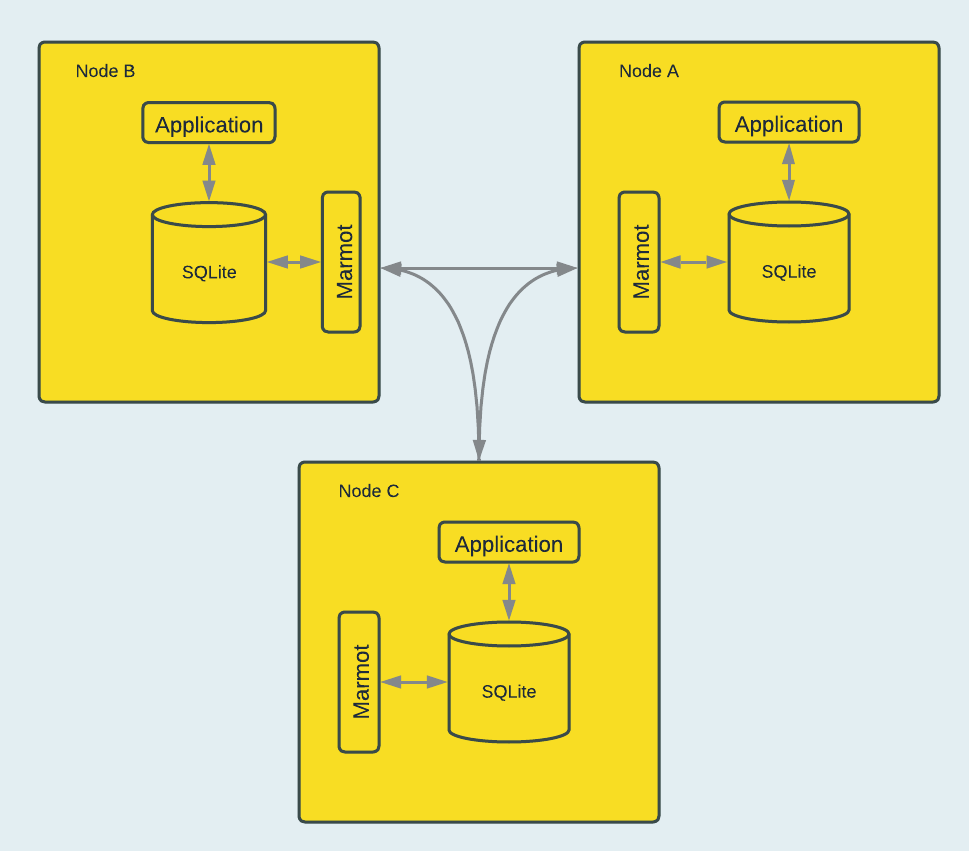
If you are using SQLite as ephemeral storage, or a scenario where eventual consistency is fine for you. Marmot can give you a solid replication between your nodes as Marmot builds on top of fault-tolerant consensus protocol (Multi-Raft), thus allowing robust recovery and replication. This means if you are running a medium traffic website based on SQLite you should be easily able to handle load without any problems. Read heavy workloads won't be bottle-necked at all as Marmot serves as a side car letting you build replication cluster without making any changes to your application code, and allows you to keep using to your SQLite database file. In a typical setting your setup would look like this:
Production status
MARMOT IS STILL EARLY FOR PRODUCTION USAGE WHERE DB CORRUPTION IS UNACCEPTABLE. USE IT FOR EPHEMERAL STORAGE USE CASE ONLY WHERE LOOSING DATA OR CORRUPTION OF DB FILE IS NOT AN ISSUE.
Right now it's being used for ephemeral cache storage in production services, on a very read heavy site. This easily replicates cache values across the cluster, keeping a fast local copy of cache database.
Running
Build
go build -o build/marmot ./marmot.go
Make sure you have 2 SQLite DBs with exact same schemas (ideally exact same state):
rm -rf /tmp/raft # Clear out previous raft state, only do for cold start
build/marmot -bootstrap 2@127.0.0.1:8162 -bind 127.0.0.1:8161 -bind-pane localhost:6001 -node-id 1 -db-path /tmp/cache-1.db
build/marmot -bootstrap 1@127.0.0.1:8161 -bind 127.0.0.1:8162 -bind-pane localhost:6002 -node-id 2 -db-path /tmp/cache-2.db
Demos
Documentation
Marmot is picks simplicity, and lesser knobs to configure by choice. Here are command line options you can use to configure marmot:
cleanup- Just cleanup and exit marmot. Useful for scenarios where you are performing a cleanup of hooks and change logs. (default:false)db-path- Path to DB from which given tables will be replicated. These tables can be specified inreplicateoption. (default:/tmp/marmot.db)replicate- A comma seperated list of tables to replicate with no spaces in between (e.g. news,history) (default: [empty]) DEPRECATED after 0.3.11 now all tables are parsed and listed, this is required for snapshots to recover quicklynode-id- An ID number (positive integer) to represent an ID for this node, this is required to be a unique number per node, and used for consensus protocol. (default: 0)bind- Ahost:portcombination of listen for other nodes on (default:0.0.0.0:8610)raft-path- Path of directory to save consensus related logs, states, and snapshots (default:/tmp/raft)shards- Number of shards over which the database tables replication will be distributed on. It serves as mechanism for consistently hashing leader from Hash(<table_name> + <primary/composite_key>) for all the nodes. These partitions can be assigned to various nodes in cluster which allows you to distribute leadership load over multiple nodes rather than single master. By default, there are 16 shards which means you should be easily able to have upto 16 leader nodes. Beyond that you should use this flag to create a bigger cluster. Higher shards also mean more disk space, and memory usage per node. Marmot has basic a very rough version of adding shards, via control pane, but it needs more polishing to make it idiot-proof.bootstrap- A comma seperated list of initial bootstrap nodes<node_id>@<ip>:<port>(e.g.2@127.0.0.1:8162,3@127.0.0.1:8163will specify 2 bootstrap nodes for cluster).bind-pane- Ahost:portcombination for control panel address (default:localhost:6010). All the endpoints are basic auth protected which should be set viaAUTH_KEYenv variable (e.g.AUTH_KEY='Basic ...'). This address should not be a public accessible, and should be only used for cluster management. This in future will serve as full control panel hosting and cluster management API. EXPERIMENTALverbose- Specify if system should dump debug logs on console as well. Only use this for debugging.
For more details and internal workings of marmot go to these docs.
Limitations
Right now there are a few limitations on current solution:
- You can't watch tables selectively on a DB. This is due to various limitations around snapshot and restore mechanism.
- WAL mode required - since your DB is going to be processed by multiple process the only way to have multi-process changes reliably is via WAL.
- Downloading snapshots of database is still WIP. However, if you can have start off node with same copies of DB it will work flawlessly.
- Marmot is eventually consistent. This simply means rows can get synced out of order, and
SERIALIZABLEassumptions on transactions might not hold true anymore.
FAQs
For FAQs visit this page
 Documentation

Documentation


There is no documentation for this package.
 Source Files
 Directories