

 README

README


go-gracefully
go-gracefully is a library for monitoring and reporting on an applications' health.
Unlike many solutions out there, go-gracefully uses an asynchronous, stream based check scheme.
This enables real-time checks as well as push based changes.
Status:
This library is currently available as a preview. I started development to support my existing work on deps.cloud.
Most health check libraries you find are pull based. In this model, you define your check as a function that's called on some set interval. While this is a great start to a solution, more advance techniques need to be able to push.
The flow of information in the system is as follows:
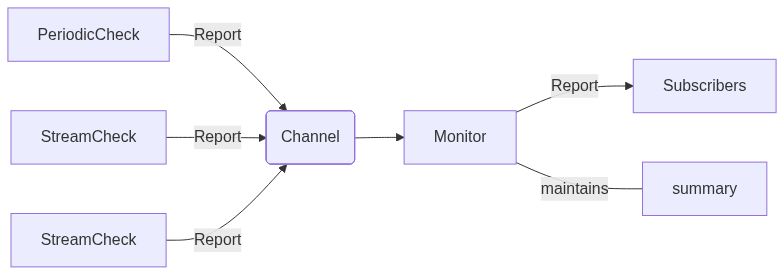
- Each
Checkproduces aReport Reportsare collected through the use of a channel by theMonitor.- The monitor updates its
summaryof the system. - When either a check, or the system state changes, a
Reportis published to subscribers.
A snapshot of the full report can be obtained from the Monitor.
How does it work?
All checks in go-gracefully have a common block of metadata.
Nameis a required descriptor of the check.- Avoid whitespace where possible. Preferred character set:
[a-zA-Z0-9-_.]
- Avoid whitespace where possible. Preferred character set:
- An optional
Runbookcan be provided to aid in the resolution of issues.- When provided, this should be a valid URL.
- Finally, a
Weightis used to determine relative importance of check to the overall system.- A check with
Weight: 100has a greater impact on the system health than one withWeight: 10.
- A check with
    // ...
    Metadata: check.Metadata{
        Name: "periodic-check",
        Runbook: "http://path/to/runbook.md",
        Weight: 10,
    },
    // ...
When check's evaluated, it can return one of four possible states.
OK- The check is operating as expected.Minor- The check is failing and will require attention soon.Major- The check is failing and requires attention soon.Outage- The check is failing and requires attention.
On its own, state represents a fractional value of health (i.e. [0-1]).
Together, the state and the weight are used to approximate an applications' health.
Inspirations
There are a lot of prior work out there. It's hard to list them all. The list below was is just a few I drew inspiration from.
- http://github.com/indeedeng/status
- https://github.com/InVisionApp/go-health
- https://godoc.org/github.com/heptiolabs/healthcheck
- https://github.com/AppsFlyer/go-sundheit
Installation
go get -u github.com/mjpitz/go-gravefully
Usage
package main

import (
    "context"
    "http"
    "log"
    "time"

    "github.com/mjpitz/go-gracefully/check"
    "github.com/mjpitz/go-gracefully/health"
    "github.com/mjpitz/go-gracefully/state"
)

func main() {
    monitor := health.NewMonitor([]check.Check{
        &check.Periodic{
            Metadata: check.Metadata{
                Name: "periodic-check",
                Runbook: "http://path/to/runbook.md",
                Weight: 10,
            },
            Interval: time.Second * 5,
            Timeout: time.Second,
            RunFunc: func(ctx context.Context) (state.State, error) {
                // make API call, check system health
                return state.OK, nil
            },
        },
        &check.Stream{
            Metadata: check.Metadata{
                Name: "stream-check",
                Runbook: "http://path/to/runbook.md",
                Weight: 10,
            },
            WatchFunc: func(ctx context.Context, channel chan check.Result) {
                stopCh := ctx.Done()

                var upstreamCh chan interface{}
                // make call that fills chan

                for {
                    select {
                        case <-stopCh:
                            return
                        case _ = <-upstreamCh:
                            channel <- check.Result{
                                State: state.OK,
                                Error: nil,
                            }
                    }
                }
            },
        },
    }...)

    reports, unsubscribe := monitor.Subscribe()
    defer unsubscribe()

    ctx := context.Background()
    if err := monitor.Start(ctx); err != nil {
        log.Fatal(err.Error())
    }

    // subscribe to changes in health
    for report := range reports {
        // access check information if present
        // - Check will not be present for changes in overall system health
        _ = report.Check

        // access check evaluation result data
        // - Result will be present for all reports
        _ = report.Result
    }

    // or add an HTTP endpoint to view the results of it
    http.HandleFunc("/healthz", health.HandlerFunc(monitor))
}
 Directories