

 README

README





 asyncmachine-go

[!NOTE] State machines communicate through states.
asyncmachine-go is a batteries-included graph control flow library implementing AOP and Actor Model through a clock-based state-machine. It features atomic transitions, relations with consensus, transparent RPC, TUI debugger, telemetry, REPL, remote workers, and diagrams.
As a control flow library, it decides about running of predefined bits of code (transition handlers) - their order and which ones to run, according to currently active states (flags). Thanks to a novel state machine, the number of handlers can be minimized while maximizing scenario coverage. It's lightweight, fault-tolerant by design, has rule-based mutations, and can be used to target virtually any step-in-time, in any workflow. It's a low-level tool with acceptable performance.
asyncmachine-go takes care of context, select, and panic, while allowing for graph-structured concurrency
with goroutine cancelation. The history log and relations have
vector formats.
It aims to create autonomous workflows with organic control flow and stateful APIs:
- autonomous - automatic states, relations, context-based decisions
- organic - relations, negotiation, cancelation
- stateful - maintaining context, responsive, atomic

Each state represents
- binary flag
- node with relations
- AOP aspect
- logical clock
- subscription topic
- multiple methods
- metric
- trace
- lock
- breakpoint
Besides workflows, it can be used for stateful applications of any size - daemons, UIs, configs, bots, firewalls, synchronization consensus, games, smart graphs, microservice orchestration, robots, contracts, streams, DI containers, test scenarios, simulators, as well as "real-time" systems which rely on instant cancelation.
Stack
The top layers depend on the bottom ones.
| . | . | . | . | . | . | PubSub | . | . | . | . | . | . |
| . | . | . | . | . | Workers | . | . | . | . | . | ||
| . | . | . | . | RPC | . | . | . | . | ||||
| . | . | . | Handlers | . | . | . | ||||||
| . | . | 🐇 Machine pkg | . | . | ||||||||
| . | Relations | . | ||||||||||
| States | ||||||||||||

Samples
Minimal - an untyped definition of 2 states and 1 relation, then 1 mutation and a check.
import am "github.com/pancsta/asyncmachine-go/pkg/machine"
// ...
mach := am.New(nil, am.Schema{
    "Foo": {Require: am.S{"Bar"}},
    "Bar": {},
}, nil)
mach.Add1("Foo", nil)
mach.Is1("Foo") // false
Complicated - wait on a multi state (event) and the Ready state with a 1s timeout, then mutate with typed args, on top of a state context.
// state ctx is an expiration ctx
ctx := client.Mach.NewStateCtx(ssC.WorkerReady)
// clock-based subscription
whenPayload := client.Mach.WhenTicks(ssC.WorkerPayload, 1, ctx)
// state mutation
client.WorkerRpc.Worker.Add1(ssW.WorkRequested, Pass(&A{
    Input: 2}))
// WaitFor* wraps select statements
err := amhelp.WaitForAll(ctx, time.Second,
    // post-mutation subscription
    mach.When1(ss.BasicStatesDef.Ready, nil),
    // pre-mutation subscription
    whenPayload)
// check cancelation
if ctx.Err() != nil {
    return // state ctx expired
}
// check error
if err != nil {
    // error state mutation
    client.Mach.AddErr(err, nil)
    return // no err required
}
// client/WorkerPayload and mach/Ready activated
Handlers - Aspect Oriented transition handlers.
// can Foo activate?
func (h *Handlers) FooEnter(e *am.Event) bool {
    return true
}
// with Foo active, can Bar activate?
func (h *Handlers) FooBar(e *am.Event) bool {
    return true
}
// Foo activates
func (h *Handlers) FooState(e *am.Event) {
    h.foo = NewConn()
}
// Foo de-activates
func (h *Handlers) FooEnd(e *am.Event) {
    h.foo.Close()
}
Schema - states of a node worker.
type WorkerStatesDef struct {
    ErrWork        string
    ErrWorkTimeout string
    ErrClient      string
    ErrSupervisor  string

    LocalRpcReady     string
    PublicRpcReady    string
    RpcReady          string
    SuperConnected    string
    ServeClient       string
    ClientConnected   string
    ClientSendPayload string
    SuperSendPayload  string

    Idle          string
    WorkRequested string
    Working       string
    WorkReady     string

    // inherit from rpc worker
    *ssrpc.WorkerStatesDef
}
All examples and benchmarks can be found in /examples.

Getting Started
- 🦾
/pkg/machineis the main package /pkg/nodeshows a high-level usage- examples in
/examplesare good for a general grasp- with
/examples/mach_templatebeing ready for copy-paste
- with
/docs/manual.mdand/docs/diagrams.mdgo deeper into implementation details/tools/cmd/am-genwill bootstrap/tools/cmd/am-dbgwill record every detail- and reading tests is always a good idea
Packages
This monorepo offers the following importable packages, especially:
- 🦾
/pkg/machineState machine, dependency free, semver compatible. /pkg/statesReusable state schemas, handlers, and piping./pkg/helpersUseful functions when working with async state machines./pkg/telemetryTelemetry exporters for dbg, metrics, traces, and logs.
Other packages:
/pkg/rpcRemote state machines, with the same API as local ones./pkg/historyHistory tracking and traversal./pkg/integrationsNATS and other JSON integrations./pkg/graphMultigraph of interconnected state machines./pkg/nodeDistributed worker pools with supervisors./pkg/pubsubDecentralized PubSub based on libp2p gossipsub.
Devtools
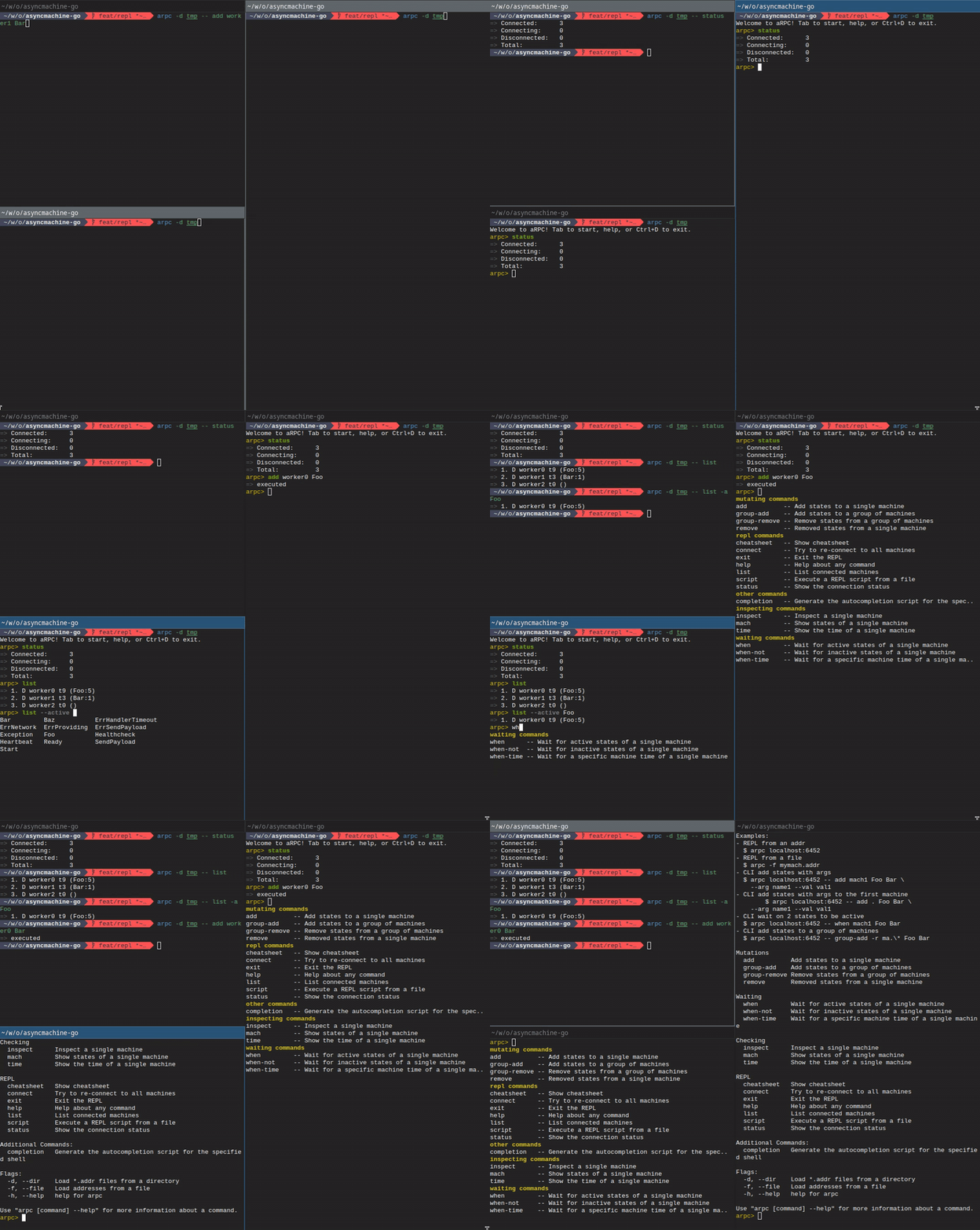
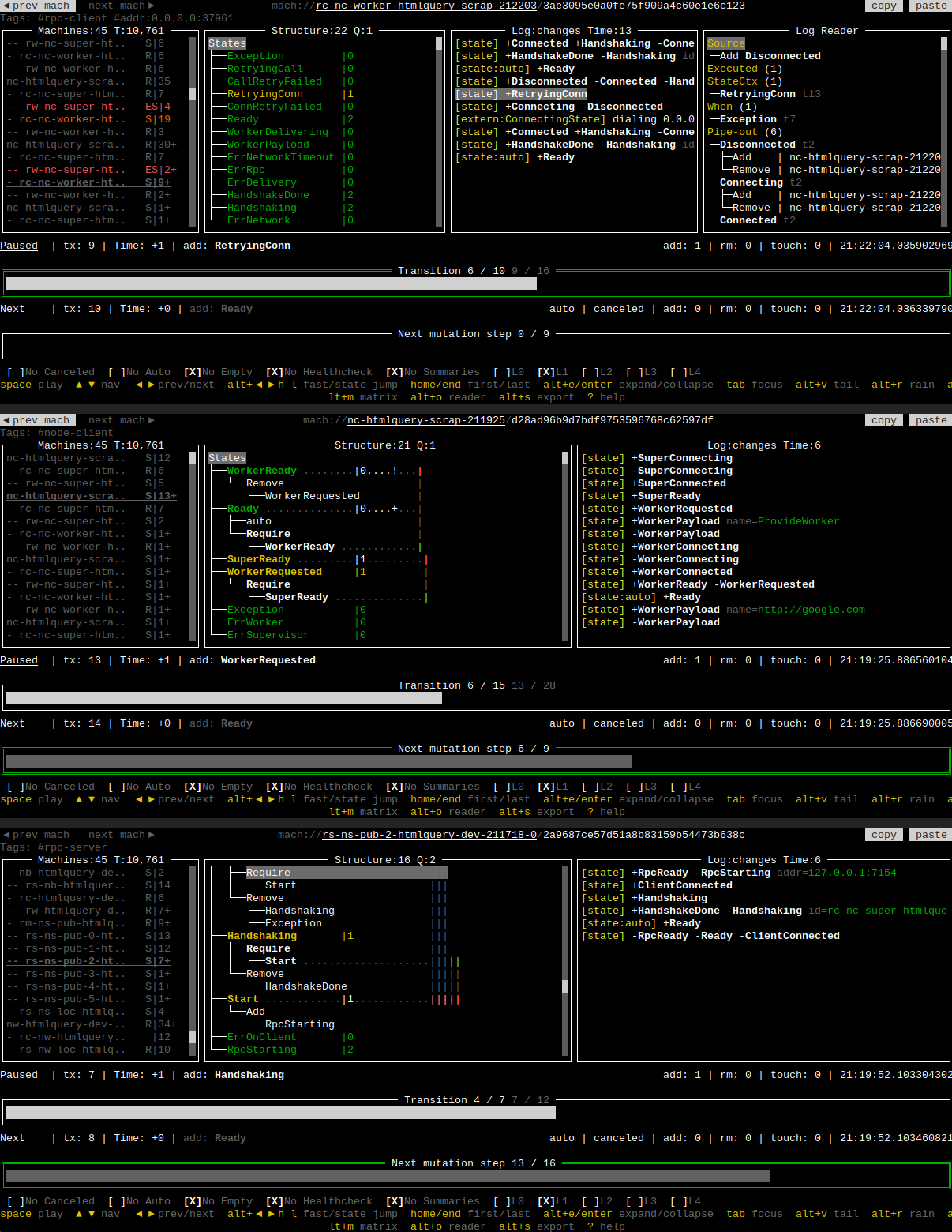
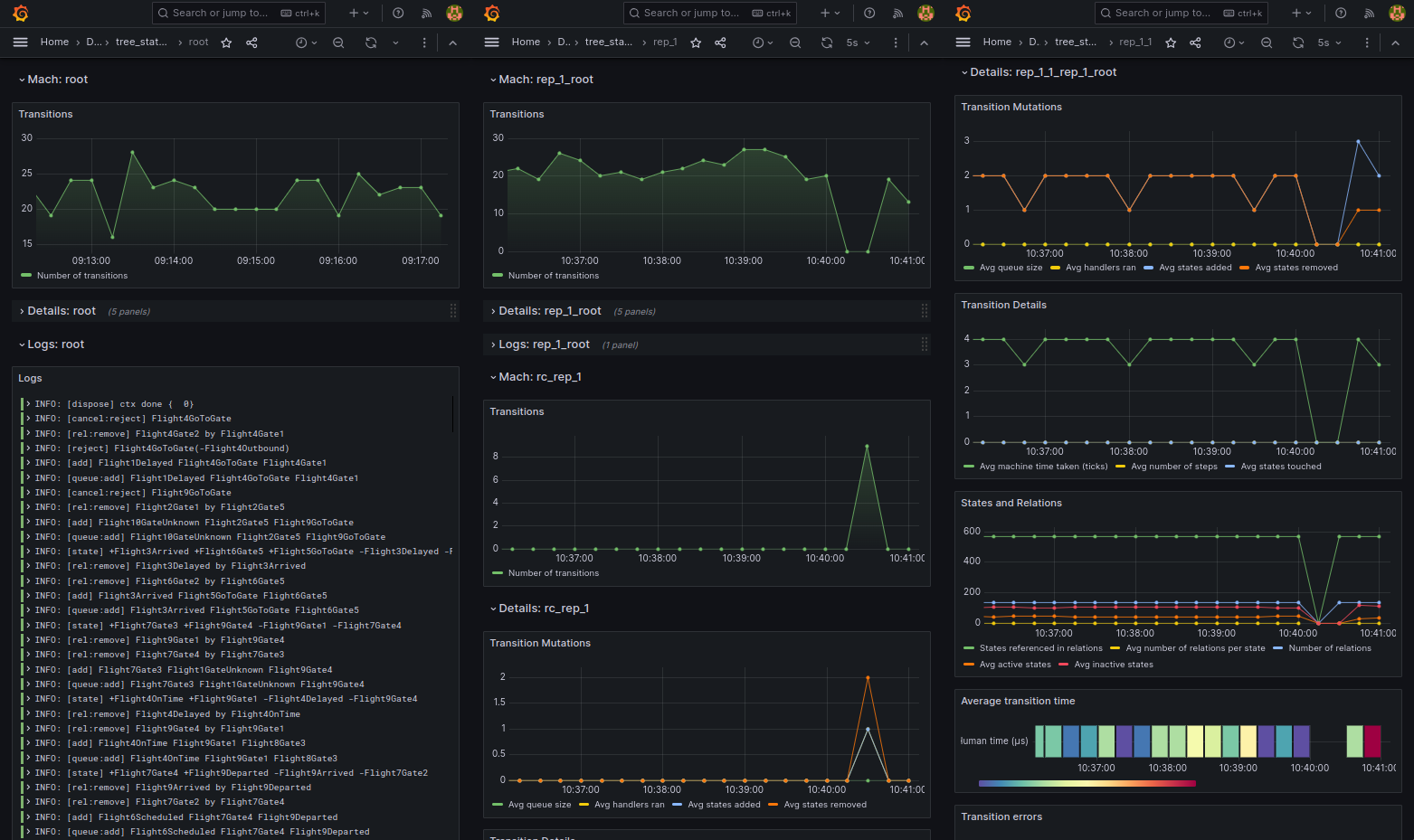
/tools/cmd/am-dbgMulti-client TUI debugger./tools/cmd/am-genGenerates schema files and Grafana dashboards./tools/cmd/am-visGenerates D2 diagrams./tools/cmd/arpcNetwork-native REPL and CLI.
Apps
- secai AI Agents framework.
- arpc REPL Cobra-based REPL.
- am-dbg TUI Debugger Single state-machine TUI app.
- libp2p PubSub Simulator Sandbox simulator for libp2p-pubsub.
- libp2p PubSub Benchmark Benchmark of libp2p-pubsub ported to asyncmachine-go.
Documentation
Goals
- scale up, not down
- defaults work by default
- everything can be traced and debugged
- automation is evolution
- state != data
Community
Status
Under development, status depends on each package. The bottom layers seem prod grade, the top ones are alpha or testing.
Development
- before
./scripts/dep-taskfile.shtask install-deps
- after
task testtask formattask linttask precommit
- good first issues
FAQ
How does asyncmachine work?
It calls struct methods according to conventions, a schema, and currently active states (eg BarEnter, FooFoo,
FooBar, BarState). It tackles nondeterminism by embracing it - like an UDP event stream with structure.
What is a "state" in asyncmachine?
State is a binary name as in status / switch / flag, eg "process RUNNING" or "car BROKEN".
What does "clock-based" mean?
Each state has a counter of activations & deactivations, and all state counters create "machine time". These are logical clocks. The queue is also counted.
What's the difference between states and events?
The same event happening many times will cause only 1 state activation, until the state becomes inactive.
The complete FAQ is available at FAQ.md.
Changes

 Directories

Directories

| Path | Synopsis |
|---|---|
|
examples
|
|
|
arpc/client
command
|
|
|
arpc/server
command
|
|
|
asynq_fileprocessing/client
command
|
|
|
asynq_fileprocessing/worker
command
|
|
|
dag_dependency_graph
command
|
|
|
fan_out_in
command
|
|
|
mach_template
command
|
|
|
mach_template/states
Package states contains a stateful schema-v2 for MachTemplate.
|
Package states contains a stateful schema-v2 for MachTemplate. |
|
pipes
command
|
|
|
raw_strings
command
|
|
|
relations_playground
command
|
|
|
repl
command
|
|
|
subscriptions
command
|
|
|
tree_state_source
command
|
|
|
tree_state_source/gen_states
command
|
|
|
internal
|
|
|
cmd/am-dbg-video
command
|
|
|
testing/cmd/am-dbg-worker
command
AM_DBG_WORKER_ADDR AM_DBG_ADDR
|
AM_DBG_WORKER_ADDR AM_DBG_ADDR |
|
pkg
|
|
|
graph
Package graph provides a graph or interconnected state-machines and their states, based on the dbg telemetry protocol.
|
Package graph provides a graph or interconnected state-machines and their states, based on the dbg telemetry protocol. |
|
helpers
Package helpers is a set of useful functions when working with async state machines.
|
Package helpers is a set of useful functions when working with async state machines. |
|
helpers/testing
Package testing provides testing helpers for state machines using testify.
|
Package testing provides testing helpers for state machines using testify. |
|
history
Package history provides mutation history tracking and traversal.
|
Package history provides mutation history tracking and traversal. |
|
machine
Package machine is a nondeterministic, multi-state, clock-based, relational, optionally-accepting, and non-blocking state machine.
|
Package machine is a nondeterministic, multi-state, clock-based, relational, optionally-accepting, and non-blocking state machine. |
|
node
Package node provides distributed worker pools with supervisors.
|
Package node provides distributed worker pools with supervisors. |
|
node/test/worker
command
|
|
|
pubsub/states
Package states contains a stateful schema-v2 for Topic.
|
Package states contains a stateful schema-v2 for Topic. |
|
pubsub/uds
Package uds was auto-translated from rust-libp2p.
|
Package uds was auto-translated from rust-libp2p. |
|
rpc
Package rpc is a transparent RPC for state machines.
|
Package rpc is a transparent RPC for state machines. |
|
states
Package states provides reusable state definitions.
|
Package states provides reusable state definitions. |
|
states/global
Package global should be imported into the package's global scope with:
|
Package global should be imported into the package's global scope with: |
|
states/pipes
Package pipes provide helpers to pipe states from one machine to another.
|
Package pipes provide helpers to pipe states from one machine to another. |
|
telemetry
Package telemetry provides telemetry exporters for asyncmachine: am-dbg, Prometheus, and OpenTelemetry.
|
Package telemetry provides telemetry exporters for asyncmachine: am-dbg, Prometheus, and OpenTelemetry. |
|
telemetry/prometheus
Package prometheus provides Prometheus metrics for asyncmachine.
|
Package prometheus provides Prometheus metrics for asyncmachine. |
|
x/helpers
Package helpers provides experimental and unstable helpers.
|
Package helpers provides experimental and unstable helpers. |
|
scripts
|
|
|
compact_number
command
|
|
|
extract_mermaid
command
|
|
|
gen_jsonschema
command
|
|
|
tools
|
|
|
cmd/am-dbg
command
am-dbg is a lightweight, multi-client debugger for asyncmachine-go.
|
am-dbg is a lightweight, multi-client debugger for asyncmachine-go. |
|
cmd/am-dbg-ssh
command
am-dbg-ssh is an SSH version of asyncmachine-go debugger.
|
am-dbg-ssh is an SSH version of asyncmachine-go debugger. |
|
cmd/am-gen
command
am-gen generates states files and Grafana dashboards.
|
am-gen generates states files and Grafana dashboards. |
|
cmd/arpc
command
|
|
|
debugger
Package debugger provides a TUI debugger with multi-client support.
|
Package debugger provides a TUI debugger with multi-client support. |
|
generator
Package generator generates state-machine schemas and grafana dashboards.
|
Package generator generates state-machine schemas and grafana dashboards. |
|
repl
Package repl provides a REPL and CLI functionality for aRPC connections.
|
Package repl provides a REPL and CLI functionality for aRPC connections. |
|
repl/states
Package states contains a stateful schema-v2 for Repl.
|
Package states contains a stateful schema-v2 for Repl. |