

 README

README

 /pkg/rpc
[!NOTE] asyncmachine-go is a pathless control-flow graph with a consensus (AOP, actor model, state-machine).
aRPC is a transparent RPC for state machines implemented using asyncmachine-go. It's
clock-based and features many optimizations, e.g. having most of the API methods executed locally (as state changes are
regularly pushed to the client). It's built on top of cenkalti/rpc2 (fork of net/rpc),
and soheilhy/cmux. Check out the dedicated example, gRPC benchmark,
and an integration tests tutorial.
Features
- mutation methods
- wait methods
- clock pushes (from source mutations)
- remote contexts
- multiplexing
- reconnect / fail-safety
- state source machine sending payloads to the client
- REPL
- queue ticks support
- initial optimizations
- web sockets
- checksums
Not implemented (yet):
WhenArgs- chunked payloads
- TLS
- compression
- msgpack encoding
Each RPC server can handle 1 RPC client at a time, but 1 state source (asyncmachine) can have many RPC servers attached to itself (via Tracer API). Additionally, remote RPC network-machines can also have RPC servers attached to themselves, creating a tree structure (see /examples/benchmark_state_source).
Components
Network State Source
Any state machine can be exposed as an RPC state source, as long as it implements /pkg/rpc/states/StateSourceSchemaDef.
This can be done either manually, or by using state helpers (SchemaMerge,
SAdd), or by generating a schema file with
am-gen. It's also required to have the states verified by Machine.VerifyStates.
Network Machine can send data to the client via the SendPayload state.
import (
    am "github.com/pancsta/asyncmachine-go/pkg/machine"
    arpc "github.com/pancsta/asyncmachine-go/pkg/rpc"
    ssrpc "github.com/pancsta/asyncmachine-go/pkg/rpc/states"
)

// ...

// inherit from RPC network machine
schema := am.SchemaMerge(ssrpc.StateSourceSchema, am.Schema{
    "Foo": {Require: am.S{"Bar"}},
    "Bar": {},
})
name := am.SAdd(ssrpc.StateSourceStates.Names(), am.S{"Foo", "Bar"})

// init
netMach := am.New(ctx, schema, nil)
netMach.VerifyStates(name)

// ...

// send data to the client
netMach.Add1(ssrpc.StateSourceStates.SendPayload, arpc.Pass(&arpc.A{
    Name: "mypayload",
    Payload: &arpc.ArgsPayload{
        Name: "mypayload",
        Source: "network machine1",
        Data: []byte{1,2,3},
    },
}))
Network Machine Schema
State schema from /pkg/rpc/states/ss_rpc.go.
type NetMachStatesDef struct {
    ErrProviding string
    ErrSendPayload string
    SendPayload string
}
Server
Each RPC server can handle 1 client at a time. Both client and server need the same network machine states definition (structure map and ordered list of states). After the initial handshake, the server will be pushing local machine time changes every PushInterval, while state changes made by an RPC client are delivered synchronously. Server starts listening on either Addr, Listener, or Conn. Basic ACL is possible via AllowId. The server doesn't emit mutation arguments, use state piping from state source to an RPC client Network Machine to receive arguments over the network. Server can listen on a WebSocket, including relayed TCP-over-WebSocket listening (useful for WASM).
import (
    amhelp "github.com/pancsta/asyncmachine-go/pkg/helpers"
    am "github.com/pancsta/asyncmachine-go/pkg/machine"
    arpc "github.com/pancsta/asyncmachine-go/pkg/rpc"
    ssrpc "github.com/pancsta/asyncmachine-go/pkg/rpc/states"
)

// ...

var addr string
var netMach *am.Machine

// init
s, err := arpc.NewServer(ctx, addr, "server", sourceMach, &arpc.ServerOpts{
    Parent: machParent,
})
if err != nil {
    panic(err)
}

// start
s.Start()
err = amhelp.WaitForAll(ctx, 2*time.Second,
    s.Mach.When1(ssrpc.ServerStates.RpcReady, ctx))
if ctx.Err() != nil {
    return
}
if err != nil {
    return err
}

// react to the client
<-netMach.When1("Foo", nil)
print("Client added Foo")
netMach.Add1("Bar", nil)
Server Schema
State schema from /pkg/rpc/states/ss_rpc.go.

Client
Each RPC client can connect to 1 server and needs to know network machine's machine schema and order. Data send by a
network machine via ServerPayload will be received by a Consumer machine
(passed via ClientOpts.Consumer) as an Add
mutation of the ServerPayload state (see a detailed diagram). Client supports
fail-safety for both connection (eg ConnRetries,
ConnRetryBackoff) and calls (eg CallRetries,
CallRetryBackoff).
After the client's Ready state becomes active, it exposes a remote network machine at client.NetMach. Remote
network machine implements most of the
Machine's methods, many of which
are evaluated locally (like Is, When,
NewStateCtx). See machine.Api
for a full list.
Time diffs received by the RPC cliebt are merged (contain multiple mutations in one diff), but can be split
per-mutation using opts.SyncMutations. Client can connect to WebSockets (useful for WASM).
import (
    amhelp "github.com/pancsta/asyncmachine-go/pkg/helpers"
    am "github.com/pancsta/asyncmachine-go/pkg/machine"
    arpc "github.com/pancsta/asyncmachine-go/pkg/rpc"
    ssrpc "github.com/pancsta/asyncmachine-go/pkg/rpc/states"
)

// ...

var addr string
// network machine state schema
var schema am.Schema
// network machine state names
var names am.S

// consumer
consumer := am.New(ctx, ssrpc.ConsumerSchema, nil)

// init
c, err := arpc.NewClient(ctx, addr, "clientid", schema, &arpc.ClientOpts{
    Consumer: consumer,
})

// start
c.Start()
err := amhelp.WaitForAll(ctx, 2*time.Second,
    c.Mach.When1(ssrpc.ClientStates.Ready, ctx))
if ctx.Err() != nil {
    return
}

// use the remote network machine
c.NetMach.Add1("Foo", nil)
<-c.NetMach.When1("Bar", nil)
print("Server added Bar")
Client Schema
State schema from /pkg/rpc/states/ss_rpc.go.
Multiplexer
Because 1 server can serve only 1 client (for simplicity), it's often required to use a port multiplexer. It's very simple to create one using NewMux and a callback function, which returns a new server instance.
import (
    amhelp "github.com/pancsta/asyncmachine-go/pkg/helpers"
    arpc "github.com/pancsta/asyncmachine-go/pkg/rpc"
    ssrpc "github.com/pancsta/asyncmachine-go/pkg/rpc/states"
)

// ...

var ctx context.Context

// new server per each new client (optional)
var newServer arpc.MuxNewServer = func(mux *arpc.Mux, id string, conn net.Conn) (*Server, error) {
    s, err := mux.NewDefaultServer(id)
    if err != nil {
        return nil, err
    }

    srv.Conn = conn
    srv.Start(e)

    return s, nil
}

// start cmux
mux, err := arpc.NewMux(ctx, t.Name(), newServer, nil)
mux.Listener = listener // or mux.Addr := ":1234"
mux.Start()
err := amhelp.WaitForAll(ctx, 2*time.Second,
    mux.Mach.When1(ssrpc.MuxStates.Ready, ctx))
Multiplexer Schema
State schema from /pkg/rpc/states/ss_rpc.go.

Selective Distribution

Every state-machine can be partially distributed over the network and updated on a different granularity level.
Synchronization scenarios:
- full sync (state names, schema, machine time)
- no schema (state names, machine time)
- selected states (state names, schema, selective ticks)
- shallow clocks (state names, schema, binary ticks)
Synchronization granularity:
- 1 clock diff per N mutations
- N clock diffs per N mutations


Scenarios can be mixed with each other to a certain degree (eg shallow clocks for selected states). Selective Distribution is like state piping, but over the network and utilizes all other aRPC optimizations.
Network Handlers
Locally piped Network Machine can then run local handlers (via a local /pkg/machine.Machine
instance) and mutate itself, which will effectively mutate the Network Source. Combining network handlers with selective
distribution can lead to large network coverage (number of hosts) consuming a tiny bandwidth usage. The structure of the
network has to be fixed, unlike in case of /pkg/pubsub.
By combining Network Handlers with Selective Distribution received by a redundant number of clients (per state), we can create multidimensional graphs. Those could be developed further with "voting receivers" (vote-based firewalls) to create more organic systems.

Implementation details
- schema is always full-or-nothing
- state indexes and time slices are always source-bound
- unless there's no schema sync, then client-bound
- time sum is always client-bound for checksums
- from a binary time slice for shallow clocks
- aRPC mutations don't have arguments - hash
am.Timeand machine IDs to create a remote address for payloads
aRPC implements several optimization strategies to achieve the results:
net/rpcmethod names as runes- binary format of
encoding/gob - index-based clock
[0, 100, 0, 120]
- diff-based clock updates
[0, 1, 0, 1]
- debounced server-mutation clock pushes
[0, 5, 2, 1]
- partial clock updates
[[1, 1], [3, 1]]
Documentation
Debugging
/pkg/rpc is immune to AM_DBG_ADDR env-based debugging, unless special variables are also active. This is to
avoid noise, but sometimes it's useful to check for network errors (which should actually be piped
to parent machines). Refer to /docs/env-configs.md for details.
Benchmark: aRPC vs gRPC
Results for version v0.7.0 (outdated).
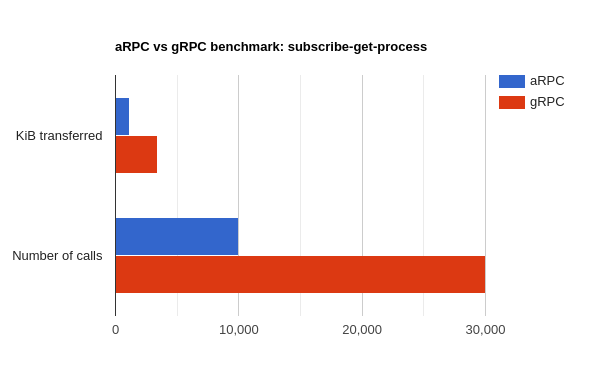
A simple and opinionated benchmark showing a subscribe-get-process scenario, implemented in both gRPC and aRPC. See
/examples/benchmark_grpc for details and source code.
> task benchmark-grpc
...
BenchmarkClientArpc
    client_arpc_test.go:136: Transferred: 609 bytes
    client_arpc_test.go:137: Calls: 4
    client_arpc_test.go:138: Errors: 0
    client_arpc_test.go:136: Transferred: 1,149,424 bytes
    client_arpc_test.go:137: Calls: 10,003
    client_arpc_test.go:138: Errors: 0
BenchmarkClientArpc-8              10000            248913 ns/op           28405 B/op        766 allocs/op
BenchmarkClientGrpc
    client_grpc_test.go:117: Transferred: 1,113 bytes
    client_grpc_test.go:118: Calls: 9
    client_grpc_test.go:119: Errors: 0
    client_grpc_test.go:117: Transferred: 3,400,812 bytes
    client_grpc_test.go:118: Calls: 30,006
    client_grpc_test.go:119: Errors: 0
BenchmarkClientGrpc-8              10000            262693 ns/op           19593 B/op        391 allocs/op
BenchmarkClientLocal
BenchmarkClientLocal-8             10000               434.4 ns/op            16 B/op          1 allocs/op
PASS
ok      github.com/pancsta/asyncmachine-go/examples/benchmark_grpc      5.187s
API
aRPC implements /pkg/machine#Api, which is a large subset of /pkg/machine#Machine methods. Below the full list,
with distinction which methods happen where (locally or on remote).
// TODO update
// A (arguments) is a map of named arguments for a Mutation.
type A map[string]any
// S (state names) is a string list of state names.
type S []string
type Time []uint64
type Clock map[string]uint64
type Result int
type Schema = map[string]State

// Api is a subset of Machine for alternative implementations.
type Api interface {
  // ///// REMOTE

  // Mutations (remote)

  // Add1 is [Machine.Add1].
  Add1(state string, args A) Result
  // Add is [Machine.Add].
  Add(states S, args A) Result
  // Remove1 is [Machine.Remove1].
  Remove1(state string, args A) Result
  // Remove is [Machine.Remove].
  Remove(states S, args A) Result
  // AddErr is [Machine.AddErr].
  AddErr(err error, args A) Result
  // AddErrState is [Machine.AddErrState].
  AddErrState(state string, err error, args A) Result
  // Toggle is [Machine.Toggle].
  Toggle(states S, args A) Result
  // Toggle1 is [Machine.Toggle1].
  Toggle1(state string, args A) Result
  // Set is [Machine.Set].
  Set(states S, args A) Result

  // Traced mutations (remote)

  // EvAdd1 is [Machine.EvAdd1].
  EvAdd1(event *Event, state string, args A) Result
  // EvAdd is [Machine.EvAdd].
  EvAdd(event *Event, states S, args A) Result
  // EvRemove1 is [Machine.EvRemove1].
  EvRemove1(event *Event, state string, args A) Result
  // EvRemove is [Machine.EvRemove].
  EvRemove(event *Event, states S, args A) Result
  // EvAddErr is [Machine.EvAddErr].
  EvAddErr(event *Event, err error, args A) Result
  // EvAddErrState is [Machine.EvAddErrState].
  EvAddErrState(event *Event, state string, err error, args A) Result
  // EvToggle is [Machine.Toggle].
  EvToggle(event *Event, states S, args A) Result
  // EvToggle1 is [Machine.Toggle1].
  EvToggle1(event *Event, state string, args A) Result

  // Waiting (remote)

  // WhenArgs is [Machine.WhenArgs].
  WhenArgs(state string, args A, ctx context.Context) <-chan struct{}

  // ///// LOCAL

  // Checking (local)

  // Err is [Machine.Err].
  Err() error
  // IsErr is [Machine.IsErr].
  IsErr() bool
  // Is is [Machine.Is].
  Is(states S) bool
  // Is1 is [Machine.Is1].
  Is1(state string) bool
  // Any is [Machine.Any].
  Any(states ...S) bool
  // Any1 is [Machine.Any1].
  Any1(state ...string) bool
  // Not is [Machine.Not].
  Not(states S) bool
  // Not1 is [Machine.Not1].
  Not1(state string) bool
  // IsTime is [Machine.IsTime].
  IsTime(time Time, states S) bool
  // WasTime is [Machine.WasTime].
  WasTime(time Time, states S) bool
  // IsClock is [Machine.IsClock].
  IsClock(clock Clock) bool
  // WasClock is [Machine.WasClock].
  WasClock(clock Clock) bool
  // Has is [Machine.Has].
  Has(states S) bool
  // Has1 is [Machine.Has1].
  Has1(state string) bool
  // CanAdd is [Machine.CanAdd].
  CanAdd(states S, args A) Result
  // CanAdd1 is [Machine.CanAdd1].
  CanAdd1(state string, args A) Result
  // CanRemove is [Machine.CanRemove].
  CanRemove(states S, args A) Result
  // CanRemove1 is [Machine.CanRemove1].
  CanRemove1(state string, args A) Result
  // Transition is [Machine.Transition].
  Transition() *Transition
  // IsLocal is [Machine.IsLocal].
  IsLocal() bool
  // ErrInternal is [Machine.ErrInternal].
  ErrInternal() <-chan error

  // Waiting (local)

  // When is [Machine.When].
  When(states S, ctx context.Context) <-chan struct{}
  // When1 is [Machine.When1].
  When1(state string, ctx context.Context) <-chan struct{}
  // WhenNot is [Machine.WhenNot].
  WhenNot(states S, ctx context.Context) <-chan struct{}
  // WhenNot1 is [Machine.WhenNot1].
  WhenNot1(state string, ctx context.Context) <-chan struct{}
  // WhenTime is [Machine.WhenTime].
  WhenTime(states S, times Time, ctx context.Context) <-chan struct{}
  // WhenTime1 is [Machine.WhenTime1].
  WhenTime1(state string, tick uint64, ctx context.Context) <-chan struct{}
  // WhenTicks is [Machine.WhenTicks].
  WhenTicks(state string, ticks int, ctx context.Context) <-chan struct{}
  // WhenNextActive is [Machine.WhenNextActive].
  WhenNextActive(state string, ctx context.Context) <-chan struct{}

  // WhenQuery is [Machine.WhenQuery].
  WhenQuery(query func(clock Clock) bool, ctx context.Context) <-chan struct{}
  // WhenErr is [Machine.WhenErr].
  WhenErr(ctx context.Context) <-chan struct{}
  // WhenQueue is [Machine.WhenQueue].
  WhenQueue(tick Result) <-chan struct{}

  // Getters (local)

  // StateNames is [Machine.StateNames].
  StateNames() S
  // ActiveStates is [Machine.ActiveStates].
  ActiveStates(states S) S
  // Tick is [Machine.Tick].
  Tick(state string) uint64
  // Clock is [Machine.Clock].
  Clock(states S) Clock
  // Time is [Machine.Time].
  Time(states S) Time
  // QueueTick is [Machine.QueueTick].
  QueueTick() uint64
  // MachineTick is [Machine.MachineTick].
  MachineTick() uint32
  // QueueLen is [Machine.QueueLen].
  QueueLen() uint16
  // NewStateCtx is [Machine.NewStateCtx].
  NewStateCtx(state string, e ...*Event) context.Context
  // Export is [Machine.Export].
  Export() (*Serialized, Schema, error)
  // Schema is [Machine.Schema].
  Schema() Schema
  // Switch is [Machine.Switch].
  Switch(groups ...S) string
  // Groups is [Machine.Groups].
  Groups() (map[string][]int, []string)
  // Index is [Machine.Index].
  Index(states S) []int
  // Index1 is [Machine.Index1].
  Index1(state string) int

  // Misc (local)

  // Id is [Machine.Id].
  Id() string
  // ParentId is [Machine.ParentId].
  ParentId() string
  // ParseStates is [Machine.ParseStates].
  ParseStates(states S) S
  // Tags is [Machine.Tags].
  Tags() []string
  // Context is [Machine.Ctx].
  Context() context.Context
  // ContextParent is [Machine.ContextParent].
  ContextParent() context.Context
  // String is [Machine.String].
  String() string
  // StringAll is [Machine.StringAll].
  StringAll() string
  // Log is [Machine.Log].
  Log(msg string, args ...any)
  // SemLogger is [Machine.SemLogger].
  SemLogger() SemLogger
  // Inspect is [Machine.Inspect].
  Inspect(states S) string
  // HandlersBind is [Machine.BindHandlers].
  HandlersBind(handlers any, opts ...BindOpts) (string, error)
  // HandlersBindMaps is [Machine.HandlerBindMaps].
  HandlersBindMaps(negotiations map[string]HandlerNegotiation,
    finals map[string]HandlerFinal, opts ...BindOpts) (string, error)
  // HandlersDetach is [Machine.DetachHandlers].
  HandlersDetach(bindingId string) error
  // Handlers is [Machine.Handlers].
  Handlers() []string
  // StatesVerified is [Machine.StatesVerified].
  StatesVerified() bool
  // Tracers is [Machine.Tracers].
  Tracers() []Tracer
  // TracerDetach is [Machine.TracerDetach].
  TracerDetach(id string) error
  // TracerBind is [Machine.TracerBind].
  TracerBind(tracer Tracer) (string, error)
  // AddBreakpoint is [Machine.AddBreakpoint].
  AddBreakpoint(added S, removed S, strict bool)
  // AddBreakpoint1 is [Machine.AddBreakpoint1].
  AddBreakpoint1(added string, removed string, strict bool)
  // Dispose is [Machine.Dispose].
  Dispose()
  // WhenDisposed is [Machine.WhenDisposed].
  WhenDisposed() <-chan struct{}
  // IsDisposed is [Machine.IsDisposed].
  IsDisposed() bool
  // OnDispose is [Machine.OnDispose].
  OnDispose(fn HandlerDispose)
}
Tests
aRPC passes the whole test suite of /pkg/machine
for the exposed methods and provides a couple of optimization-focused tests (on top of tests for
basic RPC).
Status
Testing, not semantically versioned.
monorepo
/docs/wasm.md/examples/arpc/examples/tree_state_source/examples/wasm/pkg/rpc/HOWTO.md/examples/benchmark_grpc/tools/cmd/arpc
Go back to the monorepo root to continue reading.
 Documentation

Documentation

Overview 
Package rpc is a transparent RPC for state machines.
Index 
- Constants
- Variables
- func AddErr(e *am.Event, mach *am.Machine, msg string, err error)
- func AddErrNetwork(e *am.Event, mach *am.Machine, err error)
- func AddErrNetworkTimeout(e *am.Event, mach *am.Machine, err error)
- func AddErrNoConn(e *am.Event, mach *am.Machine, err error)
- func AddErrParams(e *am.Event, mach *am.Machine, err error)
- func AddErrResp(e *am.Event, mach *am.Machine, err error)
- func AddErrRpcStr(e *am.Event, mach *am.Machine, msg string)
- func BindMux(source, target *am.Machine, activeState, inactiveState string) (string, error)
- func BindServer(source, target *am.Machine, rpcReady, clientReady string) (string, error)
- func BindServerMulti(source, target *am.Machine, rpcReady, clientConn, clientDisconn string) (string, error)
- func BindServerRpcReady(source, target *am.Machine, rpcReady string) (string, error)
- func Checksum(mTime uint64, qTick uint64, machTick uint32) uint8
- func EnableDebuggingRpc(verbose bool)
- func GetClientId(name string) string
- func MachRepl(mach am.Api, addr string, opts *ReplOpts) error
- func MachReplEnv(mach am.Api, opts *ReplOpts) (error, <-chan error)
- func NewMsgpackCodec(conn io.ReadWriteCloser) rpc2.Codec
- func NewNetworkMachine(ctx context.Context, id string, conn NetMachConn, schema am.Schema, ...) (*NetworkMachine, *NetMachInternal, error)
- func TrafficMeter(listener net.Listener, fwdTo string, counter chan<- int64, end <-chan struct{})
- func WsDialPath(machId, addr string) string
- func WsListenPath(machId, addr string) string
- type A
- type AClientConnected
- type AServerPayload
- type Args
- type Client
- func (c *Client) Args() []string
- func (c *Client) CallRetryFailedState(e *am.Event)
- func (c *Client) ConnectedState(e *am.Event)
- func (c *Client) ConnectingEnter(e *am.Event) bool
- func (c *Client) ConnectingState(e *am.Event)
- func (c *Client) DisconnectedEnter(e *am.Event) bool
- func (c *Client) DisconnectedState(e *am.Event)
- func (c *Client) DisconnectingEnter(e *am.Event) bool
- func (c *Client) DisconnectingState(e *am.Event)
- func (c *Client) ExceptionState(e *am.Event)
- func (c *Client) GetKind() Kind
- func (c *Client) HandshakeDoneEnter(e *am.Event) bool
- func (c *Client) HandshakeDoneState(e *am.Event)
- func (c *Client) HandshakingState(e *am.Event)
- func (c *Client) HealthcheckState(e *am.Event)
- func (c *Client) IsPartial() bool
- func (c *Client) RemoteBye(_ *rpc2.Client, _ *MsgEmpty, _ *MsgEmpty) error
- func (c *Client) RemoteSchemaChange(_ *rpc2.Client, msg *MsgSrvHello, _ *MsgEmpty) error
- func (c *Client) RemoteSendPayload(_ *rpc2.Client, payload *MsgSrvPayload, _ *MsgEmpty) error
- func (c *Client) RemoteSendingPayload(_ *rpc2.Client, payload *MsgSrvPayload, _ *MsgEmpty) error
- func (c *Client) RemoteUpdate(_ *rpc2.Client, update *MsgSrvUpdate, _ *MsgEmpty) error
- func (c *Client) RemoteUpdateMutations(_ *rpc2.Client, updates *MsgSrvUpdateMuts, _ *MsgEmpty) error
- func (c *Client) RetryingCallEnter(e *am.Event) bool
- func (c *Client) RetryingConnState(e *am.Event)
- func (c *Client) ServerPayloadEnter(e *am.Event) bool
- func (c *Client) ServerPayloadState(e *am.Event)
- func (c *Client) Start(e *am.Event) am.Result
- func (c *Client) StartEnd(e *am.Event)
- func (c *Client) StartState(e *am.Event)
- func (c *Client) Stop(waitTillExit context.Context, e *am.Event, dispose bool) am.Result
- func (c *Client) Sync() am.Time
- type ClientMethod
- type ClientOpts
- type ClockUpdateFunc
- type ExceptionHandler
- type Kind
- type MsgCliHello
- type MsgCliMutation
- type MsgEmpty
- type MsgSrvArgs
- type MsgSrvHello
- type MsgSrvMutation
- type MsgSrvPayload
- type MsgSrvSync
- type MsgSrvUpdate
- type MsgSrvUpdateMuts
- type Mux
- func (m *Mux) ClientConnectedState(e *am.Event)
- func (m *Mux) ExceptionState(e *am.Event)
- func (m *Mux) HasClientsEnd(e *am.Event) bool
- func (m *Mux) HealthcheckState(e *am.Event)
- func (m *Mux) NewDefaultServer(id string) (*Server, error)
- func (m *Mux) NewServer(e *am.Event, id string, conn net.Conn) (*Server, error)
- func (m *Mux) NewServerErrEnter(e *am.Event) bool
- func (m *Mux) NewServerErrState(e *am.Event)
- func (m *Mux) Start(e *am.Event) am.Result
- func (m *Mux) StartEnd(e *am.Event)
- func (m *Mux) StartEnter(e *am.Event) bool
- func (m *Mux) StartState(e *am.Event)
- func (m *Mux) Stop(e *am.Event, dispose bool) am.Result
- type MuxNewServerFn
- type MuxOpts
- type NetMachConn
- type NetMachInternal
- type NetworkMachine
- func (m *NetworkMachine) ActiveStates(states am.S) am.S
- func (m *NetworkMachine) Add(states am.S, args am.A) am.Result
- func (m *NetworkMachine) Add1(state string, args am.A) am.Result
- func (m *NetworkMachine) Add1NS(state string, args am.A) am.Result
- func (m *NetworkMachine) AddBreakpoint(added am.S, removed am.S, strict bool)
- func (m *NetworkMachine) AddBreakpoint1(added string, removed string, strict bool)
- func (m *NetworkMachine) AddErr(err error, args am.A) am.Result
- func (m *NetworkMachine) AddErrState(state string, err error, args am.A) am.Result
- func (m *NetworkMachine) AddNS(states am.S, args am.A) am.Result
- func (m *NetworkMachine) Any(states ...am.S) bool
- func (m *NetworkMachine) Any1(states ...string) bool
- func (m *NetworkMachine) BindHandlers(handlers any, opts ...am.BindOpts) (string, error)
- func (m *NetworkMachine) BindTracer(tracer am.Tracer) (string, error)
- func (m *NetworkMachine) CanAdd(states am.S, args am.A) am.Result
- func (m *NetworkMachine) CanAdd1(state string, args am.A) am.Result
- func (m *NetworkMachine) CanRemove(states am.S, args am.A) am.Result
- func (m *NetworkMachine) CanRemove1(state string, args am.A) am.Result
- func (m *NetworkMachine) Clock(states am.S) am.Clock
- func (m *NetworkMachine) Context() context.Context
- func (m *NetworkMachine) ContextParent() context.Context
- func (m *NetworkMachine) DetachHandlers(bindingId string) error
- func (m *NetworkMachine) DetachTracer(id string) error
- func (m *NetworkMachine) Dispose()
- func (m *NetworkMachine) Err() error
- func (m *NetworkMachine) ErrInternal() <-chan error
- func (m *NetworkMachine) EvAdd(event *am.Event, states am.S, args am.A) am.Result
- func (m *NetworkMachine) EvAdd1(event *am.Event, state string, args am.A) am.Result
- func (m *NetworkMachine) EvAddErr(event *am.Event, err error, args am.A) am.Result
- func (m *NetworkMachine) EvAddErrState(event *am.Event, state string, err error, args am.A) am.Result
- func (m *NetworkMachine) EvRemove(event *am.Event, states am.S, args am.A) am.Result
- func (m *NetworkMachine) EvRemove1(event *am.Event, state string, args am.A) am.Result
- func (m *NetworkMachine) EvToggle(e *am.Event, states am.S, args am.A) am.Result
- func (m *NetworkMachine) EvToggle1(e *am.Event, state string, args am.A) am.Result
- func (m *NetworkMachine) Export() (*am.Serialized, am.Schema, error)
- func (m *NetworkMachine) Groups() (map[string][]int, []string)
- func (m *NetworkMachine) Handlers() []string
- func (m *NetworkMachine) HandlersBind(handlers any, opts ...am.BindOpts) (string, error)
- func (m *NetworkMachine) HandlersBindMaps(negotiations map[string]am.HandlerNegotiation, ...) (string, error)
- func (m *NetworkMachine) HandlersDetach(bindingId string) error
- func (m *NetworkMachine) Has(states am.S) bool
- func (m *NetworkMachine) Has1(state string) bool
- func (m *NetworkMachine) Id() string
- func (m *NetworkMachine) Index(states am.S) []int
- func (m *NetworkMachine) Index1(state string) int
- func (m *NetworkMachine) Inspect(states am.S) string
- func (m *NetworkMachine) Is(states am.S) bool
- func (m *NetworkMachine) Is1(state string) bool
- func (m *NetworkMachine) IsClock(clock am.Clock) bool
- func (m *NetworkMachine) IsDisposed() bool
- func (m *NetworkMachine) IsErr() bool
- func (m *NetworkMachine) IsLocal() bool
- func (m *NetworkMachine) IsTime(t am.Time, states am.S) bool
- func (m *NetworkMachine) Log(msg string, args ...any)
- func (m *NetworkMachine) MachineTick() uint32
- func (m *NetworkMachine) MustParseStates(states am.S) am.S
- func (m *NetworkMachine) NewStateCtx(state string, event ...*am.Event) context.Context
- func (m *NetworkMachine) Not(states am.S) bool
- func (m *NetworkMachine) Not1(state string) bool
- func (m *NetworkMachine) OnDispose(fn am.HandlerDispose)
- func (m *NetworkMachine) ParentId() string
- func (m *NetworkMachine) ParseStates(states am.S) am.S
- func (m *NetworkMachine) QueueLen() uint16
- func (m *NetworkMachine) QueueTick() uint64
- func (m *NetworkMachine) RemoteId() string
- func (m *NetworkMachine) Remove(states am.S, args am.A) am.Result
- func (m *NetworkMachine) Remove1(state string, args am.A) am.Result
- func (m *NetworkMachine) Schema() am.Schema
- func (m *NetworkMachine) SemLogger() am.SemLogger
- func (m *NetworkMachine) Set(states am.S, args am.A) am.Result
- func (m *NetworkMachine) StateNames() am.S
- func (m *NetworkMachine) StatesVerified() bool
- func (m *NetworkMachine) String() string
- func (m *NetworkMachine) StringAll() string
- func (m *NetworkMachine) Switch(groups ...am.S) string
- func (m *NetworkMachine) Tags() []string
- func (m *NetworkMachine) Tick(state string) uint64
- func (m *NetworkMachine) Time(states am.S) am.Time
- func (m *NetworkMachine) Toggle(states am.S, args am.A) am.Result
- func (m *NetworkMachine) Toggle1(state string, args am.A) am.Result
- func (m *NetworkMachine) TracerBind(tracer am.Tracer) (string, error)
- func (m *NetworkMachine) TracerDetach(id string) error
- func (m *NetworkMachine) Tracers() []am.Tracer
- func (m *NetworkMachine) Transition() *am.Transition
- func (m *NetworkMachine) WasClock(clock am.Clock) bool
- func (m *NetworkMachine) WasTime(t am.Time, states am.S) bool
- func (m *NetworkMachine) When(states am.S, ctx context.Context) <-chan struct{}
- func (m *NetworkMachine) When1(state string, ctx context.Context) <-chan struct{}
- func (m *NetworkMachine) WhenArgs(state string, args am.A, ctx context.Context) <-chan struct{}
- func (m *NetworkMachine) WhenDisposed() <-chan struct{}
- func (m *NetworkMachine) WhenErr(disposeCtx context.Context) <-chan struct{}
- func (m *NetworkMachine) WhenNextActive(state string, ctx context.Context) <-chan struct{}
- func (m *NetworkMachine) WhenNot(states am.S, ctx context.Context) <-chan struct{}
- func (m *NetworkMachine) WhenNot1(state string, ctx context.Context) <-chan struct{}
- func (m *NetworkMachine) WhenQuery(clockCheck func(clock am.Clock) bool, ctx context.Context) <-chan struct{}
- func (m *NetworkMachine) WhenQueue(tick am.Result) <-chan struct{}
- func (m *NetworkMachine) WhenTicks(state string, ticks int, ctx context.Context) <-chan struct{}
- func (m *NetworkMachine) WhenTime(states am.S, times am.Time, ctx context.Context) <-chan struct{}
- func (m *NetworkMachine) WhenTime1(state string, ticks uint64, ctx context.Context) <-chan struct{}
- type ReplOpts
- type Server
- func (s *Server) ClientId() string
- func (s *Server) ExceptionState(e *am.Event)
- func (s *Server) GetKind() Kind
- func (s *Server) HandshakeDoneEnd(e *am.Event)
- func (s *Server) RemoteAdd(_ *rpc2.Client, req *MsgCliMutation, resp *MsgSrvMutation) error
- func (s *Server) RemoteAddNS(_ *rpc2.Client, req *MsgCliMutation, _ *MsgEmpty) error
- func (s *Server) RemoteArgs(_ *rpc2.Client, _ *MsgEmpty, resp *MsgSrvArgs) error
- func (s *Server) RemoteBye(_ *rpc2.Client, _ *MsgEmpty, _ *MsgEmpty) error
- func (s *Server) RemoteHandshake(client *rpc2.Client, _ *MsgEmpty, _ *MsgEmpty) error
- func (s *Server) RemoteHello(client *rpc2.Client, req *MsgCliHello, resp *MsgSrvHello) error
- func (s *Server) RemoteRemove(_ *rpc2.Client, req *MsgCliMutation, resp *MsgSrvMutation) error
- func (s *Server) RemoteSet(_ *rpc2.Client, req *MsgCliMutation, resp *MsgSrvMutation) error
- func (s *Server) RemoteSync(_ *rpc2.Client, _ *MsgEmpty, resp *MsgSrvSync) error
- func (s *Server) RpcAcceptingEnter(e *am.Event) bool
- func (s *Server) RpcAcceptingState(e *am.Event)
- func (s *Server) RpcReadyEnter(e *am.Event) bool
- func (s *Server) RpcReadyState(e *am.Event)
- func (s *Server) RpcStartingEnter(e *am.Event) bool
- func (s *Server) RpcStartingState(e *am.Event)
- func (s *Server) SendPayload(ctx context.Context, srcEvent *am.Event, payload *MsgSrvPayload) error
- func (s *Server) Start(e *am.Event) am.Result
- func (s *Server) StartEnd(e *am.Event)
- func (s *Server) StartState(e *am.Event)
- func (s *Server) Stop(e *am.Event, dispose bool) am.Result
- type ServerMethod
- type ServerOpts
Constants 
const (
	// EnvAmRpcLogServer enables machine logging for RPC server.
	EnvAmRpcLogServer = "AM_RPC_LOG_SERVER"
	// EnvAmRpcLogClient enables machine logging for RPC client.
	EnvAmRpcLogClient = "AM_RPC_LOG_CLIENT"
	// EnvAmRpcLogClientVerbose enables machine logging for RPC client in verbose
	// mode.
	EnvAmRpcLogClientVerbose = "AM_RPC_LOG_CLIENT_VERBOSE"
	// EnvAmRpcLogMux enables machine logging for RPC multiplexers.
	EnvAmRpcLogMux = "AM_RPC_LOG_MUX"
	// EnvAmRpcDbg enables env-based debugging for RPC and am-relay components.
	EnvAmRpcDbg = "AM_RPC_DBG"
	// EnvAmReplAddr is a REPL address to listen on. "1" expands to 127.0.0.1:0.
	EnvAmReplAddr = "AM_REPL_ADDR"
	// EnvAmReplDir is a dir path to save the address file as
	// $AM_REPL_DIR/mach-id.addr. Optional.
	EnvAmReplDir = "AM_REPL_DIR"

	TagRpcHandler = "rpc-handler"
	TagRpcClient  = "rpc-client"
	TagRpcServer  = "rpc-server"
	TagRpcMux     = "rpc-mux"

	PrefixNetMach = "rnm-"
	WsPathListen  = "/listen/"
	WsPathDial    = "/dial/"
)
const APrefix = "am_rpc"
Variables 
var (
	ServerAdd       = ServerMethod{"Add"}
	ServerAddNS     = ServerMethod{"AddNS"}
	ServerRemove    = ServerMethod{"Remove"}
	ServerSet       = ServerMethod{"Set"}
	ServerHello     = ServerMethod{"Hello"}
	ServerHandshake = ServerMethod{"Handshake"}
	ServerLog       = ServerMethod{"Log"}
	ServerSync      = ServerMethod{"Sync"}
	ServerArgs      = ServerMethod{"ArgsBase"}
	ServerBye       = ServerMethod{"Close"}

	ServerMethods = enum.New(ServerAdd, ServerAddNS, ServerRemove, ServerSet,
		ServerHello, ServerHandshake, ServerLog, ServerSync, ServerArgs, ServerBye)

	ClientUpdate          = ClientMethod{"ClientSetClock"}
	ClientUpdateMutations = ClientMethod{"ClientSetClockMany"}
	ClientPushAllTicks    = ClientMethod{"ClientPushAllTicks"}
	ClientSendPayload     = ClientMethod{"ClientSendPayload"}
	ClientBye             = ClientMethod{"ClientBye"}
	ClientSchemaChange    = ClientMethod{"SchemaChange"}

	ClientMethods = enum.New(ClientUpdate, ClientPushAllTicks,
		ClientSendPayload, ClientBye, ClientSchemaChange)
)
var (
	ErrInvalidParams = errors.New("invalid params")
	ErrInvalidResp   = errors.New("invalid response")
	ErrRpc           = errors.New("rpc")
	ErrNoAccess      = errors.New("no access")
	ErrNoConn        = errors.New("not connected")
	ErrDestination   = errors.New("wrong destination")

	ErrNetwork        = errors.New("network error")
	ErrNetworkTimeout = errors.New("network timeout")
)
var ArgsRpc = []am.ArgsApi{A{}}
ArgsRpc will be available in the REPL.
var Pass = am.Pass
Functions 
func AddErr ¶ added in v0.8.0
AddErr detects sentinels from error msgs and calls the proper error setter. TODO also return error for compat
func AddErrNetworkTimeout ¶ added in v0.18.0
func BindMux ¶ added in v0.18.3
BindMux binds the HasClients state with Add/Remove to custom states.
func BindServer ¶ added in v0.8.0
BindServer binds RpcReady and HandshakeDone with Add/Remove, to custom states.
func BindServerMulti ¶ added in v0.8.0
func BindServerMulti(
	source, target *am.Machine, rpcReady, clientConn, clientDisconn string,
) (string, error)
BindServerMulti binds RpcReady, ClientConnected, and ClientDisconnected. RpcReady is Add/Remove, the other two are Add-only to passed multi states.
func BindServerRpcReady ¶ added in v0.8.0
BindServerRpcReady bind RpcReady using Add to a custom multi state.
func Checksum ¶ added in v0.15.1
Checksum calculates a short checksum of current machine time and ticks.
func EnableDebuggingRpc ¶ added in v0.18.0
func EnableDebuggingRpc(verbose bool)
func GetClientId ¶ added in v0.8.0
GetClientId returns an RPC Client machine ID from a name. This ID will be used to handshake the server.
func MachRepl ¶ added in v0.10.2
MachRepl sets up a machine for a REPL connection, which allows for mutations, like any other RPC connection. See [/tools/cmd/arpc] for usage. This function is considered a debugging helper and can panic.
addr: address to listen on, defaults to 127.0.0.1:0 addrDir: optional dir path to save the address file as addrDir/mach-id.addr addrCh: optional channel to send the address to, once ready errCh: optional channel for errors
func MachReplEnv ¶ added in v0.10.2
MachReplEnv sets up a machine for a REPL connection in case AM_REPL_ADDR env var is set. See MachRepl.
func NewMsgpackCodec ¶ added in v0.17.0
func NewMsgpackCodec(conn io.ReadWriteCloser) rpc2.Codec
TODO optimize with msgpack
func NewNetworkMachine ¶ added in v0.17.0
func NewNetworkMachine(
	ctx context.Context, id string, conn NetMachConn, schema am.Schema,
	stateNames am.S, parent am.Api, tags []string, filterMutations bool,
) (*NetworkMachine, *NetMachInternal, error)
NewNetworkMachine creates a new instance of a NetworkMachine.
func TrafficMeter 
func TrafficMeter(
	listener net.Listener, fwdTo string, counter chan<- int64,
	end <-chan struct{},
)
TrafficMeter measures the traffic of a listener and forwards it to a destination. Results are sent to the [counter] channel. Useful for testing and benchmarking. TODO optimize: override Read/Write instead, omit the network stack
func WsDialPath ¶ added in v0.18.3
WsDialPath creates a WebSocket dial listen URL path. Eg /dial/MyMach/localhost:1234
func WsListenPath ¶ added in v0.18.0
WsListenPath creates a WebSocket remote listen URL path. Eg /listen/MyMach/localhost:1234
Types 
type A ¶ added in v0.8.0
type A struct {
	Args `json:"-"`

	Id        string `log:"id"`
	Name      string `log:"name"`
	MachTime  am.Time
	QueueTick uint64
	MachTick  uint32
	Addr      string `log:"addr"`
	Err       error
	Method    string `log:"addr"`
	StartedAt time.Time
	Dispose   bool
}
A represents typed arguments of the RPC package. It's a typesafe alternative to am.A.
type AClientConnected ¶ added in v0.19.0
func (AClientConnected) ArgsState ¶ added in v0.19.0
func (AClientConnected) ArgsState() string
type AServerPayload ¶ added in v0.19.0
type AServerPayload struct {
	Args `json:"-"`

	Name    string `log:"name"`
	Payload *MsgSrvPayload
}
func (AServerPayload) ArgsState ¶ added in v0.19.0
func (AServerPayload) ArgsState() string
type Args ¶ added in v0.19.0
func (Args) ArgsPrefix ¶ added in v0.19.0
type Client 
type Client struct {
	*ExceptionHandler

	Mach *am.Machine
	Id   string

	// Addr is the address the Client will connect to.
	Addr string
	// NetMach is a remote am.Machine instance. It's available after the Start
	// state settles.
	NetMach *NetworkMachine
	// Consumer is the optional consumer for deliveries.
	Consumer   *am.Machine
	CallCount  uint64
	LogEnabled bool
	// DisconnCooldown is the time to wait after notifying the server about
	// disconnecting before actually disconnecting. Default 10ms.
	DisconnCooldown time.Duration
	// LastMsgAt is the last received msg from the worker TODO
	LastMsgAt time.Time
	// HelloDelay between Connected and Handshaking. Default 0, useful for
	// rpc/Mux.
	HelloDelay time.Duration
	// ReconnectOnDisconn decides if the client will try to [RetryingConn] after a
	// clean [Disconnect].
	ReconnectOnDisconn bool
	// Custom connection (wg WebSocket) TODO handle better in notif
	Conn atomic.Pointer[net.Conn]
	Opts ClientOpts

	// Skip schema synchronization / fetching.
	SyncNoSchema bool
	// Synchronize machine times for every mutation (within a single sync msg).
	SyncAllMutations bool
	// Only sync selected states.
	SyncAllowedStates am.S
	// Skip syncing of these states.
	SyncSkippedStates am.S
	// Only activete/deactivate (0-1) clock values will be sent.
	SyncShallowClocks     bool
	SyncMutationFiltering bool

	// ConnTimeout is the maximum time to wait for a connection to be established.
	// Default 3s.
	ConnTimeout time.Duration
	// ConnRetries is the number of retries for a connection.
	ConnRetries int
	// ConnRetryTimeout is the maximum time to retry a connection.
	ConnRetryTimeout time.Duration
	// ConnRetryDelay is the time to wait between retries. If
	// ConnRetryBackoff is set, this is the initial delay and doubles on each
	// retry.
	ConnRetryDelay time.Duration
	// ConnRetryBackoff is the maximum time to wait between retries.
	ConnRetryBackoff time.Duration

	// CallTimeout is the maximum time to wait for a call to complete.
	CallTimeout time.Duration
	// CallRetries is the number of retries for a call.
	CallRetries int
	// CallRetryTimeout is the maximum time to retry a call.
	CallRetryTimeout time.Duration
	// CallRetryDelay is the time to wait between retries. If
	// CallRetryBackoff is set, this is the initial delay and doubles on each
	// retry.
	CallRetryDelay time.Duration
	// CallRetryBackoff is the maximum time to wait between retries.
	CallRetryBackoff time.Duration
	DisconnTimeout   time.Duration
	// contains filtered or unexported fields
}
Client is a type representing an RPC client that interacts with a remote am.Machine instance.
func NewClient 
func NewClient(
	ctx context.Context, addr string, id string, netSrcSchema am.Schema,
	opts *ClientOpts,
) (*Client, error)
NewClient creates a new RPC client and exposes a remote state machine as a remote worker, with a subst of the API under Client.NetMach. Optionally takes a consumer, which is a state machine with a ServerPayload state. See states.ConsumerStates.
func (*Client) Args ¶ added in v0.17.1
Args returns a list of registered typed args for a given machine.
func (*Client) CallRetryFailedState ¶ added in v0.8.0
func (*Client) ConnectedState 
func (*Client) ConnectingEnter ¶ added in v0.18.3
func (*Client) ConnectingState 
func (*Client) DisconnectedState 
func (*Client) DisconnectingState 
func (*Client) ExceptionState ¶ added in v0.8.0
func (*Client) HandshakeDoneEnter ¶ added in v0.8.0
func (*Client) HandshakeDoneState 
func (*Client) HandshakingState 
func (*Client) HealthcheckState ¶ added in v0.9.0
func (*Client) IsPartial ¶ added in v0.17.0
IsPartial is true for NetMachs syncing only a subset of the Net Source's states.
func (*Client) RemoteBye ¶ added in v0.10.1
RemoteBye is called by the server on a planned disconnect. TODO take a reason / source event?
func (*Client) RemoteSchemaChange ¶ added in v0.12.0
RemoteSchemaChange is called by the server on a source machine schema change.
func (*Client) RemoteSendPayload 
RemoteSendPayload receives a payload from the server and triggers states.ClientStatesDef.ServerPayload. The Consumer should bind his handlers and handle this state to receive the data.
func (*Client) RemoteSendingPayload ¶ added in v0.8.0
RemoteSendingPayload triggers the WorkerDelivering state, which is an optional indication that the server has started a data transmission to the Client. This payload shouldn't contain the data itself, only the name and token.
func (*Client) RemoteUpdate ¶ added in v0.17.0
RemoteUpdate updates the clock of NetMach from a cumulative diff. Only called by the server.
func (*Client) RemoteUpdateMutations ¶ added in v0.17.0
func (c *Client) RemoteUpdateMutations(
	_ *rpc2.Client, updates *MsgSrvUpdateMuts, _ *MsgEmpty,
) error
RemoteUpdateMutations updates the clock of NetMach from a list of mutations. Only called by the server.
func (*Client) RetryingCallEnter ¶ added in v0.8.0
func (*Client) RetryingConnState ¶ added in v0.8.0
RetryingConnState should be set without [ssC.Connecting] in the same mutation.
func (*Client) ServerPayloadEnter ¶ added in v0.18.0
func (*Client) ServerPayloadState ¶ added in v0.18.0
func (*Client) Start 
Start connects the client to the server and initializes the worker. Results in the Ready state.
func (*Client) StartState ¶ added in v0.8.0
func (*Client) Stop 
Stop disconnects the client from the server and disposes the worker.
waitTillExit: if passed, waits for the client to disconnect using the context.
func (*Client) Sync ¶ added in v0.17.0
Sync requests non-diff clock values from the remote machine. Useful to call after a batch of no-sync methods, eg NetworkMachine.AddNS. Sync doesn't honor ClientOpts.SyncMutations and only returns clock values (so can be used to skip mutation syncing within a period).
type ClientMethod ¶ added in v0.15.1
type ClientOpts ¶ added in v0.8.0
type ClientOpts struct {
	// Consumer is an optional target for the [states.SendPayload] state.
	Consumer *am.Machine
	// Parent is a parent state machine for a new Client state machine. See
	// [am.Opts].
	Parent am.Api
	// Make this client schema-less (infer an empty one for tracked states).
	NoSchema bool
	// Only sync selected states.
	AllowedStates am.S
	// Skip syncing of these states.
	SkippedStates am.S
	// Sync machine time for every mutation. Disables
	// [ClientOpts.SyncShallowClocks].
	// TODO de-activates states for no reason
	SyncMutations bool
	// Only activete/deactivate (0-1) clock values will be sent.
	SyncShallowClocks bool
	// Enable client-side mutation filtering by performing relations resolution
	// based on locally active states. Doesn't work with [ClientOpts.NoSchema].
	// TODO not implemented yet
	MutationFiltering bool
	// Connect via WebSocket using path, eg "/" (default for WASM).
	WebSocket string
	// Forcefully disable am-dbg conns for netmachs.
	DebugDisable bool
}
type ClockUpdateFunc ¶ added in v0.17.0
type ExceptionHandler 
type ExceptionHandler struct {
	*am.ExceptionHandler
}
ExceptionHandler is a shared exception handler for RPC server and client.
func (*ExceptionHandler) ExceptionEnter 
func (h *ExceptionHandler) ExceptionEnter(e *am.Event) bool
type MsgCliHello ¶ added in v0.17.0
type MsgCliHello struct {
	// ID of the client saying Hello.
	Id string
	// Client wants to synchronize the schema.
	SyncSchema bool
	// Hash of the current schema, or "". Schema is always full and not affected
	// by [MsgCliHello.AllowedStates] or [MsgCliHello.SkippedStates].
	SchemaHash    string
	SyncMutations bool
	AllowedStates am.S
	SkippedStates am.S
	ShallowClocks bool
}
MsgCliHello is the client saying hello to the server.
type MsgCliMutation ¶ added in v0.17.0
MsgCliMutation is the client requesting a mutation from the server.
type MsgEmpty ¶ added in v0.17.0
type MsgEmpty struct{}
MsgEmpty is an empty message of either the server or client.
type MsgSrvArgs ¶ added in v0.17.1
type MsgSrvArgs struct {
	Args []string
}
type MsgSrvHello ¶ added in v0.17.0
type MsgSrvHello struct {
	Schema     am.Schema
	Serialized *am.Serialized
	// total source states count
	StatesCount uint32
}
MsgSrvHello is the server saying hello to the client.
type MsgSrvMutation ¶ added in v0.17.0
type MsgSrvMutation struct {
	Update    *MsgSrvUpdate
	Mutations *MsgSrvUpdateMuts
	Result    am.Result
}
MsgSrvMutation is the server replying to a mutation request for the client.
type MsgSrvPayload ¶ added in v0.17.0
type MsgSrvPayload struct {
	// Name is used to distinguish different payload types at the destination.
	Name string
	// Destination is an optional machine ID that is supposed to receive the
	// payload. Useful when using rpc.Mux.
	Destination string
	// Data is the payload data. The Consumer has to know the type.
	Data any

	// Token is a unique random ID for the payload. Autofilled by the server.
	Token string
	// Source is the machine ID that sent the payload. Autofilled by the server.
	Source string
	// SourceTx is transition ID. Autofilled by the server.
	SourceTx string
}
MsgSrvPayload is the server sending a payload to the client.
type MsgSrvSync ¶ added in v0.17.0
MsgSrvSync is the server replying to a full sync request from the client.
type MsgSrvUpdate ¶ added in v0.17.0
type MsgSrvUpdate struct {
	// Indexes of incremented states.
	Indexes []uint16
	// Clock diffs of incremented states.
	// TODO optimize: []uint16 and send 2 updates when needed
	Ticks []uint32
	// TODO optimize: for shallow clocks
	// Active []bool
	// QueueTick is an incremental diff for the queue tick.
	QueueTick uint16
	// MachTick is an incremental diff for the machine tick.
	MachTick uint8
	// Checksum is the last digit of (TimeSum + QueueTick + MachTick)
	Checksum uint8
}
MsgSrvUpdate is the server telling the client about a net source's update.
type MsgSrvUpdateMuts ¶ added in v0.17.0
type MsgSrvUpdateMuts struct {
	// TODO mind partially accepted auto states (fake called states).
	// Auto         bool
	MutationType []am.MutationType
	CalledStates [][]uint16
	Updates      []MsgSrvUpdate
}
MsgSrvUpdateMuts is like MsgSrvUpdate but contains several clock updates (one for each mutation), as well as extra mutation info.
type Mux ¶ added in v0.8.0
type Mux struct {
	*am.ExceptionHandler

	Mach *am.Machine
	// Source is the state source to expose via RPC. Required if NewServerFn
	// isnt provided.
	Source am.Api
	// Typed arguments struct value
	Args []am.ArgsApi

	Name string
	Addr string
	// Listener used by this [Mux], can be set manually before Start().
	Listener   net.Listener
	LogEnabled bool
	// The last error returned by NewServerFn.
	NewServerErr error
	Opts         MuxOpts
	// contains filtered or unexported fields
}
Mux creates a new RPC server for each incoming connection.
func NewMux ¶ added in v0.8.0
func NewMux(
	ctx context.Context, addr string, name string, stateSource am.Api,
	opts *MuxOpts,
) (*Mux, error)
NewMux initializes a Mux instance to handle RPC server creation for incoming connections with the given parameters.
addr: can be empty if Mux.Listener is set later. stateSource: optional, can be replaced with [opts.NewServerFn].
func (*Mux) ClientConnectedState ¶ added in v0.8.0
func (*Mux) ExceptionState ¶ added in v0.8.0
func (*Mux) HealthcheckState ¶ added in v0.8.0
func (*Mux) NewDefaultServer ¶ added in v0.18.3
func (*Mux) NewServerErrState ¶ added in v0.8.0
func (*Mux) StartState ¶ added in v0.8.0
type MuxNewServerFn ¶ added in v0.10.2
MuxNewServerFn is a function to create a new RPC server for each incoming connection.
type MuxOpts ¶ added in v0.8.0
type MuxOpts struct {
	// NewServerFn is a function to create a new RPC server for each incoming
	// connection. Optional.
	NewServerFn MuxNewServerFn
	// Parent is a parent state machine for a new Mux state machine. See
	// [am.Opts].
	Parent am.Api
	// See [ServerOpts.Args].
	Args []am.ArgsApi
	// See [ServerOpts.ArgsUnmarshaller].
	ArgsUnmarshaller amhelp.ArgsUnmarshallerFn
}
type NetMachConn ¶ added in v0.17.0
type NetMachConn interface {
	// TODO take event for tracing errors
	Call(ctx context.Context, method ServerMethod, args any, resp any) bool
	Notify(ctx context.Context, method ServerMethod, args any) bool
}
NetMachConn is a mutation interface for NetworkMachine instances. It's meant to be (optionally) injected by whatever creates network machines, so they can communicate with the server (or another source).
type NetMachInternal ¶ added in v0.17.0
type NetMachInternal struct {
	// contains filtered or unexported fields
}
NetMachInternal are internal methods of a NetworkMachine instance returned by the constructor.
func (*NetMachInternal) Lock ¶ added in v0.17.0
func (i *NetMachInternal) Lock()
func (*NetMachInternal) Unlock ¶ added in v0.17.0
func (i *NetMachInternal) Unlock()
func (*NetMachInternal) UpdateClock ¶ added in v0.17.0
func (i *NetMachInternal) UpdateClock(
	now am.Time, qTick uint64, machTick uint32,
)
type NetworkMachine ¶ added in v0.17.0
type NetworkMachine struct {
	// If true, the machine will print all exceptions to stdout. Default: true.
	// Requires an ExceptionHandler binding and Machine.PanicToException set.
	LogStackTrace bool
	// contains filtered or unexported fields
}
NetworkMachine is a subset of `pkg/machine#Machine` for RPC. Lacks the queue and other local methods. Most methods are clock-based, thus executed locally. NetworkMachine implements am.Api.
func (*NetworkMachine) ActiveStates ¶ added in v0.17.0
func (m *NetworkMachine) ActiveStates(states am.S) am.S
ActiveStates is am.Api.ActiveStates.
func (*NetworkMachine) Add ¶ added in v0.17.0
Add is am.Api.Add, but BLOCKING.
func (*NetworkMachine) Add1 ¶ added in v0.17.0
Add1 is am.Api.Add1, but BLOCKING.
func (*NetworkMachine) AddBreakpoint ¶ added in v0.17.0
AddBreakpoint is am.Api.AddBreakpoint.
func (*NetworkMachine) AddBreakpoint1 ¶ added in v0.17.0
func (m *NetworkMachine) AddBreakpoint1(
	added string, removed string, strict bool,
)
AddBreakpoint1 is am.Api.AddBreakpoint1.
func (*NetworkMachine) AddErr ¶ added in v0.17.0
AddErr is am.Api.AddErr.
func (*NetworkMachine) AddErrState ¶ added in v0.17.0
AddErrState is am.Api.AddErrState.
func (*NetworkMachine) AddNS ¶ added in v0.17.0
AddNS is a NoSync method - an efficient way for adding states, as it doesn't wait for, nor transfers a response. Because of which it doesn't update the clock. Use Sync() to update the clock after a batch of AddNS calls.
func (*NetworkMachine) Any ¶ added in v0.17.0
func (m *NetworkMachine) Any(states ...am.S) bool
Any is am.Api.Any.
func (*NetworkMachine) Any1 ¶ added in v0.17.0
func (m *NetworkMachine) Any1(states ...string) bool
Any1 is am.Api.Any1.
func (*NetworkMachine) BindHandlers ¶ added in v0.17.0
BindHandlers is deprecated, use [Api.HandlersBind].
func (*NetworkMachine) BindTracer ¶ added in v0.17.0
func (m *NetworkMachine) BindTracer(tracer am.Tracer) (string, error)
BindTracer is deprecated, use NetworkMachine.TracerBind.
func (*NetworkMachine) CanAdd ¶ added in v0.17.0
CanAdd is am.Api.CanAdd.
func (*NetworkMachine) CanAdd1 ¶ added in v0.17.0
CanAdd1 is am.Api.CanAdd1.
func (*NetworkMachine) CanRemove ¶ added in v0.17.0
CanRemove is am.Api.CanRemove.
func (*NetworkMachine) CanRemove1 ¶ added in v0.17.0
CanRemove1 is am.Api.CanRemove1.
func (*NetworkMachine) Clock ¶ added in v0.17.0
func (m *NetworkMachine) Clock(states am.S) am.Clock
Clock is am.Api.Clock.
func (*NetworkMachine) Context ¶ added in v0.18.0
func (m *NetworkMachine) Context() context.Context
Context is am.Api.Context.
func (*NetworkMachine) ContextParent ¶ added in v0.19.0
func (m *NetworkMachine) ContextParent() context.Context
ContextParent is am.Api.ContextParent.
func (*NetworkMachine) DetachHandlers ¶ added in v0.17.0
func (m *NetworkMachine) DetachHandlers(bindingId string) error
DetachHandlers is deprecated, use [Api.HandlersDetach].
func (*NetworkMachine) DetachTracer ¶ added in v0.17.0
func (m *NetworkMachine) DetachTracer(id string) error
DetachTracer is deprecated, use NetworkMachine.TracerDetach.
func (*NetworkMachine) Dispose ¶ added in v0.17.0
func (m *NetworkMachine) Dispose()
Dispose is am.Api.Dispose.
func (*NetworkMachine) Err ¶ added in v0.17.0
func (m *NetworkMachine) Err() error
Err is am.Api.Err.
func (*NetworkMachine) ErrInternal ¶ added in v0.19.0
func (m *NetworkMachine) ErrInternal() <-chan error
ErrInternal return an empty channel from network machines.
func (*NetworkMachine) EvAdd ¶ added in v0.17.0
EvAdd is am.Api.EvAdd, but BLOCKING.
func (*NetworkMachine) EvAdd1 ¶ added in v0.17.0
EvAdd1 is am.Api.EvAdd1, but BLOCKING.
func (*NetworkMachine) EvAddErr ¶ added in v0.17.0
EvAddErr is am.Api.EvAddErr, but BLOCKING.
func (*NetworkMachine) EvAddErrState ¶ added in v0.17.0
func (m *NetworkMachine) EvAddErrState(
	event *am.Event, state string, err error, args am.A,
) am.Result
EvAddErrState is am.Api.EvAddErrState, but BLOCKING.
func (*NetworkMachine) EvRemove ¶ added in v0.17.0
EvRemove is am.Api.EvRemove, but BLOCKING.
func (*NetworkMachine) EvRemove1 ¶ added in v0.17.0
EvRemove1 is am.Api.EvRemove1, but BLOCKING.
func (*NetworkMachine) EvToggle ¶ added in v0.17.0
EvToggle is am.Api.EvToggle, but BLOCKING.
func (*NetworkMachine) EvToggle1 ¶ added in v0.17.0
EvToggle1 is am.Api.EvToggle1, but BLOCKING.
func (*NetworkMachine) Export ¶ added in v0.17.0
func (m *NetworkMachine) Export() (*am.Serialized, am.Schema, error)
Export exports the machine state: id, time and state names.
func (*NetworkMachine) Groups ¶ added in v0.17.0
func (m *NetworkMachine) Groups() (map[string][]int, []string)
Groups is am.Api.Groups.
func (*NetworkMachine) Handlers ¶ added in v0.19.0
func (m *NetworkMachine) Handlers() []string
Handlers is am.Api.Handlers.
func (*NetworkMachine) HandlersBind ¶ added in v0.19.0
HandlersBind is am.Api.BindHandlers.
NetworkMachine supports only pipe handlers (final ones, without negotiation).
func (*NetworkMachine) HandlersBindMaps ¶ added in v0.19.0
func (m *NetworkMachine) HandlersBindMaps(
	negotiations map[string]am.HandlerNegotiation,
	finals map[string]am.HandlerFinal, opts ...am.BindOpts,
) (string, error)
HandlersBindMaps is am.Api.HandlersBindMaps. TODO
func (*NetworkMachine) HandlersDetach ¶ added in v0.19.0
func (m *NetworkMachine) HandlersDetach(bindingId string) error
HandlersDetach is am.Api.DetachHandlers.
func (*NetworkMachine) Has ¶ added in v0.17.0
func (m *NetworkMachine) Has(states am.S) bool
Has is am.Api.Has.
func (*NetworkMachine) Has1 ¶ added in v0.17.0
func (m *NetworkMachine) Has1(state string) bool
Has1 is am.Api.Has1.
func (*NetworkMachine) Index ¶ added in v0.17.0
func (m *NetworkMachine) Index(states am.S) []int
Index is am.Api.Index.
func (*NetworkMachine) Index1 ¶ added in v0.17.0
func (m *NetworkMachine) Index1(state string) int
Index1 is am.Api.Index1.
func (*NetworkMachine) Inspect ¶ added in v0.17.0
func (m *NetworkMachine) Inspect(states am.S) string
Inspect is am.Api.Inspect.
func (*NetworkMachine) Is ¶ added in v0.17.0
func (m *NetworkMachine) Is(states am.S) bool
Is is am.Api.Is.
func (*NetworkMachine) Is1 ¶ added in v0.17.0
func (m *NetworkMachine) Is1(state string) bool
Is1 is am.Api.Is1.
func (*NetworkMachine) IsClock ¶ added in v0.17.0
func (m *NetworkMachine) IsClock(clock am.Clock) bool
IsClock is am.Api.IsClock.
func (*NetworkMachine) IsDisposed ¶ added in v0.17.0
func (m *NetworkMachine) IsDisposed() bool
IsDisposed is am.Api.IsDisposed.
func (*NetworkMachine) IsErr ¶ added in v0.17.0
func (m *NetworkMachine) IsErr() bool
IsErr is am.Api.IsErr.
func (*NetworkMachine) IsLocal ¶ added in v0.19.0
func (m *NetworkMachine) IsLocal() bool
IsLocal is am.Machine.IsLocal.
func (*NetworkMachine) IsTime ¶ added in v0.17.0
IsTime is am.Api.IsTime.
func (*NetworkMachine) Log ¶ added in v0.17.0
func (m *NetworkMachine) Log(msg string, args ...any)
Log is am.Api.Log.
func (*NetworkMachine) MachineTick ¶ added in v0.17.0
func (m *NetworkMachine) MachineTick() uint32
MachineTick is am.Api.MachineTick.
func (*NetworkMachine) MustParseStates ¶ added in v0.17.0
func (m *NetworkMachine) MustParseStates(states am.S) am.S
MustParseStates is am.Api.MustParseStates.
func (*NetworkMachine) NewStateCtx ¶ added in v0.17.0
NewStateCtx is am.Api.NewStateCtx.
func (*NetworkMachine) Not ¶ added in v0.17.0
func (m *NetworkMachine) Not(states am.S) bool
Not is am.Api.Not.
func (*NetworkMachine) Not1 ¶ added in v0.17.0
func (m *NetworkMachine) Not1(state string) bool
Not1 is am.Api.No1.
func (*NetworkMachine) OnDispose ¶ added in v0.17.0
func (m *NetworkMachine) OnDispose(fn am.HandlerDispose)
OnDispose is am.Api.OnDispose.
func (*NetworkMachine) ParentId ¶ added in v0.17.0
func (m *NetworkMachine) ParentId() string
ParentId is am.Api.ParentId.
func (*NetworkMachine) ParseStates ¶ added in v0.17.0
func (m *NetworkMachine) ParseStates(states am.S) am.S
ParseStates is am.Api.ParseStates.
func (*NetworkMachine) QueueLen ¶ added in v0.17.0
func (m *NetworkMachine) QueueLen() uint16
QueueLen is am.Api.QueueLen.
func (*NetworkMachine) QueueTick ¶ added in v0.17.0
func (m *NetworkMachine) QueueTick() uint64
QueueTick is am.Api.QueueTick.
func (*NetworkMachine) RemoteId ¶ added in v0.17.0
func (m *NetworkMachine) RemoteId() string
RemoteId is am.Api.RemoteId.
func (*NetworkMachine) Remove ¶ added in v0.17.0
Remove is am.Api.Remove, but BLOCKING.
func (*NetworkMachine) Remove1 ¶ added in v0.17.0
Remove1 is am.Api.Remove1, but BLOCKING.
func (*NetworkMachine) Schema ¶ added in v0.17.0
func (m *NetworkMachine) Schema() am.Schema
Schema returns a copy of machine's state structure.
func (*NetworkMachine) SemLogger ¶ added in v0.17.0
func (m *NetworkMachine) SemLogger() am.SemLogger
SemLogger is am.Api.SemLogger.
func (*NetworkMachine) Set ¶ added in v0.17.0
Set is am.Api.Set, but BLOCKING.
func (*NetworkMachine) StateNames ¶ added in v0.17.0
func (m *NetworkMachine) StateNames() am.S
StateNames is am.Api.StateNames.
func (*NetworkMachine) StatesVerified ¶ added in v0.17.0
func (m *NetworkMachine) StatesVerified() bool
StatesVerified is am.Api.StatesVerified.
func (*NetworkMachine) String ¶ added in v0.17.0
func (m *NetworkMachine) String() string
String is am.Api.String.
func (*NetworkMachine) StringAll ¶ added in v0.17.0
func (m *NetworkMachine) StringAll() string
StringAll is am.Api.StringAll.
func (*NetworkMachine) Switch ¶ added in v0.17.0
func (m *NetworkMachine) Switch(groups ...am.S) string
Switch is am.Api.Switch.
func (*NetworkMachine) Tags ¶ added in v0.17.0
func (m *NetworkMachine) Tags() []string
Tags is am.Api.Tags.
func (*NetworkMachine) Tick ¶ added in v0.17.0
func (m *NetworkMachine) Tick(state string) uint64
Tick is am.Api.Tick.
func (*NetworkMachine) Time ¶ added in v0.17.0
func (m *NetworkMachine) Time(states am.S) am.Time
Time is am.Api.Time.
func (*NetworkMachine) Toggle ¶ added in v0.17.0
Toggle is am.Api.Toggle, but BLOCKING.
func (*NetworkMachine) Toggle1 ¶ added in v0.17.0
Toggle1 is am.Api.Toggle1, but BLOCKING.
func (*NetworkMachine) TracerBind ¶ added in v0.19.0
func (m *NetworkMachine) TracerBind(tracer am.Tracer) (string, error)
TracerBind is am.Machine.TracerBind.
NetworkMachine tracers cannot mutate synchronously, as network machines don't have a queue and WILL deadlock when nested.
func (*NetworkMachine) TracerDetach ¶ added in v0.19.0
func (m *NetworkMachine) TracerDetach(id string) error
TracerDetach is am.Api.TracerDetach.
func (*NetworkMachine) Tracers ¶ added in v0.17.0
func (m *NetworkMachine) Tracers() []am.Tracer
Tracers is am.Api.Tracers.
func (*NetworkMachine) Transition ¶ added in v0.17.0
func (m *NetworkMachine) Transition() *am.Transition
Transition is am.Machine.Transition.
func (*NetworkMachine) WasClock ¶ added in v0.17.0
func (m *NetworkMachine) WasClock(clock am.Clock) bool
WasClock is am.Api.WasClock.
func (*NetworkMachine) WasTime ¶ added in v0.17.0
WasTime is am.Api.WasTime.
func (*NetworkMachine) When ¶ added in v0.17.0
func (m *NetworkMachine) When(
	states am.S, ctx context.Context,
) <-chan struct{}
When is am.Api.When.
func (*NetworkMachine) When1 ¶ added in v0.17.0
func (m *NetworkMachine) When1(
	state string, ctx context.Context,
) <-chan struct{}
When1 is am.Api.When1.
func (*NetworkMachine) WhenArgs ¶ added in v0.17.0
WhenArgs is am.Api.WhenArgs.
func (*NetworkMachine) WhenDisposed ¶ added in v0.17.0
func (m *NetworkMachine) WhenDisposed() <-chan struct{}
WhenDisposed is am.Api.WhenDisposed.
func (*NetworkMachine) WhenErr ¶ added in v0.17.0
func (m *NetworkMachine) WhenErr(disposeCtx context.Context) <-chan struct{}
WhenErr is am.Api.WhenErr.
func (*NetworkMachine) WhenNextActive ¶ added in v0.18.9
func (m *NetworkMachine) WhenNextActive(
	state string, ctx context.Context,
) <-chan struct{}
WhenNextActive is am.Api.WhenNextActive.
func (*NetworkMachine) WhenNot ¶ added in v0.17.0
func (m *NetworkMachine) WhenNot(
	states am.S, ctx context.Context,
) <-chan struct{}
WhenNot is am.Api.WhenNot.
func (*NetworkMachine) WhenNot1 ¶ added in v0.17.0
func (m *NetworkMachine) WhenNot1(
	state string, ctx context.Context,
) <-chan struct{}
WhenNot1 is am.Api.WhenNot1.
func (*NetworkMachine) WhenQuery ¶ added in v0.17.0
func (m *NetworkMachine) WhenQuery(
	clockCheck func(clock am.Clock) bool, ctx context.Context,
) <-chan struct{}
WhenQuery is am.Api.WhenQuery.
func (*NetworkMachine) WhenQueue ¶ added in v0.17.0
func (m *NetworkMachine) WhenQueue(tick am.Result) <-chan struct{}
WhenQueue is am.Api.WhenQueue.
func (*NetworkMachine) WhenTicks ¶ added in v0.17.0
func (m *NetworkMachine) WhenTicks(
	state string, ticks int, ctx context.Context,
) <-chan struct{}
WhenTicks is am.Api.WhenTicks.
func (*NetworkMachine) WhenTime ¶ added in v0.17.0
func (m *NetworkMachine) WhenTime(
	states am.S, times am.Time, ctx context.Context,
) <-chan struct{}
WhenTime is am.Api.WhenTime.
func (*NetworkMachine) WhenTime1 ¶ added in v0.17.0
func (m *NetworkMachine) WhenTime1(
	state string, ticks uint64, ctx context.Context,
) <-chan struct{}
WhenTime1 is am.Api.WhenTime1.
type ReplOpts ¶ added in v0.17.1
type ReplOpts struct {
	// optional dir path to save the address file as addrDir/mach-id.addr
	AddrDir string
	// optional channel to send err to, once ready
	ErrCh chan<- error
	// optional channel to send the address to, once ready
	AddrCh chan<- string
	// See [ServerOpts.Args].
	Args []am.ArgsApi
	// See [ServerOpts.ArgsUnmarshaller].
	ArgsUnmarshaller amhelp.ArgsUnmarshallerFn
	// Listen on a WebSocket connection instead of TCP.
	WebSocket bool
	// HTTP URL without proto to tunnel the TCP listen over a WebSocket conn.
	// See WsListenPath.
	WebSocketTunnel string
}
type Server 
type Server struct {
	*ExceptionHandler
	Mach *am.Machine

	// Source is a state Source, either a local or remote RPC worker.
	Source am.Api
	// Addr is the address of the server on the network.
	Addr string
	// DeliveryTimeout is a timeout to SendPayload to the client.
	DeliveryTimeout time.Duration
	// Listener can be set manually before starting the server.
	Listener atomic.Pointer[net.Listener]
	// Conn can be set manually before starting the server. TODO atomic?
	Conn       net.Conn
	LogEnabled bool
	CallCount  uint64
	// List of typed arguments.
	Args []am.ArgsApi
	Opts ServerOpts

	// PushInterval is the interval for clock updates, effectively throttling
	// the number of updates sent to the client within the interval window.
	// 0 means pushes are disabled. Setting to a very small value will make
	// pushes instant.
	PushInterval atomic.Pointer[time.Duration]
	// AllowId will limit clients to a specific ID, if set.
	AllowId string

	// WsTunReconn enables retrying the WebSocket tunnel.
	WsTunReconn bool
	// WsTunConnTimeout is the maximum time to wait for a WebSocket tunnel
	// connection to be established.
	WsTunConnTimeout time.Duration
	// WsTunConnRetries is the number of retries for a connection.
	WsTunConnRetries int
	// WsTunConnRetryTimeout is the maximum time to retry a connection.
	WsTunConnRetryTimeout time.Duration
	// WsTunConnRetryDelay is the time to wait between retries. If
	// WsTunConnRetryBackoff is set, this is the initial delay and doubles on each
	// retry.
	WsTunConnRetryDelay time.Duration
	// WsTunConnRetryBackoff is the maximum time to wait between retries.
	WsTunConnRetryBackoff time.Duration
	// contains filtered or unexported fields
}
Server is an RPC server that can be bound to a worker machine and provide remote access to its states and methods.
func MachReplWs ¶ added in v0.18.0
MachReplWs is a non-muxed REPL over WebSocket, See MachRepl. The returned server has to be started manually (and can be configured beforehand).
func NewServer 
func NewServer(
	ctx context.Context, addr string, name string, stateSource am.Api,
	opts *ServerOpts,
) (*Server, error)
NewServer creates a new RPC server, bound to a worker machine. The source machine has to implement states.StateSourceStatesDef interface.
addr: can be empty if Server.Listener or Server.Conn is set later.
func (*Server) ExceptionState ¶ added in v0.18.0
func (*Server) HandshakeDoneEnd 
func (*Server) RemoteAdd 
func (s *Server) RemoteAdd(
	_ *rpc2.Client, req *MsgCliMutation, resp *MsgSrvMutation,
) error
func (*Server) RemoteAddNS 
func (*Server) RemoteArgs ¶ added in v0.17.1
RemoteArgs returns a list of registered arguments.
func (*Server) RemoteHandshake 
func (*Server) RemoteHello ¶ added in v0.8.0
func (s *Server) RemoteHello(
	client *rpc2.Client, req *MsgCliHello, resp *MsgSrvHello,
) error
func (*Server) RemoteRemove 
func (s *Server) RemoteRemove(
	_ *rpc2.Client, req *MsgCliMutation, resp *MsgSrvMutation,
) error
func (*Server) RemoteSet 
func (s *Server) RemoteSet(
	_ *rpc2.Client, req *MsgCliMutation, resp *MsgSrvMutation,
) error
func (*Server) RemoteSync 
func (*Server) RpcAcceptingEnter ¶ added in v0.18.0
func (*Server) RpcAcceptingState ¶ added in v0.18.0
func (*Server) RpcReadyState 
RpcReadyState starts a ticker to compensate for clock push debounces.
func (*Server) RpcStartingEnter ¶ added in v0.8.0
func (*Server) RpcStartingState 
func (*Server) SendPayload 
func (s *Server) SendPayload(
	ctx context.Context, srcEvent *am.Event, payload *MsgSrvPayload,
) error
SendPayload sends a payload to the client.
srcEvent: optional event for tracing.
func (*Server) Start 
Start starts the server, optionally creating a Listener (if Addr provided). Results in either RpcReady or Exception.
func (*Server) StartState ¶ added in v0.18.0
type ServerMethod ¶ added in v0.15.1
type ServerOpts ¶ added in v0.8.0
type ServerOpts struct {
	// Parent is a parent state machine for a new Server state machine.
	Parent am.Api // Typed arguments struct pointer
	// optional list of typed args
	Args []am.ArgsApi
	// optional RPC args parser, defaults to [amhelp.NewArgsUnmarshaller] when
	// [ServerOpts.Args] present. Useful for REPLs.
	ArgsUnmarshaller amhelp.ArgsUnmarshallerFn
	// Listen on a WebSocket connection instead of TCP.
	WebSocket bool
	// HTTP URL without proto to tunnel the TCP listen over a WebSocket conn.
	// See WsListenPath.
	WebSocketTunnel string
}
 Source Files
 Directories