

 README

How Does It Work?
Code is bound to states (graph nodes), not transitions (graph edges in FSMs). When a state "Foo" activates, it
checks the FooEnter(e) method first, then runs FooState(e). When it deactivates, checks the FooExit(e) method,
then runs FooEnd(e). FooState(e) binds context and collects data, then forks background processes bound to that
instance of the "Foo" state. Code executed during a transition is dynamically composed of deactivating and
activating states. Transitions between states are not defined, and many states can be active simultaneously.
It should be used to solve complexity in time.








 asyncmachine-go

[!NOTE] State machines communicate through states.
asyncmachine-go is a distributed workflow engine and a declarative execution model, which implements AOP and actor model through a clock-based state machine. It features atomic transitions, relations, transparent RPC, TUI debugger, telemetry, REPL, selective distribution, diagrams, and UDP-mesh discovery (plus support for WASM and AI).
Platforms: Go, TinyGo, GopherJS.
As a control flow library, it decides about running of predefined bits of code (transition handlers) - their order and which ones to run, according to currently active states (flags). Thanks to a novel state machine, the number of handlers can be minimized while maximizing scenario coverage. It's lightweight, fault-tolerant by design, has rule-based mutations, and can target virtually any step-in-time, in any workflow. It's a low-level tool with acceptable performance.
asyncmachine-go takes care of context, select, and panic, while allowing for graph-structured concurrency
with goroutine cancelation. The history log and relations have
vector formats. It aims to create autonomous workflows with organic control flow and stateful APIs.
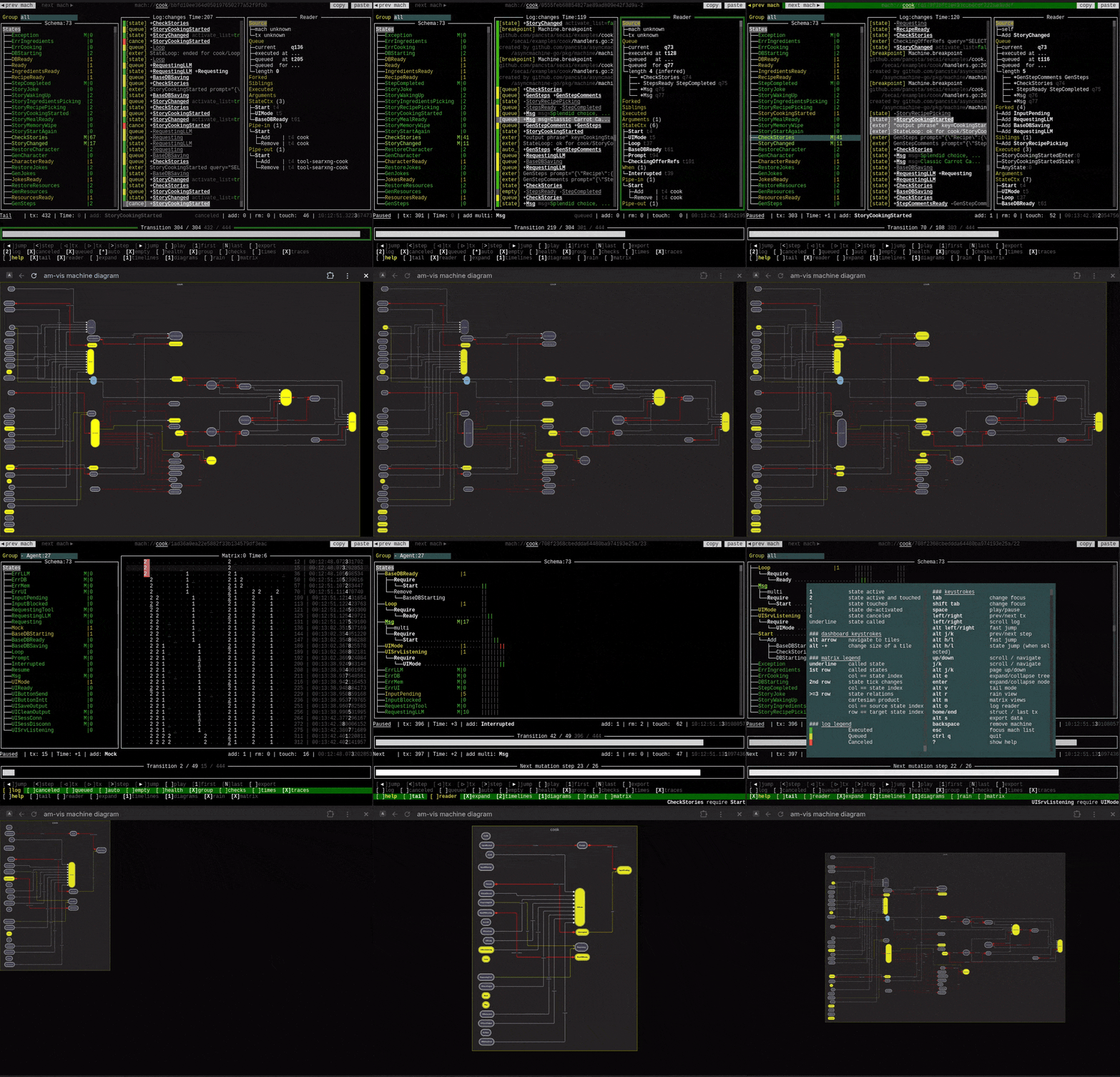
[!NOTE]
git clone https://github.com/pancsta/asyncmachine-go.git
Each state represents
- binary flag
- node with relations
- AOP aspect
- logical clock
- subscription topic
- multiple methods
- metric
- trace
- lock
- breakpoint
- CLI command
Besides the main use-case of workflows, it can be used for stateful applications of any size - daemons, UIs, stateful RPC UIs, configs, flag servers, live sessions, bots, firewalls, synchronization consensus, games, smart graphs, microservice orchestration, robots, contracts, streams, DI containers, message broking, test scenarios, simulators, as well as "real-time" systems which rely on instant cancelation.

[!NOTE] Flow is state, and state is flow, in a graph.
Samples
Minimal - an untyped definition of 2 states and 1 relation, then 1 mutation and a check.
import am "github.com/pancsta/asyncmachine-go/pkg/machine"
// ...
mach := am.New(nil, am.Schema{
    "Foo": {Require: am.S{"Bar"}},
    "Bar": {},
}, nil)
mach.Add1("Foo", nil)
mach.Is1("Foo") // false
Complicated - wait on a multi state (event) and the Ready state with a 1s timeout, then mutate with typed args, on top of a state context.
// state ctx is an expiration ctx
ctx := client.Mach.NewStateCtx(ssC.WorkerReady)
// clock-based subscription
whenPayload := client.Mach.WhenTicks(ssC.WorkerPayload, 1, ctx)
// state mutation
client.RpcWorker.NetMach.Add1(ssW.WorkRequested, Pass(&A{
    Input: 2}))
// WaitFor* wraps select statements
err := amhelp.WaitForAll(ctx, time.Second,
    // post-mutation subscription
    mach.When1(ss.BasicStatesDef.Ready, nil),
    // pre-mutation subscription
    whenPayload)
// check cancelation
if ctx.Err() != nil {
    return // state ctx expired
}
// check error
if err != nil {
    // error state mutation
    client.Mach.AddErr(err, nil)
    return // no err required
}
// client/WorkerPayload and mach/Ready activated
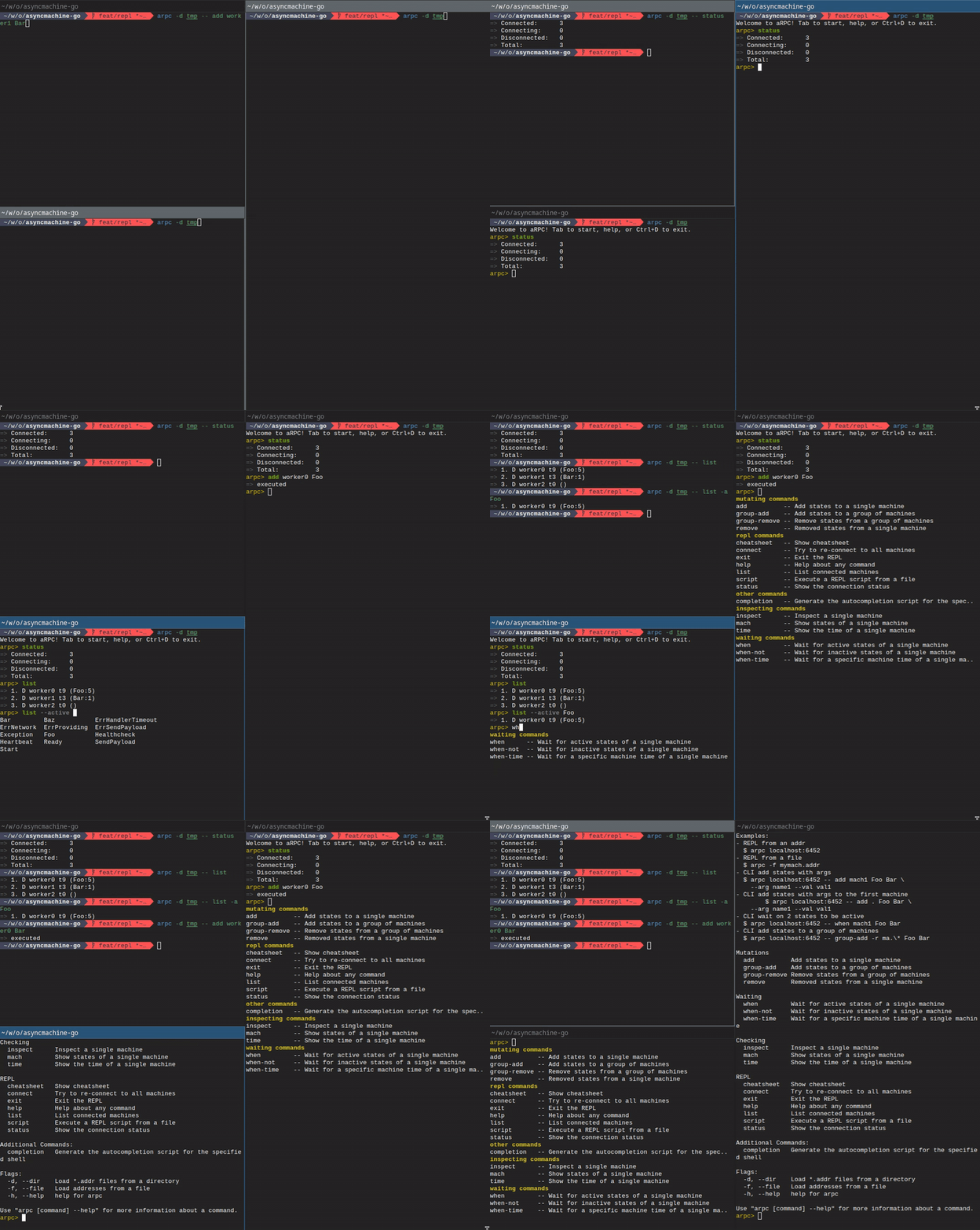
[!NOTE] Clock-based navigation in time.
Handlers - Aspect Oriented transition handlers.
// can Foo activate?
func (h *Handlers) FooEnter(e *am.Event) bool {
    return true
}
// with Foo active, can Bar activate?
func (h *Handlers) FooBar(e *am.Event) bool {
    return true
}
// Foo activates
func (h *Handlers) FooState(e *am.Event) {
    h.foo = NewConn()
}
// Foo de-activates
func (h *Handlers) FooEnd(e *am.Event) {
    h.foo.Close()
}
Schemas - relational schemas (aRPC server).
var ServerSchema = am.Schema{
    ssS.ClientConnected: {Require: S{RpcReady}},
    ssS.ErrDelivery:     {Require: S{Exception}},
    ssS.ErrHandlerTimeout: {
        Add:     S{Exception},
        Multi:   true,
        Require: S{Exception},
    },
    ssS.ErrNetwork: {
        Remove:  S{ClientConnected},
        Require: S{Exception},
    },
    ssS.ErrNetworkTimeout: {Require: S{Exception}},
    ssS.ErrOnClient:       {Require: S{Exception}},
    ssS.ErrProviding:      {Require: S{Exception}},
    ssS.ErrRpc:            {Require: S{Exception}},
    ssS.ErrSendPayload:    {Require: S{Exception}},
    ssS.Exception:         {Multi: true},
    ssS.HandshakeDone: {
        Remove:  S{Handshaking, ssS.HandshakeDone, ssS.Exception},
        Require: S{Start, ssS.ClientConnected},
    },
    ssS.Handshaking: {
        Remove:  S{Handshaking, ssS.HandshakeDone},
        Require: S{Start},
    },
    ssS.Healthcheck: {Multi: true},
    ssS.Heartbeat:   {},
    ssS.MetricSync:  {Multi: true},
    ssS.Ready: {
        Auto:    true,
        Require: S{HandshakeDone, ssS.RpcReady},
    },
    ssS.RpcAccepting: {
        Remove:  S{RpcStarting, ssS.RpcAccepting, ssS.RpcReady},
        Require: S{Start},
    },
    ssS.RpcReady: {
        Remove:  S{RpcStarting, ssS.RpcAccepting, ssS.RpcReady},
        Require: S{Start},
    },
    ssS.RpcStarting: {
        Remove:  S{RpcStarting, ssS.RpcAccepting, ssS.RpcReady},
        Require: S{Start},
    },
    ssS.SendPayload:     {Multi: true},
    ssS.Start:           {Add: S{RpcStarting}},
    ssS.WebSocketTunnel: {},
}
All examples and benchmarks can be found in /examples.
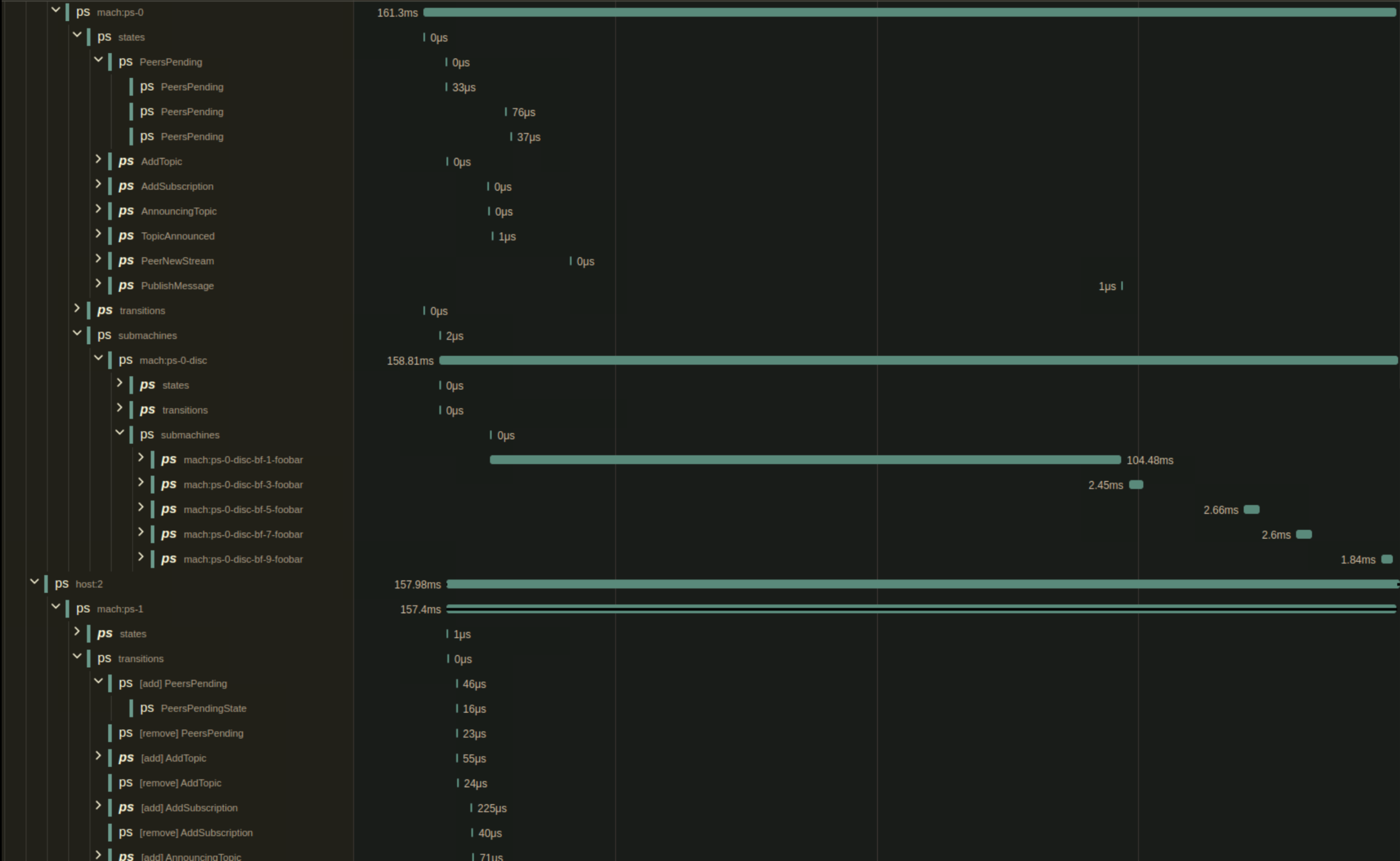
Getting Started
- 🦾
/pkg/machineis the main package /docs/getting-started.mdis a short, step-by-step tutorial/docs/manual.mdand/docs/cookbook.mdare the go-to/docs/diagrams.mdtry to explain things visually/examplesshow use cases and integrations- with
/examples/mach_templatebeing ready for copy-paste - also Basic, CLI Daemon, aRPC, WASM Workflow, TUI
- and classics like FSM, NFA, DAG
- migrating from Temporal?
- with
/tools/cmd/am-genand/docs/editorswill bootstrap/tools/cmd/am-dbgwill record every detail- code in
/pkg/nodeshows a high-level usage - and reading tests is always a good idea
Packages
This monorepo offers the following importable packages, especially:
- 🦾
/pkg/machineState machine, dependency free, semver compatible. /pkg/statesReusable state schemas, handlers, and piping./pkg/helpersUseful functions when working with async state machines./pkg/telemetryTelemetry exporters for dbg, metrics, traces, and logs.
Other packages:
/pkg/rpcRemote state machines, with the same API as local ones./pkg/historyHistory tracking and traversal in mem, KV, and SQL./pkg/integrationsIntegrations for JSON, NATS, MCP, and yaegi./pkg/graphDirectional multigraph of connected state machines (UDP synced).
Experimental:
/pkg/nodeDistributed worker pools with supervisors./pkg/pubsubDecentralized PubSub based on libp2p gossipsub.
Devtools
/tools/cmd/am-dbgMulti-client TUI debugger./tools/cmd/am-genGenerates schema files and Grafana dashboards./tools/cmd/arpcNetwork-native REPL and CLI./tools/cmd/am-visGenerates D2 diagrams./tools/cmd/am-relayRotates logs and relays WASM.
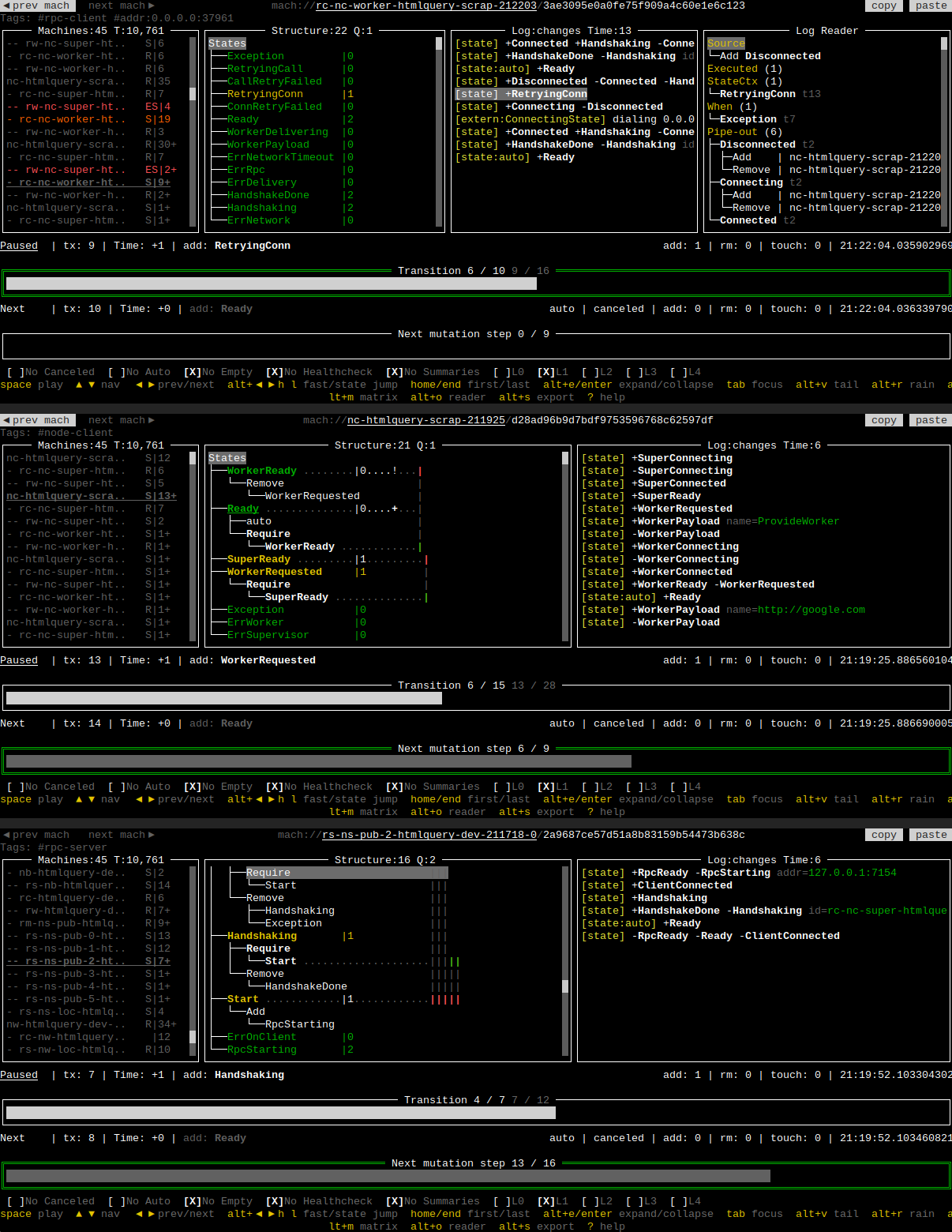
[!NOTE] Inspecting cause-and-effect in distributed systems.
Apps
asyncmachine-go synchronizes state for the following projects:
- DEEPSWAPP Browser - Browse your browser with another browser
- secai - AI Workflows
- Self-hosting of pkg/rpc, pkg/node, pkg/pubsub
- arpc REPL - Cobra-based REPL
- am-dbg TUI Debugger - Single state-machine TUI app
- libp2p PubSub Simulator - Sandbox simulator for libp2p-pubsub
- libp2p PubSub Benchmark - Benchmark of libp2p-pubsub ported to asyncmachine-go
Documentation
Goals
- scale up, not down
- defaults work by default
- everything can be traced and debugged
- automation is evolution
- state != data
Community

[!NOTE] Hundreds of clones.
Status
Under development, status depends on each package. The bottom layers seem prod grade, the top ones are alpha or testing.
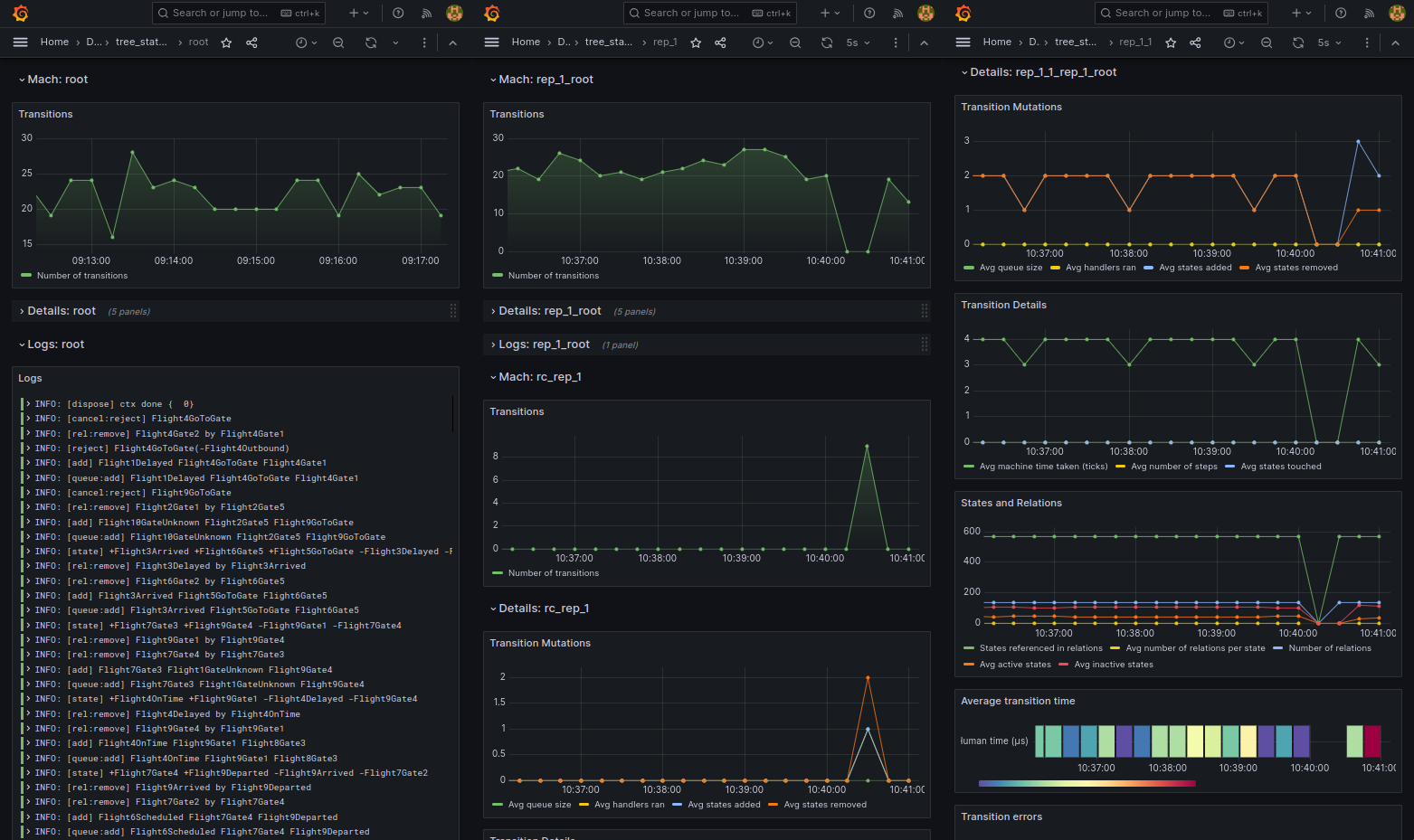
[!NOTE] Managing distributed concurrency.
Development
- good first issues
- before
./scripts/dep-taskfile.shtask install-deps
- after
task testtask formattask linttask precommit
Roadmap
- high perf netgraph
- more tooling, diagrams, integrations
- bug fixes and optimizations
- ROADMAP.md

[!NOTE] Step by step.
FAQ
What is a "state" in asyncmachine?
State is a binary ID as in status / switch / flag, eg "process RUNNING" or "car BROKEN".
What does "clock-based" mean?
Each state has a counter of activations & deactivations, and all state counters create "machine time". These are logical clocks, and the queue is also (partially) counted.
What's the difference between states and events?
The same event happening many times will cause only 1 state activation, until the state becomes inactive.
The complete FAQ is available at FAQ.md.
Changes
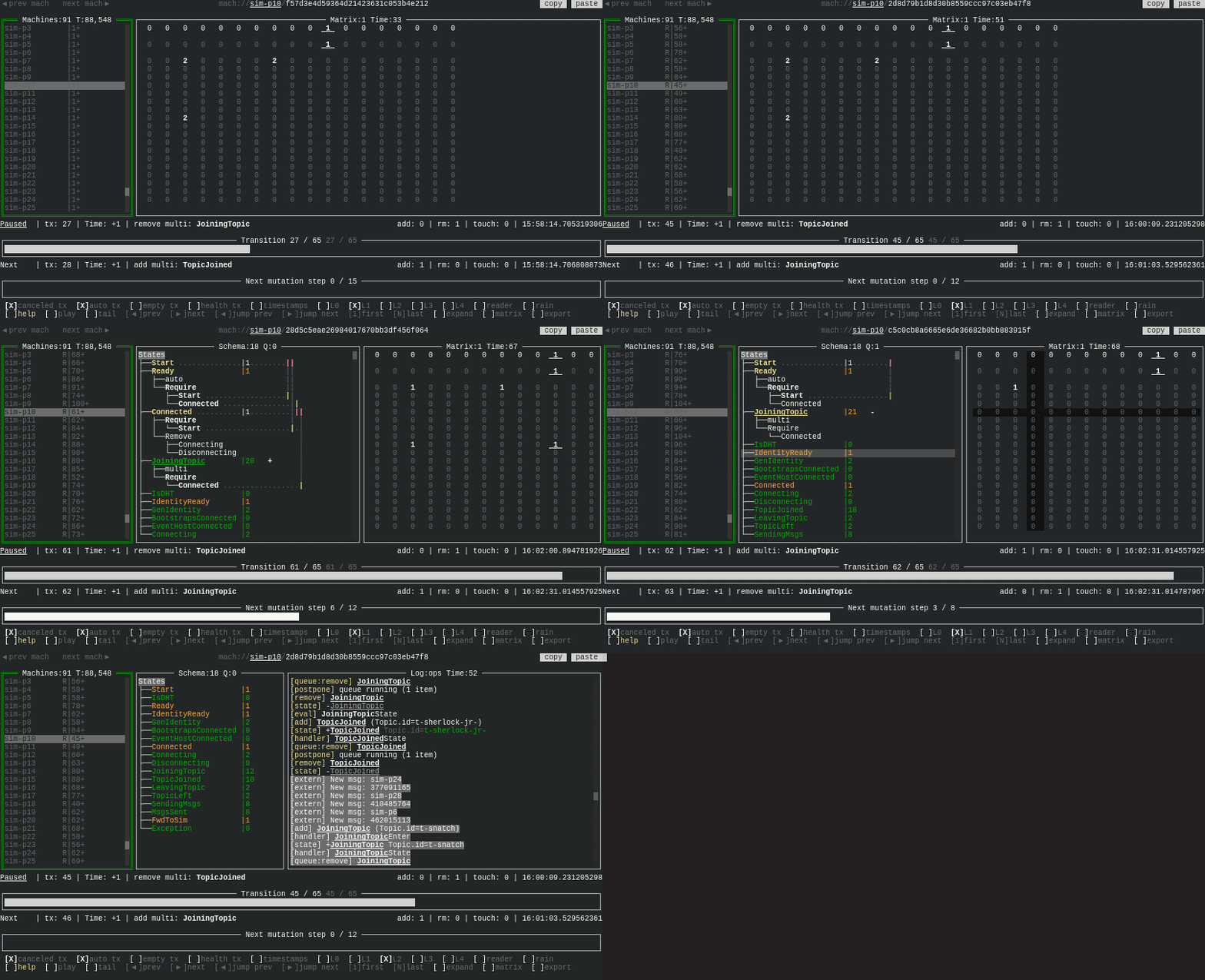
[!NOTE] Don't lose your sync.
 Directories

| Path | Synopsis |
|---|---|
|
docs
|
|
|
examples
|
|
|
arpc/client
command
|
|
|
arpc/server
command
|
|
|
asynq_fileprocessing/client
command
|
|
|
asynq_fileprocessing/worker
command
|
|
|
basic
command
ProcessingFile to FileProcessed 1 async and 1 sync state
|
ProcessingFile to FileProcessed 1 async and 1 sync state |
|
cli
command
|
|
|
cli/states
Package states contains a stateful schema-v2 for a CLI.
|
Package states contains a stateful schema-v2 for a CLI. |
|
cli_daemon/cli
command
|
|
|
cli_daemon/daemon
command
|
|
|
cli_daemon/states
Package states contains a stateful schema-v2 for a CLI.
|
Package states contains a stateful schema-v2 for a CLI. |
|
dag_dependency_graph
command
|
|
|
fan_out_in
command
|
|
|
mach_template
command
Package main is a boilerplate for asyncmachine-go.
|
Package main is a boilerplate for asyncmachine-go. |
|
mach_template/states
Package states contains a stateful schema-v2 for MachTemplate.
|
Package states contains a stateful schema-v2 for MachTemplate. |
|
pipes
command
|
|
|
raw_strings
command
Package main is an educational example of a state machine operating on string-based states.
|
Package main is an educational example of a state machine operating on string-based states. |
|
relations_playground
command
|
|
|
repl
command
|
|
|
subscriptions
command
|
|
|
tree_state_source
command
|
|
|
tree_state_source/gen_states
command
|
|
|
tui
command
|
|
|
internal
|
|
|
nofmt
Package nofmt provides the small subset of fmt used by asyncmachine libraries, without importing fmt.
|
Package nofmt provides the small subset of fmt used by asyncmachine libraries, without importing fmt. |
|
testing/cmd/am-dbg-worker
command
AM_DBG_WORKER_ADDR AM_DBG_ADDR
|
AM_DBG_WORKER_ADDR AM_DBG_ADDR |
|
pkg
|
|
|
graph
Package graph provides a graph or interconnected state-machines and their states, based on the dbg telemetry protocol.
|
Package graph provides a graph or interconnected state-machines and their states, based on the dbg telemetry protocol. |
|
graph/gochickpeas
Package gochickpeas implements the amtypes.DbGraph backend over the in-memory gochickpeas graph database.
|
Package gochickpeas implements the amtypes.DbGraph backend over the in-memory gochickpeas graph database. |
|
graph/types
Package shared contains graph types and helpers shared by the DbGraph backends: the DbGraph interface, the mirror model types, and GQL model helpers.
|
Package shared contains graph types and helpers shared by the DbGraph backends: the DbGraph interface, the mirror model types, and GQL model helpers. |
|
helpers
Package helpers is a set of useful functions when working with async state machines.
|
Package helpers is a set of useful functions when working with async state machines. |
|
helpers/testing
Package testing provides testing helpers for state machines using testify.
|
Package testing provides testing helpers for state machines using testify. |
|
history
Package history provides machine history tracking and traversal using the process' memory and structs.
|
Package history provides machine history tracking and traversal using the process' memory and structs. |
|
history/badger
Package badger provides machine history tracking and traversal using the Badger K/V database.
|
Package badger provides machine history tracking and traversal using the Badger K/V database. |
|
history/bbolt
Package bbolt provides machine history tracking and traversal using the bbolt K/V database.
|
Package bbolt provides machine history tracking and traversal using the bbolt K/V database. |
|
integrations/ark
Package ark integrates the ark ECS with asyncmachine graphs and in-memory pubsub simulations.
|
Package ark integrates the ark ECS with asyncmachine graphs and in-memory pubsub simulations. |
|
integrations/grpc
Package grpc exposes asyncmachines over gRPC.
|
Package grpc exposes asyncmachines over gRPC. |
|
integrations/mcp-go
Package mcp exposes asyncmachines over mcp-go as an MCP server.
|
Package mcp exposes asyncmachines over mcp-go as an MCP server. |
|
integrations/rest
Package rest exposes asyncmachines over a JSON REST API.
|
Package rest exposes asyncmachines over a JSON REST API. |
|
machine
Local copy of the internal nofmt formatter for pkg/machine.
|
Local copy of the internal nofmt formatter for pkg/machine. |
|
machine/gen
command
Command gen generates map-based handler bindings for the pkg/machine test suite.
|
Command gen generates map-based handler bindings for the pkg/machine test suite. |
|
node
Package node provides distributed worker pools with supervisors.
|
Package node provides distributed worker pools with supervisors. |
|
node/test/worker
command
|
|
|
rpc
Package rpc is a transparent RPC for state machines.
|
Package rpc is a transparent RPC for state machines. |
|
rpc/gen
command
|
|
|
rpc/states/gen
command
|
|
|
states
Package states provides reusable state definitions.
|
Package states provides reusable state definitions. |
|
states/gen
command
|
|
|
states/pipes
Package pipes provide helpers to pipe states from one machine to another.
|
Package pipes provide helpers to pipe states from one machine to another. |
|
telemetry
Package telemetry provides telemetry exporters: am-dbg, Prometheus, OpenTelemetry.
|
Package telemetry provides telemetry exporters: am-dbg, Prometheus, OpenTelemetry. |
|
telemetry/prometheus
Package prometheus provides Prometheus metrics for asyncmachine.
|
Package prometheus provides Prometheus metrics for asyncmachine. |
|
x/helpers
Package helpers provides experimental and unstable helpers.
|
Package helpers provides experimental and unstable helpers. |
|
tools
|
|
|
cmd/am-dbg
command
am-dbg is a lightweight, multi-client debugger for asyncmachine-go.
|
am-dbg is a lightweight, multi-client debugger for asyncmachine-go. |
|
cmd/am-gen
command
am-gen generates schema files and Grafana dashboards.
|
am-gen generates schema files and Grafana dashboards. |
|
cmd/am-relay
command
|
|
|
cmd/am-vis
command
Package am-vis generates diagrams of a filtered graph.
|
Package am-vis generates diagrams of a filtered graph. |
|
cmd/arpc
command
|
|
|
debugger
Package debugger provides a TUI debugger with multi-client support.
|
Package debugger provides a TUI debugger with multi-client support. |
|
generator
Package generator generates state-machine schemas and grafana dashboards.
|
Package generator generates state-machine schemas and grafana dashboards. |
|
relay/states
Package states contains a stateful schema-v2 for Relay.
|
Package states contains a stateful schema-v2 for Relay. |
|
repl
Package repl provides a REPL and CLI functionality for aRPC connections.
|
Package repl provides a REPL and CLI functionality for aRPC connections. |
|
repl/states
Package states contains a stateful schema-v2 for Repl.
|
Package states contains a stateful schema-v2 for Repl. |
|
visualizer/states
Package states contains a stateful schema-v2 for Visualizer.
|
Package states contains a stateful schema-v2 for Visualizer. |