

 README

README

secai is an AtomicAgents-like framework for autonomous LLM daemons. It's implemented on top of a unified state graph and makes a solid foundation for complex, proactive, and long-lived AI Agents with deep and structured memory. It offers a dedicated set of devtools and is written in the Go programming language. By having graph-based flow, secai allows for precise behavior modeling of agents, including interruptions and fault-tolerancy.
Features
- atomicity on the state level
- atomic consensus with relations and negotiation
- declarative flow definitions
- REPL & CLI
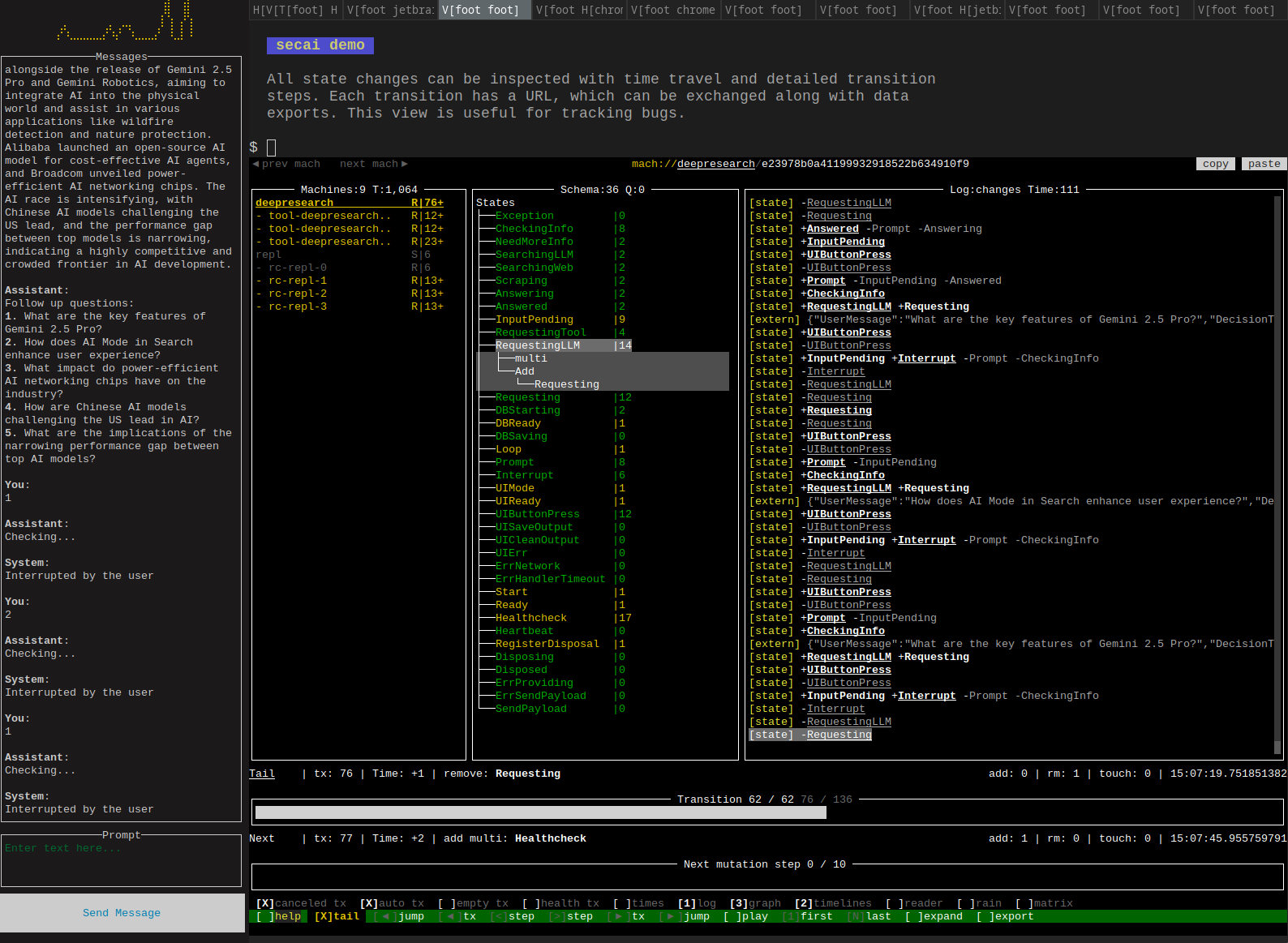
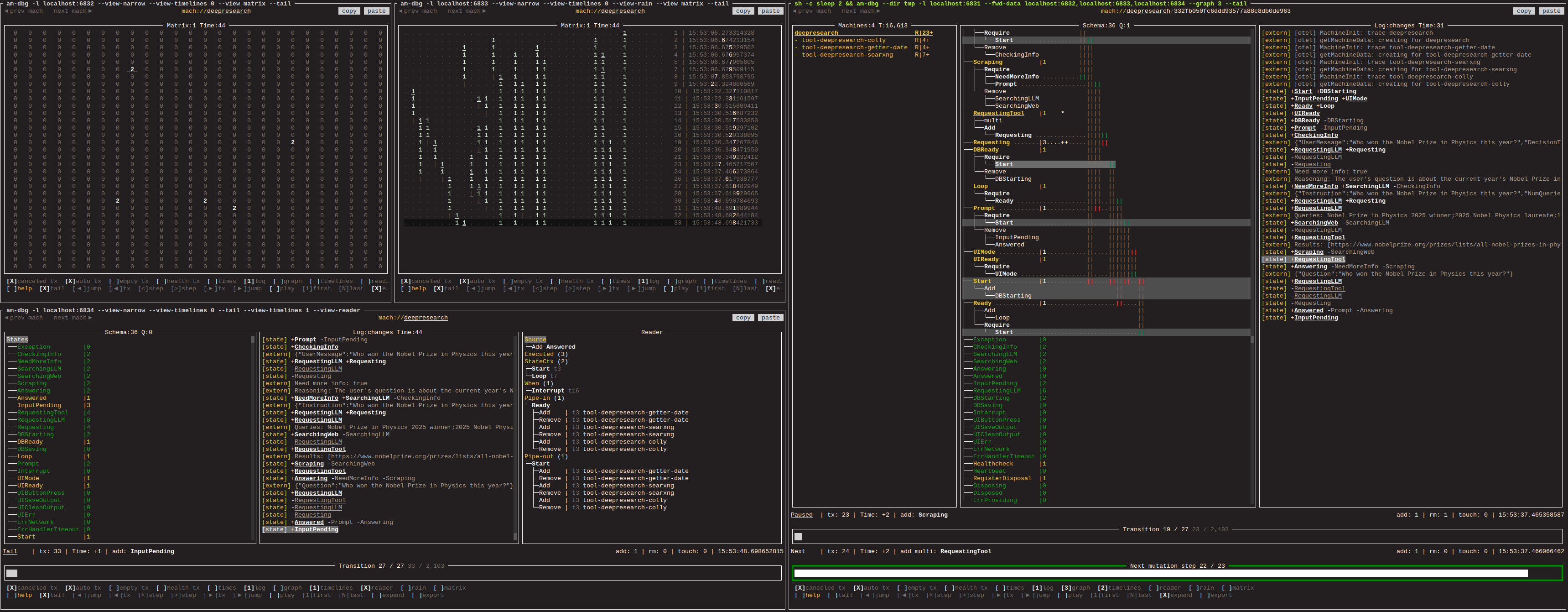
- TUI debugger (+zellij dashboards)
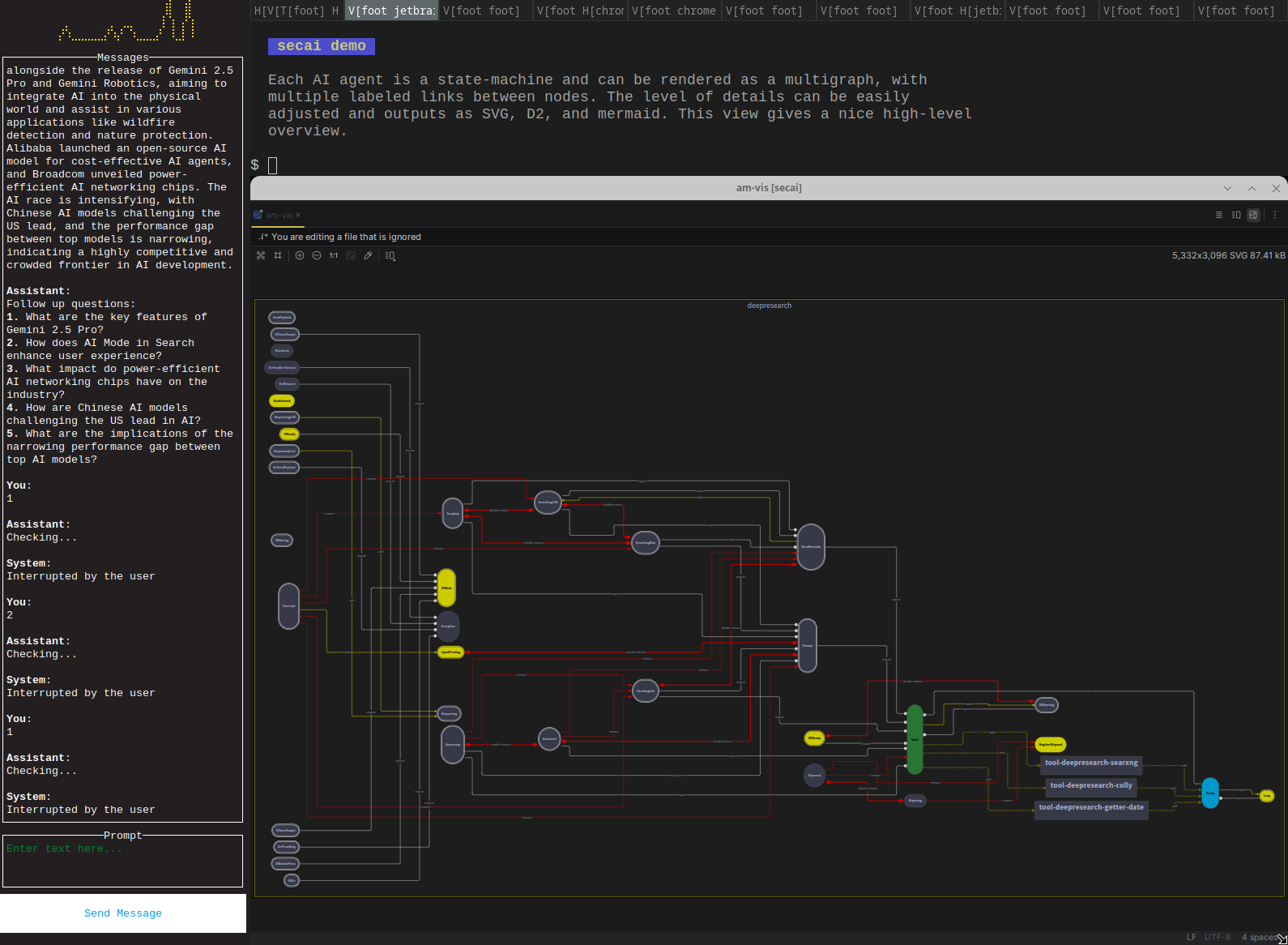
- automatic diagrams (SVG, D2, mermaid)
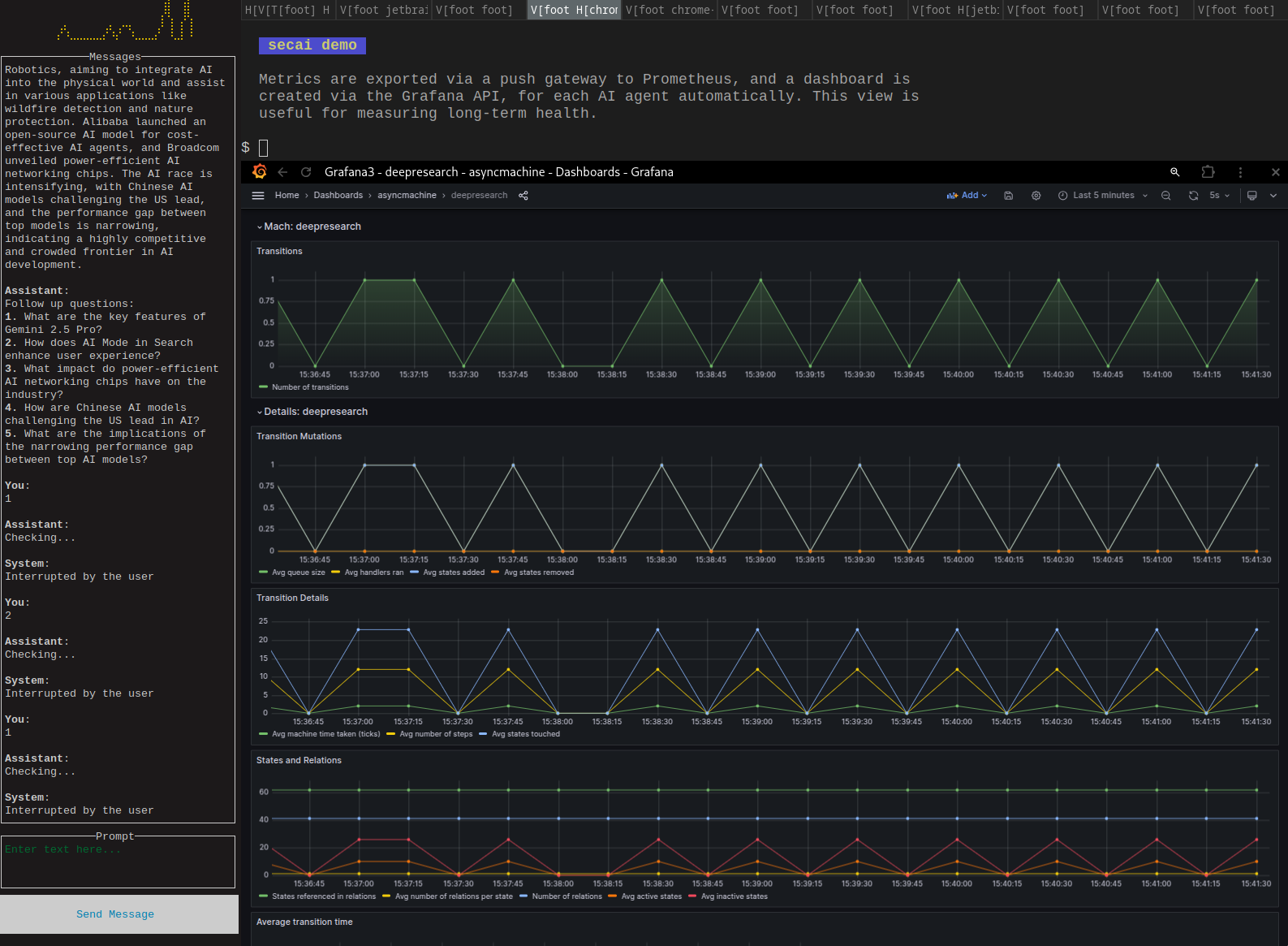
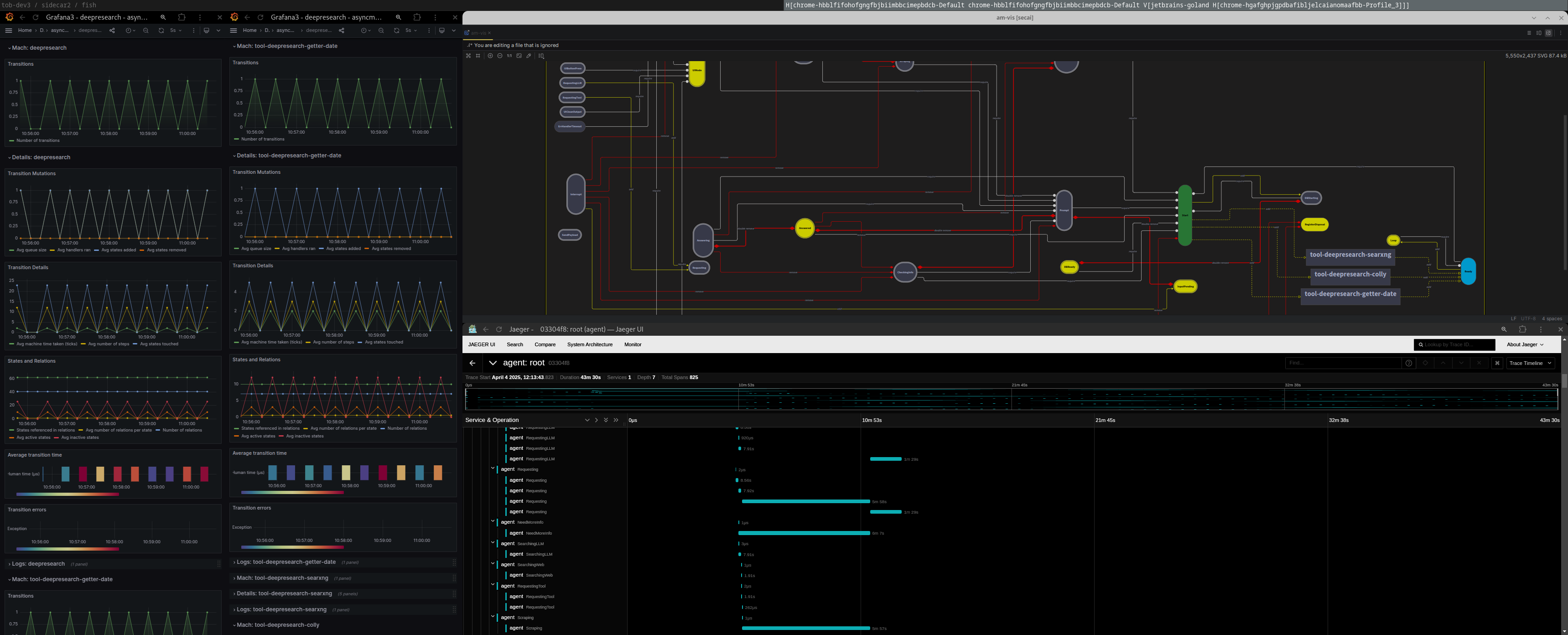
- automatic observability (Prometheus, Grafana, Jaeger)
- cancellation support (interrupts)
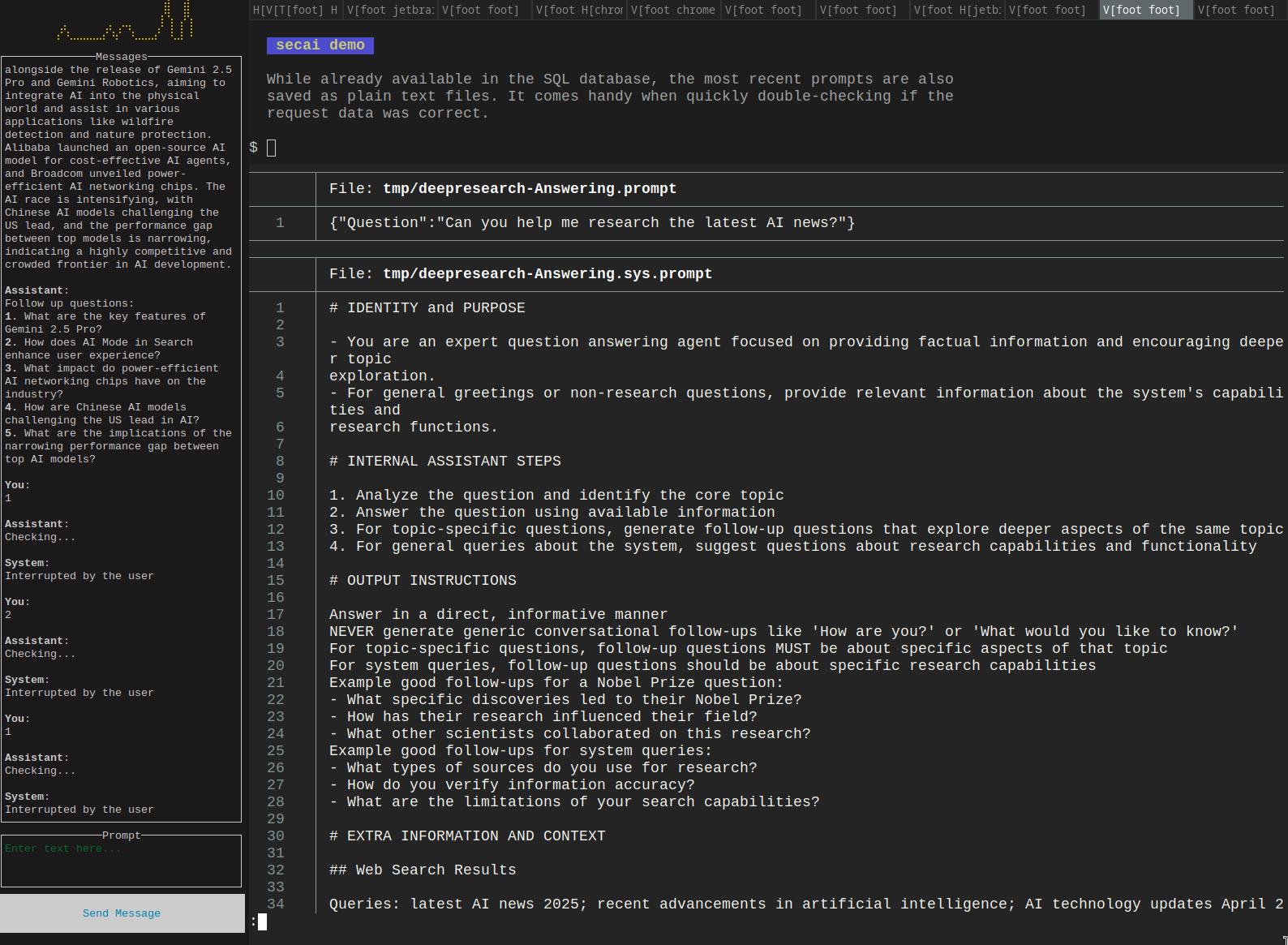
- prompt history in SQL (embedded SQLite)
- chat TUI (tview)
Tools
Planned
- typesafe arguments struct
- history DSL with a vector format (WIP)
- pro-active scenarios (WIP)
- MCP
- dynamic tools
- dynamic state graph
- i18n
Implementation
- pure Golang
- typesafe state & prompt schemas
- asyncmachine-go for graphs and control flow
- instructor-go for the LLM layer
- network transparency (aRPC, debugger, REPL)
- structured concurrency (multigraph-based)
- tview for chat TUI
Components
- Agent (actor)
- state-machine schema
- Tool (actor)
- state-machine schema
- Prompt (stateless)
- params schema
- result schema
- Document
- title, content
Comparison
| Feature | secai | AtomicAgents |
|---|---|---|
| Model | unified state graph | BaseAgent class |
| Debugger | multi-client with time travel | X |
| Diagrams | customizable level of details | X |
| Observability | logging & Grafana & Otel | X |
| REPL & CLI | network-based | X |
| History | state-based and prompt-based | prompt-based |
| Pkg manager | Golang | in-house |
| Control Flow | declarative & fault tolerant | imperative |
| CLI | bubbletea, lipgloss | rich |
| TUI | tview, cview | textual |
Go vs Python
- just works, batteries included, no magic
- 1 package manager vs 4
- single binary vs interpreted multi-file source
- coherent static typing vs maybe
- easy & stable vs easy
- no ecosystem fragmentation
- million times faster /s
Try It
Unlike Python apps, you can start it with a single command:
- Install Go
- Set either of the API keys:
export OPENAI_API_KEY=myapikeyexport DEEPSEEK_API_KEY=myapikey
- Run
go run github.com/pancsta/secai/examples/deepresearch/cmd@latest
Demo
Screenshots are also available.
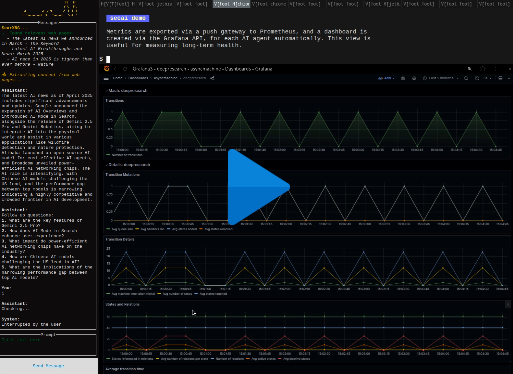
[!NOTE] This tech demo is a 5min captions-only screencast, showcasing all 9 ways an agent can be seen, in addition to the classic chat view.
Example
Code snippets from /examples/deepresearch. Both the state and prompt schemas are pure and debuggable Golang code.
State Schema
// ResearchStatesDef contains all the states of the Research state machine.
type ResearchStatesDef struct {
    *am.StatesBase

    // PROMPTS

    CheckingInfo string
    NeedMoreInfo string

    Searching  string
    SearchDone string

    Answering string
    Answered  string

    *ss.AgentStatesDef
}

// ResearchGroupsDef contains all the state groups Research state machine.
type ResearchGroupsDef struct {
    Info    S
    Search  S
    Answers S
}

// ResearchSchema represents all relations and properties of ResearchStates.
var ResearchSchema = SchemaMerge(
    // inherit from Agent
    ss.AgentSchema,

    am.Schema{

        // PROMPTS

        // Choice "agent"
        ssR.CheckingInfo: {
            Require: S{ssR.Start},
            Remove:  sgR.Info,
        },
        ssR.NeedMoreInfo: {
            Require: S{ssR.Start},
            Add:     S{ssR.Searching},
            Remove:  sgR.Info,
        },

        // Query "agent"
        ssR.Searching: {
            Require: S{ssR.NeedMoreInfo},
            Remove:  sgR.Search,
        },
        ssR.SearchDone: {
            Require: S{ssR.Start},
            Remove:  sgR.Search,
        },

        // Q&A "agent"
        ssR.Answering: {
            Require: S{ssR.Start},
            Remove:  SAdd(sgR.Info, sgR.Answers, sgR.Search),
        },
        ssR.Answered: {
            Require: S{ssR.Start},
            Remove:  SAdd(sgR.Info, sgR.Answers, sgR.Search),
        },
    })

var sgR = am.NewStateGroups(ResearchGroupsDef{
        Info:    S{ssR.CheckingInfo, ssR.NeedMoreInfo},
        Search:  S{ssR.Searching, ssR.SearchDone},
        Answers: S{ssR.Answering, ssR.Answered},
    })
Prompt Schema
func NewCheckingInfoPrompt(agent secai.AgentApi) *secai.Prompt[ParamsCheckingInfo, ResultCheckingInfo] {
    return secai.NewPrompt[ParamsCheckingInfo, ResultCheckingInfo](
        agent, ssR.CheckingInfo, `
            - You are a decision-making agent that determines whether a new web search is needed to answer the user's question.
            - Your primary role is to analyze whether the existing context contains sufficient, up-to-date information to
            answer the question.
            - You must output a clear TRUE/FALSE decision - TRUE if a new search is needed, FALSE if existing context is
            sufficient.
        `, `
            1. Analyze the user's question to determine whether or not an answer warrants a new search
            2. Review the available web search results
            3. Determine if existing information is sufficient and relevant
            4. Make a binary decision: TRUE for new search, FALSE for using existing context
        `, `
            Your reasoning must clearly state WHY you need or don't need new information
            If the web search context is empty or irrelevant, always decide TRUE for new search
            If the question is time-sensitive, check the current date to ensure context is recent
            For ambiguous cases, prefer to gather fresh information
            Your decision must match your reasoning - don't contradict yourself
        `)
}

// CheckingInfo (Choice "agent")

type ParamsCheckingInfo struct {
    UserMessage  string
    DecisionType string
}

type ResultCheckingInfo struct {
    Reasoning string `jsonschema:"description=Detailed explanation of the decision-making process"`
    Decision  bool   `jsonschema:"description=The final decision based on the analysis"`
}
Read the schema file in full.
Screenshots
| SVG graph | am-dbg | Grafana | Jaeger | REPL |
|
|
|
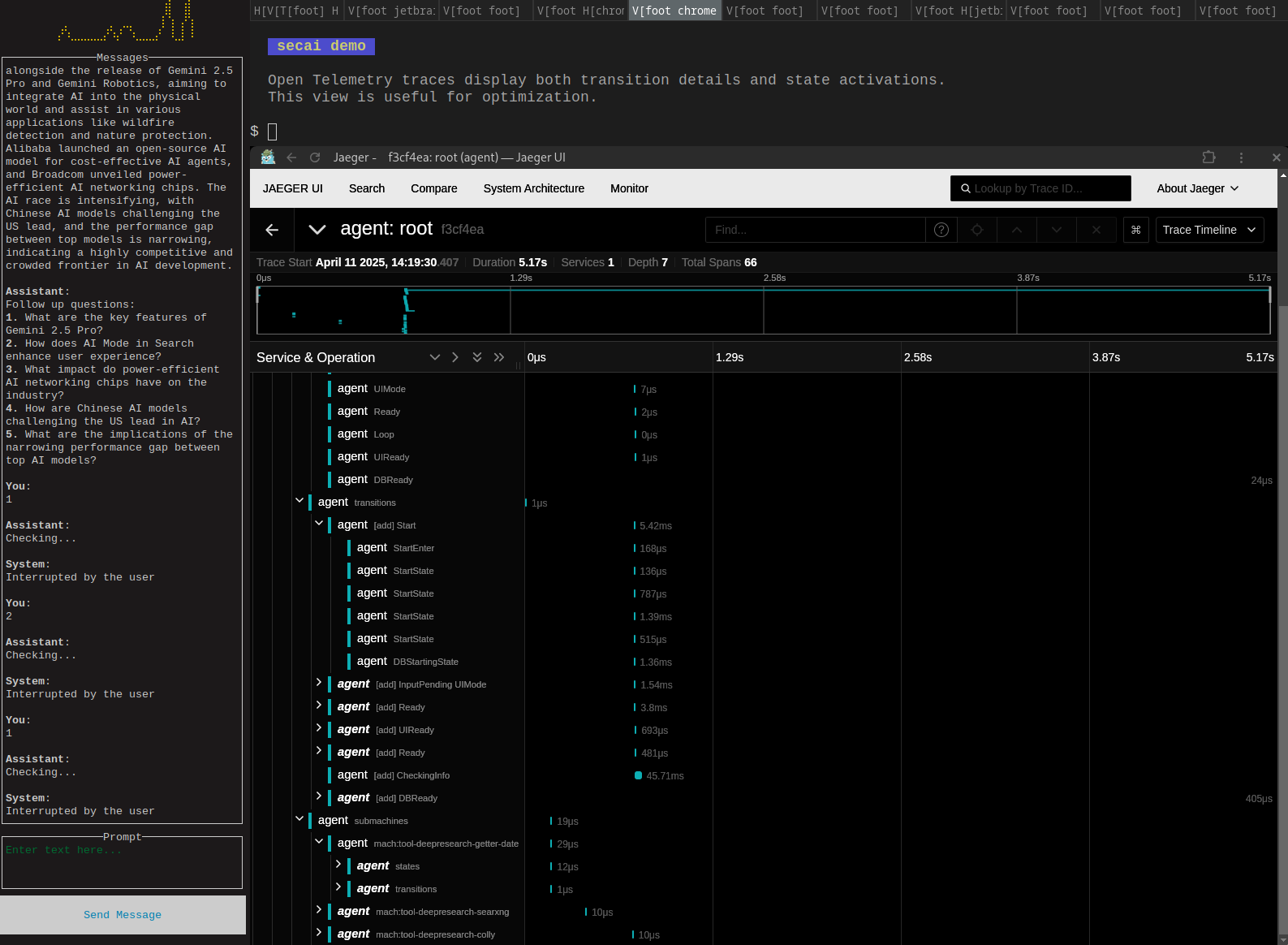
|
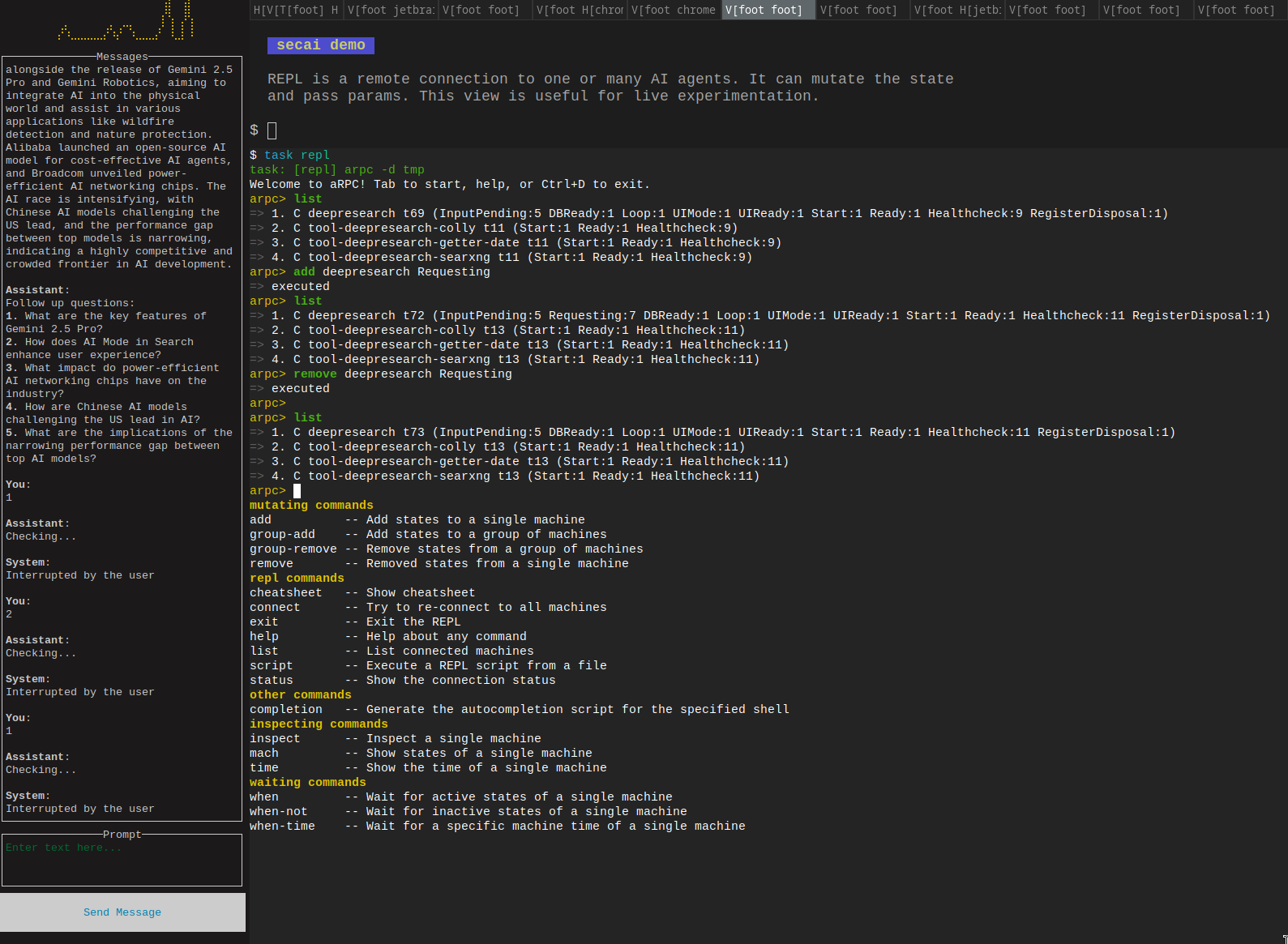
|
| SQL | IDE | Bash | Prompts | |
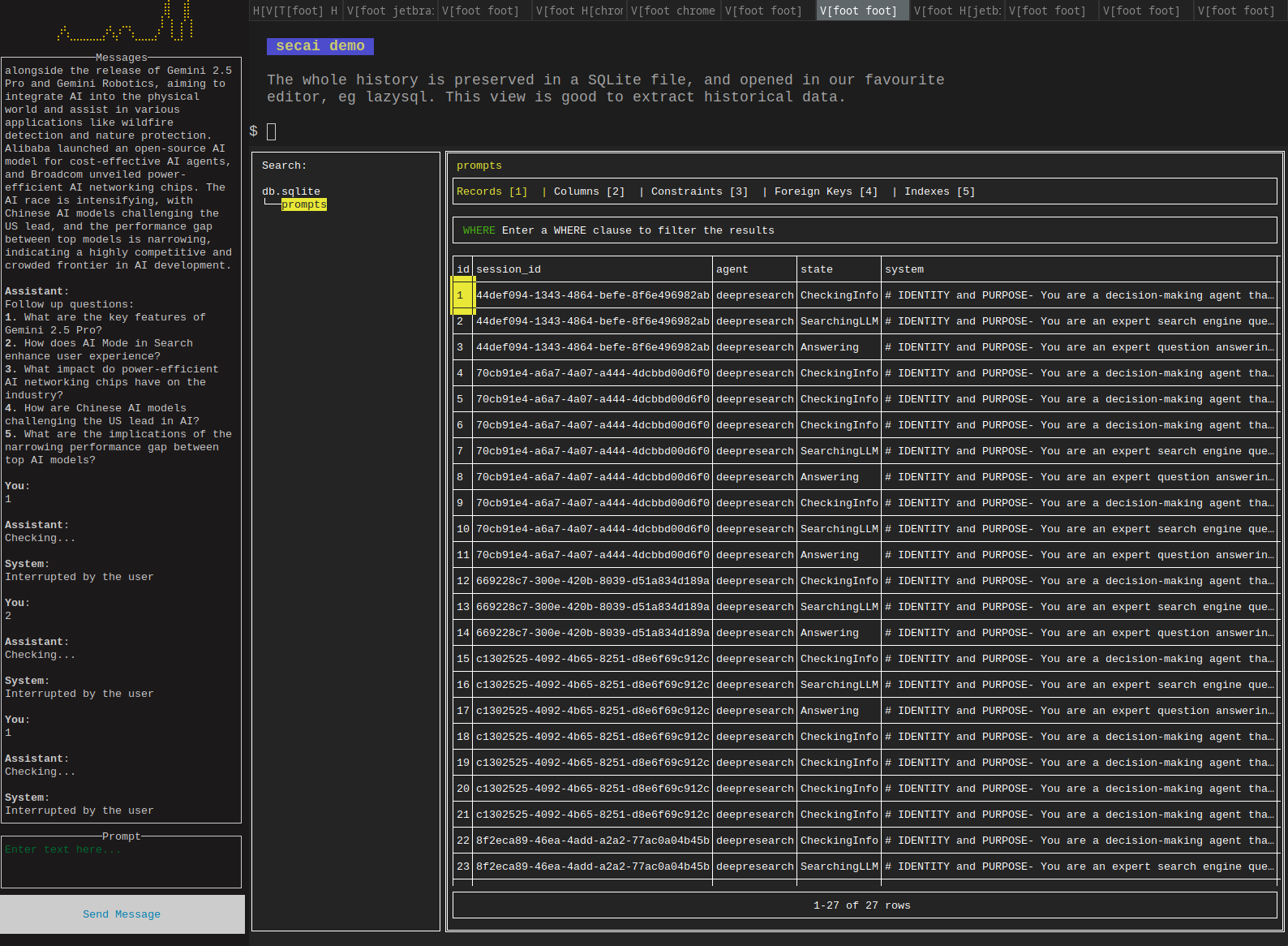
|
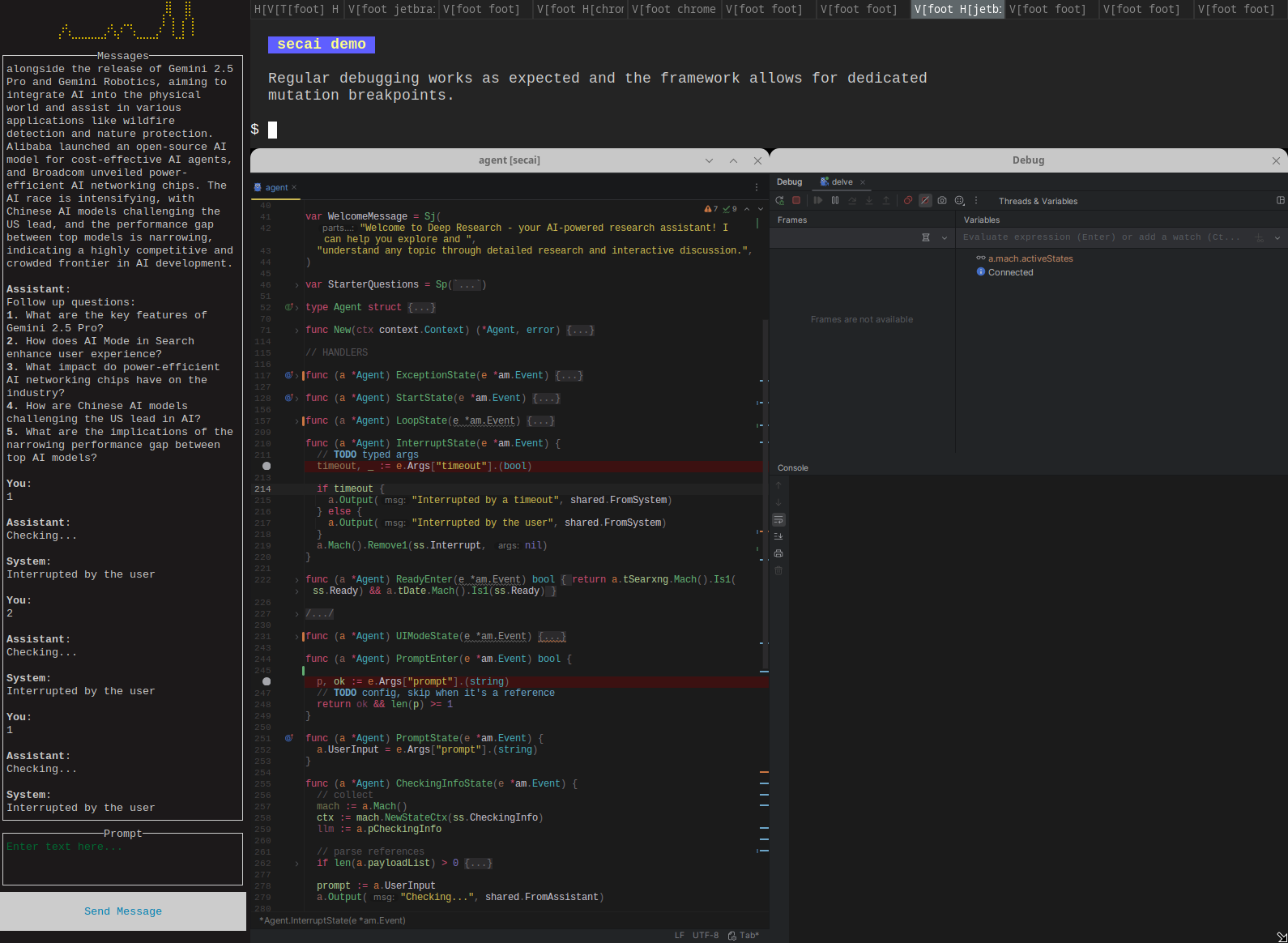
|
|
|
|
| Dashboard 1 | ||||
|
||||
| Dashboard 2 | ||||
|
||||
Documentation
- asyncmachine-go / api / docs
- instructor-go / api / docs
- tview / api / docs
Getting Started
We can use /examples/deepresearch as a starting template. It allows for further updates of the base framework.
git clone https://github.com/pansta/secai- install task
./secai/scripts/deps.sh - copy the agent
cp -R secai/examples/deepresearch MYAGENT - copy agent's config
cp secai/template.env MYAGENT/.env - copy project configs
cp -R secai/config MYAGENT cd MYAGENTgo mod init github.com/USER/MYAGENTgo mod tidytask install-depstask starttask --list
Chat TUI
A simple chat TUI with UI states is included in /tui, consisting of:
- senders & msgs scrollable view with links
- multiline prompt with blocking and progress
- send / stop button
Bash Scripts
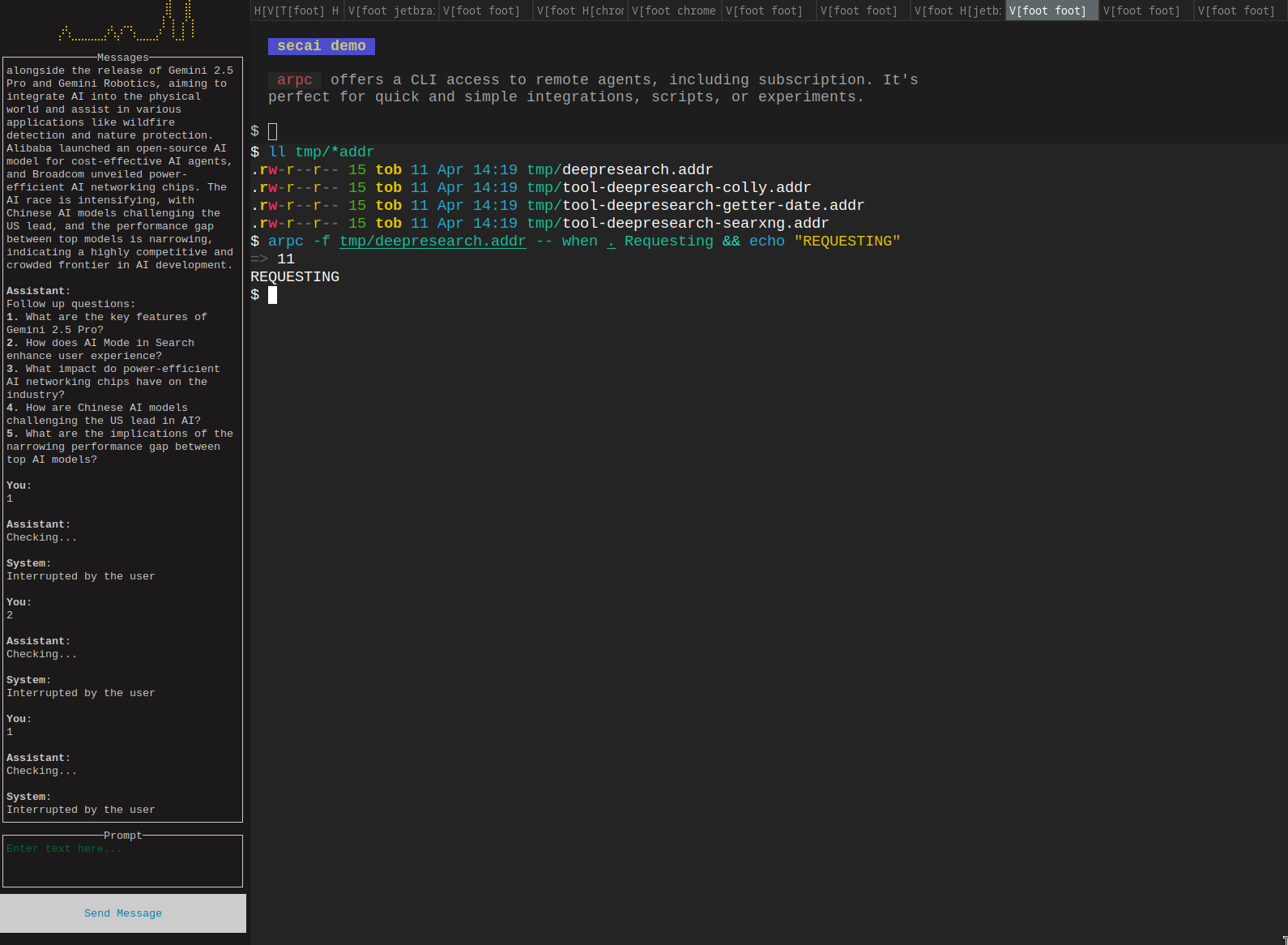
arpc offers a CLI access to remote agents, including subscription. It's perfect for quick and simple integrations, scripts, or experiments.
Example: arpc -f tmp/deepresearch.addr -- when . Requesting && echo "REQUESTING"
- Connect to the address from
tmp/deepresearch.addr - When the last connected agent (
.) goes into stateRequesting - Print "REQUESTING" and exit
Acknowledgements
 Documentation

Documentation

Index 
- func InitAgent[G AgentApi](ctx context.Context, id string, states am.S, machSchema am.Schema, agent G) (G, error)
- func ToolAddToPrompts(t ToolApi, prompts ...PromptApi)
- type Agent
- func (a *Agent) DB() *sql.DB
- func (a *Agent) DBReadyEnd(e *am.Event)
- func (a *Agent) DBSavingEnter(e *am.Event) bool
- func (a *Agent) DBSavingState(e *am.Event)
- func (a *Agent) DBStartingState(e *am.Event)
- func (a *Agent) Log(txt string, args ...any)
- func (a *Agent) Mach() *am.Machine
- func (a *Agent) OpenAI() *instructor.InstructorOpenAI
- func (a *Agent) Output(txt string, from shared.From)
- func (a *Agent) PromptEnd(e *am.Event)
- func (a *Agent) PromptState(e *am.Event)
- func (a *Agent) Queries() *db.Queries
- func (a *Agent) RequestingExit(e *am.Event) bool
- func (a *Agent) RequestingLLMEnd(e *am.Event)
- func (a *Agent) RequestingLLMEnter(e *am.Event) bool
- func (a *Agent) RequestingLLMExit(e *am.Event) bool
- func (a *Agent) RequestingToolEnd(e *am.Event)
- func (a *Agent) RequestingToolEnter(e *am.Event) bool
- func (a *Agent) RequestingToolExit(e *am.Event) bool
- func (a *Agent) SetMach(m *am.Machine)
- func (a *Agent) SetOpenAI(c *instructor.InstructorOpenAI)
- func (a *Agent) Start() am.Result
- func (a *Agent) StartEnter(e *am.Event) bool
- func (a *Agent) StartState(e *am.Event)
- func (a *Agent) Stop(disposeCtx context.Context) am.Result
- type AgentApi
- type CheckpointSamples
- type Document
- type InRes
- type Prompt
- func (p *Prompt[P, R]) AddTool(tool ToolApi)
- func (p *Prompt[P, R]) AppendHistOpenAI(msg *openai.ChatCompletionMessage)
- func (p *Prompt[P, R]) Generate() string
- func (p *Prompt[P, R]) HistOpenAI() []openai.ChatCompletionMessage
- func (p *Prompt[P, R]) MsgsOpenAI() []openai.ChatCompletionMessage
- func (p *Prompt[P, R]) Run(params P, model string) (*R, error)
- type PromptApi
- type PromptSchemaless
- type S
- type Scenario
- type ScenarioSamples
- type Tool
- type ToolApi
Constants 
This section is empty.
Variables 
This section is empty.
Functions 
func ToolAddToPrompts 
Types 
type Agent 
type Agent struct {
	*am.ExceptionHandler
	*ssam.DisposedHandlers

	// UserInput is a prompt submitted the user, owned by [schema.AgentStatesDef.Prompt].
	UserInput string
	// contains filtered or unexported fields
}
func (*Agent) DBReadyEnd 
func (*Agent) DBSavingState 
func (*Agent) DBStartingState 
func (*Agent) OpenAI 
func (a *Agent) OpenAI() *instructor.InstructorOpenAI
func (*Agent) PromptState 
func (*Agent) RequestingLLMEnd 
func (*Agent) RequestingToolEnd 
func (*Agent) SetOpenAI 
func (a *Agent) SetOpenAI(c *instructor.InstructorOpenAI)
func (*Agent) StartState 
type AgentApi 
type AgentApi interface {
	Output(txt string, from shared.From)

	Mach() *am.Machine
	SetMach(*am.Machine)

	SetOpenAI(c *instructor.InstructorOpenAI)
	OpenAI() *instructor.InstructorOpenAI

	Start() am.Result
	Stop(disposeCtx context.Context) am.Result
	Log(txt string, args ...any)

	DB() *sql.DB
	Queries() *db.Queries
}
type CheckpointSamples 
type Document 
type Document struct {
	// contains filtered or unexported fields
}
func NewDocument 
type Prompt 
type Prompt[P any, R any] struct {
	Conditions   string
	Steps        string
	Result       string
	SchemaParams P
	SchemaResult R

	// number of previous messages to include
	HistoryMsgLen int
	// number of previous machine times to include
	HistoryStateLen int

	State string
	A     AgentApi
	// contains filtered or unexported fields
}
func (*Prompt[P, R]) AppendHistOpenAI 
func (p *Prompt[P, R]) AppendHistOpenAI(msg *openai.ChatCompletionMessage)
func (*Prompt[P, R]) HistOpenAI 
func (p *Prompt[P, R]) HistOpenAI() []openai.ChatCompletionMessage
func (*Prompt[P, R]) MsgsOpenAI 
func (p *Prompt[P, R]) MsgsOpenAI() []openai.ChatCompletionMessage
type PromptApi 
type PromptApi interface {
	AddTool(tool ToolApi)

	HistOpenAI() []openai.ChatCompletionMessage
	AppendHistOpenAI(msg *openai.ChatCompletionMessage)
}
type PromptSchemaless 
type Scenario 
type Scenario struct {
	// Name of the scenario
	Name string

	// scenario only applicable if these states are active (optional)
	RequireActive am.S
	// scenario only applicable if these states are inactive (optional)
	RequireInactive am.S

	// states possible to trigger (separately)
	Inputs am.S
	// states expected to happen
	Checkpoints am.S
	// additional context states (optional)
	Contexts am.S

	// number of future transitions to check for checkpoint activations, eg [1, 5, 10]
	// will mark a checkpoint true if it gets activated in 1 or 5 or 10 txes
	// from the input state
	// default: [1]
	ActivationDistances []int
	// number of mutations to simulate and check for checkpoint confirmations
	ScenarioSteps int // default: 1
}
Scenario produces ScenarioSamples for checkpoint states.
type ScenarioSamples 
type ScenarioSamples struct {
	// active checkpoints in the beginning of the scenario
	StartingCheckpoints []string
	// names of input states, with only one being called at a time
	Inputs []string
	// names of checkpoint states
	Checkpoint []string
	// names of context states
	Contexts []string
	// samples with Checkpoint states as inputs
	Samples []*CheckpointSamples
}
 Source Files
 Directories

Directories

| Path | Synopsis |
|---|---|
|
examples
|
|
|
deepresearch
Package deepresearch is a port of atomic-agents/deepresearch to secai.
|
Package deepresearch is a port of atomic-agents/deepresearch to secai. |
|
deepresearch/cmd
command
|
|
|
Package schema contains a stateful schema-v2 for Agent.
|
Package schema contains a stateful schema-v2 for Agent. |
|
tools
|
|