 The highest tagged major version is


 README

README






[中文]
gnet is an Event-Loop networking framework that is fast and small. It makes direct epoll and kqueue syscalls rather than using the standard Go net package, and works in a similar manner as netty and libuv.
The goal of this project is to create a server framework for Go that performs on par with Redis and Haproxy for packet handling.
gnet sells itself as a high-performance, lightweight, non-blocking network library written in pure Go which works on transport layer with TCP/UDP/Unix-Socket protocols, so it allows developers to implement their own protocols of application layer upon gnet for building diversified network applications, for instance, you get an HTTP Server or Web Framework if you implement HTTP protocol upon gnet while you have a Redis Server done with the implementation of Redis protocol upon gnet and so on.
gnet derives from the project: evio while having a much higher performance.
Features
- High-performance Event-Loop under multi-threads/goroutines model
- Built-in load balancing algorithm: Round-Robin
- Concise APIs
- Efficient memory usage: Ring-Buffer
- Supporting multiple protocols: TCP, UDP, and Unix Sockets
- Supporting two event-notification mechanisms: epoll on Linux and kqueue on FreeBSD
- Supporting asynchronous write operation
- Flexible ticker event
- SO_REUSEPORT socket option
Key Designs
Multiple-Threads/Goroutines Model
Multiple Reactors Model
gnet redesigns and implements a new built-in multiple-threads/goroutines model: 『Multiple Reactors』 which is also the default multiple-threads model of netty, Here's the schematic diagram:

and it works as the following sequence diagram:

Multiple Reactors + Goroutine-Pool Model
You may ask me a question: what if my business logic in EventHandler.React contains some blocking code which leads to blocking in event-loop of gnet, what is the solution for this kind of situation?
As you know, there is a most important tenet when writing code under gnet: you should never block the event-loop in the EventHandler.React, otherwise, it will lead to a low throughput in your gnet server, which is also the most important tenet in netty.
And the solution for that would be found in the subsequent multiple-threads/goroutines model of gnet: 『Multiple Reactors with thread/goroutine pool』which pulls you out from the blocking mire, it will construct a worker-pool with fixed capacity and put those blocking jobs in EventHandler.React into the worker-pool to unblock the event-loop goroutines.
This new networking model is under development and about to be delivered soon and its architecture diagram of the new model is in here:
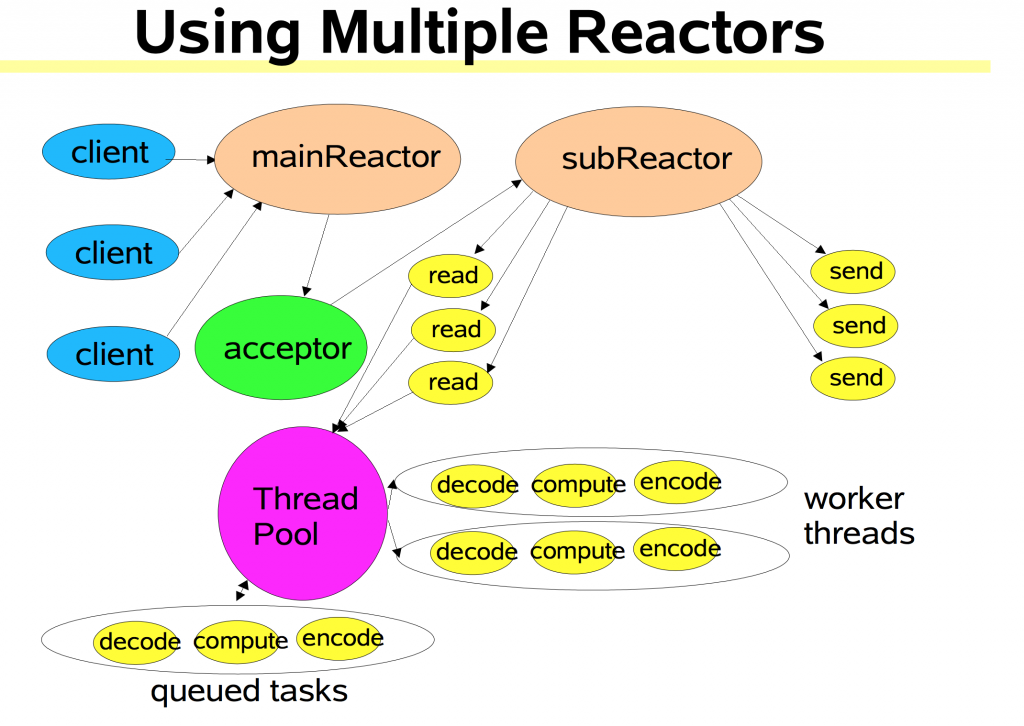
and it works as the following sequence diagram:

Before you can benefit from this new networking model in handling blocking business logic, there is still a way for you to handle your business logic in networking: you can utilize the open-source goroutine-pool to unblock your blocking code, and I now present you ants: a high-performance goroutine pool in Go that allows you to manage and recycle a massive number of goroutines in your concurrent programs.
You can import ants to your gnet server and put your blocking code to the ants pool in EventHandler.React, which makes your business code non-blocking.
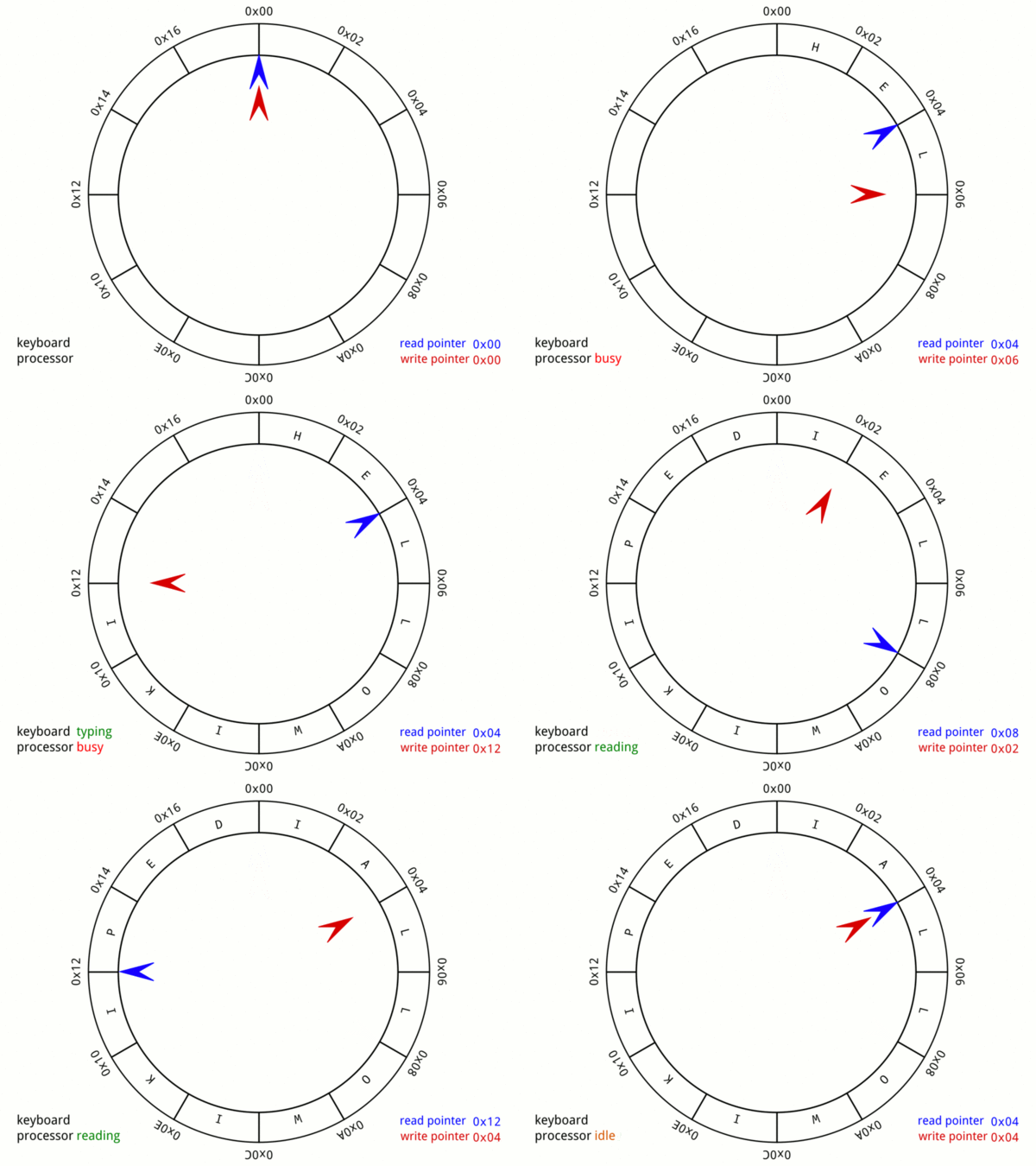
Auto-scaling Ring Buffer
gnet utilizes Ring-Buffer to buffer network data and manage memories in networking.
Getting Started
Installation
$ go get -u github.com/panjf2000/gnet
Usage
It is easy to create a network server with gnet. All you have to do is just make your implementation of gnet.EventHandler interface and register your event-handler functions to it, then pass it to the gnet.Serve function along with the binding address(es). Each connection is represented as a gnet.Conn interface that is passed to various events to differentiate the clients. At any point you can close a client or shutdown the server by return a Close or Shutdown action from an event.
The simplest example to get you started playing with gnet would be the echo server. So here you are, a simplest echo server upon gnet that is listening on port 9000:
Echo server without blocking logic
package main

import (
	"log"

	"github.com/panjf2000/gnet"
)

type echoServer struct {
	*gnet.EventServer
}

func (es *echoServer) React(c gnet.Conn) (out []byte, action gnet.Action) {
	top, tail := c.ReadPair()
	out = top
	if tail != nil {
		out = append(top, tail...)
	}
	c.ResetBuffer()
	return
}

func main() {
	echo := new(echoServer)
	log.Fatal(gnet.Serve(echo, "tcp://:9000", gnet.WithMulticore(true)))
}
As you can see, this example of echo server only sets up the EventHandler.React function where you commonly write your main business code and it will be invoked once the server receives input data from a client. The output data will be then sent back to that client by assigning the out variable and return it after your business code finish processing data(in this case, it just echo the data back).
Echo server with blocking logic
package main

import (
	"log"
	"time"

	"github.com/panjf2000/ants/v2"
	"github.com/panjf2000/gnet"
)

type echoServer struct {
	*gnet.EventServer
	pool *ants.Pool
}

func (es *echoServer) React(c gnet.Conn) (out []byte, action gnet.Action) {
	data := c.ReadBytes()
	c.ResetBuffer()

	// Use ants pool to unblock the event-loop.
	_ = es.pool.Submit(func() {
		time.Sleep(1 * time.Second)
		c.AsyncWrite(data)
	})

	action = gnet.DataRead
	return
}

func main() {
	// Create a goroutine pool.
	poolSize := 64 * 1024
	pool, _ := ants.NewPool(poolSize, ants.WithNonblocking(true))
	defer pool.Release()
	echo := &echoServer{pool: pool}
	log.Fatal(gnet.Serve(echo, "tcp://:9000", gnet.WithMulticore(true)))
}
Like I said in the 『Multiple Reactors + Goroutine-Pool Model』section, if there are blocking code in your business logic, then you ought to turn them into non-blocking code in any way, for instance you can wrap them into a goroutine, but it will result in a massive amount of goroutines if massive traffic is passing through your server so I would suggest you utilize a goroutine pool like ants to manage those goroutines and reduce the cost of system resources.
I/O Events
Current supported I/O events in gnet:
EventHandler.OnInitCompleteis activated when the server is ready to accept new connections.EventHandler.OnOpenedis activated when a connection has opened.EventHandler.OnClosedis activated when a connection has closed.EventHandler.Reactis activated when the server receives new data from a connection.EventHandler.Tickis activated immediately after the server starts and will fire again after a specified interval.EventHandler.PreWriteis activated just before any data is written to any client socket.
Ticker
The EventHandler.Tick event fires ticks at a specified interval.
The first tick fires immediately after the Serving events and if you intend to set up a ticker event, remember to pass an option: gnet.WithTicker(true) to gnet.Serve.
events.Tick = func() (delay time.Duration, action Action){
	log.Printf("tick")
	delay = time.Second
	return
}
UDP
The gnet.Serve function can bind to UDP addresses.
- All incoming and outgoing packets will not be buffered but sent individually.
- The
EventHandler.OnOpenedandEventHandler.OnClosedevents are not available for UDP sockets, only theReactevent.
Multi-threads
The gnet.WithMulticore(true) indicates whether the server will be effectively created with multi-cores, if so, then you must take care of synchronizing memory between all event callbacks, otherwise, it will run the server with a single thread. The number of threads in the server will be automatically assigned to the value of runtime.NumCPU().
Load balancing
The current built-in load balancing algorithm in gnet is Round-Robin.
SO_REUSEPORT
Servers can utilize the SO_REUSEPORT option which allows multiple sockets on the same host to bind to the same port and the OS kernel takes care of the load balancing for you, it wakes one socket per accpet event coming to resolved the thundering herd.
Just use functional options to set up SO_REUSEPORT and you can enjoy this feature:
gnet.Serve(events, "tcp://:9000", gnet.WithMulticore(true), gnet.WithReusePort(true)))
Performance
Contrasts to the similar networking libraries
On Linux (epoll)
Test Environment
# Machine information
        OS : Ubuntu 18.04/x86_64
       CPU : 8 Virtual CPUs
    Memory : 16.0 GiB

# Go version and configurations
Go Version : go1.12.9 linux/amd64
GOMAXPROCS=8
Echo Server

HTTP Server

On FreeBSD (kqueue)
Test Environment
# Machine information
        OS : macOS Mojave 10.14.6/x86_64
       CPU : 4 CPUs
    Memory : 8.0 GiB

# Go version and configurations
Go Version : go version go1.12.9 darwin/amd64
GOMAXPROCS=4
Echo Server

HTTP Server

License
Source code in gnet is available under the MIT License.
Thanks
Relevant Articles
 Documentation

Documentation

Index 
- Variables
- func Serve(eventHandler EventHandler, addr string, opts ...Option) error
- type Action
- type Conn
- type EventHandler
- type EventServer
- func (es *EventServer) OnClosed(c Conn, err error) (action Action)
- func (es *EventServer) OnInitComplete(svr Server) (action Action)
- func (es *EventServer) OnOpened(c Conn) (out []byte, action Action)
- func (es *EventServer) PreWrite()
- func (es *EventServer) React(c Conn) (out []byte, action Action)
- func (es *EventServer) Tick() (delay time.Duration, action Action)
- type IEventLoopGroup
- type Option
- type Options
- type Server
Constants 
This section is empty.
Variables 
var (
	// ErrClosing indicates this server is closing.
	ErrClosing = errors.New("closing event-loop")
)
Functions 
func Serve 
func Serve(eventHandler EventHandler, addr string, opts ...Option) error
Serve starts handling events for the specified addresses.
Addresses should use a scheme prefix and be formatted like `tcp://192.168.0.10:9851` or `unix://socket`. Valid network schemes:
tcp   - bind to both IPv4 and IPv6
tcp4  - IPv4
tcp6  - IPv6
udp   - bind to both IPv4 and IPv6
udp4  - IPv4
udp6  - IPv6
unix  - Unix Domain Socket
The "tcp" network scheme is assumed when one is not specified.
Types 
type Conn 
type Conn interface {
	// Context returns a user-defined context.
	Context() interface{}

	// SetContext sets a user-defined context.
	SetContext(interface{})

	// LocalAddr is the connection's local socket address.
	LocalAddr() net.Addr

	// RemoteAddr is the connection's remote peer address.
	RemoteAddr() net.Addr

	// ReadPair reads all data from ring buffer.
	ReadPair() ([]byte, []byte)
	// ResetBuffer resets the ring buffer.
	ResetBuffer()

	// ReadN reads bytes with the given length from ring buffer.
	ReadN(int) (int, []byte, []byte)
	// ShiftN shifts the "read" pointer in ring buffer with the given length.
	ShiftN(int)

	// ReadBytes reads all data and return a new slice.
	ReadBytes() []byte

	// AyncWrite writes data asynchronously.
	AsyncWrite([]byte)
}
Conn is an gnet connection.
type EventHandler ¶ added in v1.0.0
type EventHandler interface {
	// OnInitComplete fires when the server can accept connections. The server
	// parameter has information and various utilities.
	OnInitComplete(server Server) (action Action)

	// OnOpened fires when a new connection has opened.
	// The info parameter has information about the connection such as
	// it's local and remote address.
	// Use the out return value to write data to the connection.
	// The opts return value is used to set connection options.
	OnOpened(c Conn) (out []byte, action Action)

	// OnClosed fires when a connection has closed.
	// The err parameter is the last known connection error.
	OnClosed(c Conn, err error) (action Action)

	// PreWrite fires just before any data is written to any client socket.
	PreWrite()

	// React fires when a connection sends the server data.
	// The in parameter is the incoming data.
	// Use the out return value to write data to the connection.
	React(c Conn) (out []byte, action Action)

	// Tick fires immediately after the server starts and will fire again
	// following the duration specified by the delay return value.
	Tick() (delay time.Duration, action Action)
}
EventHandler represents the server events' callbacks for the Serve call. Each event has an Action return value that is used manage the state of the connection and server.
type EventServer ¶ added in v1.0.0
type EventServer struct {
}
EventServer is a built-in implementation of EventHandler which sets up each method with a default implementation, you can compose it with your own implementation of EventHandler when you don't want to implement all methods in EventHandler.
func (*EventServer) OnClosed ¶ added in v1.0.0
func (es *EventServer) OnClosed(c Conn, err error) (action Action)
OnClosed fires when a connection has closed. The err parameter is the last known connection error.
func (*EventServer) OnInitComplete ¶ added in v1.0.0
func (es *EventServer) OnInitComplete(svr Server) (action Action)
OnInitComplete fires when the server can accept connections. The server parameter has information and various utilities.
func (*EventServer) OnOpened ¶ added in v1.0.0
func (es *EventServer) OnOpened(c Conn) (out []byte, action Action)
OnOpened fires when a new connection has opened. The info parameter has information about the connection such as it's local and remote address. Use the out return value to write data to the connection. The opts return value is used to set connection options.
func (*EventServer) PreWrite ¶ added in v1.0.0
func (es *EventServer) PreWrite()
PreWrite fires just before any data is written to any client socket.
type IEventLoopGroup ¶ added in v1.0.0
type IEventLoopGroup interface {
	// contains filtered or unexported methods
}
IEventLoopGroup represents a set of event-loops.
type Option ¶ added in v1.0.0
type Option func(opts *Options)
Option is a function that will set up option.
func WithOptions ¶ added in v1.0.0
WithOptions sets up all options.
func WithTCPKeepAlive ¶ added in v1.0.0
WithTCPKeepAlive ...
type Options 
type Options struct {
	// Multicore indicates whether the server will be effectively created with multi-cores, if so,
	// then you must take care with synchonizing memory between all event callbacks, otherwise,
	// it will run the server with single thread. The number of threads in the server will be automatically
	// assigned to the value of runtime.NumCPU().
	Multicore bool

	//ReusePort indicates whether to set up the SO_REUSEPORT option.
	ReusePort bool

	Ticker bool

	TCPKeepAlive time.Duration
}
Options are set when the client opens.
type Server 
type Server struct {
	// Multicore indicates whether the server will be effectively created with multi-cores, if so,
	// then you must take care with synchonizing memory between all event callbacks, otherwise,
	// it will run the server with single thread. The number of threads in the server will be automatically
	// assigned to the value of runtime.NumCPU().
	Multicore bool

	// The addrs parameter is an array of listening addresses that align
	// with the addr strings passed to the Serve function.
	Addr net.Addr

	// NumLoops is the number of loops that the server is using.
	NumLoops int
}
Server represents a server context which provides information about the running server and has control functions for managing state.
 Source Files
 Directories