

 README

README

#PiGlow

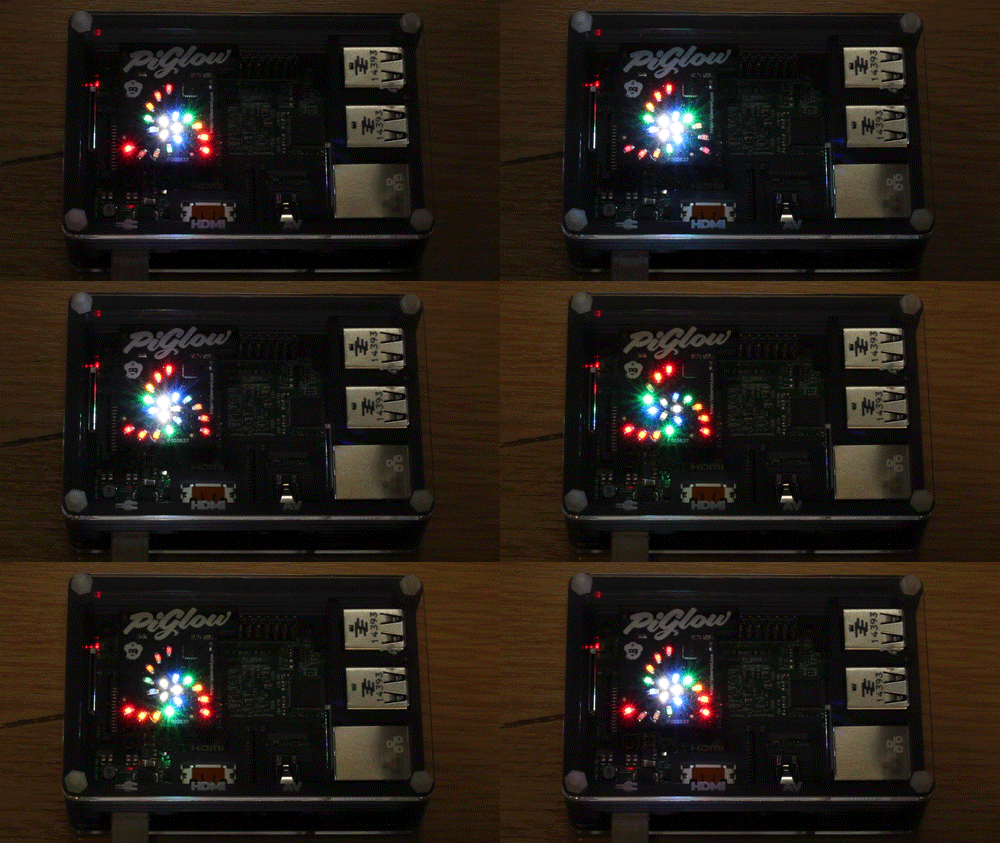
This package provides an alternative API to that provided by https://godoc.org/github.com/goiot/devices/piglow which aims to make it easier to use without hard-coding maps from LED number to position.
The PiGlow is a small add on board for the Raspberry Pi that provides 18 individually controllable LEDs. This board uses the SN3218 8-bit 18-channel PWM chip to drive 18 surface mount LEDs. Communication is done via I2C over the GPIO header with a bus address of 0x54. Each LED can be set to a PWM value of between 0 and 255.
##Datasheet:
 Documentation

Documentation

Overview 
Package piglow implements a driver for the Pimoroni PiGlow.
Example 
package main

import (
	"time"

	"github.com/rogpeppe/misc/piglow"
	"golang.org/x/exp/io/i2c"
)

func main() {
	p, err := piglow.Open(&i2c.Devfs{Dev: "/dev/i2c-1"})
	if err != nil {
		panic(err)
	}

	if err := p.Setup(); err != nil {
		panic(err)
	}

	brightness := uint8(0)
	allLEDs := piglow.All.LEDs()
	for i := 0; i < 10; i++ {
		brightness ^= 1
		p.SetBrightness(allLEDs, brightness)
		time.Sleep(300 * time.Millisecond)
	}
}
Output:
Index 
- Constants
- Variables
- type Arm
- type Client
- type Color
- type Group
- type LED
- type PiGlow
- func (p *PiGlow) Client() *Client
- func (p *PiGlow) Close() error
- func (p *PiGlow) Enable() error
- func (p *PiGlow) Reset() error
- func (p *PiGlow) SetBrightness(leds Set, level uint8) error
- func (p *PiGlow) SetLEDControlRegister(register, enables int) error
- func (p *PiGlow) Setup() error
- func (p *PiGlow) Shutdown() error
- type Radius
- type RadiusRange
- type Range
- type Set
Examples 
Constants 
const MaxRadius = 5
const NumArms = 3
NumArms holds the number of LED spiral arms in the PiGlow.
const NumLEDs = 18
NumLEDs holds the number of LEDs available.
Variables 
var All = Range{
	R1: NumLEDs,
}
All defines a Group that holds all the LEDs.
Functions 
This section is empty.
Types 
type Arm 
type Arm uint8
Arm represents one of the three arms of the PiGlow LED spiral. It ranges from 0 to 2.
type Client 
type Client struct {
	// contains filtered or unexported fields
}
type Color 
type Color uint8
Color represents a color of a PiGlow LED.
All the colors of the LEDs. Lower colors are closer to the center of the spiral.
type Group 
type Group interface {
	// LEDs returns the set of all the LEDs in the group.
	LEDs() Set
}
Group represents a group of LEDs, such as all the LEDs of a particular color.
func ParseGroup 
ParseGroup parses a group from a string. A group can be specified in one of the following forms:
<number> - the LED with the given decimal number (0-17)
<number0>..<number1> - all the LEDs in the half-open range [number0..number1).
arm<number> - the arm with the given number (0-3)
r<number> - the LEDs the given distance from the center (0-6)
r<number0>..r<number0> - all the LEDs in the half-open range of radii [number0..number1)
<color-name> - all the LEDs with the given color
all			- all the LEDs
type LED 
type LED int
LED represents one of the 18 PiGlow LEDs. Values range from 0 to 17 - the device LED numbers are one greater than this value because they start numbering from 1.
type PiGlow 
type PiGlow struct {
	// contains filtered or unexported fields
}
PiGlow represents a PiGlow device.
func Open 
Open opens a new PiGlow. A PiGlow must be closed if no longer in use. If the PiGlow has not been powered down since last use, it will be opened with its last programmed state.
func (*PiGlow) Client 
Client returns a new client instance. Each client has its own virtual set of LEDs - the levels from all current clients will be added to produce the final result.
This is useful when several independent goroutines wish to use the same PiGlow.
The client must be closed after use.
func (*PiGlow) Close 
Close frees the underlying resources. It must be called once the PiGlow is no longer in use.
func (*PiGlow) SetBrightness 
SetBrightness sets the brightness of all the LEDs in the given set to the given level.
func (*PiGlow) SetLEDControlRegister 
SetLEDControlRegister sets the control register 1-3 to the bitmask enables.
bitmask definition:
0 - LED disabled
1 - LED enabled
LED Control Register 1 - LED channel 1  to 6   bits 0-5
LED Control Register 2 - LED channel 7  to 12  bits 0-5
LED Control Register 3 - LED channel 13 to 18  bits 0-5
type Radius 
type Radius uint8
Radius represents the LEDs a certain distance from the center of the spiral. Zero represents the LEDs closest to the center; 5 represents the LEDs furthest away.
type RadiusRange 
type RadiusRange struct {
	// R0 holds the start of the range.
	R0 Radius

	// R1 holds one beyond the end of the range.
	// If R1 <= R0, the set is empty.
	R1 Radius
}
RadiusRange represents a range of radii.
func (RadiusRange) LEDs 
func (r RadiusRange) LEDs() Set
LEDs implements Group.LEDs by returning all the LEDs in the given radius range.
type Range 
type Range struct {
	// R0 holds the start of the range.
	R0 LED
	// R1 holds one beyond the end of the range.
	// If R1 <= R0, the set is empty.
	R1 LED
}
Range represents a numerical range of LEDs.
 Source Files
 Directories