

 README

README

Micro




Micro is an API first development platform. It addresses the core requirements for building apps in the cloud by providing a set of services which act as the building blocks of any platform. Micro deals with the complexity of distributed systems and provides simpler programmable abstractions to build on.
Overview
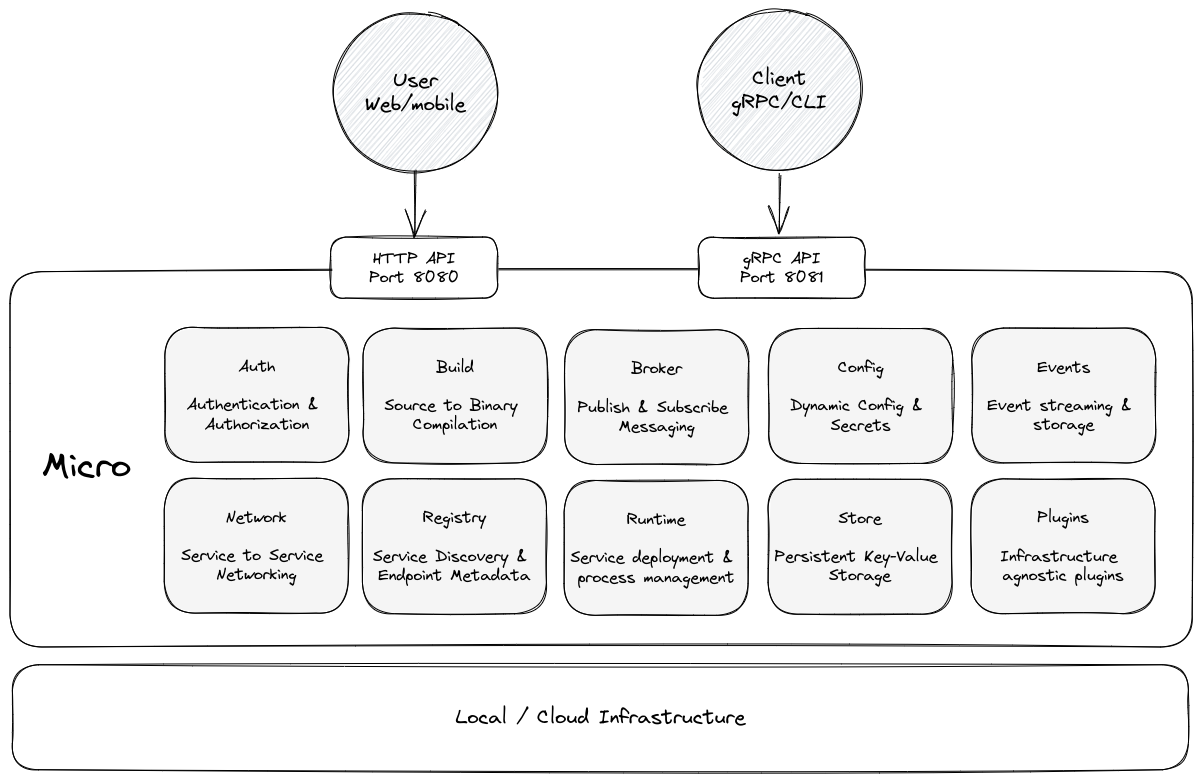
Architecture
Below are the core components that make up Micro.
Server
Micro is built as a microkernel architecture. It abstracts away the complexity of the underlying infrastructure by providing a set of building block services composed as a single logical server for the end user to consume.
The server consists of the following services.
- Auth - Authentication and authorization out of the box using JWT tokens and rule based access control.
- Broker - Ephemeral pubsub messaging for asynchronous communication and distributing notifications
- Config - Dynamic configuration and secrets management for service level config without reload
- Events - Event streaming with ordered messaging, replay from offsets and persistent storage
- Network - service-to-service networking and control plane for all internal request traffic
- Runtime - Service lifecycle and process management with support for source to running auto build
- Registry - Centralised service discovery and API endpoint explorer with feature rich metadata
- Store - Key-Value storage with TTL expiry and persistent crud to keep microservices stateless
API
The server embeds a HTTP API gateway (on port 8080) which can be used to make requests as simple JSON. The API automatically maps HTTP Paths and POST requests to internal RPC service names and endpoints.
Proxy
Additionally there's a gRPC proxy (on port 8081) which used to make requests via the CLI or externally. The proxy is identity aware which means it can be used to gatekeep remote access to Micro running anywhere.
Framework
Micro comes with a built in Go framework for service based development. The framework makes it drop dead simple to write your services without having to piece together endless lines of boilerplate code. Configured and initialised by default, just import it and get started.
Command Line
The command line interface includes dynamic command mapping for all services running on the platform. It turns any service instantly into a CLI command along with flag parsing for inputs. Includes support for environments, namespaces, creating and running services, status info and logs.
Environments
Micro bakes in the concept of Environments and multi-tenancy through Namespaces. Run your server locally for
development and in the cloud for staging and production, seamlessly switch between them using the CLI commands micro env set [environment]
and micro user set [namespace].
Install
From Source
make build
Prebuilt Binaries
Windows
powershell -Command "iwr -useb https://raw.githubusercontent.com/micro/micro/master/scripts/install.ps1 | iex"
Linux
wget -q https://raw.githubusercontent.com/micro/micro/master/scripts/install.sh -O - | /bin/bash
MacOS
curl -fsSL https://raw.githubusercontent.com/micro/micro/master/scripts/install.sh | /bin/bash
Run the server
The server starts with a single command ready to use
micro server
Now go to localhost:8080 and make sure the output is something like {"version": "v3.10.1"}.
Usage
Set the environment e.g local
micro env set local
Login to Micro
Default username/password: admin/micro
$ micro login
Enter username: admin
Enter password:
Successfully logged in.
See what's running:
$ micro services
auth
broker
config
events
network
registry
runtime
store
Create a Service
Generate a service using the template
micro new helloworld
Output
Creating service helloworld

.
├── main.go
├── handler
│   └── helloworld.go
├── proto
│   └── helloworld.proto
├── Makefile
├── README.md
├── .gitignore
└── go.mod


download protoc zip packages (protoc-$VERSION-$PLATFORM.zip) and install:

visit https://github.com/protocolbuffers/protobuf/releases

compile the proto file helloworld.proto:

cd helloworld
make init
go mod vendor
make proto
Making changes
Edit the protobuf definition in proto/helloworld.proto and run make proto to recompile
Go to handler/helloworld.go to make changes to the response handler
type Helloworld struct{}

func New() *Helloworld {
        return &Helloworld{}
}

func (h *Helloworld) Call(ctx context.Context, req *pb.Request, rsp *pb.Response) error {
        rsp.Msg = "Hello " + req.Name
        return nil
}
Run the service
Run from local dir
micro run .
Or from a git url
micro run github.com/micro/services/helloworld
Check service status
$ micro status
NAME		VERSION	SOURCE					STATUS	BUILD	UPDATED	METADATA
helloworld	latest	github.com/micro/services/helloworld	running	n/a	4s ago	owner=admin, group=micro
View service logs
$ micro logs helloworld
2020-10-06 17:52:21  file=service/service.go:195 level=info Starting [service] helloworld
2020-10-06 17:52:21  file=grpc/grpc.go:902 level=info Server [grpc] Listening on [::]:33975
2020-10-06 17:52:21  file=grpc/grpc.go:732 level=info Registry [service] Registering node: helloworld-67627b23-3336-4b92-a032-09d8d13ecf95
Call via CLI
$ micro helloworld call --name=Jane
{
	"msg": "Hello Jane"
}
Call via API
curl "http://localhost:8080/helloworld/Call?name=John"
Call via RPC
An RPC client is used within a service and must be run by micro
package main

import (
	"context"
	"fmt"
	"time"

	"micro.dev/v4/service"
	pb "github.com/micro/services/helloworld/proto"
)

func callService(hw pb.HelloworldService) {
	for {
		// call an endpoint on the service
		rsp, err := hw.Call(context.Background(), &pb.CallRequest{
			Name: "John",
		})
		if err != nil {
			fmt.Println("Error calling helloworld: ", err)
			return
		}

		// print the response
		fmt.Println("Response: ", rsp.Message)

		time.Sleep(time.Second)
	}
}

func main() {
	// create and initialise a new service
	srv := service.New(
		service.Name("caller"),
	)

	// new helloworld client
	hw := pb.NewHelloworldService("helloworld", srv.Client())

	// run the client caller
	go callService(hw)

	// run the service
	service.Run()
}
Run it
micro run .
Call via Go
Get your user token
export TOKEN=`micro user token`
Call helloworld
package main

import (
    "fmt"
    "os"

    "github.com/micro/micro-go"
)

type Request struct {
	Name string `json:"name"`
}

type Response struct {
	Msg string `json:"msg"`
}

func main() {
	token := os.Getenv("TOKEN")
	c := micro.NewClient(nil)

	// set your api token
	c.SetToken(token)

   	req := &Request{
		Name: "John",
	}

	var rsp Response

	if err := c.Call("helloworld", "Call", req, &rsp); err != nil {
		fmt.Println(err)
		return
	}

	fmt.Println(rsp)
}
Run it
go run main.go
Call via JS
const micro = require('micro-js-client');

new micro.Client({ token: process.env.TOKEN })
  .call('helloworld', 'Call', {"name": "Alice"})
  .then((response) => {
    console.log(response);
  });
Get Started
For more see the getting started guide.
Micro Web
Use services via the web with the Micro Web dashboard
micro web
Browse to localhost:8082
Dev Env
1 click deploy a Micro Dev environment on a DigitalOcean Droplet
Use our refcode so we get $25 credit too!
 Directories

Directories

| Path | Synopsis |
|---|---|
|
api
module
|
|
|
client
module
|
|
|
proto
module
|
|
|
proto/api
module
|
|
|
proto/api/proto
module
|
|
|
auth
module
|
|
|
jwt
module
|
|
|
broker
module
|
|
|
client
module
|
|
|
grpc
module
|
|
|
router
module
|
|
|
selector
module
|
|
|
selector/static
module
|
|
|
cli
Package cli is a command line interface
|
Package cli is a command line interface |
|
cli/gen
Package gen provides the micro gen command which simply runs go generate
|
Package gen provides the micro gen command which simply runs go generate |
|
cli/init
Package init provides the micro init command for initialising plugins and imports
|
Package init provides the micro init command for initialising plugins and imports |
|
cli/new
Package new generates micro service templates
|
Package new generates micro service templates |
|
cli/run
Package runtime is the micro runtime
|
Package runtime is the micro runtime |
|
cli/shutdown
Package shutdown will issue a shutdown signal
|
Package shutdown will issue a shutdown signal |
|
cli/store
Package cli implements the `micro store` subcommands for example:
|
Package cli implements the `micro store` subcommands for example: |
|
cli/token
Package token contains CLI client token related helpers tToken files consist of one line per token, each token having the structure of `micro://envAddress/namespace[/id]:token`, ie.
|
Package token contains CLI client token related helpers tToken files consist of one line per token, each token having the structure of `micro://envAddress/namespace[/id]:token`, ie. |
|
cli/user
Package user handles the user cli command
|
Package user handles the user cli command |
|
cli/util
Package cliutil contains methods used across all cli commands @todo: get rid of os.Exits and use errors instread
|
Package cliutil contains methods used across all cli commands @todo: get rid of os.Exits and use errors instread |
|
micro
command
|
|
|
protoc-gen-micro
command
protoc-gen-micro is a plugin for the Google protocol buffer compiler to generate Go code.
|
protoc-gen-micro is a plugin for the Google protocol buffer compiler to generate Go code. |
|
protoc-gen-micro/generator
The code generator for the plugin for the Google protocol buffer compiler.
|
The code generator for the plugin for the Google protocol buffer compiler. |
|
server
Package server is the micro server which runs the whole system
|
Package server is the micro server which runs the whole system |
|
web
Package web is a web dashboard
|
Package web is a web dashboard |
|
client
module
|
|
|
client/auth
module
|
|
|
client/config
module
|
|
|
client/gen
module
|
|
|
client/init
module
|
|
|
client/new
module
|
|
|
client/new/template
module
|
|
|
client/run
module
|
|
|
client/shutdown
module
|
|
|
client/store
module
|
|
|
client/store/snapshot
module
|
|
|
client/token
module
|
|
|
client/user
module
|
|
|
client/util
module
|
|
|
go-micro
module
|
|
|
pkg
module
|
|
|
pkg/service
module
|
|
|
pkg/service/proto
module
|
|
|
proto-gen-micro
module
|
|
|
protoc-gen-micro/examples
module
|
|
|
protoc-gen-micro/plugin
module
|
|
|
protoc-gen-openapi
module
|
|
|
protoc-get-micro
module
|
|
|
config
module
|
|
|
source
module
|
|
|
source/file
module
|
|
|
debug
module
|
|
|
log
module
|
|
|
errors
module
|
|
|
examples
module
|
|
|
go-micro
module
|
|
|
logger
module
|
|
|
metadata
module
|
|
|
micro
module
|
|
|
go-micro
module
|
|
|
pkg
module
|
|
|
service
module
|
|
|
service/proto
module
|
|
|
plugin
module
|
|
|
registry
module
|
|
|
registry/etcd
module
|
|
|
plugins
module
|
|
|
selector
module
|
|
|
selector/static
module
|
|
|
server
module
|
|
|
server/http
module
|
|
|
server/http/v4/web
module
|
|
|
v4/broker
module
|
|
|
v4/broker/kafka
module
|
|
|
proto
module
|
|
|
api
module
|
|
|
network
module
|
|
|
router
module
|
|
|
protoc-gen-micro
module
|
|
|
protoc-gen-openapi
module
|
|
|
registry
module
|
|
|
etcd
module
|
|
|
selector
module
|
|
|
server
module
|
|
|
grpc
module
|
|
|
logger
module
|
|
|
service
module
|
|
|
api/handler
Package handler provides http handlers
|
Package handler provides http handlers |
|
api/handler/rpc
Package rpc is a go-micro rpc handler.
|
Package rpc is a go-micro rpc handler. |
|
api/router
Package router provides api service routing
|
Package router provides api service routing |
|
api/router/registry
Package registry provides a dynamic api service router
|
Package registry provides a dynamic api service router |
|
api/server/http
Package http provides a http server with features; acme, cors, etc
|
Package http provides a http server with features; acme, cors, etc |
|
auth/jwt
Package jwt is a jwt implementation of the auth interface
|
Package jwt is a jwt implementation of the auth interface |
|
broker
Package broker is the micro broker
|
Package broker is the micro broker |
|
broker/memory
Package memory provides a memory broker
|
Package memory provides a memory broker |
|
client
Package client is an interface for an RPC client
|
Package client is an interface for an RPC client |
|
client/grpc
Package grpc provides a gRPC client
|
Package grpc provides a gRPC client |
|
config
Package config is an interface for dynamic configuration.
|
Package config is an interface for dynamic configuration. |
|
config/env
Package env provides config from environment variables
|
Package env provides config from environment variables |
|
context
Package context provides a context for accessing services
|
Package context provides a context for accessing services |
|
context/metadata
Package metadata is a way of defining message headers
|
Package metadata is a way of defining message headers |
|
errors
Package errors provides a way to return detailed information for an RPC request error.
|
Package errors provides a way to return detailed information for an RPC request error. |
|
events
Package events is for event streaming and storage
|
Package events is for event streaming and storage |
|
logger
Package log provides a log interface
|
Package log provides a log interface |
|
model
Package model implements convenience methods for managing indexes on top of the Store.
|
Package model implements convenience methods for managing indexes on top of the Store. |
|
model/sql
Package sql is for a sql database model
|
Package sql is for a sql database model |
|
profile
Package profile is for specific profiles @todo this package is the definition of cruft and should be rewritten in a more elegant way
|
Package profile is for specific profiles @todo this package is the definition of cruft and should be rewritten in a more elegant way |
|
registry
Package registry is the micro registry
|
Package registry is the micro registry |
|
registry/cache
Package cache provides a registry cache
|
Package cache provides a registry cache |
|
registry/memory
Package memory provides an in-memory registry
|
Package memory provides an in-memory registry |
|
registry/noop
Package noop is a registry which does nothing
|
Package noop is a registry which does nothing |
|
router/kubernetes
Package kubernetes is a kubernetes router which uses the service name and network to route
|
Package kubernetes is a kubernetes router which uses the service name and network to route |
|
runtime
Package runtime is a service runtime manager
|
Package runtime is a service runtime manager |
|
runtime/build/util/tar
Package tar is a wrapper around archive/tar, it's used for archiving and unarchiving source from and into folders on the host.
|
Package tar is a wrapper around archive/tar, it's used for archiving and unarchiving source from and into folders on the host. |
|
runtime/build/util/zip
Package zip is a wrapper around archive/zip, it's used for archiving and unarchiving source from and into folders on the host.
|
Package zip is a wrapper around archive/zip, it's used for archiving and unarchiving source from and into folders on the host. |
|
runtime/local/process
Package process executes a binary
|
Package process executes a binary |
|
runtime/local/process/os
Package os runs processes locally
|
Package os runs processes locally |
|
runtime/local/test/bar
command
Package main is used to test the local runtime, specifically the entrypoint function
|
Package main is used to test the local runtime, specifically the entrypoint function |
|
runtime/local/test/foo/cmd/bar
command
Package main is used to test the local runtime, specifically the entrypoint function
|
Package main is used to test the local runtime, specifically the entrypoint function |
|
runtime/local/test/foo/cmd/baz
command
Package main is used to test the local runtime, specifically the entrypoint function
|
Package main is used to test the local runtime, specifically the entrypoint function |
|
runtime/local/test/qux/cmd/test
command
Package main is used to test the local runtime, specifically the entrypoint function
|
Package main is used to test the local runtime, specifically the entrypoint function |
|
runtime/source
Package source retrieves source code
|
Package source retrieves source code |
|
runtime/source/go
Package golang is a source for Go
|
Package golang is a source for Go |
|
server/grpc
Package grpc provides a grpc server
|
Package grpc provides a grpc server |
|
store
Package store is an interface for distributed data storage.
|
Package store is an interface for distributed data storage. |
|
store/file
Package local is a file system backed store
|
Package local is a file system backed store |
|
store/memory
Package memory is a in-memory store store
|
Package memory is a in-memory store store |
|
auth/client
module
|
|
|
broker/client
module
|
|
|
cmd
module
|
|
|
codec
module
|
|
|
codec/json
module
|
|
|
config/client
module
|
|
|
events/client
module
|
|
|
events/stream
module
|
|
|
grpc
module
|
|
|
metadata
module
|
|
|
pkg
module
|
|
|
pkg/cache
module
|
|
|
pkg/service
module
|
|
|
pkg/service/proto
module
|
|
|
pkg/tracing
module
|
|
|
proxy
module
|
|
|
registry/client
module
|
|
|
registry/consul
module
|
|
|
registry/etcd
module
|
|
|
registry/etcdv3
module
|
|
|
runtime/build/util
module
|
|
|
runtime/client
module
|
|
|
services
module
|
|
|
services/pkg
module
|
|
|
services/pkg/gorm
module
|
|
|
store/client
module
|
|
|
time
module
|
|
|
time/handler
module
|
|
|
time/proto
module
|
|
|
web
module
|
|
|
servicecodec
module
|
|
|
json
module
|
|
|
servicelogger
module
|
|
|
services
module
|
|
|
helloworld
module
|
|
|
helloworld/proto
module
|
|
|
pkg
module
|
|
|
pkg/gorm
module
|
|
|
pkg/tenant
module
|
|
|
pkg/tracing
module
|
|
|
store
module
|
|
|
file
module
|
|
|
fakes
Code generated by counterfeiter.
|
Code generated by counterfeiter. |
|
transport
module
|
|
|
kafka
module
|
|
|
util
module
|
|
|
backoff
Package backoff provides backoff functionality
|
Package backoff provides backoff functionality |
|
codec
Package codec is an interface for encoding messages
|
Package codec is an interface for encoding messages |
|
codec/bytes
Package bytes provides a bytes codec which does not encode or decode anything
|
Package bytes provides a bytes codec which does not encode or decode anything |
|
codec/grpc
Package grpc provides a grpc codec
|
Package grpc provides a grpc codec |
|
codec/json
Package json provides a json codec
|
Package json provides a json codec |
|
codec/jsonrpc
Package jsonrpc provides a json-rpc 1.0 codec
|
Package jsonrpc provides a json-rpc 1.0 codec |
|
codec/proto
Package proto provides a proto codec
|
Package proto provides a proto codec |
|
codec/protorpc
Protorpc provides a net/rpc proto-rpc codec.
|
Protorpc provides a net/rpc proto-rpc codec. |
|
codec/text
Package text reads any text/* content-type
|
Package text reads any text/* content-type |
|
config
Package config contains helper methods for client side config management (`~/.micro/config.json` file).
|
Package config contains helper methods for client side config management (`~/.micro/config.json` file). |
|
muxer
Package muxer provides proxy muxing
|
Package muxer provides proxy muxing |
|
proxy
Package proxy is a transparent proxy built on the go-micro/server
|
Package proxy is a transparent proxy built on the go-micro/server |
|
proxy/grpc
Package grpc is a grpc proxy built for the go-micro/server
|
Package grpc is a grpc proxy built for the go-micro/server |
|
proxy/http
Package http provides a micro rpc to http proxy
|
Package http provides a micro rpc to http proxy |
|
qson
Package qson implmenets decoding of URL query params into JSON and Go values (using JSON struct tags).
|
Package qson implmenets decoding of URL query params into JSON and Go values (using JSON struct tags). |
|
ring
Package ring provides a simple ring buffer for storing local data
|
Package ring provides a simple ring buffer for storing local data |
|
selector
Package selector is for node selection and load balancing
|
Package selector is for node selection and load balancing |
|
sync
Package sync is an interface for distributed synchronization
|
Package sync is an interface for distributed synchronization |
|
sync/memory
Package memory provides a sync.Mutex implementation of the lock for local use
|
Package memory provides a sync.Mutex implementation of the lock for local use |
|
opentelemetry
module
|
|
|
opentelemetry/jaeger
module
|
|
|
v4
|
|
|
cmd
module
|
|
|
cmd/protoc-gen-micro
module
|